Checked 13 October 2026. Task types are from the OPH framework (2011) and the University of Jyväskylä’s description and demonstration; the level wording is from OPH’s assessment criteria for writing, all read on 13 October 2026. Every task and model text below is our own; none is an official task and no grade is promised for any text.
YKI-testin kirjoittaminen: what the writing subtest asks for
In the writing subtest (kirjoittaminen) you write three texts of different types, for example a message, a letter, an opinion text, a complaint or an application (viesti, kirje, mielipideteksti, valitus tai hakemus). The tasks are guided and may come with extra material [official: framework, section 6.4, in Finnish; our translation]. The University of Jyväskylä adds that the tasks vary in topic and in degree of formality, names the opinion text (mielipidekirjoitus) as an example of an intermediate task, and says what the assessors attend to: how understandable the content is, how natural the language is, and, at the higher levels especially, how well it suits the situation [official: JYU, our translation].
This page gives you four tasks we wrote, one for each of four text types: an informal message, a semi-formal message, a complaint, and an opinion text. Each has a model text written in a grade 3 style, followed by a marked-up list of sentences that would move it in the direction of grade 4, each tied to a line in OPH’s published assessment criteria. Two other writing tasks, with full model answers in both styles, are in YKI speaking and writing: example tasks with model answers; nothing here repeats them. ProSyllabus is an independent study site. We are not affiliated with, or endorsed by, the Finnish National Agency for Education (OPH), the University of Jyväskylä or the Finnish Immigration Service (Migri). Every rule here is quoted or summarised from their published pages; OPH decides everything about the test and Migri decides every citizenship application.
Official: framework 6.4 and oph.fi (test fees), read 13 October 2026. The tasks and model texts are ours.
Read this before you use the model texts
- They are our own illustrations. No assessor has graded them, and “grade 3 style” means written to match the wording of the level 3 criteria, not awarded a 3.
- The grade 3 style texts are written in correct Finnish on purpose. The level 3 criteria tolerate errors; a model you copy from should not contain them.
- Do not learn them by heart. The criteria describe memorised phrases as a level 2 feature; the point of a model is its shape.
- No official word limit is published for the writing tasks. Follow the instructions printed with each task in the test.
How the tasks are worded: what the demonstration shows
The University of Jyväskylä’s demonstration for the Finnish intermediate level shows two writing tasks, an e-mail to a housing manager and an opinion piece for a discussion forum, and three instructions above them: completing the subtest requires doing all the tasks; write in clear handwriting; follow the instructions given in the tasks exactly [official: JYU demonstration; a demonstration of the paper test, not the test itself]. The phrases below come from those two example tasks. They are worth knowing because the instructions in the Finnish test are in Finnish.
| Phrase in the demonstration task | In English | What it asks of you |
|---|---|---|
| Mainitse viestissä seuraavat asiat: | Mention the following things in the message: | A list of points follows. Each one must be visible in your text |
| ainakin kaksi muuta asiaa | at least two other things | Add content of your own; the listed points are not enough |
| Muista aloitus ja lopetus. | Remember the opening and the closing. | A greeting at the top and a closing at the end |
| Valitse niistä yksi | Choose one of them | Two topics are offered for the opinion piece; write on one only |
| Mitä mieltä olet siitä? Miksi? | What do you think about it? Why? | State a view and give reasons for it |
| Perustele ainakin kolmella tavalla. | Give at least three reasons. | Three separate reasons, in that example task |
Our four tasks follow the same pattern: a situation, a reader, and points to cover. On paper you write by hand; from the start of 2027 every Finnish test is taken on a computer at the test centre, so if that is your sitting, practise on a keyboard with ä and ö.
Grade 3 and grade 4 in OPH’s writing criteria
The wording is OPH’s, from the assessment criteria for writing attached to its page “After the YKI test”.
| Criterion | Level 3 (OPH) | Level 4 (OPH) |
|---|---|---|
| General | Can write simple, coherent text about general topics. Text content is comprehensible, but some unclear expressions and illogical formulations may occasionally cause pauses in reading | Can write both private and semi-official texts and present his/her ideas coherently. Is able to express his/her opinion fairly extensively and emphasise the relevant salient issues. Can differentiate between formal and informal language, but may occasionally use inappropriate expressions |
| Flexibility | Manages well everyday communication situations, but cannot sufficiently express the difference between formal and informal register | Can in familiar and less familiar text types adjust what he/she writes according to the purpose of the text, recipient and the situation |
| Coherence | Can write fairly coherent text | Can use a variety of linguistic means to mark relationship between ideas and to produce coherent text, although there may be some lack of coherence in long contributions |
| Precision and range | Can express what he/she wishes in a comprehensible and fairly accurate manner. Errors, however, occur in expressing complex ideas or when the text type or topic is less familiar | Can convey information fairly accurately and almost in detail. Has a good range of vocabulary for general topics. Can avoid extensive repetition |
| Grammatical accuracy | The use of grammatical structures follows the target language requirements in familiar situations. Though in more demanding situations the use of grammatical structures may be unnatural, the message is understood | Controls grammatical structures relatively well. Minor flaws in structures may occur, but they not lead to misunderstanding |
Between the two levels the criteria print three short lines: more variety in expression; level of abstraction is higher; the writer makes the difference between formal and informal register [official]. Every “lift” below is one of those three, or one of the level 4 cells above. Which grade you need is another matter: for citizenship, grade 3 in writing is enough when it is paired with speaking or listening. What separates level 3 from the level below it is set out in Why people miss level 3.
Task 1: an informal message (viesti ystävälle)
The task · Tehtävä
• Kerro, miksi et pääse.
• Pahoittele.
• Ehdota, miten voit auttaa muulla tavalla.
English: Your friend Mikko is moving on Saturday and has asked you to help. However, you cannot come. Write him a message. • Say why you cannot come. • Apologise. • Suggest how you can help in another way.
Model text in a grade 3 style · Mallivastaus
Kiitos viestistä. Valitettavasti en pääse lauantaina auttamaan muutossa. Minulla on silloin työvuoro, ja se loppuu vasta kuudelta. Olen tosi pahoillani.
Haluan kuitenkin auttaa. Voin tulla sunnuntaina aamulla. Voin purkaa laatikoita ja koota hyllyjä. Minulla on myös porakone, jos tarvitset sitä.
Soita, jos sunnuntai sopii sinulle. Onnea muuttoon!
Terveisin
Daniel
English: Hi Mikko! Thanks for your message. Unfortunately I cannot come on Saturday to help with the move. I have a shift then, and it does not end until six. I am really sorry. I still want to help. I can come on Sunday morning. I can unpack boxes and put shelves together. I also have a drill, if you need it. Call me if Sunday suits you. Good luck with the move! Regards, Daniel
All three points of the task are covered, in order, in short clear sentences. Simple and coherent is the wording of the level 3 general criterion.
What would lift it towards grade 4
| In the grade 3 style text | A version in the direction of grade 4 | In English | Line of the criteria |
|---|---|---|---|
| Minulla on silloin työvuoro, ja se loppuu vasta kuudelta. | Olen juuri silloin töissä, enkä valitettavasti saanut vaihdettua vuoroa, vaikka yritin. | I am at work just then, and unfortunately I could not swap the shift, although I tried. | Coherence: a variety of linguistic means to mark the relationship between ideas (enkä, vaikka) |
| Voin tulla sunnuntaina aamulla. Voin purkaa laatikoita ja koota hyllyjä. | Jos apu kelpaa vielä sunnuntaina, tulen heti aamulla purkamaan laatikoita ja kokoamaan hyllyjä. | If help is still welcome on Sunday, I will come first thing in the morning to unpack boxes and put shelves together. | Range: “can avoid extensive repetition” (three sentences starting with voin become one) |
| Olen tosi pahoillani. | Minua harmittaa kovasti, koska muistan omasta muutostani, miten paljon apua silloin tarvitsee. | It really bothers me, because I remember from my own move how much help you need then. | More variety in expression: a feeling with its reason, not a set phrase |
| Moi Mikko! … Terveisin | Keep it informal: Moi Mikko! … Nähdään sunnuntaina! | Hi Mikko! … See you on Sunday! | Register: a message to a friend stays friendly. Making it formal would be the wrong adjustment |
Task 2: a semi-formal message (viesti esihenkilölle)
The task · Tehtävä
• Kerro, milloin haluat olla vapaalla ja miksi.
• Ehdota, miten työsi hoidetaan sillä aikaa.
• Kysy, pitääkö sinun täyttää jokin lomake.
English: You want to take two days off, because your parents are coming to visit from abroad. Write an e-mail to your supervisor. • Say when you want to be off and why. • Suggest how your work will be covered meanwhile. • Ask whether you have to fill in a form.
Model text in a grade 3 style · Mallivastaus
kirjoitan, koska haluaisin pitää kaksi vapaapäivää. Päivät ovat 14. ja 15. toukokuuta.
Vanhempani tulevat silloin Suomeen käymään. He asuvat ulkomailla, enkä ole nähnyt heitä kahteen vuoteen. Haluan hakea heidät lentokentältä ja olla heidän kanssaan.
Olen puhunut Jussin kanssa. Hän voi tehdä vuoroni ensimmäisenä päivänä. Toisen päivän työt teen valmiiksi jo aiemmin samalla viikolla.
Pitääkö minun täyttää jokin lomake? Kerro myös, jos nämä päivät eivät sovi.
Ystävällisin terveisin
Mei Tanaka
English: Hello Anne, I am writing because I would like to take two days off. The days are 14 and 15 May. My parents are coming to visit Finland then. They live abroad, and I have not seen them for two years. I want to fetch them from the airport and be with them. I have talked to Jussi. He can do my shift on the first day. I will finish the second day’s work earlier in the same week. Do I have to fill in a form? Tell me also if these days do not suit. Kind regards, Mei Tanaka
After a greeting that ends in a comma, Finnish continues with a small letter, as here. Addressing a supervisor by first name and with sinä is common in Finnish workplaces; to an office or a person you do not know, use te. That is our observation, not a rule from the criteria.
What would lift it towards grade 4
| In the grade 3 style text | A version in the direction of grade 4 | In English | Line of the criteria |
|---|---|---|---|
| kirjoitan, koska haluaisin pitää kaksi vapaapäivää. Päivät ovat 14. ja 15. toukokuuta. | Olisiko mahdollista, että pitäisin kaksi vapaapäivää 14. ja 15. toukokuuta? | Would it be possible for me to take two days off on 14 and 15 May? | Flexibility: adjusting what you write to the recipient and the situation. A request to a supervisor is put as a question |
| He asuvat ulkomailla, enkä ole nähnyt heitä kahteen vuoteen. | Vanhempani, joita en ole nähnyt kahteen vuoteen, tulevat silloin käymään Suomessa. | My parents, whom I have not seen for two years, are coming to visit Finland then. | More variety in expression: a relative clause carries the reason inside the sentence |
| Olen puhunut Jussin kanssa. Hän voi tehdä vuoroni ensimmäisenä päivänä. | Olen jo sopinut Jussin kanssa, että hän tekee vuoroni ensimmäisenä päivänä, jos annat luvan. | I have already agreed with Jussi that he will do my shift on the first day, if you give permission. | Precision: conveying information “fairly accurately and almost in detail” |
| Kerro myös, jos nämä päivät eivät sovi. | Jos päivät eivät sovi, kuulisin siitä mielelläni mahdollisimman pian, jotta ehdin tehdä muita järjestelyjä. | If the days do not suit, I would be glad to hear as soon as possible, so that I have time to make other arrangements. | Register: the conditional (kuulisin) softens a request; jotta gives the purpose |
Task 3: a complaint (valitus tai palaute)
A complaint is one of the text types the framework names, and feedback on purchases and services (kiitokset, valitukset: thanks, complaints) is listed under the topic area shops and services [official: framework 6.4 and annex 2]. The risk in this text type is tone: a complaint that is only angry is hard to act on. State what happened, in order, and say what you want.
The task · Tehtävä
• Kerro, milloin kävitte ravintolassa.
• Kerro, mitä tapahtui.
• Kerro, mitä toivot ravintolalta.
English: You went to a restaurant with a friend. You had to wait more than an hour for the food, and there was a mistake in the bill. Write feedback to the restaurant. • Say when you were at the restaurant. • Say what happened. • Say what you hope the restaurant will do.
Model text in a grade 3 style · Mallivastaus
kävin ravintolassanne ystäväni kanssa lauantaina 3. lokakuuta. Olimme varanneet pöydän kello kuudeksi.
Ilta ei valitettavasti mennyt hyvin. Tilasimme ruoan heti, mutta saimme sen vasta kello 19.15. Kukaan ei kertonut meille, miksi ruoka oli myöhässä. Ruoka oli hyvää, mutta se oli vähän kylmää.
Myös lasku oli väärin. Laskussa oli kolme juomaa, mutta me joimme vain kaksi. Huomasin virheen vasta kotona.
Toivon, että palautatte minulle ylimääräisen juoman hinnan, 7 euroa. Toivon myös, että kerrotte asiakkaille, jos ruoka on myöhässä.
Ystävällisin terveisin
Elena Popescu
English: Dear recipient, I visited your restaurant with my friend on Saturday 3 October. We had booked a table for six o’clock. Unfortunately the evening did not go well. We ordered the food at once, but we did not get it until 19.15. Nobody told us why the food was late. The food was good, but it was a little cold. The bill was also wrong. There were three drinks on the bill, but we drank only two. I noticed the mistake only at home. I hope that you will refund me the price of the extra drink, 7 euros. I also hope that you will tell customers if the food is late. Kind regards, Elena Popescu
When, what happened, what is wanted: the three points in four short paragraphs (the second point, what happened, takes two: the late food and the bill). The reader is addressed as te from the first line to the last (ravintolassanne, palautatte, kerrotte).
What would lift it towards grade 4
| In the grade 3 style text | A version in the direction of grade 4 | In English | Line of the criteria |
|---|---|---|---|
| Tilasimme ruoan heti, mutta saimme sen vasta kello 19.15. Kukaan ei kertonut meille, miksi ruoka oli myöhässä. | Vaikka tilasimme heti, jouduimme odottamaan ruokaa yli tunnin, eikä kukaan henkilökunnasta kertonut, mistä viivästys johtui. | Although we ordered at once, we had to wait more than an hour for the food, and nobody on the staff told us what caused the delay. | Coherence: three facts become one sentence with vaikka and eikä |
| Ruoka oli hyvää, mutta se oli vähän kylmää. | Ruoka oli sinänsä maukasta, mutta se oli ehtinyt jäähtyä ennen kuin se tuotiin pöytään. | The food itself was tasty, but it had had time to cool before it was brought to the table. | Range: a good range of vocabulary for general topics (maukas, jäähtyä) |
| Myös lasku oli väärin. | Odottamisen ymmärrän kiireisenä iltana, mutta virheellistä laskua on vaikeampi hyväksyä. | I understand the waiting on a busy evening, but an incorrect bill is harder to accept. | General: “emphasise the relevant salient issues”. The reader learns which of the two problems matters more |
| Toivon myös, että kerrotte asiakkaille, jos ruoka on myöhässä. | Olen käynyt ravintolassanne usein ja tulisin mielelläni uudelleen, joten toivon, että otatte palautteeni huomioon. | I have often been to your restaurant and would gladly come again, so I hope you will take my feedback into account. | Flexibility: written for its purpose. A firm but friendly close makes a reply more likely |
Task 4: an opinion text (mielipideteksti)
The task · Tehtävä
English: The local paper’s website is discussing the question: should the municipality offer every child one free hobby? Write your opinion text. Say what you think and give reasons for your opinion.
Model text in a grade 3 style · Mallivastaus
Mielestäni kunnan pitää tarjota jokaiselle lapselle yksi ilmainen harrastus.
Harrastukset ovat nykyään kalliita. Esimerkiksi jääkiekko voi maksaa monta sataa euroa vuodessa. Kaikilla perheillä ei ole siihen rahaa. Silloin lapsi jää kotiin.
Harrastus on lapselle tärkeä. Harrastuksessa hän saa ystäviä ja oppii uusia asioita. Minun tyttäreni aloitti jalkapallon, ja nyt hän puhuu suomea paremmin, koska hän käyttää sitä joukkueessa.
Ilmainen harrastus maksaa kunnalle rahaa. Se on kuitenkin hyvä tapa käyttää rahaa, koska lapset voivat silloin paremmin.
Toivon, että meidän kuntamme kokeilee tätä.
English: A free hobby is a good idea. In my opinion the municipality must offer every child one free hobby. Hobbies are expensive nowadays. For example, ice hockey can cost several hundred euros a year. Not all families have the money for it. Then the child stays at home. A hobby is important for a child. In a hobby the child makes friends and learns new things. My daughter started football, and now she speaks Finnish better, because she uses it in the team. A free hobby costs the municipality money. It is nevertheless a good way to use money, because the children are then better off. I hope that our municipality will try this.
A heading, the view in the first sentence, three reasons (cost; friends and learning; language, the last two sharing a paragraph), one objection answered, and a closing wish. The cost of ice hockey is the writer’s example, not a fact we have checked.
What would lift it towards grade 4
| In the grade 3 style text | A version in the direction of grade 4 | In English | Line of the criteria |
|---|---|---|---|
| Mielestäni kunnan pitää tarjota jokaiselle lapselle yksi ilmainen harrastus. | Kannatan ehdotusta, kunhan lapsi saa itse valita, mitä hän harrastaa. | I support the proposal, as long as the child may choose what to take up. | General: expressing an opinion “fairly extensively”. A view with a condition says more than yes or no |
| Kaikilla perheillä ei ole siihen rahaa. Silloin lapsi jää kotiin. | Koska monet lajit maksavat satoja euroja vuodessa, osa lapsista jää kokonaan ilman harrastusta, vaikka kiinnostusta olisi. | Because many sports cost hundreds of euros a year, some children are left without a hobby altogether, even though they would be interested. | Coherence: cause and contrast marked inside one sentence (koska, vaikka) |
| Ilmainen harrastus maksaa kunnalle rahaa. Se on kuitenkin hyvä tapa käyttää rahaa. | On totta, että tämä maksaa kunnalle, mutta uskon, että raha tulee takaisin, jos nuoret voivat paremmin. | It is true that this costs the municipality money, but I believe the money comes back if young people are better off. | Opinion texts, level 4: developing an argument with supporting details, advantages and disadvantages |
| Toivon, että meidän kuntamme kokeilee tätä. | Tärkeintä on mielestäni se, ettei harrastaminen riipu vanhempien tuloista. | The most important thing, in my view, is that having a hobby does not depend on the parents’ income. | General: “emphasise the relevant salient issues”; and a step up in abstraction, from my daughter to a principle |
Check your own text
Writing checklist and word count by text type
Choose the kind of text, then paste or type your Finnish answer. The tool counts words, sentences and paragraphs and runs the checks that fit that kind of text: opening and closing, one form of address, linking words, reasons, and ä and ö.
Rough checks of our own that look for common words; they cannot judge your Finnish and they miss anything spelled differently. No official word limit is published for the writing tasks, so the count is information, not a target. Nothing you type leaves this page or is stored.
Try it on the four model texts above. The grade 3 style texts pass the checks on opening, closing and paragraphs, and two of them are told that few linking words were found. That is the difference the “lift” tables add, and it is the direction of the level 4 coherence line.
The same checklist as a table
| Check | Applies to | Why |
|---|---|---|
| Every point of the task is in the text | All four | The demonstration’s instruction is to follow the task instructions exactly |
| Opening and closing | Messages and complaints | The demonstration e-mail task says: Muista aloitus ja lopetus |
| A heading, and your view in the first lines | Opinion text | Ours: the reader should know your view before your reasons |
| One form of address, sinä or te | Messages and complaints | Level 4 criteria: differentiating formal and informal language |
| A reason with every opinion; three in an opinion text | Opinion text, and any text with a wish | Level 2 criteria: “cannot necessarily give reasons”. The demonstration opinion task asks for at least three |
| Linking words between sentences | All four | Level 3: fairly coherent text. Level 4: a variety of linguistic means to mark relationships |
| Paragraphs | All four | Ours: one paragraph for each point of the task makes the coverage visible |
| ä and ö | All four, especially on a keyboard | Ours: a and ä are different letters, and the wrong one can change the word |
Openings, closings and linking words
Our own reference lists, in standard Finnish. None of these is prescribed by OPH; they are the conventions the model texts above follow.
| Kind of text | Opening | Closing | Form of address |
|---|---|---|---|
| Informal message | Moi Mikko! · Hei Leena! | Nähdään! · Terveisin Daniel | sinä |
| Semi-formal message to someone you know | Hei Anne, | Ystävällisin terveisin + full name | sinä, with conditional verbs for requests |
| Message or complaint to an office or a company | Hei, · Hyvä vastaanottaja, | Ystävällisin terveisin + full name | te |
| Opinion text | A heading; no greeting | A last sentence that states your main point or wish | none; you write to all readers |
| Linking word | Meaning | Example (ours) | In English |
|---|---|---|---|
| koska · sillä | because · for | En pääse, koska olen töissä. | I cannot come, because I am at work. |
| joten · siksi | so · that is why | Bussi oli myöhässä, joten myöhästyin. | The bus was late, so I was late. |
| mutta · kuitenkin | but · however | Ruoka oli hyvää, mutta se oli kylmää. | The food was good, but it was cold. |
| vaikka | although | Tulen, vaikka olen väsynyt. | I will come although I am tired. |
| enkä · eikä | and I do not · and … not | Olen sairas, enkä pääse töihin. | I am ill and cannot come to work. |
| jotta | so that | Kirjoitan ajoissa, jotta ehdit vastata. | I am writing in good time so that you have time to reply. |
| ensinnäkin · toiseksi · lisäksi | first of all · secondly · in addition | Ensinnäkin harrastus on kallis. | First of all, the hobby is expensive. |
| toisaalta | on the other hand | Toisaalta se maksaa kunnalle. | On the other hand, it costs the municipality money. |
Writing practice fits into week 2 of the four-week YKI preparation plan, which also has a writing prompt for each of the nine topic areas. For the whole test in one overview, see YKI test in English: the complete guide.
The same test on seven printable pages
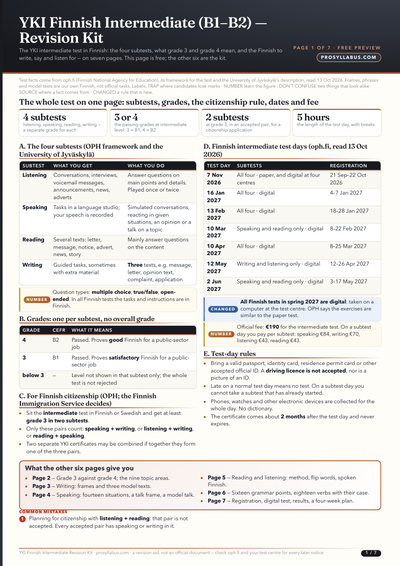
Page 3 of the kit gives a frame for each of the three text types, a friendly message, a semi-formal message and an opinion text, with three model texts of its own on different topics from the four on this page.
The YKI Finnish Intermediate revision kit is a seven-page PDF in English with the Finnish you need: the four subtests, grade 3 against grade 4, frames and three model texts for writing, fourteen speaking situations and a model talk, a method for reading and listening, sixteen grammar points and eighteen verbs with the case each one takes. Its test facts come from oph.fi; its model texts are our own, never official tasks. Page 1 is free to read in full before you decide.
Frequently asked questions
How many texts do you write in the YKI writing subtest?
Three texts of different types, according to the framework: for example a message, a letter, an opinion text, a complaint or an application.
What is a mielipideteksti?
An opinion text, also called mielipidekirjoitus: you state your view on a question and give reasons for it. The University of Jyväskylä names it as an example of an intermediate-level writing task.
How many words should a YKI writing answer be?
No word limit is published on the official pages we read on 13 October 2026. Follow the instructions printed with each task in the test.
How many reasons do I need in an opinion text?
There is no general rule published. The opinion task on the University of Jyväskylä’s demonstration page asks the writer to give at least three reasons, so practise with three.
Should I use sinä or te in a YKI message?
It depends on the reader. The level 4 criteria describe telling formal from informal language apart; the level 3 criteria do not yet require it. Whichever you choose, keep to it through the text.
Do I have to write all three texts?
The demonstration’s instructions say that completing the writing subtest requires doing all the tasks, and the framework says a subtest done incompletely is entered as “cannot be assessed”.
Is the writing subtest done by hand or on a computer?
On paper you write by hand. The 7 November 2026 test is digital at four pilot centres, and all Finnish tests in spring 2027 are taken on a computer at the test centre.
Are these model texts graded examples?
No. They are our own illustrations written to match the wording of OPH’s criteria. No assessor has graded them and no grade is promised.
What is the difference between grade 3 and grade 4 writing?
OPH’s criteria summarise the step as more variety in expression, a higher level of abstraction, and a difference made between formal and informal register.
Will grammar mistakes stop me getting grade 3 in writing?
The level 3 criteria accept that structures may be unnatural in more demanding situations as long as the message is understood. The model texts here are error-free because a model should be.
Does writing count for Finnish citizenship?
Yes, at grade 3 or higher together with speaking or with listening comprehension. Those are two of the three accepted pairs.
More in this series
- Practice set for all four subtests, with answers and a self-marking tool
- Fee, test days, registration and whether a course is worth it (cost planner)
- YKI for Finnish citizenship: grade 3 and the three accepted subtest pairs (checker)
- Levels 3 and 4: what each grade on the certificate means (level reader)
- Speaking and writing: five example tasks with grade 3 and grade 4 style model answers
- A 4-week YKI preparation plan built on the four subtests (plan builder)
- Reading and listening: strategies and practice sets with 16 questions (grader)
- YKI test in English: the whole test in one overview (timeline tool)
- Why people miss level 3: level 2 against level 3 in the official criteria (self-check)
- YKI Finnish intermediate notice board — official updates
Sources
- official — OPH — Yleisten kielitutkintojen perusteet 2011 (the framework: subtests, assessment, level descriptions, topic areas, language functions; in Finnish, attached on oph.fi)
- official — University of Jyväskylä, Centre for Applied Language Studies — Yleiset kielitutkinnot (description of the subtests and levels, in Finnish)
- official — University of Jyväskylä — YKI demonstration pages, Finnish intermediate level: instructions and example tasks for the four subtests (a demonstration, not the test)
- official — OPH — Assessment criteria for writing (YKI), PDF attached to “After the YKI test” (levels 1 to 6, general criteria and text types)
- official — OPH — After the YKI test (results, certificate, assessment, reassessment and its statistics)
- official — OPH — Registering for the YKI test (terms, refund conditions, test fees, waiting list, special arrangements)
- official — OPH — Selecting the right YKI test, the test days (levels, subtests, test days and registration periods for autumn 2026 and spring 2027)
- official — OPH news — Digital YKI tests will be piloted in November 2026
- official — OPH — Proving your language skills for the Finnish citizenship application
official = a document published by the conducting body. reported = a news or coaching site we could not check against an original. Where sources disagree this page says so rather than picking one.