Checked 13 October 2026. Level descriptions are from the OPH framework (2011) and the assessment criteria for speaking and writing attached on oph.fi, read on 13 October 2026. The comparison between level 2 and level 3 and every conclusion drawn from it are our reading, not OPH’s. No pass rate is published on the pages we read.
Onko YKI-testi vaikea? What can be said honestly
“Is the YKI test hard?” (onko YKI-testi vaikea) and “I did not pass YKI” (YKI ei mennyt läpi) are things people type into a search engine about the test, and the answers they find often come with a percentage. We cannot give you one. We found no pass rate and no distribution of grades on the oph.fi pages or the University of Jyväskylä’s YKI pages we read on 13 October 2026. OPH publishes statistics on reassessments and on special arrangements, not on results. A figure quoted elsewhere may be true, but it is not from those pages, and we do not repeat it.
What is published is more useful than a percentage: the standard itself. OPH attaches the assessment criteria for speaking and for writing to its page “After the YKI test”, and the framework describes every level for every subtest. So the question “why do people miss level 3?” has a definite answer in one sense, for speaking and writing: a performance placed below 3 is one in which the assessors did not see the level 3 line of the criteria. Level 2 is the line below it. Reading and listening are different: they are scored in points that are converted into levels, and the conversion is not published. Setting the two lines side by side shows exactly what has to be visible. That comparison is ours, made from the official text; where we draw a conclusion we say so. ProSyllabus is an independent study site. We are not affiliated with, or endorsed by, the Finnish National Agency for Education (OPH), the University of Jyväskylä or the Finnish Immigration Service (Migri). Every rule here is quoted or summarised from their published pages; OPH decides everything about the test and Migri decides every citizenship application.
Official: oph.fi (assessment criteria PDFs) and the framework, sections 7 and 8, read 13 October 2026.
First, what “below 3” is
The intermediate test gives three results in each subtest: 3, 4 or below 3 (alle 3). “Below 3” means “that you did not have the required skills for the chosen level of the YKI test. This result only applies to a specific subtest. It does not mean that the whole test has been rejected” [official: oph.fi]. It is not a grade 2: the intermediate test is not built to say how far below 3 someone is. And there is no overall result to fail, only four separate ones. The certificate entries are explained one by one in YKI-testin tasot: level 3 vs level 4.
| Subtests | How they are assessed (framework, section 7) | What that means for you |
|---|---|---|
| Speaking and writing | Against assessment criteria built directly on the level scale; the performance is compared with the level criteria, not with other candidates | There is no quota. What counts is what is visible in your recording and your three texts |
| Listening and reading | In points, which are converted into level assessments | The conversion is not published on the pages we read, so no practice score maps to a grade |
One more thing OPH says belongs here, because it explains many disappointments: “the people grading the YKI test performances do not know you … The only thing they assess is how well you speak, write and understand what you hear and read in the test situation.” Someone who manages daily life in Finnish can still leave a recording that does not show it.
Speaking: level 2 against level 3, criterion by criterion
The two middle columns quote OPH’s assessment criteria for speaking, shortened in places. The right-hand column is our reading of the step between them.
| Criterion | Level 2 (OPH) | Level 3 (OPH) | The step (our reading) |
|---|---|---|---|
| General | Can only manage in routine situations that require a simple and direct exchange of information. Getting the message across depends on how much help in formulating it the conversational partner is ready to give | Can cope in most practical situations and is able to show initiative in everyday situations. Speech can be fairly slow, but there are few unnatural pauses. Is easy to understand in spite of the fact that he/she transfers structures from the mother tongue or some other language into the target language, and that his/her foreign accent is clearly evident | From needing help to carrying the situation yourself. In a studio nobody can help you, so the recording has to stand alone |
| Fluency | Can make him/herself understood in short contributions, even though pauses, false starts and reformulation are very common | Can express him/herself with relative ease. Despite some problems in formulation resulting in pauses, he/she is able to keep going effectively without help | Pauses are allowed at level 3. Stopping is the problem: keep going |
| Flexibility | Can exploit rehearsed and memorised simple phrases and is able to use them in new, but routine, situations | Can exploit a wide range of simple language flexibly even in less routine situations | Memorised phrases belong to level 2. Level 3 is simple language used for a situation you did not rehearse |
| Coherence | Can use the most frequently occurring connectors (such as “and”, “but” and “because”) to link simple sentences … as a simple list of points | Can link a series of shorter, discrete simple elements into a connected, linear sequence of points | From a list to a sequence: first, then, because of that, in the end |
| Precision and range | Can convey simple and straightforward information in familiar, routine communicative situations. Can control a narrow and concrete vocabulary that has to do with everyday needs | Can express things he/she regards as important in comprehensible and fairly accurate manner. Has sufficient vocabulary to express him/herself on most topics pertinent to his/her everyday life (family, hobbies and interests, work, travel, etc.) | Vocabulary beyond needs: enough to talk about your life, not only to get things done |
| Pronunciation | Generally clear enough to be understood despite a noticeable foreign accent, but conversational partners will need to ask for repetition from time to time | Clearly intelligible even if a foreign accent is sometimes evident and occasional mispronunciations occur | An accent is no obstacle at level 3. Being understood the first time is the test: a recording cannot be asked to repeat |
| Grammatical accuracy | Uses some simple structures correctly, but still systematically makes mistakes in basic structures, for example, mixes up tenses | Communicates with reasonable accuracy in familiar contexts, though with noticeable mother tongue influence. Errors occur, but it is clear what he/she is trying to express | Errors are expected at level 3. Systematic errors in basic structures are what the level 2 line describes |
Read the level 3 column again and notice how much imperfection it allows: slow speech, pauses, a clearly evident accent, noticeable mother-tongue influence, errors. The criteria also carry a note at the top: the performance “should not be assessed according to one criterion only” [official]. In our reading, then, level 3 speaking is not missed through an accent or a wrong case ending. It is missed when the speaker stops, answers in memorised fragments that do not fit the situation, or cannot be understood without a second hearing.
Writing: level 2 against level 3
| Criterion | Level 2 (OPH) | Level 3 (OPH) | The step (our reading) |
|---|---|---|---|
| General | Can write short, simple texts on everyday topics. Text can, however, be fragmented and contain expressions that are difficult to understand | Can write simple, coherent text about general topics. Text content is comprehensible, but some unclear expressions and illogical formulations may occasionally cause pauses in reading | From fragmented to coherent, and from “difficult to understand” to “occasionally cause pauses” |
| Flexibility | Holds simple expressions that have been learnt as phrases and can use them in written everyday communicative situations | Manages well everyday communication situations, but cannot sufficiently express the difference between formal and informal register | Level 3 does not yet require two registers. That difference is the step to level 4 |
| Coherence | Can use the most frequently occurring connectors (such as “and”, “but” and “because”) to link simple sentences and random expressions in order to write a short text | Can write fairly coherent text | Connectors alone are level 2. The text as a whole has to hang together |
| Precision and range | Can convey simple and straightforward information in familiar, routine communicative situations. Can control a narrow and concrete vocabulary | Can express what he/she wishes in a comprehensible and fairly accurate manner. Errors, however, occur in expressing complex ideas or when the text type or topic is less familiar | Saying what you want to say, not only what you have the words for |
| Grammatical accuracy | Uses some simple structures correctly, but still systematically makes mistakes in basic structures, for example, mixes up tenses | The use of grammatical structures follows the target language requirements in familiar situations. Though in more demanding situations the use of grammatical structures may be unnatural, the message is understood | Basic structures right on familiar ground; unnatural is tolerated, unclear is not |
| Opinion texts | Can express his/her opinion on matters related to him/her, but cannot necessarily give reasons | Can write short, simple essays on interesting topics. Can draw conclusions and express opinions with some certainty on gathered information | A reason with every opinion. This is the clearest single line between the two levels |
The criteria print the step between some levels in a few words. Between levels 3 and 4 they say: more variety in expression, a higher level of abstraction, and a difference made between formal and informal register. Between levels 1 and 2, for writing: the text is more coherent and connected, and has more content; for speaking: speech is more continuous, there is more content, and the speaker tries to produce speech more actively [official]. No such line is printed for the step from 2 to 3, which is why the right-hand columns above are our reading and not OPH’s. The direction is the same throughout, though: more continuous, more connected, more content.
Reading and listening: level 2 against level 3
For the comprehension subtests there are no published criteria tables, only the level descriptions in annex 1 of the framework. The framework is in Finnish; the English here is our translation.
| Subtest | Level 2 (framework) | Level 3 (framework) | The step (our reading) |
|---|---|---|---|
| Listening | Understands slowish, clear and simplified speech about everyday, familiar things. Long stretches of speech and large wholes may be hard to understand | Understands longer continuous speech if the topic is fairly familiar, and the main idea of clear, normal-speed speech such as many TV and radio programmes on current matters | From simplified speech to normal-speed speech, and from short to longer stretches |
| Reading | Understands short, simple texts easily; understands main points of texts on familiar everyday topics and some things in texts on general topics | Understands ordinary everyday texts that need no knowledge of the subject; gets the main points of even a fairly long text on a general topic | From short texts to fairly long ones, and from familiar topics to general ones |
In our reading, the listening step is the one that practice with a teacher hides. Classroom Finnish tends to be what the level 2 line describes, slowish, clear and simplified (hitaahkoa, selkeää ja yksinkertaistettua); the level 3 description names TV and radio. Whether you can follow a news item at normal speed is something you can find out tonight. Two reading texts and two listening scripts with sixteen questions are in YKI: luetun ja kuullun ymmärtäminen.
The same content on each side of the line
These short Finnish examples are ours. They are illustrations of the wording in the criteria, not graded samples, and no grade is promised for either side. Every sentence in them is correct Finnish on purpose: the difference shown is in connection and content, not in grammar.
Writing: fragmented, as the level 2 line describes
English: I live in Vantaa. I have two children. Work is in Helsinki. The bus is often late. I like summer.
Five true sentences and no link between them: the reader has to build the connection.
Writing: simple and coherent, as the level 3 line describes
English: I live in Vantaa with my two children. I work in Helsinki, so I travel by bus every day. Unfortunately the bus is often late, and that is why I leave home early. In summer I cycle to work, because it is nicer.
The same facts, still simple, now joined with joten, ja siksi and koska into one line of thought.
Speaking: the task (ours) · Tilanne
English: You have a dentist’s appointment tomorrow, but you cannot go. Phone and reschedule it.
Speaking: short contributions, as the level 2 line describes
English: Hello. I have an appointment tomorrow. I cannot come. I want a new appointment.
The message gets across, but the listener must ask who is calling, which appointment, and when would suit.
Speaking: carrying the situation, as the level 3 line describes
English: Hello, this is Sara Lindqvist. I have an appointment tomorrow at ten, but unfortunately I cannot come, because my child is ill. Could I have a new appointment for next week? The morning suits me best.
Who, which appointment, why, what is wanted and when: the speaker shows initiative, which is the phrase in the level 3 general criterion.
Losing a result without lacking Finnish
Some ways of ending up without a grade 3 have nothing to do with language level. Each of these is stated in an official source.
| What happens | What the source says | Result |
|---|---|---|
| You arrive late | OPH: “You will not be able to take the YKI test if you are late.” | No test (on a subtest day: no subtest that has already started). The refund conditions cover only your own illness |
| A subtest is left undone or incomplete | Framework, section 8: the certificate carries “ei voida arvioida” for that skill | Cannot be assessed |
| You do not write all the writing tasks | Demonstration, writing: completing the subtest requires doing all the tasks | The subtest is not complete |
| You talk about something other than the task | Demonstration, speaking: an accepted performance requires that you speak on the topic given in the task; and “Puhu joka tehtävässä jotain” (say something in every task) | A fluent answer to a different question does not count as the task |
| You leave questions blank | Demonstration, reading and listening: answer all questions; wrong answers are not penalised | Points given away |
| On paper, answers stay in the booklet | Demonstration: only answers marked on the answer sheet are taken into account for multiple-choice and true/false items | Right answers that are never read |
| You use a phone or another device | OPH: devices are collected for the day; using a phone or other prohibited device is cheating. The Jyväskylä demonstration’s instructions go further: carrying any electronic device on you during the test day results in a failed test | Disqualified; after cheating, no test in that language for the following 6 or 12 months |
| You chose the advanced test to be safe | OPH: you only receive a grade for the level of the test you took | “Below 5” gives no evidence of grade 3 or 4 |
Self-diagnosis
Self-diagnosis: which side of the level 3 line are you on?
Tick every statement that is true of you today. Be strict: tick only what you could show to a stranger on a bad day. Each statement is built on a line in the official criteria or descriptions, or on OPH’s test-day advice; the table below the tool says which.
A self-estimate built on our reading of OPH’s criteria and the framework’s level descriptions. It is not a grade and cannot predict one: trained assessors compare your performance with the criteria. Nothing you tick is stored.
The twelve statements and the line each one comes from
| # | Statement | Built on |
|---|---|---|
| 1 | I can keep talking for a minute without help, even with pauses | Speaking, fluency, level 3: “able to keep going effectively without help” |
| 2 | I can deal with a situation I have not rehearsed | Speaking, flexibility, level 3: simple language used flexibly “even in less routine situations” |
| 3 | A stranger understands me the first time | Speaking, pronunciation, level 3: “clearly intelligible”; level 2: partners “need to ask for repetition from time to time” |
| 4 | My points follow each other in order | Speaking, coherence, level 3: “a connected, linear sequence of points” |
| 5 | My text can be read through with only occasional stops | Writing, general, level 3: unclear expressions “may occasionally cause pauses in reading” |
| 6 | I give a reason with every opinion | Writing, opinion, level 2: “cannot necessarily give reasons” |
| 7 | My tenses and verb endings are mostly right on familiar ground | Grammatical accuracy, level 2: “systematically makes mistakes in basic structures, for example, mixes up tenses” |
| 8 | I have the words for family, free time, work and travel | Precision and range, level 3: vocabulary for “family, hobbies and interests, work, travel, etc.” |
| 9 | I follow clear Finnish at normal speed on a familiar topic | Framework, listening, level 3: clear, normal-speed speech; level 2: slowish, simplified speech |
| 10 | I get the main points of a fairly long general text | Framework, reading, level 3 |
| 11 | I answer every question and speak in every task | OPH’s test-day reminders and the demonstration instructions |
| 12 | I have done every task type once | OPH: get to know the structure of the test and the types of questions used in it |
How to avoid it: seven habits that follow from the criteria
| Habit | Criterion it serves | How to practise |
|---|---|---|
| Finish the sentence you started, then start another | Fluency: keep going without help | A one-minute recorded talk a day; never stop the recording |
| Answer the task that was set, point by point | Task completion, as the demonstration instructions put it | Number the bullet points of a writing task and tick each one off in your text |
| Join every two sentences that belong together | Coherence: a connected sequence, a fairly coherent text | Rewrite yesterday’s text with koska, joten, mutta, siksi |
| Give the reason | Opinion: level 2 “cannot necessarily give reasons” | One spoken opinion a day with two reasons |
| Check the verbs last | Grammatical accuracy in familiar contexts | A final read of every text for person and tense only |
| Listen at full speed | Listening level 3: clear, normal-speed speech | News in standard Finnish daily, heard twice |
| Guess before you leave a blank | No penalty for wrong answers | In practice sets, allow yourself no empty line |
These habits are the spine of the four-week YKI preparation plan. For writing, four tasks with grade 3 style model texts and a list of what would lift each towards grade 4 are in YKI-testin kirjoittaminen: four model texts; for speaking, three speaking tasks with two model answers each.
If the result was below 3
Three routes are open, and they do different things. A reassessment has your same answers read again by different assessors. It costs 108 EUR per subtest, takes about three months on average, cannot be appealed, and is refunded only if the grade changes. OPH publishes how often that happens: in 2025 there were 128 requests and 7 of them changed a subtest grade; in 2024, 130 requests and 7 changes [official]. It is the right route if you believe the assessment was wrong, and the wrong one if you hope for a second chance at the tasks.
A new test is a new registration and a new fee. You do not lose what you already have: a certificate does not expire, and for citizenship the Finnish Immigration Service says two separate certificates may together form an accepted pair [official: read live on 13 October 2026]. A subtest day, where one is offered, lets you register and pay only for the subtests you need: 10 March and 2 June 2027 offer speaking and reading, 12 May 2027 writing and listening [official: oph.fi]. OPH’s citizenship page still says to take all four subtests on the same day, which does not match its subtest-day pages; both statements, and what to ask the Immigration Service, are set out in Kansalaisuus ja kielitaito: the three accepted pairs. Fees and registration periods are in YKI-testin hinta.
The same test on seven printable pages
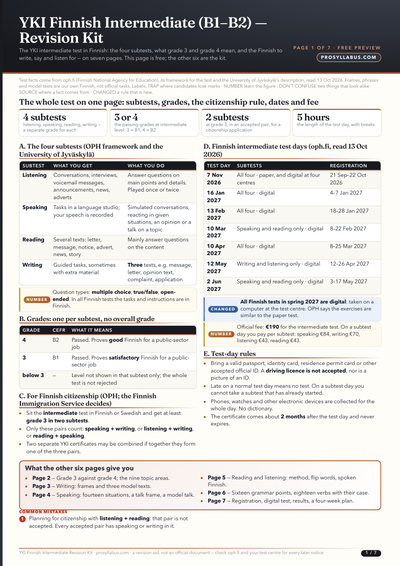
Page 2 of the kit sets the grades against each other for every skill with a self-check list, and pages 3 and 4 give the frames that turn separate sentences into a connected text or talk.
The YKI Finnish Intermediate revision kit is a seven-page PDF in English with the Finnish you need: the four subtests, grade 3 against grade 4, frames and three model texts for writing, fourteen speaking situations and a model talk, a method for reading and listening, sixteen grammar points and eighteen verbs with the case each one takes. Its test facts come from oph.fi; its model texts are our own, never official tasks. Page 1 is free to read in full before you decide.
Frequently asked questions
Is the YKI test difficult?
There is no official measure of difficulty and no published pass rate on the pages we read. The intermediate test asks for CEFR B1 at grade 3; whether that is hard depends on where your Finnish is now.
What is the pass rate of the YKI intermediate test?
We found none on the oph.fi or University of Jyväskylä pages we read on 13 October 2026. OPH publishes statistics on reassessments and special arrangements, not on grades.
What does “alle 3” mean?
Below 3: you did not show the required skills for the intermediate level in that subtest. It applies to that subtest only and is not a grade 2.
What is the difference between YKI level 2 and level 3 in speaking?
In OPH’s criteria, level 2 manages routine situations in short contributions with help from the other speaker; level 3 copes in most practical situations, shows initiative and keeps going without help despite pauses.
What is the difference between level 2 and level 3 in writing?
Level 2 texts are short and simple and can be fragmented; level 3 texts are simple and coherent. At level 2 a writer cannot necessarily give reasons for an opinion.
Does my accent lower my YKI speaking grade?
The level 3 criteria accept a clearly evident foreign accent and occasional mispronunciations, as long as pronunciation is clearly intelligible.
Do grammar mistakes mean I will not get level 3?
Not by themselves. The level 3 criteria say errors occur but it is clear what the speaker is trying to express. Systematic mistakes in basic structures are what the level 2 line describes.
Is the YKI test graded on a curve?
No. Speaking and writing are compared with level criteria, not with other candidates, so there is no quota.
I did not pass YKI. Should I ask for a reassessment?
Only if you think the assessment itself was wrong. It re-reads the same answers for 108 EUR per subtest and takes about three months; in 2025 it changed a grade in 7 of 128 requests.
Can I retake only the subtest I did not pass?
On a subtest day, yes, for the subtests offered that day. For citizenship, the Finnish Immigration Service says two separate certificates may together form an accepted pair.
What does “ei voida arvioida” mean on my certificate?
Cannot be assessed. The framework says it is entered when a subtest was not done at all or was done incompletely.
More in this series
- Practice set for all four subtests, with answers and a self-marking tool
- Fee, test days, registration and whether a course is worth it (cost planner)
- YKI for Finnish citizenship: grade 3 and the three accepted subtest pairs (checker)
- Levels 3 and 4: what each grade on the certificate means (level reader)
- Speaking and writing: five example tasks with grade 3 and grade 4 style model answers
- A 4-week YKI preparation plan built on the four subtests (plan builder)
- Reading and listening: strategies and practice sets with 16 questions (grader)
- YKI test in English: the whole test in one overview (timeline tool)
- Writing: two messages, a complaint and an opinion text with model texts (checklist tool)
- YKI Finnish intermediate notice board — official updates
Sources
- official — OPH — Assessment criteria for speaking (YKI), PDF attached to “After the YKI test” (levels 1 to 6, six criteria)
- official — OPH — Assessment criteria for writing (YKI), PDF attached to “After the YKI test” (levels 1 to 6, general criteria and text types)
- official — OPH — Yleisten kielitutkintojen perusteet 2011 (the framework: subtests, assessment, level descriptions, topic areas, language functions; in Finnish, attached on oph.fi)
- official — OPH — After the YKI test (results, certificate, assessment, reassessment and its statistics)
- official — OPH — Before the YKI test: the test day, ID, what is not allowed, cancelling, tips for practising
- official — OPH — Selecting the right YKI test, the test days (levels, subtests, test days and registration periods for autumn 2026 and spring 2027)
- official — OPH — Registering for the YKI test (terms, refund conditions, test fees, waiting list, special arrangements)
- official — University of Jyväskylä — YKI demonstration pages, Finnish intermediate level: instructions and example tasks for the four subtests (a demonstration, not the test)
- official — OPH news — Subtest days for the YKI test will be piloted in autumn 2026
- official — OPH — Proving your language skills for the Finnish citizenship application
- official — Finnish Immigration Service — Proving your language skills in a YKI test (read live on 13 October 2026)
official = a document published by the conducting body. reported = a news or coaching site we could not check against an original. Where sources disagree this page says so rather than picking one.