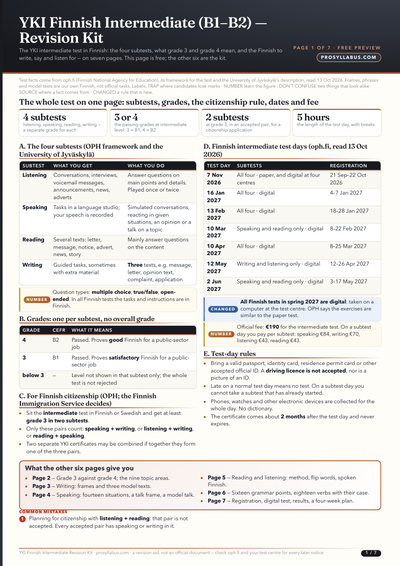

Checked 13 October 2026. Subtest descriptions are from the OPH framework (2011), the University of Jyväskylä’s description and its demonstration pages, read on 13 October 2026. The demonstration shows the paper test; Finnish tests are digital from the start of 2027. Every text, script and question below is our own.
YKI: luetun ja kuullun ymmärtäminen, the two comprehension subtests
People search for luetun ymmärtäminen and kuullun ymmärtäminen; the YKI framework calls the same two subtests tekstin ymmärtäminen (reading comprehension) and puheen ymmärtäminen (listening comprehension). They are two of the four subtests of the intermediate test, each graded separately as 3, 4 or below 3 [official: oph.fi]. For a citizenship application neither is enough alone or together: listening counts only with writing, and reading only with speaking [official: OPH and the Finnish Immigration Service].
This page gives you what the two subtests are made of according to the official descriptions, seven strategies that follow from those descriptions, and then practice: two reading texts and two listening scripts written by us, sixteen questions in the three official question types, the sentence that decides each answer, and a grader that scores the two skills separately. None of it is an official task. ProSyllabus is an independent study site. We are not affiliated with, or endorsed by, the Finnish National Agency for Education (OPH), the University of Jyväskylä or the Finnish Immigration Service (Migri). Every rule here is quoted or summarised from their published pages; OPH decides everything about the test and Migri decides every citizenship application.
Official: oph.fi, OPH’s answer-sheet instructions and the University of Jyväskylä’s demonstration pages, read 13 October 2026.
What the two subtests contain
| Feature | Tekstin ymmärtäminen (reading) | Puheen ymmärtäminen (listening) |
|---|---|---|
| Material | Several texts of different lengths: for example a letter, a message, a notice, an advert, a news item, a story. Jyväskylä adds factual texts, and says that at intermediate level some texts are longer and richer in vocabulary than at basic level | Several different recordings: for example conversations, interviews, voicemail messages, announcements, news, bulletins and adverts |
| What the questions target | Main points, details and the whole. Mainly content questions | Main points, details and the whole. Mainly content questions |
| What makes it harder at a higher level | Vocabulary, topics and the difficulty of the questions | Vocabulary, speech tempo, topics and the difficulty of the questions; Jyväskylä says the speakers’ speed also separates the levels |
| How many times | You have the text in front of you | Framework: “once or twice”. Jyväskylä’s description: “usually twice”. Jyväskylä’s demonstration: all tasks twice at basic and intermediate level |
| Minutes and number of questions | Not published on the pages we read | Not published on the pages we read |
The three statements about hearing a recording once or twice are all official and do not match, so we print all three and do not choose. They are consistent in one way: nothing promises you a third hearing. The older English-language demonstration even marks some multiple-choice items “You will hear the recording once” [official: JYU demonstration, English intermediate level]. Prepare to catch the answer the first time.
What grade 3 and grade 4 mean in these two subtests
| Subtest | Grade 3 (framework, annex 1, our translation) | Grade 4 |
|---|---|---|
| Reading | Understands ordinary everyday texts that need no knowledge of the subject; gets the main points of even a fairly long text on a general topic, but parts of more demanding texts may be missed | Understands texts on general topics without effort: the main content, how the things mentioned connect, and conclusions that can be drawn; a few details and tones may stay unclear |
| Listening | Understands longer continuous speech if the topic is fairly familiar, and the main idea of clear, normal-speed speech on current matters; an unfamiliar topic or a long stretch still causes difficulty | Understands normal-speed speech on general topics in different situations; only details may be missed. Abstract topics, fast colloquial speech and dialect can make it harder |
The full Finnish wording of these descriptions is in YKI-testin tasot: level 3 vs level 4. Notice the phrase in the grade 4 reading description: connections between the things mentioned and conclusions. Two of the questions below (6 and 15) cannot be answered by finding one sentence; you have to put two pieces of information together.
How your answers are collected
On paper, the multiple-choice and true/false questions are marked with the letter M in the test booklet and answered on a separate answer sheet that a computer reads. You tick the box with an X in pencil, and a true/false item is marked A if the statement is true and B if it is false [official: OPH’s answer-sheet instructions]. The demonstration’s instructions add four things: only one option or statement is correct; only answers marked on the answer sheet are taken into account; answers to open questions are written in the task booklet, in clear handwriting; and at the end of the listening section there are 10 minutes to transfer your multiple-choice and true/false answers to the sheet [official: JYU demonstration, Finnish intermediate level].
Those instructions describe the paper test. On 7 November 2026 the test is digital at four pilot centres, and all Finnish tests in spring 2027 are digital. OPH says of the digital test that “the exercises are similar to those in the YKI test that you take using pen and paper” [official]; it does not describe on the pages we read how answers are entered on the computer, so we do not either.
Seven strategies, and where each one comes from
| Strategy | Where it comes from | In practice |
|---|---|---|
| 1. Answer every question | Demonstration: “Vastaa kaikkiin kysymyksiin. Vääristä vastauksista ei rangaista.” (Answer all the questions. Wrong answers are not penalised.) OPH: “Always try to answer something!” | A blank and a wrong answer score the same, so a guess costs nothing |
| 2. Read the questions before you listen | Demonstration: there is always preparation time before a task | Use it to underline what each question asks for: a time, a place, a reason |
| 3. Look for the idea, not the word | Jyväskylä: questions are written so that answering is not based only on understanding single words | Expect the question to use a different word from the text: Saturday for weekend, cost for price |
| 4. Ask what this type of text is for | Jyväskylä: questions are aimed at what suits each text type, for example a product’s features or terms of sale for an advert, topics and central content for news | In a notice look for who must do what and by when; in news, what changed and why |
| 5. Keep open answers short and in the right language | OPH: “Pay attention to the required language. Check in which language you have to write the answers.” | A few words that carry the idea. In the Finnish test the tasks and instructions are in Finnish |
| 6. On paper, protect the transfer | Demonstration and answer-sheet instructions: only the sheet counts; task numbers must match | Mark answers in the booklet first, then transfer in order and check the last number lines up |
| 7. Watch numbers, days and negatives | Ours, from writing questions of this kind | Most wrong options in the sets below are built from a number, a weekday or a “not” that really is in the text |
Set 1, reading: a news item (uutinen)
Read the text once at your normal speed, then answer the four questions without a dictionary. The English is there for checking afterwards.
Read this · Lue teksti
Koivurannan kaupungin bussiliikenne muuttuu maanantaina 10. elokuuta. Linja 4 lopetetaan kokonaan, koska sillä on ollut vain vähän matkustajia. Sen tilalle tulee linja 14, joka ajaa keskustasta sairaalan kautta Mäntylään. Uusi linja kulkee arkisin kahdenkymmenen minuutin välein, mutta viikonloppuisin vain kerran tunnissa.
Lippujen hinnat eivät nouse. Kertalippu maksaa edelleen kolme euroa, ja sen voi ostaa kuljettajalta vain kortilla. Käteistä rahaa ei busseissa enää oteta vastaan. Kaupungin liikennepäällikön mukaan muutos nopeuttaa matkaa, koska kuljettajan ei tarvitse antaa vaihtorahaa.
Kaikki asukkaat eivät ole tyytyväisiä. Mäntylässä asuva eläkeläinen kertoo, että uusi pysäkki on hänen kotoaan lähes kilometrin päässä, kun vanha oli aivan oven edessä. Kaupunki lupaa seurata tilannetta syksyn ajan ja tehdä tarvittaessa muutoksia vuodenvaihteessa. Palautetta voi antaa kaupungin verkkosivuilla syyskuun loppuun asti.
English: Bus routes change in Koivuranta in August. Bus services in the town of Koivuranta change on Monday 10 August. Route 4 is withdrawn completely, because it has had only a few passengers. It is replaced by route 14, which runs from the centre via the hospital to Mäntylä. The new route runs every twenty minutes on weekdays but only once an hour at weekends. Ticket prices are not going up. A single ticket still costs three euros, and it can be bought from the driver by card only. Cash is no longer accepted on the buses. According to the town’s head of transport the change makes journeys faster, because the driver does not have to give change. Not all residents are pleased. A pensioner living in Mäntylä says that the new stop is almost a kilometre from home, whereas the old one was right at the door. The town promises to follow the situation through the autumn and to make changes at the turn of the year if needed. Feedback can be given on the town’s website until the end of September.
Our own text; Koivuranta and Mäntylä are invented places.
| # | Type | Question in Finnish | In English |
|---|---|---|---|
| 1 | Multiple choice | Miksi linja 4 lopetetaan? A) Matkustajia on ollut vähän. · B) Liput ovat liian kalliita. · C) Kuljettajia ei ole tarpeeksi. | Why is route 4 being withdrawn? A) There have been few passengers. · B) The tickets are too expensive. · C) There are not enough drivers. |
| 2 | True / false | Linja 14 kulkee lauantaisin kahdenkymmenen minuutin välein. | Route 14 runs every twenty minutes on Saturdays. |
| 3 | Multiple choice | Miten kertalipun voi maksaa bussissa? A) vain käteisellä · B) käteisellä tai kortilla · C) vain kortilla | How can you pay for a single ticket on the bus? A) cash only · B) cash or card · C) card only |
| 4 | Open | Miksi Mäntylässä asuva eläkeläinen on tyytymätön? | Why is the pensioner who lives in Mäntylä dissatisfied? |
Set 2, reading: a message from an employer (viesti)
Read this · Lue teksti
Hei Amir,
kiitos, että hyväksyit työtarjouksemme. Kesätyösi alkaa maanantaina 1. kesäkuuta kello 7.30. Tule ensimmäisenä päivänä toimiston ovelle, älä myymälään, sillä myymälä aukeaa vasta yhdeksältä.
Ensimmäisen viikon teet töitä yhdessä Sarin kanssa, joka on ollut meillä töissä jo kuusi kesää. Hän näyttää sinulle kasvihuoneet ja kertoo, miten kasveja kastellaan. Toisesta viikosta alkaen työskentelet myös kassalla, joten saat siihen koulutuksen perjantaina.
Saat meiltä työvaatteet ja käsineet, mutta turvakengät sinun täytyy hankkia itse. Korvaamme niistä kuittia vastaan enintään 50 euroa. Ruokatauko on puoli tuntia, eikä se ole työaikaa. Taukotilassa on jääkaappi ja mikro, koska lähin ruokapaikka on kolmen kilometrin päässä.
Palkka maksetaan kuun viimeisenä päivänä. Toisitko verokorttisi mukanasi heti ensimmäisenä päivänä? Ilman sitä palkasta pidätetään tavallista enemmän veroa.
Jos sairastut, soita minulle ennen työvuoron alkua. Tekstiviesti ei riitä.
Terveisin
Kaisa Niemelä
puutarhuri, yrittäjä
English: Subject: Welcome to work at Puutarha Niemelä. Hi Amir, thank you for accepting our job offer. Your summer job starts on Monday 1 June at 7.30. On the first day come to the office door, not to the shop, because the shop does not open until nine. For the first week you will work together with Sari, who has already worked with us for six summers. She will show you the greenhouses and tell you how the plants are watered. From the second week you will also work at the till, so you will be trained for that on Friday. We give you work clothes and gloves, but you must get safety shoes yourself. We reimburse at most 50 euros for them against a receipt. The meal break is half an hour, and it is not working time. The break room has a fridge and a microwave, because the nearest place to eat is three kilometres away. Wages are paid on the last day of the month. Could you bring your tax card with you on the very first day? Without it, more tax than usual is withheld from your pay. If you fall ill, phone me before your shift starts. A text message is not enough. Regards, Kaisa Niemelä, gardener, owner.
Our own text; the business and the people are invented.
| # | Type | Question in Finnish | In English |
|---|---|---|---|
| 5 | Multiple choice | Minne Amirin pitää mennä ensimmäisenä työpäivänä? A) myymälään · B) toimiston ovelle · C) kasvihuoneeseen | Where must Amir go on his first working day? A) to the shop · B) to the office door · C) to the greenhouse |
| 6 | True / false | Amir saa kassakoulutuksen ennen kuin hän aloittaa työt kassalla. | Amir gets till training before he starts working at the till. |
| 7 | True / false | Työnantaja korvaa turvakengät kokonaan, vaikka ne maksaisivat 80 euroa. | The employer reimburses the safety shoes in full even if they cost 80 euros. |
| 8 | Open | Mitä Amirin pitää tehdä, jos hän sairastuu? | What must Amir do if he falls ill? |
Set 3, listening: a station announcement (kuulutus)
We cannot play a recording on this page, so the script stands in for one. Do not read it yourself first. Read the four questions, then have a Finnish speaker read the script aloud at normal speed, or paste it into a text-to-speech reader, and listen. Try to answer after one hearing; listen a second time to check.
| # | Type | Question in Finnish | In English |
|---|---|---|---|
| 9 | Multiple choice | Miksi juna on myöhässä? A) Veturissa on vika. · B) Raiteella tehdään töitä. · C) Juna odottaa toista junaa. | Why is the train late? A) The locomotive has a fault. · B) There is work on the track. · C) The train is waiting for another train. |
| 10 | Multiple choice | Miltä raiteelta juna lähtee? A) raiteelta 2 · B) raiteelta 3 · C) raiteelta 7 | Which track does the train leave from? A) track 2 · B) track 3 · C) track 7 |
| 11 | True / false | Seinäjoelle matkustava ehtii vaihtaa junaa Tampereella. | A passenger travelling to Seinäjoki has time to change trains in Tampere. |
| 12 | Open | Mistä junassa voi tänään ostaa kahvia? | Where on the train can you buy coffee today? |
Hear this · Kuuntele kuulutus
Ravintolavaunu ei ole tänään käytössä, mutta kahvia ja pientä syötävää voi ostaa myyntikärrystä, joka kulkee junan läpi.
Jatkoyhteys Tampereelta Seinäjoelle odottaa tätä junaa, joten vaihto onnistuu myöhästymisestä huolimatta. Matkustajat, jotka eivät halua odottaa, voivat käyttää samaa lippua kello 17.05 lähtevässä taajamajunassa, joka pysähtyy kaikilla asemilla.
Pahoittelemme myöhästymisestä aiheutuvaa haittaa.
English: Attention, passengers! The train leaving for Tampere at 16.42 is about 25 minutes late because of a fault in the locomotive. Exceptionally, the train leaves from track 7, not from track 3. The restaurant car is not in use today, but coffee and snacks can be bought from the sales trolley that goes through the train. The connecting service from Tampere to Seinäjoki will wait for this train, so the change works despite the delay. Passengers who do not want to wait may use the same ticket on the local train leaving at 17.05, which stops at every station. We apologise for the inconvenience caused by the delay.
Our own script, an announcement being one of the listening materials the framework names. The times and tracks are invented.
Set 4, listening: a conversation at a repair shop (keskustelu)
The same method: questions first, then the script read aloud by two voices if you can arrange it.
| # | Type | Question in Finnish | In English |
|---|---|---|---|
| 13 | Multiple choice | Mitä pyörälle on jo tehty? A) Takarengas on vaihdettu. · B) Jarrut on vaihdettu ja ketju rasvattu. · C) Pyörälle ei ole tehty vielä mitään. | What has already been done to the bicycle? A) The rear tyre has been changed. · B) The brakes have been changed and the chain oiled. · C) Nothing has been done to it yet. |
| 14 | True / false | Asiakas haluaa, että takarengas vaihdetaan nyt. | The customer wants the rear tyre changed now. |
| 15 | Multiple choice | Kuinka paljon asiakas maksaa, kun hän hakee pyörän? A) 43 euroa · B) 60 euroa · C) 103 euroa | How much does the customer pay when collecting the bicycle? A) 43 euros · B) 60 euros · C) 103 euros |
| 16 | Open | Milloin asiakas hakee pyörän? | When does the customer collect the bicycle? |
Hear this · Kuuntele keskustelu
Korjaaja: Hetkinen, katson. Millä nimellä?
Asiakas: Okafor. Se on sininen naisten pyörä.
Korjaaja: Joo, löytyi. Jarrut on vaihdettu ja ketju rasvattu, niin kuin sovittiin. Mutta takarengas oli niin kulunut, että sekin pitäisi vaihtaa. Emme vaihtaneet sitä, koska halusimme kysyä ensin teiltä.
Asiakas: Paljonko se maksaisi?
Korjaaja: Rengas on 28 euroa ja työ 15, eli yhteensä 43 euroa lisää. Huolto oli 60 euroa.
Asiakas: Se on aika paljon. Kestääkö vanha rengas vielä tämän syksyn?
Korjaaja: Kaupunkiajossa luultavasti kestää, mutta talvella en ajaisi sillä. Liukkaalla se on vaarallinen.
Asiakas: Selvä. En aja talvella, joten jätetään se nyt vaihtamatta. Milloin voin hakea pyörän?
Korjaaja: Olemme auki tänään kuuteen asti. Huomenna torstaina olemme poikkeuksellisesti kiinni koulutuksen takia, ja perjantaina avaamme taas kymmeneltä.
Asiakas: En ehdi tänään, eli tulen sitten perjantaina töiden jälkeen. Voiko teillä maksaa kortilla?
Korjaaja: Voi, kortilla tai käteisellä. Ottakaa mukaan lappu, jonka saitte maanantaina, niin löydämme pyörän nopeammin.
English: Customer: Hello, I brought a bicycle to you for servicing on Monday. Is it ready yet? Mechanic: One moment, I will look. Under what name? Customer: Okafor. It is a blue women’s bicycle. Mechanic: Yes, found it. The brakes have been changed and the chain oiled, as agreed. But the rear tyre was so worn that it should be changed too. We did not change it, because we wanted to ask you first. Customer: How much would it cost? Mechanic: The tyre is 28 euros and the work 15, so 43 euros more in total. The service was 60 euros. Customer: That is quite a lot. Will the old tyre last this autumn? Mechanic: In town riding it probably will, but I would not ride on it in winter. On a slippery surface it is dangerous. Customer: All right. I do not ride in winter, so let us leave it unchanged for now. When can I collect the bicycle? Mechanic: We are open until six today. Tomorrow, Thursday, we are exceptionally closed for training, and on Friday we open again at ten. Customer: I do not have time today, so I will come on Friday after work. Can I pay by card? Mechanic: Yes, by card or in cash. Bring the slip you were given on Monday, and we will find the bicycle faster.
Our own script. A conversation is one of the listening materials the framework names.
Mark your answers
Grade your sixteen answers
Enter what you answered. For the four open questions, read the model answer below first and then say honestly whether your answer had the same idea. The grader gives a score for reading and one for listening and shows the sentence behind every answer you missed.
Reading: questions 1 to 8
Listening: questions 9 to 16
A practice score on our own questions. It cannot be turned into a YKI grade: the framework says comprehension tasks are scored in points that are converted into levels, and no conversion is published on the pages we read. Nothing you enter is stored.
Answer key with the reason for each answer
| # | Answer | The sentence that decides it | Why the others fail |
|---|---|---|---|
| 1 | A | Linja 4 lopetetaan kokonaan, koska sillä on ollut vain vähän matkustajia. | Ticket prices are mentioned, but they are not rising; drivers are mentioned only for giving change |
| 2 | Väärin (false) | Uusi linja kulkee arkisin kahdenkymmenen minuutin välein, mutta viikonloppuisin vain kerran tunnissa. | The text never says “lauantai”; you have to know Saturday is part of the weekend |
| 3 | C | sen voi ostaa kuljettajalta vain kortilla. Käteistä rahaa ei busseissa enää oteta vastaan. | “Käteistä” is in the text, but with a negative verb |
| 4 | Uusi pysäkki on kaukana hänen kotoaan (lähes kilometrin päässä). | uusi pysäkki on hänen kotoaan lähes kilometrin päässä, kun vanha oli aivan oven edessä | An answer about ticket prices or cash would be about a different paragraph |
| 5 | B | Tule ensimmäisenä päivänä toimiston ovelle, älä myymälään | The shop is named, but after “älä”; the greenhouses come later in the week |
| 6 | Oikein (true) | Toisesta viikosta alkaen työskentelet myös kassalla, joten saat siihen koulutuksen perjantaina. | Two facts joined: till work from week two, training on the Friday before it |
| 7 | Väärin (false) | Korvaamme niistä kuittia vastaan enintään 50 euroa. | “Enintään” means at most; the 80 euros is our invention to test that word |
| 8 | Soittaa Kaisalle ennen työvuoron alkua. | Jos sairastut, soita minulle ennen työvuoron alkua. Tekstiviesti ei riitä. | “Lähettää tekstiviesti” is the answer the text rules out |
| 9 | A | myöhässä noin 25 minuuttia veturin vian vuoksi | Another train does wait, but it is the connection waiting for this train, not the other way round |
| 10 | C | Juna lähtee poikkeuksellisesti raiteelta 7, ei raiteelta 3. | Track 3 is said aloud, after “ei” |
| 11 | Oikein (true) | Jatkoyhteys Tampereelta Seinäjoelle odottaa tätä junaa, joten vaihto onnistuu | The delay suggests “false”; the announcement says the connection waits |
| 12 | Myyntikärrystä. | kahvia ja pientä syötävää voi ostaa myyntikärrystä, joka kulkee junan läpi | “Ravintolavaunusta” is the word you hear first, but that car is not in use |
| 13 | B | Jarrut on vaihdettu ja ketju rasvattu, niin kuin sovittiin. | The tyre is discussed at length but was not changed |
| 14 | Väärin (false) | En aja talvella, joten jätetään se nyt vaihtamatta. | The mechanic recommends it; the customer decides against |
| 15 | B | Huolto oli 60 euroa. … jätetään se nyt vaihtamatta. | 43 is the tyre that is not bought; 103 is our sum of 60 and 43, the price if it had been |
| 16 | Perjantaina töiden jälkeen. | En ehdi tänään, eli tulen sitten perjantaina töiden jälkeen. | Today is possible until six but the customer has no time; on Thursday the shop is closed |
Reading your result
Count the two skills separately, as the test does. There is no pass mark we can give you: the framework says comprehension tasks are scored in points that are then converted into level assessments, and the conversion is not on the pages we read [official: framework, section 7]. What you can read from sixteen questions is a pattern.
| What you missed | What it suggests (our reading) | What to do next |
|---|---|---|
| Questions 2, 3, 7, 10 (a number, a day or a negative) | You found the right place in the text but not the small word that turns it | Re-read each text and circle every ei, vain, vasta, enintään, paitsi |
| Questions 6 and 15 (two facts joined) | Single sentences are fine; connecting them is the step the grade 4 description names | After every text ask one “so what follows?” question of your own |
| Questions 4, 8, 12, 16 (open) | You understood but could not put the idea into a few Finnish words | Practise answering with a verb and its object: Soittaa Kaisalle. Myyntikärrystä. |
| Mostly listening | Reading speed carries you; live speech does not wait | A radio or TV news item every day, twice, no pausing |
| Mostly reading | Longer written sentences slow you down | One notice or news item a day; write the main point in one sentence |
Then build the habit into a plan: week 3 of the four-week YKI preparation plan is reading and listening volume. A third reading text and a third listening script, a housing-company notice and a voicemail message, are in YKI keskitaso practice by subtest; use them as your next unseen set.
Three mistakes on the day that have nothing to do with Finnish
- Leaving an item blank. The demonstration’s instructions say wrong answers are not penalised.
- On paper: an answer circled in the booklet but never transferred. Only the answer sheet is read for multiple-choice and true/false items.
- Answering an open question in the wrong language. OPH tells you to check which language the answers must be written in.
Sources: University of Jyväskylä demonstration instructions and oph.fi, read 13 October 2026.
The same test on seven printable pages
Page 5 of the kit is a method for reading and listening on one sheet: what to look for in each text type, and the small words that turn an answer.
The YKI Finnish Intermediate revision kit is a seven-page PDF in English with the Finnish you need: the four subtests, grade 3 against grade 4, frames and three model texts for writing, fourteen speaking situations and a model talk, a method for reading and listening, sixteen grammar points and eighteen verbs with the case each one takes. Its test facts come from oph.fi; its model texts are our own, never official tasks. Page 1 is free to read in full before you decide.
Frequently asked questions
What is the difference between luetun ymmärtäminen and tekstin ymmärtäminen in YKI?
They mean the same subtest. The framework’s official name for reading comprehension is tekstin ymmärtäminen, and for listening comprehension puheen ymmärtäminen.
How many questions are in the YKI reading and listening subtests?
The official pages we read on 13 October 2026 do not give a number. The framework says only that each sitting has several texts of different lengths and several different recordings.
What kinds of questions are used?
Multiple-choice questions, true/false questions and open-ended questions, according to OPH. In the answer-sheet instructions a multiple-choice item has options A, B and C.
Do wrong answers lose points in YKI?
The demonstration pages’ instructions for the Finnish intermediate reading and listening tasks say that wrong answers are not penalised, so answer every question.
How many times do you hear each recording?
The official sources differ. The framework says once or twice, the University of Jyväskylä’s description says usually twice, and its demonstration page says all tasks are heard twice at basic and intermediate level.
In which language do I answer the open questions?
OPH tells candidates to check in which language the answers have to be written. In all Finnish-language tests the tasks and instructions are in Finnish.
Is there time to read the questions before a listening task?
The demonstration’s instructions say there is always preparation time before a task and that the answer time is marked in the task booklet.
What score do I need for grade 3 in reading or listening?
It is not published on the pages we read. Points are converted into level assessments by the test organisers, and no conversion table is given.
Are these practice texts real YKI tasks?
No. Every text, script and question on this page is our own, written in the text types the framework names. Official example tasks are on the University of Jyväskylä’s demonstration pages.
Do reading and listening count for Finnish citizenship?
Each counts only as part of an accepted pair: listening with writing, or reading with speaking. Listening and reading together are not an accepted pair.
Is the digital test different for reading and listening?
OPH says the exercises in the digital test are similar to those in the paper test. It does not describe on the pages we read how answers are entered on the computer.
More in this series
- Practice set for all four subtests, with answers and a self-marking tool
- Fee, test days, registration and whether a course is worth it (cost planner)
- YKI for Finnish citizenship: grade 3 and the three accepted subtest pairs (checker)
- Levels 3 and 4: what each grade on the certificate means (level reader)
- Speaking and writing: five example tasks with grade 3 and grade 4 style model answers
- A 4-week YKI preparation plan built on the four subtests (plan builder)
- YKI test in English: the whole test in one overview (timeline tool)
- Why people miss level 3: level 2 against level 3 in the official criteria (self-check)
- Writing: two messages, a complaint and an opinion text with model texts (checklist tool)
- YKI Finnish intermediate notice board — official updates
Sources
- official — OPH — Yleisten kielitutkintojen perusteet 2011 (the framework: subtests, assessment, level descriptions, topic areas, language functions; in Finnish, attached on oph.fi)
- official — University of Jyväskylä, Centre for Applied Language Studies — Yleiset kielitutkinnot (description of the subtests and levels, in Finnish)
- official — University of Jyväskylä — YKI demonstration pages, Finnish intermediate level: instructions and example tasks for the four subtests (a demonstration, not the test)
- official — University of Jyväskylä — YKI demonstration pages (examples of task types, not official test questions)
- official — OPH — Instructions for filling in the answer sheet (YKI), PDF attached to “Before the YKI test”
- official — OPH — Before the YKI test: the test day, ID, what is not allowed, cancelling, tips for practising
- official — OPH — Selecting the right YKI test, the test days (levels, subtests, test days and registration periods for autumn 2026 and spring 2027)
- official — OPH news — Digital YKI tests will be piloted in November 2026
- official — OPH — Proving your language skills for the Finnish citizenship application
- official — Finnish Immigration Service — Proving your language skills in a YKI test (read live on 13 October 2026)
official = a document published by the conducting body. reported = a news or coaching site we could not check against an original. Where sources disagree this page says so rather than picking one.