
Checked 13 October 2026. Free-material map and quick facts from oph.fi (Finnish pages), the University of Jyväskylä, Yle and Helsingin aikuisopisto, read on 14 October 2026; the demonstration pages were read on 13 October 2026. Test structure from the OPH framework (2011) and oph.fi pages read on 13 October 2026. All Finnish tests in spring 2027 are digital; OPH says the exercises are similar to the paper test. Every practice text and answer below is our own, not an official task.
YKI testi harjoitus keskitaso: what this page gives you
The intermediate YKI test (keskitaso) has four subtests, and you get a separate grade for each: 3, 4 or below 3 [official: oph.fi]. (A subtest left undone or done incompletely is marked “cannot be assessed” instead.) This page gives you one practice task for each subtest, written by us in the style the official framework describes, with an English translation, the answers and the reason for each answer. At the end, a tool lets you mark yourself against the official level descriptions.
Two things to know before you start. First, these are our own tasks. OPH itself links to demonstration tasks and says of them: “They are not the official test questions!” [official]. The same is true here. Second, the official pages we read publish no minutes and no number of tasks for any subtest, apart from the three texts in writing, so this page states none and sets no clock for you. ProSyllabus is an independent study site. We are not affiliated with, or endorsed by, the Finnish National Agency for Education (OPH), the University of Jyväskylä or the Finnish Immigration Service (Migri). Every rule here is quoted or summarised from their published pages; OPH decides everything about the test and Migri decides every citizenship application.
Official: oph.fi and the framework “Yleisten kielitutkintojen perusteet 2011”, sections 4 and 6.
Quick facts: free YKI practice
| Fact | What the official page says | Source |
|---|---|---|
| Official textbook | None: “YKI-testiin ei ole virallista oppikirjaa” (there is no official textbook for the YKI test) | oph.fi, Ennen YKI-testiä |
| Free demonstration tasks | The University of Jyväskylä’s demonstration pages show the subtests and task types of all three levels. They are a presentation for practising, not the test | jyu.fi demonstration pages, linked by OPH |
| Main task types | Multiple choice, true/false and open questions | oph.fi, Ennen YKI-testiä |
| Topic areas | The same nine at every level: me and my background, home and housing, shops and services, culture, travelling, health and well-being, work, the environment, society | oph.fi, Ennen YKI-testiä |
| Yle’s 2024 practice package | Reading and listening tasks on nine topics, at level B1 | yle.fi, linked from the Ykitreenit page OPH lists |
| Length of the test day | 5 hours for the basic and intermediate tests, with breaks | oph.fi, Ennen YKI-testiä |
| Next Finnish intermediate test | 7 November 2026; registration 21 September to 22 October 2026 | oph.fi, test days |
Checked on 14 October 2026.
Yhteenveto suomeksi
- OPH:n mukaan YKI-testiin ei ole virallista oppikirjaa. OPH:n sivulla “Ennen YKI-testiä” on linkkejä ilmaisiin harjoituksiin.
- Jyväskylän yliopiston esittelysivuilla näet keskitason tehtävätyypit kaikista neljästä osakokeesta. Sivusto on esittely, ei oikea testi.
- Ylen YKItreeneissä on B1-tason tekstin ja puheen ymmärtämisen tehtäviä yhdeksästä aiheesta.
- Helsingin aikuisopiston sivulla on ohjeita ja harjoituksia erityisesti keskitason testiin.
- Tällä sivulla on lisäksi jokaiselle osakokeelle oma harjoitustehtävä, tehtävien vastaukset ja 30 päivän suunnitelma. Tehtävät ja suunnitelma ovat meidän, eivät virallisia.
- Seuraava suomen kielen keskitason testi on 7.11.2026. Ilmoittautuminen päättyy 22.10.2026.
YKI testi harjoitus: the free practice material OPH points to
OPH’s Finnish page “Ennen YKI-testiä” (before the YKI test) ends with a short list of links to support your practice. It says there is no official textbook, “mutta voit tehdä erilaisia harjoitustehtäviä ennen testiin osallistumista” (but you can do various practice exercises before taking part in the test) [official: oph.fi]. Below is each item on that list, described in its own words, with our suggestion for how to use it. None of these sites is ours, and nothing on them is an official test question.
1. University of Jyväskylä: the demonstration pages (esittelysivut)
- Where: ykitesti2.solki.jyu.fi. OPH links the older address ykitesti.solki.jyu.fi, which now points to this site.
- In its own words: “Täällä voit tutustua perus-, keski- ja ylimmän tason tutkintojen osakokeisiin ja tehtävätyyppeihin.” (Here you can get to know the subtests and task types of the basic, intermediate and advanced tests.) And: “Tämä sivusto EI ole varsinainen tutkinto, vaan esittely, jonka avulla voit harjoitella testitehtäviä.” (This site is NOT the actual test but a presentation with which you can practise test tasks.)
- What the Finnish intermediate pages held when we read them on 13 October 2026: reading, two sets of sample tasks (Mallitehtävät 1 and 2); listening, two sets with audio files; writing, example tasks including an e-mail to the manager of a housing company and an opinion text; speaking, example task types including a short talk about a person who is important to you, with a recorded model answer (malliesimerkki), and a conversation task.
- How to use it (our advice): do each subtest once, without a dictionary, before you touch any other material. It is the only place on this list that shows the real task formats.
2. University of Jyväskylä: descriptions of the subtests
- Where: jyu.fi, Yleiset kielitutkinnot (YKI).
- In its own words: “Tekstin ymmärtämisen kokeessa käytettäviä tekstityyppejä ovat mm. kirje, viesti, ilmoitus, mainos, uutinen, asiateksti ja kertomus.” (Text types used in the reading test include letters, messages, notices, advertisements, news items, factual texts and stories.) On writing: “Kirjoittamistaitoa arvioidaan kolmen erityyppisen tehtävän perusteella.” (Writing is assessed on three tasks of different types.)
- How to use it (our advice): read it once and turn the lists into a checklist: one notice, one advertisement, one news item and one message a week, read in Finnish.
3. Yle: Ykitreenit
- Where: OPH links Ylen YKItreenit. At the top it points to Yle’s 2024 package for the intermediate level; the older intermediate-level exercises are listed below it.
- In its own words: “Uusissa tekstin ja puheen ymmärtämisen tehtävissä on 9 aihetta ja taso B1.” (The new reading and listening tasks have 9 topics and level B1.) The package: “Lue lyhyitä tekstejä, kuuntele alle minuutin audioita ja videoita.” (Read short texts, listen to audio and video clips under a minute long.) Yle says three experienced Finnish teachers wrote the tasks, and that they work best in the Chrome browser and the Yle app.
- The older intermediate set, in its own words: “Puheen (1) ja tekstin (2) ymmärtämisen tehtäviä sekä rakenne- ja sanastoharjoituksia (3).” (Listening (1) and reading (2) tasks, and structure and vocabulary exercises (3).)
- How to use it (our advice): one of the nine topics a day, listening before reading, so that you meet each topic area of the test once.
4. Helsingin aikuisopisto (Helsinki adult education centre): instructions and exercises
- Where: helao.fi, Ohjeita ja harjoituksia suomen kielen YKIin.
- In its own words: “Tällä sivulla voit tutustua erityisesti keskitason (B1–B2) YKI-testiin ja testitehtäviin.” (On this page you can get to know especially the intermediate (B1–B2) YKI test and its tasks.) It was put together in the OPH-funded YKIIN project in 2015–2016, and it links its own test, Menossa YKIin, which sets out to find “miten hyvin osaat suomen kielen sanastoa ja kielioppia” (how well you know Finnish vocabulary and grammar).
- How to use it (our advice): take Menossa YKIin early and write down the three grammar points that cost you most; they become your revision list.
5. OPH’s own documents
- The framework, Yleisten kielitutkintojen perusteet: OPH points to pages 16–18 for the topic areas. The instructions for filling in the answer sheet (Vastauslomakkeen täyttöohje), which matter if your test is on paper. On the page “YKI-testin jälkeen”, the assessment criteria for speaking and for writing; we set out what they say about grades 3 and 4 in YKI keskitaso: what levels 3 and 4 require.
- OPH also links the Finnish Courses search engine for Finnish and Swedish courses. That is a course finder, not practice material, and a course is optional: “Testiä varten ei ole pakko käydä erillistä kielikurssia” (you do not have to take a separate language course for the test) [official: oph.fi].
| Material | Subtests covered | Level | Run by |
|---|---|---|---|
| Demonstration pages | All four, with sample tasks and audio | Basic, intermediate and advanced | University of Jyväskylä |
| Descriptions of the subtests | All four, described (no tasks) | All levels | University of Jyväskylä |
| Yle 2024 package | Reading and listening | B1 | Yle |
| Yle Ykitreenit, intermediate exercises | Listening, reading, structure and vocabulary | Intermediate | Yle |
| Instructions and exercises for the YKI | The intermediate test and its tasks, links, a vocabulary and grammar test | B1–B2 | Helsingin aikuisopisto |
| Framework, answer-sheet instructions, assessment criteria | Topic areas; the answer sheet; criteria for speaking and writing | All levels | OPH |
What none of these is: an official past paper. We found no past papers on the OPH pages we read, and no score from any of these sites converts into a YKI grade.
A 30-day plan built on the free material (ours)
This plan is ours, not OPH’s. It uses only the free material above and the tasks further down this page, in an order that starts with the real formats and ends with them. For a fuller week-by-week plan with daily habits, see YKI preparation: a 4-week plan.
| Days | What to do | Material |
|---|---|---|
| 1–2 | Read the subtest descriptions and the nine topic areas. Do demonstration reading and listening set 1 once, without a dictionary. Note what surprised you. | University of Jyväskylä descriptions and demonstration pages; framework pages 16–18 |
| 3–4 | Do the demonstration writing and speaking examples. Write the e-mail task by hand; record the speaking tasks on your phone. | Demonstration pages |
| 5 | Take Menossa YKIin. Write down the three grammar points that cost you most. | Helsingin aikuisopisto |
| 6–14 | One Yle B1 topic a day, nine topics in nine days: listening first, then reading. Keep five new words from each. | Yle 2024 package |
| 15–17 | Structure and vocabulary exercises, aimed at your three grammar points from day 5. | Yle Ykitreenit, intermediate exercises |
| 18–21 | The four practice tasks on this page. Compare your writing and speaking with the models, then mark yourself with the tool. | This page |
| 22–25 | One text and one recorded talk a day, each on a topic area you have not used yet. Check them against OPH’s criteria for grades 3 and 4. | Our guide to levels 3 and 4 |
| 26–28 | Demonstration reading and listening set 2. Redo the writing and speaking examples and compare them with what you produced on days 3–4. | Demonstration pages |
| 29 | If your test is on paper, read the answer-sheet instructions once so the form is not new on the day. | OPH, Vastauslomakkeen täyttöohje |
| 30 | Rest. Re-read the test-day details you received when you registered. | — |
Two notes on the plan. The order matters more than the dates: the demonstration pages come first and again at the end, so you can see the difference. And it sets no timings, because no minutes per subtest are published on the official pages we read; follow the times printed in the test itself.
What each subtest contains, in the words of the framework
The table summarises sections 6.1 to 6.4 of the framework and the University of Jyväskylä’s description of the subtests. The Finnish names are the ones the framework uses for the four subtests.
| Subtest | Material | What you do |
|---|---|---|
| Tekstin ymmärtäminen (reading comprehension) | Several texts of different lengths: for example a letter, a message, a notice, an advert, a news item, a story | Mainly answer questions on the content: main points, details and the whole |
| Puheen ymmärtäminen (listening comprehension) | Several recordings: for example conversations, interviews, voicemail messages, announcements, news, adverts | Answer questions on main points, details and the whole. The framework says tasks are heard once or twice; Jyväskylä says usually twice |
| Kirjoittaminen (writing) | Guided tasks that may include extra material | Write three texts of different types: for example a message, a letter, an opinion text, a complaint or an application |
| Puhuminen (speaking) | Tasks done in a language studio; your speech is recorded for the assessors | Take part in simulated conversations, react in given situations, give an opinion or talk about a given topic |
In all Finnish-language YKI tests the tasks and instructions are in Finnish [official: oph.fi]. So part of practising is reading task instructions in Finnish, which is why every task below is given in Finnish first. The topics come from nine areas that are the same at every level: I and my background (OPH’s English label), home and housing, shops and services, culture, travelling, health and wellbeing, work, the environment, society [official].
What is not published, and what we therefore do not tell you
- How many minutes each subtest lasts. OPH gives only the length of the day: the intermediate test takes 5 hours, with breaks.
- How many tasks or questions each subtest has, apart from the three texts in writing.
- A word limit for the writing tasks.
- How many points in reading or listening give grade 3 or grade 4.
If a website gives you exact minutes or question counts, ask where the figure comes from. We could not find them on the oph.fi pages or in the framework, read on 13 October 2026.
1. Tekstin ymmärtäminen: a reading task
Read the notice once at normal speed, then answer the seven questions. In the test you may not use a dictionary, so do not use one here. The text type, a notice from a housing company, is one of the types the framework lists.
Read this · Lue teksti
Taloyhtiön putkia korjataan ensi viikolla. Vesi on poikki tiistaina 3.11. kello 9–15 A- ja B-rapussa. C-rapussa vesikatko on vasta keskiviikkona, ja se kestää vain aamupäivän.
Ottakaa vettä talteen jo edellisenä iltana. Pesukonetta ei saa käyttää katkon aikana. Jos vesi on katkon jälkeen ruskeaa, valuttakaa sitä muutaman minuutin ajan ennen kuin käytätte sitä.
Talon sauna on suljettu koko viikon. Maksetut saunavuorot hyvitetään seuraavassa vuokrassa, joten asukkaan ei tarvitse tehdä mitään. Pesutupa on käytössä normaalisti, paitsi tiistaina.
Lisätietoja antaa huoltoyhtiö arkisin kello 8–16. Kiireellisissä tapauksissa soittakaa päivystysnumeroon.
Isännöitsijä
English: NOTICE TO RESIDENTS. The housing company’s pipes will be repaired next week. The water will be off on Tuesday 3 November from 9 to 15 in stairwells A and B. In stairwell C the water cut is not until Wednesday, and it lasts only the morning. Store some water the evening before. The washing machine must not be used during the cut. If the water is brown after the cut, let it run for a few minutes before you use it. The building’s sauna is closed all week. Paid sauna slots will be credited against the next rent, so a resident does not need to do anything. The laundry room is in normal use, except on Tuesday. More information from the maintenance company on weekdays from 8 to 16. In urgent cases call the on-call number. The property manager.
Our own text. Read the English only after you have answered.
| # | Type | Question in Finnish | In English |
|---|---|---|---|
| 1 | Multiple choice | Milloin C-rapussa ei tule vettä? A) tiistaina koko päivän · B) keskiviikkona aamupäivällä · C) koko viikon | When is there no water in stairwell C? A) all day Tuesday · B) Wednesday morning · C) all week |
| 2 | Multiple choice | Mitä asukkaan pitää tehdä, jotta hän saa hyvityksen saunavuorosta? A) soittaa huoltoyhtiöön · B) täyttää lomake · C) ei mitään | What must a resident do to be credited for the sauna slot? A) call the maintenance company · B) fill in a form · C) nothing |
| 3 | True / false | Pesutupaa voi käyttää keskiviikkona. | The laundry room can be used on Wednesday. |
| 4 | True / false | Pesukonetta saa käyttää katkon aikana, jos vesi on kirkasta. | The washing machine may be used during the cut if the water is clear. |
| 5 | True / false | Huoltoyhtiö vastaa kysymyksiin myös lauantaisin. | The maintenance company answers questions on Saturdays too. |
| 6 | Open-ended | Mitä A-rapun asukkaan kannattaa tehdä maanantai-iltana? | What should a resident of stairwell A do on Monday evening? |
| 7 | Open-ended | Mitä pitää tehdä, jos vesi on katkon jälkeen ruskeaa? | What must you do if the water is brown after the cut? |
Answers to the reading task
| # | Answer | The sentence that decides it | Why |
|---|---|---|---|
| 1 | B | C-rapussa vesikatko on vasta keskiviikkona, ja se kestää vain aamupäivän. | Tuesday is the day for A and B. “Vasta” (not until) and “vain” (only) carry the answer. |
| 2 | C | ... joten asukkaan ei tarvitse tehdä mitään. | The credit is automatic. Options A and B are things people usually have to do, which is why they tempt. |
| 3 | Oikein (true) | Pesutupa on käytössä normaalisti, paitsi tiistaina. | “Paitsi” (except) takes out Tuesday only. |
| 4 | Väärin (false) | Pesukonetta ei saa käyttää katkon aikana. | The ban has no condition. Clear water is not mentioned at all. |
| 5 | Väärin (false) | Lisätietoja antaa huoltoyhtiö arkisin kello 8–16. | “Arkisin” means on weekdays, Monday to Friday. |
| 6 | Ottaa vettä talteen. (Store some water.) | Ottakaa vettä talteen jo edellisenä iltana. | For A and B the cut is on Tuesday, so “the evening before” is Monday evening. |
| 7 | Valuttaa vettä muutaman minuutin ajan ennen käyttöä. (Let the water run for a few minutes before using it.) | Jos vesi on katkon jälkeen ruskeaa, valuttakaa sitä muutaman minuutin ajan ennen kuin käytätte sitä. | A short, exact answer taken from the text is enough for an open question. |
Notice what the questions did. Not one could be answered by spotting a single word: each needed a small word such as vasta, vain, paitsi or arkisin. That is deliberate. The University of Jyväskylä says of the real test that questions are written so that answering does not rest on understanding single words alone [official: JYU].
2. Puheen ymmärtäminen: a listening task
We cannot play you a recording here, so use the script as one. Do not read it yourself first. Ask a Finnish speaker to read it aloud at normal speed, or paste it into a text-to-speech reader on your phone, and listen twice. Read the six questions before the first hearing. A voicemail message (puhelinvastaajaviesti) is one of the recording types the framework names.
Hear this · Kuuntele viesti
Voin tarjota teille uuden ajan joko perjantaina kello 8.30 tai ensi maanantaina kello 15.15. Perjantain aika on toisella lääkärillä, maanantaina paikalla on taas oma lääkärinne.
Soittakaa meille takaisin tänään ennen kello neljää, niin varaan ajan teille. Jos emme kuule teistä, lähetämme teille uuden ajan kirjeellä.
Verikokeessa voitte käydä jo ennen vastaanottoa. Laboratorioon ei tarvitse varata aikaa, mutta muistakaa olla syömättä kymmenen tuntia ennen koetta. Kiitos ja hyvää päivänjatkoa!
English: Hello, this is nurse Tiina Mäkelä from the Koivula health station. I am calling because the doctor’s appointment booked for you on Thursday at 14 unfortunately has to be cancelled. The doctor has fallen ill. I can offer you a new time either on Friday at 8.30 or next Monday at 15.15. Friday’s appointment is with another doctor; on Monday your own doctor is back. Call us back today before four o’clock and I will book the time for you. If we do not hear from you, we will send you a new time by letter. You can go for the blood test before the appointment. You do not need to book a time for the laboratory, but remember not to eat for ten hours before the test. Thank you and have a good day!
Our own script; the nurse and the health station are invented.
| # | Type | Question in Finnish | In English |
|---|---|---|---|
| 1 | Multiple choice | Miksi hoitaja soittaa? A) Lääkäriaika perutaan, koska lääkäri on sairas. · B) Potilas on myöhässä. · C) Verikokeen tulokset ovat valmiit. | Why is the nurse calling? A) The appointment is cancelled because the doctor is ill. · B) The patient is late. · C) The blood test results are ready. |
| 2 | Multiple choice | Minkä ajan potilas valitsee, jos hän haluaa tavata oman lääkärinsä? A) torstai kello 14 · B) perjantai kello 8.30 · C) maanantai kello 15.15 | Which time does the patient choose to see his or her own doctor? A) Thursday at 14 · B) Friday at 8.30 · C) Monday at 15.15 |
| 3 | True / false | Potilaan pitää soittaa takaisin viimeistään huomenna. | The patient must call back tomorrow at the latest. |
| 4 | True / false | Laboratorioon täytyy varata aika. | A time must be booked for the laboratory. |
| 5 | True / false | Ennen verikoetta pitää olla syömättä kymmenen tuntia. | You must not eat for ten hours before the blood test. |
| 6 | Open-ended | Mitä tapahtuu, jos potilas ei soita takaisin? | What happens if the patient does not call back? |
Answers to the listening task
| # | Answer | What was said | Why |
|---|---|---|---|
| 1 | A | ... joudutaan valitettavasti perumaan. Lääkäri on sairastunut. | The reason comes in the next sentence, not in the same one. Blood tests are mentioned, but not results. |
| 2 | C | ... maanantaina paikalla on taas oma lääkärinne. | Friday is with another doctor (toisella lääkärillä). Thursday is the cancelled time. |
| 3 | Väärin (false) | Soittakaa meille takaisin tänään ennen kello neljää ... | Today, before four. “Tänään” against “huomenna” is the whole question. |
| 4 | Väärin (false) | Laboratorioon ei tarvitse varata aikaa ... | A negative verb at the start of the clause: ei tarvitse. |
| 5 | Oikein (true) | ... muistakaa olla syömättä kymmenen tuntia ennen koetta. | “Olla syömättä” means to go without eating. |
| 6 | Uusi aika lähetetään kirjeellä. (A new time is sent by letter.) | Jos emme kuule teistä, lähetämme teille uuden ajan kirjeellä. | One clause is a complete answer. You do not need a full paragraph. |
If you scored lower here than in reading, that is normal: in listening you cannot go back. Hear the message a third time with the script in front of you and mark every time, day and negative. Those are the places where listening questions are usually decided.
3. Kirjoittaminen: a writing task with a model answer
The writing subtest asks for three texts of different types. Here is one, a semi-formal message. Write your own answer by hand or on a keyboard before you read ours. From the start of 2027 every Finnish test is digital, so if that is your sitting, type it, with ä and ö.
The task · Tehtävä
• Kerro, kuka olet ja miksi kirjoitat.
• Selitä tilanteesi.
• Kysy, voitko vaihtaa toiseen ryhmään.
• Kysy yksi asia kurssin oppikirjasta.
English: You have enrolled on a Finnish course at the adult education centre, but your shifts have changed and you can no longer come on Tuesday evenings. Write a message to the course teacher. Say who you are and why you are writing. Explain your situation. Ask whether you can change to another group. Ask one thing about the course book.
A model answer · Mallivastaus (our own)
olen Asha Verma ja olen ilmoittautunut tiistai-illan suomen kurssille. Kirjoitan teille, koska työvuoroni ovat muuttuneet.
Olen ensi kuusta alkaen iltavuorossa joka tiistai, joten en valitettavasti pääse tunneille. Haluaisin kuitenkin jatkaa opiskelua, koska tarvitsen suomea työssäni.
Olisiko mahdollista vaihtaa torstain ryhmään? Jos se on täynnä, voinko jäädä varasijalle?
Haluaisin myös kysyä, onko torstain ryhmässä käytössä sama oppikirja kuin tiistain ryhmässä.
Kiitos etukäteen vastauksestanne.
Ystävällisin terveisin
Asha Verma
English: Hello, I am Asha Verma and I have enrolled on the Tuesday evening Finnish course. I am writing to you because my shifts have changed. From next month I am on the evening shift every Tuesday, so unfortunately I cannot come to the lessons. I would still like to continue studying, because I need Finnish in my work. Would it be possible to change to the Thursday group? If it is full, can I stay on the reserve list? I would also like to ask whether the Thursday group uses the same course book as the Tuesday group. Thank you in advance for your reply. Kind regards, Asha Verma.
The writer is invented. This is our illustration, not an official answer, and no grade is promised for it.
Check your own text against the model
- Did you cover all four points of the task, in an order a reader can follow?
- Did you keep one form of address? A teacher you do not know gets te: teille, vastauksestanne.
- Did you give a reason with koska or joten, not only facts?
- Did you ask politely with the conditional: Olisiko mahdollista ...? Haluaisin kysyä ...
- Did you open and close the message as a message: a greeting, thanks, your name?
These five checks are ours, drawn from the grade 3 and grade 4 descriptions for writing: simple, coherent text at 3; a coherent whole with formal and informal language kept apart at 4.
For two more writing tasks, each with a grade 3 style and a grade 4 style model side by side, go to YKI speaking and writing: example tasks with model answers.
4. Puhuminen: two speaking tasks with model answers
In the studio you speak to a recording, and your speech is recorded for the assessors. Practise the same way: read the task, then record yourself on your phone before you look at the model. OPH’s advice for the test day is to use your normal speaking voice and to always try to answer something.
Task A, reacting in a situation · Tilanne
English: You are in the library. You have borrowed a book, but it is lost. Tell the librarian and ask what you have to do.
A model answer for task A (our own)
English: Hello, I have a small problem. I borrowed a book from you about a month ago, but I cannot find it anywhere any more. I have looked for it at home and at work. What do I have to do now? Can I pay for the book or buy a new one to replace it?
Task B, talking about a topic · Kertominen
English: Tell how you spend your free time. Say also why free time is important to you.
A model answer for task B (our own)
English: In my free time I am outdoors a lot. I go for a walk almost every evening, because I sit at work all day. At weekends I meet friends or cook for my family. In winter I read more, because it is dark and cold outside. I think free time is important, because then you have time to rest and to think about something other than work.
Both models do three things the grade 3 description asks for: they deal with an everyday practical situation, they take the initiative (a question in task A, a reason in task B), and they keep going without long breaks. Three more speaking tasks, with what separates a grade 3 style answer from a grade 4 style one, are in the speaking and writing guide.
Mark yourself against the official level descriptions
Reading and listening are scored in points that are then converted into a grade; speaking and writing are compared directly with level criteria, not with other candidates. That is section 7 of the framework. The table gives the official descriptions for grades 3 and 4 in our English, shortened. Use it to place your recorded speaking and your written text.
| Subtest | Grade 3 (B1) | Grade 4 (B2) |
|---|---|---|
| Listening | Follows longer continuous speech and the main idea of clear, normal-speed speech if the topic is fairly familiar. A long stretch or an unfamiliar topic can cause difficulty. | Understands normal-speed speech on general topics in different situations; only details may be missed. Abstract topics, fast colloquial speech and dialect can make it harder. |
| Speaking | Copes in the most common practical situations and can take the initiative. Speech may be fairly slow, but without many unnatural breaks. Is understood despite gaps in language or pronunciation. | Copes fairly well in formal and informal situations and separates the two to some extent. Gives and justifies an opinion understandably; describes what was seen, heard and experienced. |
| Reading | Understands ordinary everyday texts. Gets the main points of a fairly long text on a general topic; parts of harder texts may be missed. | Understands texts on general topics without effort, sees how the things mentioned connect and can draw conclusions. A few details and tones may stay unclear. |
| Writing | Writes simple, coherent text on ordinary topics. Mostly understandable, but unclear expressions or structures from another language break the flow in places. | Writes private and semi-official texts as a coherent whole, sets out a view fairly broadly and stresses the key points. Separates formal from informal language. |
Mark yourself against the official level descriptions
Enter your scores on the reading and listening sets above, then place your speaking and writing against the two descriptions in the table. The tool tells you what that adds up to and which citizenship pairs it would cover. It is a self-estimate, not a grade.
The descriptions are official (framework 2011, annex 1). The 70% line this tool uses for our two short sets is our own rule of thumb: OPH publishes no points-to-grade table, so no score on any practice set converts into a YKI grade. Nothing you enter is stored.
If the tool does not load: reading your marks by hand
| Your result | What it suggests (our rule of thumb) |
|---|---|
| Reading 5 or more of 7, listening 5 or more of 6 | You are comfortable with a text and a message of this kind. It is not a grade: OPH publishes no points-to-grade table. |
| Speaking and writing both match the grade 3 description | You would be aiming at the citizenship pair speaking + writing. |
| Writing matches grade 3, speaking does not yet | Listening + writing is the pair to aim at; work on speaking next. |
| Speaking matches grade 3, writing does not yet | Reading + speaking is the pair to aim at; work on writing next. |
| Neither speaking nor writing matches grade 3 yet | No accepted pair is possible without one of them. Start there. |
Why the tool keeps coming back to speaking and writing: for a citizenship application only three pairs of subtests count, and each of them contains speaking or writing. The pairs, the rule about two certificates and a checker for your own grades are in YKI for Finnish citizenship. What grades 3 and 4 mean subtest by subtest is in YKI levels 3 and 4.
A seven-day loop for this practice set
This plan is ours. It repeats the four tasks above on new material so that the page is practice and not only reading.
| Day | What to do | Material |
|---|---|---|
| 1 | Do the reading and listening tasks above. Write down which small word decided each answer you got wrong. | This page |
| 2 | Write the message to the teacher, then compare it with the model using the five checks. | This page |
| 3 | Record speaking tasks A and B. Listen once for content, once for pauses. | Your phone |
| 4 | Find a real notice in Finnish (housing company, library, health station) and write three questions about it for yourself. | Any notice you have received |
| 5 | Listen to one short news item in standard Finnish twice; write one sentence on the main point and two details. | Yle, which OPH links to through Ykitreenit |
| 6 | Rewrite the day 2 message to a friend instead of a teacher: sinä instead of te, a different opening and close. | Your day 2 text |
| 7 | Use the self-marking tool again. Note the one subtest that moved least and start the next week with it. | This page |
The same test on seven printable pages
This page is one task per subtest. The kit is the reference to keep beside you while you repeat them on new topics.
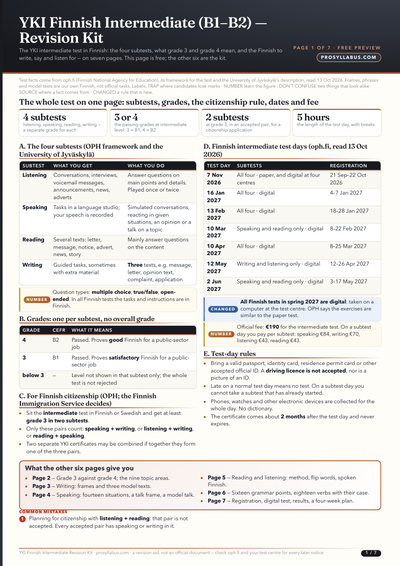
The YKI Finnish Intermediate revision kit is a seven-page PDF in English with the Finnish you need: the four subtests, grade 3 against grade 4, frames and three model texts for writing, fourteen speaking situations and a model talk, a method for reading and listening, sixteen grammar points and eighteen verbs with the case each one takes. Its test facts come from oph.fi; its model texts are our own, never official tasks. Page 1 is free to read in full before you decide.
When you are ready to book, the fee, the test days and the registration rules are in YKI test fee 2026, dates and whether a course is worth it.
Frequently asked questions
Is there an official YKI practice test for the intermediate level?
OPH links to demonstration pages run with the University of Jyväskylä that show example task types for each subtest. OPH says they are examples and not the official test questions. There is no official textbook.
Where can I practise for the YKI test for free?
OPH’s Finnish page “Ennen YKI-testiä” links the University of Jyväskylä’s demonstration pages and subtest descriptions, Yle’s Ykitreenit and the Helsinki adult education centre’s instructions and exercises. All are free; none is an official test.
Is Yle’s Ykitreenit an official YKI test?
No. It is practice material from Yle that OPH links. Yle’s 2024 package has reading and listening tasks on nine topics at level B1.
Are there YKI past papers?
We found none on the OPH pages we read on 14 October 2026. The demonstration pages show sample tasks and say they are a presentation, not the actual test.
How many questions are there in the YKI reading subtest?
The official pages we read on 13 October 2026 do not say. The framework says only that each sitting has several texts of different lengths. We therefore give no number.
How long is each YKI subtest?
OPH publishes the length of the day, 5 hours with breaks for the intermediate test, but not the minutes for each subtest on the pages we read. Your test centre sends the start time before the test day.
Are the practice tasks on this page real YKI tasks?
No. Every text, question and model answer here is our own, written in the style the official framework describes. No grade is promised for any model answer.
In which language are the instructions in the Finnish YKI test?
In Finnish. OPH says that in all Finnish language tests the tasks and instructions are in Finnish.
How many times do you hear a listening task?
The framework says tasks are heard once or twice. The University of Jyväskylä says they are usually heard twice. Practise answering as much as you can on the first hearing.
How many texts do you write in the YKI writing subtest?
Three texts of different types, according to the framework, for example a message, a letter, an opinion text, a complaint or an application.
Can I convert my practice score into a YKI grade?
No. Reading and listening points are converted into a grade by the test organisers, and that conversion is not published. Speaking and writing are compared with level criteria by trained assessors.
Can I use a dictionary in the YKI test?
No. OPH says you are not allowed to use a dictionary or study materials, and phones, watches and other electronic devices are collected for the whole day.
Is the Finnish YKI test on a computer?
On 7 November 2026 it is digital at four pilot centres and on paper elsewhere. OPH says all Finnish language tests in spring 2027 will be taken digitally, on a computer at the test centre.
Which subtests matter most for citizenship?
Speaking and writing. The three accepted pairs are speaking and writing, listening and writing, and reading and speaking, so every pair contains one of those two.
More in this series
- Fee, test days, registration and whether a course is worth it (cost planner)
- YKI for Finnish citizenship: grade 3 and the three accepted subtest pairs (checker)
- Levels 3 and 4: what each grade on the certificate means (level reader)
- Speaking and writing: five example tasks with grade 3 and grade 4 style model answers
- A 4-week YKI preparation plan built on the four subtests (plan builder)
- Reading and listening: strategies and practice sets with 16 questions (grader)
- YKI test in English: the whole test in one overview (timeline tool)
- Why people miss level 3: level 2 against level 3 in the official criteria (self-check)
- Writing: two messages, a complaint and an opinion text with model texts (checklist tool)
- YKI results: when they come, how to read them, re-marking and retakes (in Finnish, results timeline tool)
- YKI Finnish intermediate notice board — official updates
Sources
- official — Opetushallitus — Ennen YKI-testiä: test day, what is not allowed, links for practising (in Finnish, read 14 October 2026)
- official — Opetushallitus — Sopivan YKI-testin valinta ja testipäivät (in Finnish, read 14 October 2026)
- official — OPH — Selecting the right YKI test, the test days (levels, subtests, test days and registration periods for autumn 2026 and spring 2027)
- official — OPH — Before the YKI test: the test day, ID, what is not allowed, cancelling, tips for practising
- official — OPH — After the YKI test (results, certificate, assessment, reassessment and its statistics)
- official — OPH — Proving your language skills for the Finnish citizenship application
- official — OPH — Yleisten kielitutkintojen perusteet 2011 (the framework: subtests, assessment, level descriptions, topic areas, language functions; in Finnish, attached on oph.fi)
- official — University of Jyväskylä, Centre for Applied Language Studies — Yleiset kielitutkinnot (description of the subtests and levels, in Finnish)
- official — University of Jyväskylä — YKI demonstration pages (examples of task types, not official test questions)
- official — University of Jyväskylä — Yleisten kielitutkintojen esittelysivut, the address OPH links (it points to the current demonstration site; in Finnish, read 14 October 2026)
- official — Yle — YKItreenit: tavoitteena yleinen kielitutkinto suomen kielessä (the page OPH links; updated 2 May 2024, read 14 October 2026)
- official — Yle — YKI-testi tulossa? Harjoittele B1-suomea hauskalla tavalla (26 April 2024, read 14 October 2026)
- official — Yle — Suomen kielen YKItreenit, harjoitustehtäviä: keskitaso (read 14 October 2026)
- official — Helsingin aikuisopisto — Ohjeita ja harjoituksia suomen kielen YKIin (the page OPH links; read 14 October 2026)
- official — OPH news — Digital YKI tests will be piloted in November 2026
official = a document published by the conducting body. reported = a news or coaching site we could not check against an original. Where sources disagree this page says so rather than picking one.