Checked 13 October 2026. The format, timings and criteria are from HK-dir’s candidate pages and its assessment form for the oral test (revised 26 September 2023), all read on 13 October 2026. The practice tasks and model answers are ours and the levels beside them are our estimates. HK-dir can change tasks, timings and the form; the test length is printed two ways in two official texts and both are shown.
People who search for norskprøve B1 muntlig mostly want one thing: to hear what a B1 answer sounds like next to an answer that stops at A2. HK-dir, the directorate that makes the test, publishes the tasks, the timings and the form the sensor fills in, and this page starts from those. It then does what the official pages do not: it puts an A2-style answer and a B1-style answer to the same task side by side, in Norwegian with an English translation, and names what separates them using the form’s own words. B1 in the oral test is the level statsborgerloven § 8 asks of applicants for Norwegian citizenship between 18 and 67, which is why this guide sits in a cluster about statsborgerprøven.
One thing must be clear before you read a single model answer. The tasks and answers below are ours. They follow the official task format but they are not official example tasks, and the levels printed beside them are our estimates against HK-dir’s published descriptors. HK-dir’s own example tasks are free PDFs on its page Øv til muntlig prøve: do those as well. And do not learn any answer by heart. The form’s explanation tells examiners to ask follow-up questions when an answer “bærer preg av å kunne være innlært på forhånd”, shows signs of having been learnt in advance [official].
Official: HK-dir, Om muntlig prøve; the oral assessment form; reglement 2026 point 3.1. Read 13 October 2026.
Norskprøve B1 muntlig: the three tasks of the A2–B1 test
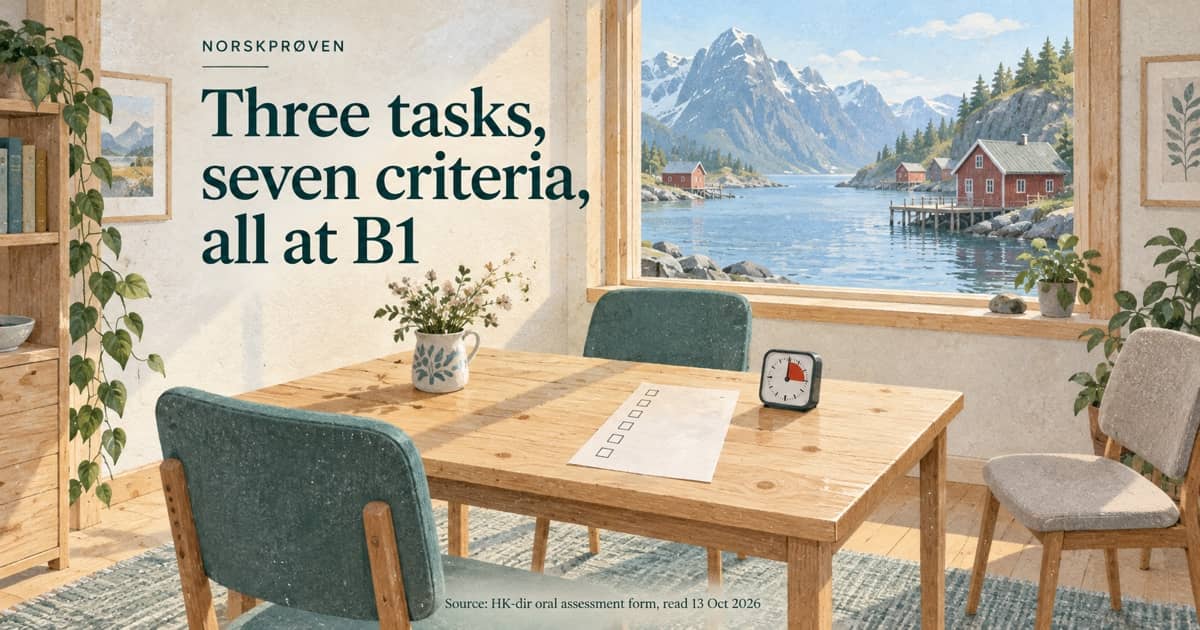
You do not register for “B1”. You register for one of three oral tests: A1–A2, A2–B1 or B1–B2. The A2–B1 test is the one built to separate A2 from B1, and it has three tasks. The table is HK-dir’s description; the last column is the heading the assessment form gives each task.
| Task | Who speaks | What HK-dir says you get | Time (HK-dir) | What the form measures |
|---|---|---|---|---|
| Oppgave A: Fortelle om et tema | You alone | A question from the examiner about a topic from daily life, for example school, leisure, work, family, food or weather. Follow-up questions may come. | About 2–3 minutes | Fortelle/beskrive (tell, describe) |
| Oppgave B: Snakke sammen om et tema | You and the other candidate | A question or an issue to talk about together. Follow-up questions may come. | About 5–7 minutes together | Utveksle informasjon/synspunkter (exchange information and views) |
| Oppgave C: Si din mening om et tema og begrunne meningen din | You alone | A question or an issue; you say what you think and give reasons. Follow-up questions may come. | About 2–3 minutes | Uttrykke/grunngi synspunkter (express views and give reasons) |
Add the timings up and the tasks themselves fill 13 to 19 minutes for two candidates: two turns at task A, one shared task B and two turns at task C (our arithmetic from HK-dir’s per-task figures). The rest is instructions and changeovers. On total length the official texts disagree. HK-dir’s candidate page says “Den muntlige prøven varer omtrent 20–25 minutter”, and its page for test centres, updated on 7 October 2026, says the same. The 2026 test regulations, point 3.1, say “Den muntlige prøven tar 25 til 30 minutter å gjennomføre”. We print both and do not choose; plan for half an hour in the room.
Who is there: the other candidate, an eksaminator who works at the test centre and asks the questions, and a sensor who listens and sets the result. HK-dir: “Eksaminator er også med og vurderer, men sensor er den som avgjør resultatet” [official]. The test measures only how well you speak Norwegian, “og ikke hva du kan om temaene i prøven”: your opinions and your knowledge are not marked.
Registered for A2–B1, placed anywhere
In the oral test the level you register for is not a ceiling. HK-dir: “På den muntlige prøven kan du få et lavere resultat enn det nivået du har meldt deg opp til. Du kan også få høyere resultat.” If the sensor thinks you can manage a higher level than the test you registered for, you can be given an extra question from the level above [official]. That is the opposite of the writing test, where you can never be placed above the level you registered for; our companion guide on norskprøve skriftlig A2–B1 with marked sample texts covers that part.
How the sensor decides: seven crosses, all at B1
The sensor fills in a one-page form for the A2–B1 test. It has three task rows (formidlingskriterier: did you do what the task asked, understandably) and four language rows judged across the whole test: flyt, uttale, ordforråd, grammatikk. Each row is crossed under A2, at A2 or at B1. The line at the foot of the form is the rule that matters most: “For å plasseres på et nivå må kandidaten være på det nivået på alle kriteriene.” To be placed at a level the candidate must be at that level on all the criteria. HK-dir’s explanation spells out the consequence: there will be cases where a candidate is at B1 on every criterion but one and is therefore placed at A2 [official].
| Criterion | A2 on the form (our translation) | B1 on the form (our translation) |
|---|---|---|
| Task A (tell) | Answers the task in a simple and mostly understandable way. May need support from the examiner. | Answers the task in an easily understandable way. |
| Task B (conversation) | Takes part in a conversation in a simple way and is mostly understood. May need support to keep the conversation going. | Takes part in a conversation in an independent and understandable way. |
| Task C (opinion) | Expresses views in a very simple way. May need support from the examiner. | Expresses views and gives some reasons for them in an understandable way. Speaks independently. |
| Flyt (fluency) | Produces some connected speech, but takes many pauses to look for words and phrasings. | Speaks reasonably coherently. Manages to keep the speech going despite hesitation and noticeable searching for words and correct forms. |
| Uttale (pronunciation) | Mostly understandable to a sympathetic listener, despite strong influence from other languages. | In the main understandable. The candidate may still have systematic pronunciation errors, and stress may be strongly influenced by other languages. |
| Ordforråd (vocabulary) | Enough vocabulary to speak about everyday subjects; uses a number of everyday words and expressions correctly. Still makes many wrong word choices. | A fairly broad vocabulary. Masters well a simple repertoire of words and expressions tied to familiar subjects. May choose words that lead to misunderstandings, especially when the subject is unfamiliar or abstract. |
| Grammatikk (grammar) | Shows a number of examples of correct use of basic grammatical structures. Makes many errors, including quite elementary ones. | A fairly good grip on basic grammatical structures. Shows some examples of complex sentences. Makes a number of errors, and some may lead to misunderstandings, especially in complex structures. |
Read the B1 column again and notice how much error it allows. B1 does not mean correct Norwegian. HK-dir’s explanation says the test measures communicative competence: “vi først og fremst er interessert i om kandidatene klarer å uttrykke det de skal på de ulike oppgavene, og ikke om alt de sier er korrekt”. It also tells sensors that spoken language is full of restarts and reformulations even among people who master the language very well, and that they must not expect candidates to speak more correctly or more bookishly than everyone else who speaks Norwegian [official]. All seven rows have to reach B1. In the three task rows and the fluency row, the difference from A2 shows in a few plain words: Task A’s line asks for an answer that is “lett forståelig” (easy to understand) where the A2 line says “enkel og stort sett forståelig” and allows examiner support; Task B’s line has selvstendig (on your own); Task C’s line has gir noen grunner (gives some reasons) and “snakker selvstendig”; and the fluency line has rimelig sammenhengende (reasonably connected). Pronunciation, vocabulary and grammar still have to meet their own B1 lines.
What the form’s explanation adds, in HK-dir’s own terms
- Task C is the one “laget for å måle på B1-nivå”. To be judged B1 on it you must give some reasons for a view tied to what the task asks. Because giving reasons is not part of A2, expressing views in a very simple way is enough for A2.
- Going a little off the topic is tolerated. “Det viktigste er at kandidaten får brukt språkfunksjonene oppgaven spør etter.” An answer wholly beside the task, or one that sounds learnt, brings follow-up questions.
- Words from other languages count against you when a listener who knows only Norwegian could not follow. The explanation’s own examples: “traffic” would probably be understood; “chair” for stol is treated as a word error like any other.
- There is no standard pronunciation of Norwegian, and the same acceptance of variation applies to pronunciation coloured by other languages, as long as it is understandable enough for the level.
- Personality and cultural background are not assessed. Sensors are told to have a high tolerance for different ways of speaking and of solving the tasks.
All five points are from “Forklaring til kriteriene” in HK-dir’s oral assessment form (revised 2023), read 13 October 2026.
Task A, fortelle om et tema: one task, two answers
Practice task A (ours)
Fortell om en vanlig helg. Hva pleier du å gjøre, og hvem er du sammen med?
In English: Tell us about an ordinary weekend. What do you usually do, and who are you with?
Ours, not official: written by us in the official task format. It is not an official example task and not a real candidate’s answer.
Model answer 1 of 2
A2-style answer (our estimate). Six errors are left in on purpose.
I helgen jeg sover lenge. Jeg står opp klokka ti. Jeg spiser frokost med familien min. Etterpå vi går i butikken og handler mat. På lørdag jeg lager middag. Jeg liker lage mat fra hjemlandet mitt. På søndag vi går tur hvis det er fint vær. Om kvelden jeg ser på tv. Det er en fin helg.
English translation
At the weekend I sleep late. I get up at ten. I eat breakfast with my family. Afterwards we go to the shop and buy food. On Saturday I make dinner. I like making food from my home country. On Sunday we go for a walk if the weather is fine. In the evening I watch television. It is a nice weekend.
Ours, not official: written by us in the official task format. It is not an official example task and not a real candidate’s answer.
Model answer 2 of 2
B1-style answer (our estimate)
En vanlig helg hos meg er ganske rolig. På lørdag pleier jeg å sove litt lenger enn vanlig fordi jeg står tidlig opp hele uka. Etter frokost handler vi mat for hele uka, og det tar ofte lang tid siden butikken er full av folk på lørdager. Om ettermiddagen lager jeg gjerne en rett fra hjemlandet mitt. Jeg synes det er hyggelig å lage mat når jeg har god tid. På søndag går vi ofte tur i skogen hvis været er bra. Hvis det regner, blir vi hjemme og ser en film sammen. Forrige helg var litt annerledes, for da fikk vi besøk av noen venner som vi ikke hadde sett på lenge. Jeg liker helgene godt, men jeg skulle ønske at de var litt lengre.
English translation
An ordinary weekend for me is fairly quiet. On Saturday I usually sleep a little longer than normal, because I get up early all week. After breakfast we buy food for the whole week, and it often takes a long time, since the shop is full of people on Saturdays. In the afternoon I like to make a dish from my home country. I think it is pleasant to cook when I have plenty of time. On Sunday we often go for a walk in the forest if the weather is good. If it rains, we stay at home and watch a film together. Last weekend was a little different, because we had a visit from some friends we had not seen for a long time. I like the weekends a lot, but I wish they were a little longer.
Ours, not official: written by us in the official task format. It is not an official example task and not a real candidate’s answer.
| Line of the form | In the A2-style answer | In the B1-style answer |
|---|---|---|
| Task A | Does answer the question, in a list of short statements. An examiner would probably have to ask “Hva mer?” to keep it going. | Answers both halves of the question and carries on unprompted for well over a minute. |
| Flyt | Nine separate sentences; nothing joins one to the next except “etterpå”. | Sentences are tied with fordi, siden, når, hvis, for, men: connected speech. |
| Ordforråd | Everyday words used correctly: frokost, butikken, handler, tur. | A wider everyday range: pleier å, en rett, hyggelig, annerledes, fikk besøk, skulle ønske. |
| Grammatikk | Basic patterns, with the verb in the wrong place after every opening time phrase. An elementary error, repeated. | Verb second after “På lørdag”, “Etter frokost”, “Hvis det regner”; past tense and past perfect in the last part; a relative clause with “som”. |
The errors left in the A2-style answer, with the correct form. All but one are the same mistake: in a Norwegian main clause the verb comes second, so when a sentence opens with a time phrase the subject moves behind the verb.
| In the A2-style answer | Correct | Rule |
|---|---|---|
| I helgen jeg sover lenge. | I helgen sover jeg lenge. | Verb second after an opening time phrase |
| Etterpå vi går i butikken | Etterpå går vi i butikken | Verb second |
| På lørdag jeg lager middag. | På lørdag lager jeg middag. | Verb second |
| Jeg liker lage mat | Jeg liker å lage mat | Infinitive marker å after liker |
| På søndag vi går tur | På søndag går vi tur | Verb second |
| Om kvelden jeg ser på tv. | Om kvelden ser jeg på tv. | Verb second |
Task B, snakke sammen om et tema: the conversation
Task B is the only one you do with the other candidate, and it is the longest: about five to seven minutes together. The form’s B1 line is “Tar del i en samtale på en selvstendig og forståelig måte”. HK-dir’s explanation says the conversation task measures interaction: responding to what the other candidate says, asking for clarification, asking and answering questions, agreeing and disagreeing [official]. HK-dir says you usually take the test together with another candidate (a pareksamen), and each candidate is placed on his or her own form; what you control is whether you ask, answer and build on what was said.
Practice task B (ours)
Dere skal snakke sammen. Er det best å bo i en by eller på et lite sted? Hva er bra, og hva er vanskelig?
In English: You are going to talk together. Is it best to live in a town or in a small place? What is good, and what is difficult?
Ours, not official: written by us in the official task format. It is not an official example task and not a real candidate’s answer.
Model exchange 1 of 2
A2-style exchange (our estimate). One error is left in on purpose.
Kandidat 1: Jeg bor i en by. Jeg liker byen. Det er mange butikker.
Kandidat 2: Jeg bor på et lite sted. Det er stille der. Liker du byen?
Kandidat 1: Ja. Bussen går ofte. Men det er dyrt.
Kandidat 2: Ja, dyrt. På et lite sted det er billige hus.
Kandidat 1: Har du jobb der?
Kandidat 2: Nei, ikke nå. Det er vanskelig å finne jobb.
English translation
Candidate 1: I live in a town. I like the town. There are many shops.
Candidate 2: I live in a small place. It is quiet there. Do you like the town?
Candidate 1: Yes. The bus goes often. But it is expensive.
Candidate 2: Yes, expensive. In a small place there are cheap houses.
Candidate 1: Do you have a job there?
Candidate 2: No, not now. It is hard to find a job.
Ours, not official. The error: “På et lite sted det er billige hus” should be “På et lite sted er det billige hus” (verb second).
Model exchange 2 of 2
B1-style exchange (our estimate)
Kandidat 1: Jeg synes det er best å bo i en by fordi det er lettere å finne jobb der. Hva mener du?
Kandidat 2: Jeg er delvis enig. Det er flere jobber i byen, men det er også mye dyrere å bo der. Jeg bor på et lite sted, og der har vi råd til et større hus.
Kandidat 1: Det er et godt poeng. Men hva gjør du hvis du ikke har bil? Der jeg bor, går bussen hvert tiende minutt.
Kandidat 2: Det er riktig at man trenger bil hos oss. Til gjengjeld er det trygt for barna, og alle kjenner hverandre.
Kandidat 1: Ja, det forstår jeg. Kanskje det beste er å bo litt utenfor byen slik at man får begge deler?
Kandidat 2: Det kunne jeg tenke meg. Da har man kort vei til jobben og likevel litt ro.
English translation
Candidate 1: I think it is best to live in a town, because it is easier to find a job there. What do you think?
Candidate 2: I partly agree. There are more jobs in town, but it is also much more expensive to live there. I live in a small place, and there we can afford a bigger house.
Candidate 1: That is a good point. But what do you do if you have no car? Where I live, the bus goes every ten minutes.
Candidate 2: It is true that you need a car where we live. On the other hand it is safe for the children, and everyone knows each other.
Candidate 1: Yes, I understand that. Perhaps the best thing is to live a little outside the town, so that you get both?
Candidate 2: I could imagine that. Then you have a short way to work and still some quiet.
Ours, not official: written by us in the official task format. It is not an official example task and not a real candidate’s answer.
| What to listen for | A2-style exchange | B1-style exchange |
|---|---|---|
| Who keeps it going | Short statements and two direct questions. The form’s A2 line: may need support to keep the conversation going. | Each turn ends by handing over (“Hva mener du?”) or picks up the last thing said (“Det er et godt poeng. Men …”). No help needed: selvstendig. |
| Responding | “Ja, dyrt” repeats a word. | “Jeg er delvis enig”, “Det er riktig at …”, “Til gjengjeld …”: agrees in part, then adds. |
| Reasons | Facts side by side, no reasons. | Every view has a reason: fordi, men, slik at. |
| Length of turns | About 5 to 10 words a turn in our text. | About 20 to 30 words a turn in our text. HK-dir gives about five to seven minutes for the task; short turns run out long before that (our observation, not an official measure). |
Phrases that do the work in task B
- Hva mener du om det? (What do you think about that?)
- Jeg er enig med deg, men … (I agree with you, but …)
- Jeg er ikke helt enig, fordi … (I do not quite agree, because …)
- Kan du forklare hva du mener med …? (Can you explain what you mean by …?)
- Det har jeg ikke tenkt på. (I had not thought of that.)
- Hvordan er det der du bor? (What is it like where you live?)
These are ordinary Norwegian, not a script. Use them to react to what your partner actually says; a memorised speech delivered at your partner is the opposite of what the task measures.
Task C, si din mening og begrunne den: where B1 is decided
Task C is the task HK-dir says is “laget for å måle på B1-nivå”. The explanation is exact about the line: to be judged B1 in formidling here, the candidate “må … gi noen grunner for et synspunkt knyttet til det oppgaven spør om, på en forståelig måte”; and “ettersom det å begrunne ikke er en del av det man skal kunne på A2, er det tilstrekkelig å uttrykke synspunkter på en helt enkel måte for å kunne bli vurdert til A2” [official]. A view with no reason is an A2 answer however correct its grammar.
Practice task C (ours)
Bør barn ha mobiltelefon på skolen? Hva mener du? Begrunn svaret ditt.
In English: Should children have a mobile phone at school? What do you think? Give reasons for your answer.
Ours, not official: written by us in the official task format. It is not an official example task and not a real candidate’s answer.
Model answer 1 of 2
A2-style answer (our estimate). One error is left in on purpose.
Jeg mener barn ikke skal ha mobil på skolen. Mobil er ikke bra. Barna ser på mobilen hele tiden. De snakker ikke sammen. Læreren blir sint. Hjemme de kan bruke mobil. Det er min mening.
English translation
I think children should not have a mobile at school. Mobiles are not good. The children look at the mobile all the time. They do not talk together. The teacher gets angry. At home they can use a mobile. That is my opinion.
Ours, not official. The error: “Hjemme de kan bruke mobil” should be “Hjemme kan de bruke mobil” (verb second).
Model answer 2 of 2
B1-style answer (our estimate)
Jeg mener at barn ikke bør bruke mobiltelefon i timene, og det har jeg to grunner til. For det første blir det vanskelig å konsentrere seg når telefonen ligger på pulten fordi det hele tiden kommer nye meldinger. For det andre snakker barna mindre med hverandre i friminuttene hvis alle sitter med hver sin skjerm. Samtidig forstår jeg at mange foreldre vil kunne ringe barna sine. Derfor synes jeg at telefonen kan ligge i sekken og være slått av i skoletiden. Da kan barna bruke den på vei hjem, men ikke mens de skal lære.
English translation
I think children should not use a mobile phone in lessons, and I have two reasons for that. First, it becomes hard to concentrate when the phone is lying on the desk, because new messages keep coming. Second, the children talk less with each other in the breaks if everyone is sitting with their own screen. At the same time I understand that many parents want to be able to ring their children. That is why I think the phone can lie in the school bag and be switched off during school hours. Then the children can use it on the way home, but not while they are supposed to be learning.
Ours, not official: written by us in the official task format. It is not an official example task and not a real candidate’s answer.
| Line of the form | In the A2-style answer | In the B1-style answer |
|---|---|---|
| Task C | A view, stated twice. The sentences after it are observations, and the listener has to work out that they are meant as reasons. | A view, two reasons announced and given (“For det første … fordi”, “For det andre … hvis”), a concession and a proposal. |
| Independence | About 20 seconds of speech. The examiner would have to ask “Hvorfor?”. | Close to a minute before any follow-up, and the follow-up has something to follow up. |
| Grammatikk | Main clauses, with one attempt at a subordinate clause (“Jeg mener barn ikke skal …”, without at). | Subordinate clauses with at, når, fordi, hvis, mens: “noen eksempler på komplekse setninger”. |
Follow-up questions come after tasks A and C, and they are where a learnt answer falls apart. Practise answering these aloud after each of your own answers (they are ours, written in the style the task descriptions imply): Kan du si litt mer om det? (Can you say a little more about that?) Hvorfor mener du det? (Why do you think that?) Var det annerledes i landet du kommer fra? (Was it different in the country you come from?) Hva ville du gjort hvis du kunne bestemme? (What would you do if you could decide?)
Practise it: timer and self-check
Norskprøve B1 muntlig: practice timer and self-check
Pick a task, press start and speak aloud (record yourself on your phone). Stop when you have nothing more to say. The timer tells you whether you filled the time HK-dir gives for that task. Then listen to the recording and tick what was true.
0:00
The times are HK-dir’s for the A2–B1 test. The seven lines are our plain-English version of the B1 column of HK-dir’s assessment form; ticking them is a habit for practice, not a result. Nothing is recorded or sent by this page.
The same self-check as a table, for readers on a page where the tool does not run. Our wording of the B1 column; the official wording is in the criteria table above.
| # | Line of the form | Ask yourself after listening to your recording |
|---|---|---|
| 1 | Task A | I answered what the task asked in a way that was easy to follow. |
| 2 | Task B | I took part in the conversation myself (“selvstendig”), asking and answering, and was understood. |
| 3 | Task C | I gave my view and reasons for it, speaking on my own. (The form says “noen grunner”, some reasons; two is our practice target.) |
| 4 | Flyt (fluency) | I spoke reasonably coherently and kept going even when I had to search for a word. |
| 5 | Uttale (pronunciation) | A listener could understand what I said in the main. |
| 6 | Ordforråd (vocabulary) | I had a fairly broad vocabulary for familiar topics; a wrong word choice now and then is allowed at B1, more so when the topic is unfamiliar or abstract. |
| 7 | Grammatikk (grammar) | My basic sentences mostly held, and I tried a few longer ones (fordi, hvis, som, at). |
A two-week routine that follows the form
- Days 1–3: task A. One daily-life question a day, recorded twice. The second time, add one reason and one sentence about the past.
- Days 4–6: task C. One question a day. Say your view in the first sentence, give reasons (two is our target; the form says “noen grunner”) with “for det første” and “for det andre”, then one thing the other side would say.
- Days 7–9: task B with another person, in Norwegian only, seven minutes on a clock. If nobody is available, write both parts and read them aloud, but answer the second part without looking.
- Days 10–12: HK-dir’s own example tasks for A2–B1, timed, with a follow-up question after each.
- Days 13–14: one full run in order A, B, C. Tick the seven lines. Work only on the lines you could not tick.
The routine is ours. HK-dir’s advice on its practice page is shorter: practise speaking Norwegian with others, and train on the example tasks.
Registering, the result and what you cannot appeal
| Item | What the official text says | Source |
|---|---|---|
| Which test to register for | A1–A2, A2–B1 or B1–B2. An oral result can be higher or lower than the level registered for. | HK-dir, Om muntlig prøve |
| Choosing the level | Ask your teacher if you attend a course; otherwise HK-dir points to its Nivåvelgeren and a self-assessment form. | HK-dir, Om muntlig prøve |
| Result | The FAQ says about three weeks, and that all results come at the same time. Each test period has its own published result date. | HK-dir, FAQ; Når er prøven? |
| Seeing the form | You have a right to see your assessment form after the result. The test centre keeps it for one year and can give you a copy. | HK-dir, Om muntlig prøve |
| Appeal | On the oral part you can complain only about formal errors in how the test was run that may have affected the result, within three weeks of the test. The level itself cannot be appealed. | Integreringsforskriften § 42 |
| Taking it again | You can retake one or more parts; the latest and best result stands on the certificate. Not the same part twice in one test period. | HK-dir, FAQ; Meld deg på |
| Dialect | Allowed in the oral test. | HK-dir, FAQ |
The dates of the next test periods, the five-day registration window, the fee range and the rule that norskprøven cannot be taken abroad are in Norwegian citizenship requirements: language level and test, and are not repeated here. Which oral level a citizenship application needs, and which older tests UDI still accepts, is in norskprøve for statsborgerskap: which level counts. If you need B2 rather than B1, the B1–B2 test has a different third task; see norskprøve B2: who needs it and how it is assessed.
B1 in the oral test is half of statsborgerloven § 8. The other half is statsborgerprøven, a knowledge test in Norwegian at level A2 that you can start reading for today; the difference between it and samfunnskunnskapsprøven is set out in statsborgerprøven vs samfunnskunnskapsprøven.
Practise it, don't just read it
The other test in § 8 is one you can practise with questions today.
One practice quiz is live on the exam page: 12 questions in Norwegian on Demokratiet i Norge, three options each, with the reason for every answer in English. None of its questions is repeated in this article.
The whole curriculum on seven pages
Preparing for the oral test and statsborgerprøven in the same months? The curriculum reading is the part you can shorten.
The Statsborgerprøven Revision Kit is a seven-page PDF in English, built on the same lessons of samfunnskunnskap.no (57 by our count), with the Norwegian word you will meet in the test printed beside each fact, a Norwegian–English word list, a list of traps and a 20-question self-test. Page 1 is free to read in full. It is a revision aid, not an official document, and it does not replace the lessons.
Frequently asked questions
How many tasks are there in norskprøve muntlig at A2–B1?
Three: telling about a topic alone, talking together with the other candidate about a topic, and giving your opinion with reasons alone. The A1–A2 test has four tasks.
How long does the oral norskprøve take?
HK-dir’s candidate page and its page for test centres say about 20 to 25 minutes. The 2026 test regulations say 25 to 30 minutes. Both are official texts; allow half an hour.
Can I get B1 if I register for A1–A2?
HK-dir says an oral result can be higher than the level you registered for, and that the sensor can give an extra question from the level above. The A2–B1 test is the one whose tasks are built to show B1, so it is the natural choice if B1 is your aim.
Do I need correct grammar to get B1?
No. The B1 line of the form expects a fairly good grip on basic structures and says the candidate makes a number of errors. The explanation says the test is first of all interested in whether candidates manage to express what the tasks ask.
What happens if I am B1 on six criteria and A2 on one?
The form says a candidate must be at the level on all criteria to be placed there, and HK-dir’s explanation gives exactly this case: such a candidate is placed at A2.
Are the model answers on this page official?
No. The tasks and answers are ours, written in the official format, and the levels are our estimates against the published descriptors. HK-dir’s own example tasks are on its page Øv til muntlig prøve.
Can I memorise an answer?
It will not help. Examiners are told to ask follow-up questions when an answer seems learnt in advance, and the form’s explanation gives the aim that nobody should be able to get by on a memorised answer about any topic.
Who decides my result?
The sensor at the test centre. The examiner, who asks the questions, also takes part in the assessment, but HK-dir says the sensor decides.
Can I appeal my oral result?
Not the level. Under integreringsforskriften § 42 you can complain only about formal errors in how the oral test was carried out, within three weeks of the test.
Will my opinions affect the result?
No. HK-dir says the test measures only how well you speak Norwegian, not what you know about the topics, and the form’s explanation says opinions and knowledge are not assessed.
Is B1 oral enough for Norwegian citizenship?
For applicants between 18 and 67, statsborgerloven § 8 asks for at least B1 in an oral Norwegian test and a passed statsborgerprøve. Other conditions apply too.
More in this series
- Statsborgerprøven or samfunnskunnskapsprøven: which one you take
- Norwegian citizenship requirements 2026: language level and test (checklist)
- Statsborgerprøven pass mark, pass rate and why people fail (10-question mini test)
- Statsborgerprøven pensum: all 13 topics and 57 lessons, with a tracker
- Norwegian citizenship test in English: what is allowed, plus 15 practice questions
- Norskprøve skriftlig A2–B1: sample texts with marking, word counter and checklist
- Norskprøve B2: who needs it (studies, authorisation, citizenship) and how it is assessed
- Statsborgerprøven øve: a seven-day revision plan with 10 new practice questions
- Norskprøve for statsborgerskap: the oral level that counts and the tests UDI accepts
Sources
- official — HK-dir — Norskprøve A1–B2: Om muntlig prøve (levels, the tasks at each level, length, who sets the result), read 13 Oct 2026
- official — HK-dir — Norskprøve A1–B2: Øv til muntlig prøve (links to the official example tasks), read 13 Oct 2026
- official — HK-dir — Vurderingsskjema for norskprøven, delprøve i muntlig kommunikasjon, with “Forklaring til kriteriene” (bokmål, revised 26.09.23; PDF downloaded 13 Oct 2026)
- official — HK-dir — Reglement for gjennomføring av prøver i norsk og samfunnskunnskap 2026, chapter 3 (information about the tests)
- official — HK-dir — Innhold i prøvene (page for test centres, last updated 7 Oct 2026)
- official — HK-dir — Norskprøve A1–B2: Les om prøven (four parts, who marks them)
- official — HK-dir — Norskprøve A1–B2: Meld deg på (fee, who can sit it, not abroad)
- official — HK-dir — Ofte stilte spørsmål om norskprøven
- official — Integreringsforskriften, §§ 23, 26, 28, 34, 41 and 42 (lovdata.no, last amended from 1 July 2026; read 13 Oct 2026)
- official — Lov om norsk statsborgerskap (statsborgerloven), §§ 7, 8 and 10–16 a (lovdata.no, read 13 Oct 2026)
official = a document published by the conducting body. reported = a news or coaching site we could not check against an original. Where sources disagree this page says so rather than picking one.