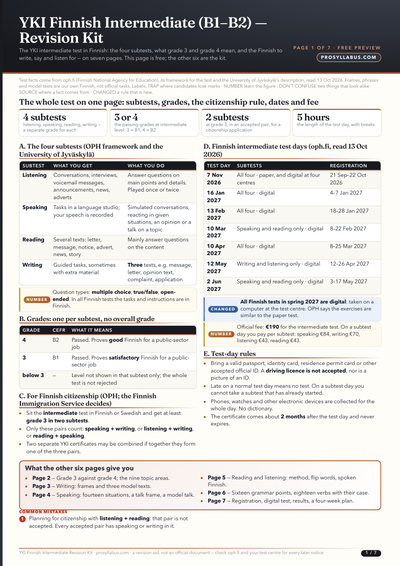

Checked 13 October 2026. Assessment criteria for speaking and writing are OPH’s two Finnish PDFs, and the quick facts and OPH wording on missed levels are from its Finnish pages, all read on 14 October 2026. Level descriptions are from the OPH framework “Yleisten kielitutkintojen perusteet 2011” and OPH’s English scale, both attached on oph.fi and read on 13 October 2026. The descriptions have not changed with the digital test. English versions of the subtest descriptions are our translation.
YKI testi keskitaso: quick facts
| Fact | What the official page says | Source |
|---|---|---|
| Grades in the intermediate test | Each subtest gets 3 or 4 if it is passed, or “alle 3” (below 3) if it is not | oph.fi, YKI-testin jälkeen |
| CEFR equivalents | Grade 3 corresponds to CEFR B1, grade 4 to B2 | oph.fi, test days page |
| Grade only for the level taken | You receive a grade only for the level of the test you took | oph.fi, YKI-testin jälkeen |
| Published assessment criteria | Two criteria sheets, one for speaking and one for writing, attached to the page “YKI-testin jälkeen” | oph.fi, YKI-testin jälkeen |
| How speaking and writing are judged | Against criteria built on the level scale, not against other candidates; the performance is judged as a whole, not by one criterion | Framework 2011, section 7; OPH’s criteria sheets |
| How reading and listening are judged | In points, which are converted into a level; no conversion table is published on the pages we read | Framework 2011, section 7 |
Checked on 14 October 2026.
YKI testi tasot: six grades, three tests
The YKI test uses a six-point scale, and the scale is split across three tests. You choose the test level when you register, and “you will only receive a grade for the level of the test that you took” [official: oph.fi]. The intermediate test, keskitaso, can therefore give exactly three grades in each subtest you complete: 3, 4 or below 3 (a subtest not done, or done incompletely, is marked “cannot be assessed” instead). It cannot tell you that you are at 2, and it cannot give you a 5.
| YKI grade | Test that awards it | CEFR level it corresponds to | Result if you miss the level |
|---|---|---|---|
| 1 | Basic level (perustaso) | A1 | below 1 |
| 2 | Basic level (perustaso) | A2 | below 1 |
| 3 | Intermediate level (keskitaso) | B1 | below 3 |
| 4 | Intermediate level (keskitaso) | B2 | below 3 |
| 5 | Advanced level (ylin taso) | C1 | below 5 |
| 6 | Advanced level (ylin taso) | C2 | below 5 |
Official correspondences from oph.fi. The certificate states that the YKI scale is empirically linked to the scale of the Common European Framework of Reference.
The second thing to fix in your mind is that there is no overall grade. “You get a separate grade, i.e. a proficiency level assessment, for each subtest in the YKI test” [official]. The Finnish Immigration Service notes that the structure changed in 2012: certificates from 2002–2011 carried an assessment of the general level, and today’s do not [official: Migri, read live on 13 October 2026]. So nobody “passes YKI at level 3”. You hold a profile, such as listening 4, speaking 3, reading 4, writing below 3, and whoever asked for the certificate decides whether that profile is enough. ProSyllabus is an independent study site. We are not affiliated with, or endorsed by, the Finnish National Agency for Education (OPH), the University of Jyväskylä or the Finnish Immigration Service (Migri). Every rule here is quoted or summarised from their published pages; OPH decides everything about the test and Migri decides every citizenship application.
Official: oph.fi, “Selecting the right YKI test” and “After the YKI test”, read 13 October 2026.
Level 3 and level 4 in general: the official wording
OPH says the certificate contains the proficiency level descriptions; these are the two paragraphs for the intermediate grades. The English is OPH’s own, from the scale attached to its test-days page.
| Grade | OPH’s description |
|---|---|
| 3 (B1) | Understands longer stretches of speech and the central idea from many TV and radio programmes if the topic area is relatively familiar and the speech tempo is normal. Understands ordinary everyday texts but more demanding texts with unfamiliar subject matter may cause difficulties. Can cope in the most common speech situations and is able to write simple, coherent text on everyday topics, even though grammatical and lexical inaccuracies may occasionally hinder comprehension. |
| 4 (B2) | Understands normal tempo speech on general topics, but some details may not be understood. Fast spoken language and dialects, however, cause difficulties. Has no difficulty understanding texts dealing with general topics, although some nuances conveyed in the text may not be clear. Copes fairly well in a variety of both official and unofficial speech situations. Is able to write both private and semi-official texts and to express thoughts as a coherent whole. |
Read the two side by side and three shifts stand out. From familiar topics to general topics. From the most common situations to official and unofficial situations. From simple, coherent text to private and semi-official texts as a coherent whole. Grade 3 allows mistakes that “occasionally hinder comprehension”; the grade 4 paragraph no longer mentions them. The University of Jyväskylä’s version of the scale adds a line on accuracy to each: at 3, a good command of everyday vocabulary and the central structures of basic grammar; at 4, a good command of basic grammar and vocabulary, and a difference made between formal and informal language in speech and writing [official: JYU].
Level 3 vs level 4 in each subtest
Annex 1 of the framework describes each grade separately for each subtest. This is the text the assessors’ criteria are built on. The Finnish is the official wording; the English is our translation.
| Subtest | Grade | Official description (Finnish) | In English (our translation) |
|---|---|---|---|
| Listening | 3 | Ymmärtää pidempää yhtäjaksoista puhetta, jos aihepiiri on suhteellisen tuttu. Ymmärtää keskeisen ajatuksen puheesta, kuten monista televisio- ja radio-ohjelmista, jotka koskevat ajankohtaisia asioita ja joissa puhe on selkeää ja normaalitempoista. Normaalitempoinenkin puhe tuottaa kuitenkin välillä vaikeuksia, jos aihepiiri on vieras tai jos puhejakso on pitkä. | Understands longer continuous speech if the topic is fairly familiar. Understands the main idea of speech, such as many TV and radio programmes on current matters in which the speech is clear and at normal speed. Even normal-speed speech sometimes causes difficulty if the topic is unfamiliar or the stretch of speech is long. |
| Listening | 4 | Ymmärtää normaalitempoista puhetta yleisistä aihepiireistä eri tilanteissa, kuten keskusteltaessa kasvokkain tai kuunneltaessa radiota; vain yksityiskohtia saattaa jäädä ymmärtämättä. Abstraktit aiheet, nopea puhekieli ja murteellisuudet voivat vaikeuttaa ymmärtämistä. | Understands normal-speed speech on general topics in different situations, such as talking face to face or listening to the radio; only details may be missed. Abstract topics, fast colloquial speech and dialect features can make understanding harder. |
| Speaking | 3 | Selviää tavallisimmissa käytännön puhetilanteissa ja pystyy olemaan aloitteellinen jokapäiväisissä kielenkäyttötilanteissa. Puhe voi olla melko hidasta, mutta epäluontevia katkoja ei esiinny kovin paljon. Tulee ymmärretyksi kielellisistä ja/tai ääntämisestä johtuvista puutteistaan huolimatta. | Copes in the most common practical speaking situations and can take the initiative in everyday situations of language use. Speech may be fairly slow, but there are not very many unnatural breaks. Is understood despite shortcomings in language and/or pronunciation. |
| Speaking | 4 | Selviää melko hyvin sekä virallisissa että epävirallisissa puhetilanteissa ja pystyy puheessaan erottamaan jossakin määrin muodollisen ja epämuodollisen kielimuodon. Pystyy esittämään ja perustelemaan mielipiteensä ymmärrettävästi sekä kuvailemaan näkemäänsä, kuulemaansa ja kokemaansa. Joutuu vain harvoin käyttämään kiertoilmauksia arkielämän puhetilanteissa kielitaidon puutteellisuuden vuoksi. | Copes fairly well in both formal and informal speaking situations and can to some extent separate formal from informal language in speech. Can present and justify an opinion understandably and describe what he or she has seen, heard and experienced. Only rarely has to talk around a word in everyday speaking situations because of gaps in language skills. |
| Reading | 3 | Ymmärtää tavallisia jokapäiväisen elämän tekstejä, jotka eivät vaadi aiheen tuntemusta. Saa selvän yleisiä aihepiirejä käsittelevän laajahkonkin tekstin pääasioista, mutta vaativammista teksteistä voi jäädä osia ymmärtämättä ja vieraammat aihepiirit saattavat tuottaa vaikeuksia. | Understands ordinary texts of everyday life that do not require knowledge of the subject. Makes out the main points of even a fairly long text on a general topic, but parts of more demanding texts may not be understood and less familiar topics may cause difficulty. |
| Reading | 4 | Ymmärtää vaivatta yleisiä aihepiirejä käsitteleviä tekstejä. Ymmärtää teksteistä pääsisällön, havaitsee tekstissä mainittujen asioiden keskinäiset yhteydet ja pystyy tekemään tekstin perusteella johtopäätöksiä. Muutamat yksityiskohdat ja tekstin sävyt voivat jäädä epäselviksi. | Understands texts on general topics without effort. Understands the main content, notices how the things mentioned in the text relate to each other and can draw conclusions from the text. A few details and tones of the text may remain unclear. |
| Writing | 3 | Pystyy kirjoittamaan yksinkertaista, yhtenäistä tekstiä tavallisista aiheista. Teksti on sisällöltään pääosin ymmärrettävää, mutta jotkin epäselvät ilmaukset, epäjohdonmukaisuudet tai ei-kohdekielinen rakenteiden käyttö katkaisevat paikoin lukurytmin tai vaikeuttavat ymmärtämistä. | Can write simple, coherent text on ordinary topics. The content is mostly understandable, but some unclear expressions, inconsistencies or use of structures foreign to the language interrupt the reading in places or make understanding harder. |
| Writing | 4 | Pystyy kirjoittamaan sekä yksityisiä että puolivirallisia tekstejä ja esittämään ajatuksiaan yhtenäisenä kokonaisuutena. Pystyy ilmaisemaan näkökantansa suhteellisen laajasti sekä korostamaan esityksessään keskeisiä seikkoja. Tekee eron virallisen ja epävirallisen kielimuodon välillä, mutta epäluontevia ilmauksia saattaa esiintyä satunnaisesti. | Can write both private and semi-official texts and present thoughts as a coherent whole. Can express a point of view fairly broadly and emphasise the key points. Separates formal from informal language, though unnatural expressions may occur occasionally. |
What actually changes between 3 and 4
Our reading of the eight descriptions above, as differences you can practise. The left and middle columns paraphrase the framework; the right-hand column is our advice.
| What is described | At grade 3 | At grade 4 | How to move (our advice) |
|---|---|---|---|
| Topics you can handle | Fairly familiar, everyday | General topics; abstract ones still harder | Read and listen outside your own life: environment and society are topic areas too |
| Speed and length of speech | Clear, normal speed; long stretches cause trouble | Normal speed in different situations; only details missed | Listen to whole radio items without pausing, then write the main point and two details |
| Fluency in speaking | May be fairly slow, few unnatural breaks | Rarely needs to talk around a missing word | Record one-minute talks daily; learn the words you had to avoid |
| Opinion | Not mentioned | Presents and justifies an opinion understandably | Never state a view without koska and one example |
| Register | Not mentioned | Separates formal from informal language | Write each message twice: once with sinä, once with te |
| Reading depth | Main points of a fairly long text | Connections between the things mentioned; conclusions | After reading, say why something happened, not only what happened |
| Text as a whole | Simple and coherent; unclear spots break the flow | A coherent whole with the key points stressed | Plan paragraphs before writing; link them with toisaalta, siksi, lisäksi |
Model answers written in a grade 3 style and a grade 4 style for the same tasks, so that you can see these differences in real Finnish, are in YKI speaking and writing: example tasks with model answers.
Mitä tasot 3 ja 4 vaativat: OPH’s assessment criteria, subtest by subtest
The level descriptions above say what a grade means. For speaking and writing OPH also publishes the sheets the assessors work from: Puhumisen arviointikriteerit and Kirjoittamisen arviointikriteerit, attached to its Finnish page “YKI-testin jälkeen” [official: oph.fi]. Each sheet breaks a level into criteria such as fluency, flexibility and accuracy. Both open with the same warning, which is the most useful sentence on them: “Suorituksen arvio muotoutuu kokonaisuudesta, ei yhden yksittäisen kriteerin mukaan.” (The assessment of a performance is formed from the whole, not from any single criterion.)
Below are the level 3 and level 4 rows of both sheets. The Finnish is OPH’s wording, copied from the PDFs; where a cell is long we give its first sentences. The English is our plain gloss, not an official translation. OPH also attaches English versions of both sheets to its English “After the YKI test” page.
Speaking (puhuminen): level 3 and level 4 criteria
| Criterion | Level | OPH’s wording (Finnish) | Plain English (our gloss) |
|---|---|---|---|
| General criteria (Yleiskriteerit) | 3 | Selviää tavallisimmissa käytännön puhetilanteissa ja pystyy olemaan aloitteellinen jokapäiväisissä kielenkäyttötilanteissa. Puhe voi olla melko hidasta, mutta epäluontevia katkoja ei esiinny kovin paljon. | copes in the most common practical speaking situations and can take the initiative in everyday ones; speech may be fairly slow, but there are not many unnatural breaks |
| General criteria (Yleiskriteerit) | 4 | Selviää melko hyvin vieraammissakin viestintätilanteissa. Erottaa puheessaan muodollisen ja epämuodollisen kielimuodon ainakin jossain määrin. Pystyy esittämään ja perustelemaan mielipiteensä ymmärrettävästi. | copes fairly well even in less familiar situations, separates formal and informal language at least to some degree, and presents and justifies opinions understandably |
| Fluency (Sujuvuus) | 3 | Pystyy ilmaisemaan itseään ymmärrettävästi ja suhteellisen helposti ilman apua. Tauot, jotka johtuvat puheen muotoiluun liittyvistä ongelmista, ovat yleisiä etenkin pidemmissä yhtäjaksoisissa tuotoksissa. | gets the message across understandably and fairly easily without help; pauses while working out how to say something are common, especially in longer stretches |
| Fluency (Sujuvuus) | 4 | Puhuu suhteellisen sujuvasti. Pitkät tauot ovat harvinaisia vaikka epäröintiä voi esiintyä rakenteita ja ilmauksia etsiessä. | speaks fairly fluently; long pauses are rare, though there may be hesitation while searching for structures and expressions |
| Flexibility (Joustavuus) | 3 | Selviytyy arkipäivän viestintätilanteista hyvin, mutta muodollisen ja epämuodollisen rekisterin vaihtelu on puutteellista. | copes well in everyday situations, but switching between formal and informal language is still incomplete |
| Flexibility (Joustavuus) | 4 | Pystyy tavanomaisissa ja vähän vieraammissakin tilanteissa sovittamaan sanottavansa tilanteen ja vastaanottajan mukaan. | in usual and somewhat less familiar situations, can fit what is said to the situation and the listener |
| Coherence and linking (Koherenssi/sidosteisuus) | 3 | Pystyy yhdistämään ilmauksia yhtenäiseksi ja johdonmukaiseksi puheeksi, vaikka sidoskeinojen käyttö voi olla puutteellista ja toistavaa. | joins expressions into connected, logical speech, though the linking words used may be limited and repetitive |
| Coherence and linking (Koherenssi/sidosteisuus) | 4 | Pystyy käyttämään erilaisia kielellisiä keinoja osoittaakseen ajatusten väliset suhteet ja saadakseen aikaan koherentin tuotoksen. Pitkissä puheosuuksissa voi esiintyä jonkin verran koherenssin puutetta. | uses a range of language to show how ideas relate and to keep the whole coherent; long turns may lose some coherence |
| Precision and range of expression (Ilmaisun tarkkuus/laajuus/idiomaattisuus) | 3 | Pystyy ilmaisemaan sanottavansa ymmärrettävästi ja melko tarkasti. Virheitä esiintyy kompleksisia ajatuksia ilmaistaessa tai silloin, kun kyseessä on vähemmän tuttu tilanne tai aihe. | says things understandably and fairly precisely; errors appear with complex ideas or a less familiar situation or topic |
| Precision and range of expression (Ilmaisun tarkkuus/laajuus/idiomaattisuus) | 4 | Pystyy ilmaisemaan sanottavansa tarkasti ja melko yksityiskohtaisesti. Hallitsee useimpia yleisiä aihepiirejä koskevan sanaston. Pystyy välttämään liiallista toistoa. | says things precisely and in fair detail, knows the vocabulary of most general topics, and avoids too much repetition |
| Pronunciation (Ääntäminen/fonologinen hallinta) | 3 | Ääntäminen on selvästi ymmärrettävää, vaikka siinä on puutteita. | pronunciation is clearly understandable, though it has flaws |
| Pronunciation (Ääntäminen/fonologinen hallinta) | 4 | On omaksunut selkeän ääntämyksen ja intonaation, vaikka ääntämisessä on puutteita. | has a clear pronunciation and intonation, though pronunciation still has flaws |
| Grammatical accuracy (Rakenteiden tarkkuus) | 3 | Rakenteiden käyttö on kohdekielenomaista tutuissa tilanteissa. Vaikka vaativammissa tilanteissa rakenteiden käyttö on epäluontevaa, viesti tulee kuitenkin ymmärretyksi. | grammar sounds like Finnish in familiar situations; in more demanding ones it is unnatural, but the message still gets across |
| Grammatical accuracy (Rakenteiden tarkkuus) | 4 | Hallitsee rakenteet suhteellisen hyvin. Rakenteissa esiintyy vähäisiä puutteita, jotka eivät kuitenkaan aiheuta väärinkäsityksiä. | controls grammar fairly well; minor flaws occur, but they do not cause misunderstandings |
What changes from 3 to 4 in speaking · TASO 3 > 4
► Sisällön abstraktiotaso on korkeampi
► Puhuja tekee eron muodollisen ja epämuodollisen rekisterin välillä
English: Expression is more varied. The content is more abstract. The speaker separates formal and informal registers.
OPH’s speaking criteria sheet, the line between the level 3 and level 4 rows. English: our gloss.
Writing (kirjoittaminen): level 3 and level 4 criteria
| Criterion | Level | OPH’s wording (Finnish) | Plain English (our gloss) |
|---|---|---|---|
| General criteria (Yleiskriteerit) | 3 | Pystyy kirjoittamaan yksinkertaista, yhtenäistä tekstiä tavallisista aiheista. Teksti on sisällöltään ymmärrettävää, mutta muutamat epäselvät ilmaukset ja epäjohdonmukaisuudet katkaisevat paikoin lukurytmin. | writes simple, connected text on ordinary topics; the content is understandable, but a few unclear expressions and inconsistencies break the reading flow in places |
| General criteria (Yleiskriteerit) | 4 | Pystyy kirjoittamaan sekä yksityisiä että puolivirallisia tekstejä ja esittämään ajatuksiaan yhtenäisenä kokonaisuutena. Pystyy ilmaisemaan mielipiteensä suhteellisen laajasti sekä korostamaan esityksessään keskeisiä seikkoja. | writes both private and semi-official texts and presents ideas as a connected whole; expresses opinions fairly fully and stresses the key points |
| Flexibility (Joustavuus) | 3 | Pystyy selviytymään arkipäivän viestintätilanteista hyvin, mutta epämuodollisen ja muodollisen rekisterin erottaminen on puutteellista. | copes well with everyday writing situations, but keeping informal and formal language apart is still incomplete |
| Flexibility (Joustavuus) | 4 | Pystyy tavanomaisissa ja vähän vieraammissakin tekstilajeissa sovittamaan tuotoksensa tarkoituksen, vastaanottajan ja tilanteen mukaan. | in usual and somewhat less familiar text types, fits the text to its purpose, its reader and the situation |
| Coherence and linking (Koherenssi/sidosteisuus) | 3 | Pystyy kirjoittamaan melko yhtenäistä ja johdonmukaista tekstiä. | writes fairly connected and logical text |
| Coherence and linking (Koherenssi/sidosteisuus) | 4 | Pystyy käyttämään erilaisia kielellisiä keinoja osoittaakseen ajatusten väliset suhteet ja saadakseen aikaan koherentin tuotoksen. Pitkissä tuotoksissa voi esiintyä jonkin verran koherenssin puutetta. | uses a range of language to show how ideas relate and to keep the whole coherent; long texts may lose some coherence |
| Precision and range of expression (Ilmaisun tarkkuus/laajuus/idiomaattisuus) | 3 | Pystyy ilmaisemaan sanottavansa ymmärrettävästi ja melko tarkasti. Epätarkkuutta esiintyy käsitteellisiä asioita ilmaistaessa tai kun kyseessä on vähemmän tuttu tekstilaji tai aihe. | says things understandably and fairly precisely; imprecision appears with abstract matters or a less familiar text type or topic |
| Precision and range of expression (Ilmaisun tarkkuus/laajuus/idiomaattisuus) | 4 | Pystyy ilmaisemaan sanottavansa tarkasti ja melko yksityiskohtaisesti. Hallitsee yleisiä aihepiirejä koskevan sanaston. Pystyy välttämään liiallista toistoa. | says things precisely and in fair detail, knows the vocabulary of general topics, and avoids too much repetition |
| Grammatical accuracy (Rakenteiden tarkkuus) | 3 | Rakenteiden käyttö on kohdekielenmukaista tutuissa tilanteissa. Vaikka vaativammissa tilanteissa käyttö on epäluontevaa, viesti tulee kuitenkin ymmärretyksi | grammar follows Finnish in familiar situations; in more demanding ones it is unnatural, but the message still gets across |
| Grammatical accuracy (Rakenteiden tarkkuus) | 4 | Hallitsee rakenteet suhteellisen hyvin. Rakenteissa esiintyy vähäisiä puutteita, jotka eivät kuitenkaan aiheuta väärinkäsityksiä. | controls grammar fairly well; minor flaws occur, but they do not cause misunderstandings |
What changes from 3 to 4 in writing · TASO 3 –> 4
Abstraktiotaso on korkeampi.
Kirjoittaja tekee eron muodollisen ja epämuodollisen rekisterin välillä.
English: Expression is more varied. The level of abstraction is higher. The writer separates formal and informal registers.
OPH’s writing criteria sheet, the line between the level 3 and level 4 rows. The sheet also has columns for kinds of text (reporting, creative writing, report/essay/opinion), which we leave out here. English: our gloss.
Reading and listening: no criteria sheet
For the two comprehension subtests OPH attaches no criteria sheet. The framework says comprehension tasks are scored in points, “jotka muutetaan taitotasoarvioiksi” (which are converted into level assessments) [official: framework, section 7]. So for reading and listening, “what level 3 and 4 require” is the level description in the table further up: at 3, the main points of fairly long texts and of clear speech on fairly familiar topics; at 4, general topics without effort, how things connect, and conclusions. The number of points needed is not published on the pages we read.
Read the two sheets side by side and the same three steps appear in both: more varied expression, more abstract content, and keeping formal and informal language apart. At level 3 the sheets say outright that switching register is still incomplete (“puutteellista”); at level 4 you fit what you say or write to the situation and the reader. That is the clearest single target if you are aiming at 4.
If the tool does not load: reading your self-check by hand
| Your choices | What it suggests (ours) |
|---|---|
| Every criterion at the level 4 row | Your own reading puts you at the level 4 description. Check it on a task you have not seen, and with someone who can read Finnish. |
| A mix of level 3 and level 4 rows | The level 4 rows you did not tick are your practice list. OPH judges the whole performance, so a mix does not tell you the grade. |
| Any criterion where neither row fits | Work there first: below the level 3 description in one criterion can pull the whole performance down. |
Read your own certificate
The same reading as a table
| On the certificate | What it means |
|---|---|
| 4 in a subtest | You showed the grade 4 description (CEFR B2) in that skill on that day. |
| 3 in a subtest | You showed the grade 3 description (CEFR B1) in that skill. It is a pass at intermediate level. |
| below 3 (alle 3) | You did not show the level in that subtest. It applies to that subtest only: “It does not mean that the whole test has been rejected.” |
| ei voida arvioida (cannot be assessed) | The subtest was not done at all, or was done incompletely (framework, section 8). |
| 3 or 4 in all four subtests | Every accepted citizenship pair is covered. OPH links grade 3 to satisfactory and grade 4 to good Finnish for public-sector posts. |
| 3 or 4 in two subtests only | Enough for citizenship if the two form an accepted pair: speaking + writing, listening + writing, or reading + speaking. |
What “below 3” does and does not tell you
“Below 3” (alle 3) is the result people misread most. OPH explains it this way: the grades below 1, below 3 or below 5 “mean that you did not have the required skills for the chosen level of the YKI test. This result only applies to a specific subtest” [official]. It is not a grade 2. The intermediate test is built to separate 3 from 4, and it is not designed to say how far under 3 someone is; the framework says the intermediate test is targeted at levels 3 to 4. If you want to know whether you are at 2, only the basic-level test can tell you.
The same logic runs upward. A candidate who is really at grade 5 gets a 4 from the intermediate test, because 4 is the highest result it awards. And a candidate who sits the advanced test and gets “below 5” has, on our reading of OPH’s sentence about receiving a grade only for the level taken, no evidence of grade 3 or 4 from that sitting. Choose the test whose two grades are the ones you need.
A different entry is “ei voida arvioida”, cannot be assessed. The framework says it is printed against a skill when that subtest was left entirely undone or was done incompletely [official: framework, section 8]. On the test day OPH’s advice is blunt: “Always complete all tasks and answer all questions. Always try to answer something!” An attempt can be assessed; a blank cannot.
Why a level is not reached: what OPH’s own pages say
We found no list of the most common reasons candidates miss a grade on the official pages we read. What OPH does publish is below, in its own Finnish words, with our English gloss. We add nothing to it.
| OPH’s wording (Finnish) | Plain English (our gloss) | Where |
|---|---|---|
| Arvio alle 1, alle 3 tai alle 5 tarkoittaa, että sinulla ei ole tutkintotasolla vaadittavia taitoja. Tämä tulos koskee vain tiettyä osakoetta. | Below 1, below 3 or below 5 means you did not have the skills the test level requires. The result applies only to that subtest. | oph.fi, YKI-testin jälkeen |
| Jos jonkin taidon osakoe on jäänyt kokonaan suorittamatta tai se on suoritettu vaillinaisesti, todistukseen tulee maininta kyseisen taidon kohdalle ”ei voida arvioida”. | If a subtest was not done at all or was done incompletely, the certificate says “cannot be assessed” for that skill. | Framework 2011, section 8 |
| Tee kaikki tehtävät ja vastaa kaikkiin kysymyksiin. Yritä aina vastata jotakin! | Do every task and answer every question. Always try to answer something. | oph.fi, Ennen YKI-testiä |
| Huomaa vastauskieli. Tarkista, millä kielellä vastaukset pitää kirjoittaa. | Note the answer language. Check which language the answers must be written in. | oph.fi, Ennen YKI-testiä |
| Kuuntele ja lue tarkasti kaikki ohjeet ja noudata niitä. | Listen to and read all instructions carefully, and follow them. | oph.fi, Ennen YKI-testiä |
| Tee kaikki osakokeet, että saat todistuksen. | Do all the subtests so that you get a certificate. | oph.fi, Ennen YKI-testiä |
| Suorituksen arvio muotoutuu kokonaisuudesta, ei yhden yksittäisen kriteerin mukaan. | A performance is judged as a whole, not by one criterion. | OPH’s criteria sheets for speaking and writing |
Two more things come straight from the criteria sheets above. At level 3 the speaking sheet still expects pauses while you work out what to say (“Tauot … ovat yleisiä”), and both sheets expect the formal–informal switch to be incomplete. On our reading, neither of those alone keeps you below 3, because both are written into the level 3 rows themselves. What the level 3 rows do require is that the message gets across: the speaking sheet says that in more demanding situations grammar may be unnatural, “viesti tulee kuitenkin ymmärretyksi” (the message is still understood).
Separate from grades, OPH lists what makes it reject a whole test (“Testisuorituksesi hylätään”): cheating, such as talking to another candidate or using a phone, not following the invigilator’s instructions, taking test material away, or disturbing others and not stopping when told. That is a rejected test, not “below 3” [official: oph.fi, Ennen YKI-testiä].
How the grades are arrived at
| Subtests | How they are assessed | What is published |
|---|---|---|
| Listening and reading (comprehension) | Scored in points, and the points are converted into a level | The method (framework, section 7). The conversion table is not on the pages we read |
| Speaking and writing (production) | Criterion-referenced: your performance is compared with criteria built directly on the level scale, not with other candidates’ performances | The level descriptions above; OPH also attaches assessment criteria to its “After the YKI test” page |
Two consequences follow. There is no quota: because speaking and writing are compared with the level and not with other candidates, a strong group does not push your grade down. And there is no pass mark we can give you for reading and listening: any page that states a percentage for grade 3 is stating something OPH has not published on the pages we read on 13 October 2026.
The assessors are trained, and most are teachers of the language. An assessor cannot be the candidate’s teacher or close relative. The Centre for Applied Language Studies at the University of Jyväskylä trains them, supervises their work and checks consistency with feedback and statistical analysis [official: framework and oph.fi]. OPH reminds candidates that the assessors do not know you: they assess only what you show in the test situation. If you disagree with a grade you can ask for a reassessment at 108 EUR per subtest, but OPH’s own statistics show it rarely changes a grade: 7 changes from 128 requests in 2025. The year-by-year figures are in the fee and dates guide.
Which grade do you need?
OPH is careful to say that it “does not decide what the results of the YKI test can be used for”. The body that asks for the certificate sets the grade, and you should find out two things before you register: the level, and whether a grade is needed in each subtest [official].
| Purpose | Grade asked for | Who says so |
|---|---|---|
| Finnish citizenship | At least 3 in two subtests forming an accepted pair | OPH and the Finnish Immigration Service |
| Public-sector post requiring satisfactory Finnish or Swedish | Intermediate test at grade 3 | OPH; check the job advertisement or the employer |
| Public-sector post requiring good Finnish or Swedish | Intermediate test at grade 4 | OPH; check the job advertisement or the employer |
| Public-sector post requiring excellent Finnish or Swedish | Advanced test at grade 6 | OPH |
| A place of study | Set by the institution | OPH: ask the educational institution |
| Another employer | Set by the employer | OPH: ask the employer about its requirements |
Notice what OPH’s sentences about public-sector posts leave open: they say the level can be proven “by completing the intermediate level YKI test at grade 3” (or 4), without saying whether every subtest must be at that grade. We do not fill that gap. OPH’s own advice covers it: “ask them directly if your test result is sufficient. You can also ask whether they accept a single YKI test or several YKI tests together.” For citizenship the answer is known and specific; it is set out in YKI for Finnish citizenship.
What the intermediate level demands in topics and functions
The topic areas and the language functions are the same at all three levels; what changes is how much you are expected to do with them. The framework’s annexes 2 and 3 give the intermediate column in a few words each. Our translations:
| Area or function | Expected at intermediate level (framework) |
|---|---|
| Me and my background; work | More thoroughly and with more nuance than at basic level |
| Shops and services | More thoroughly and with more nuance, also about matters other than your own life |
| Travelling | Coping independently with travel arrangements |
| The environment; society | Understanding larger wholes too, and telling in general terms about conditions in your own country |
| Giving information, opinions, feelings | More thoroughly and more naturally, adapting better to situations of different formality |
| Getting things done (buying, booking, asking for help) | More precisely, adapting better to situations of different formality |
| Social conventions (greeting, apologising, thanking) | Already better adapted to the situation, in familiar and semi-official situations |
| Managing the conversation (asking to repeat, correcting yourself) | As a more natural part of communication |
The phrase that keeps returning is formality. At basic level it is enough to get the meaning across briefly. At intermediate level the framework expects expression that is “more natural and better suited to the situation”. That single idea, saying the same thing differently to a friend and to an office, runs through the grade 4 descriptions for both speaking and writing.
Should you aim at 3 or at 4?
You do not choose between them when you register: it is one test, and the grade is decided by what you show. But you can choose what to prepare for. If your purpose is citizenship, grade 3 in an accepted pair is the whole requirement, and the efficient plan is to make two subtests safe rather than all four excellent. If your purpose is a post that requires good Finnish, you need 4, and the differences in the table above are your syllabus: general topics, justified opinions, two registers, texts that hold together. Either way, find out where you are first. A practice task for each subtest and a self-marking tool are in YKI keskitaso practice by subtest.
What we could not find
Not on the official pages we read on 14 October 2026
- A points-to-grade table for reading or listening: how many points give 3 or 4.
- A criteria sheet for reading or listening; OPH attaches sheets for speaking and writing only.
- A list of the most common reasons candidates miss level 3 or level 4.
- Sample speaking or writing performances published with an official grade 3 or 4 attached to them.
- Any rule that a certain number of criteria must reach a level; OPH says only that the performance is judged as a whole.
The same test on seven printable pages
Page 2 of the kit sets grade 3 against grade 4 for each skill on one sheet, with a self-check list and the nine topic areas.
The YKI Finnish Intermediate revision kit is a seven-page PDF in English with the Finnish you need: the four subtests, grade 3 against grade 4, frames and three model texts for writing, fourteen speaking situations and a model talk, a method for reading and listening, sixteen grammar points and eighteen verbs with the case each one takes. Its test facts come from oph.fi; its model texts are our own, never official tasks. Page 1 is free to read in full before you decide.
Frequently asked questions
What are the YKI levels?
Six grades across three tests: basic level gives grades 1 and 2, intermediate level gives 3 and 4, and advanced level gives 5 and 6. They correspond to CEFR levels A1 to C2.
What is YKI level 3?
Grade 3 is the lower passing grade of the intermediate test and corresponds to CEFR B1: coping in the most common situations and writing simple, coherent text on everyday topics.
What is YKI level 4?
Grade 4 is the higher grade of the intermediate test and corresponds to CEFR B2: understanding normal-speed speech on general topics and writing private and semi-official texts as a coherent whole.
Is there an overall YKI grade?
No. You get a separate grade for each of the four subtests. Certificates from 2002 to 2011 carried a general level; the structure changed in 2012.
What does “below 3” mean on a YKI certificate?
That you did not show the required skills for the intermediate level in that subtest. It applies only to that subtest and is not a grade 2.
Can I get grade 5 from the intermediate test?
No. You receive a grade only for the level of the test you took, so the intermediate test gives 3, 4 or below 3.
What does “ei voida arvioida” mean?
Cannot be assessed. The framework says it is printed when a subtest was not done at all or was done incompletely.
How many points do I need for grade 3 in reading or listening?
The pages we read do not publish it. The framework says comprehension tasks are scored in points that are converted into levels, but gives no conversion table.
What does YKI keskitaso require?
At grade 3 you cope in the most common situations, follow the main points of fairly long texts and clear speech on familiar topics, and write simple, connected text. At grade 4 you handle general topics, justify your opinion and separate formal from informal language. OPH’s criteria sheets set this out for speaking and writing.
Where are the official YKI assessment criteria?
OPH attaches “Puhumisen arviointikriteerit” and “Kirjoittamisen arviointikriteerit” to its Finnish page “YKI-testin jälkeen”, and English versions to “After the YKI test”. There is no criteria sheet for reading or listening.
Is one weak criterion enough to fail a YKI subtest?
OPH does not say so. Its criteria sheets state that a performance is judged as a whole, not by any single criterion.
What changes between YKI level 3 and level 4?
OPH’s criteria sheets name three steps: more varied expression, a higher level of abstraction, and separating formal and informal registers.
Are YKI speaking and writing graded on a curve?
No. They are criterion-referenced: your performance is compared with level criteria, not with other candidates.
Which YKI grade proves good Finnish for a public-sector job?
OPH says good Finnish or Swedish can be proven by completing the intermediate-level test at grade 4, and satisfactory skills at grade 3. Check the job advertisement or ask the employer.
Does a YKI certificate expire?
No. OPH says it never expires, though an employer may test your skills again if the certificate is old.
What is printed on the YKI certificate?
Your name and date of birth, the level and language of the test, the completed subtests and their grades, the legislation, the level descriptions, and a note that the scale is linked to the CEFR.
More in this series
- Practice set for all four subtests, with answers and a self-marking tool
- Fee, test days, registration and whether a course is worth it (cost planner)
- YKI for Finnish citizenship: grade 3 and the three accepted subtest pairs (checker)
- Speaking and writing: five example tasks with grade 3 and grade 4 style model answers
- A 4-week YKI preparation plan built on the four subtests (plan builder)
- Reading and listening: strategies and practice sets with 16 questions (grader)
- YKI test in English: the whole test in one overview (timeline tool)
- Why people miss level 3: level 2 against level 3 in the official criteria (self-check)
- Writing: two messages, a complaint and an opinion text with model texts (checklist tool)
- YKI results: when they come, how to read them, re-marking and retakes (in Finnish, results timeline tool)
- YKI Finnish intermediate notice board — official updates
Sources
- official — Opetushallitus — YKI-testin jälkeen: grades, assessment, the assessment criteria attachments (in Finnish, read 14 October 2026)
- official — Opetushallitus — Puhumisen arviointikriteerit (YKI), PDF attached to “YKI-testin jälkeen” (in Finnish, read 14 October 2026)
- official — Opetushallitus — Kirjoittamisen arviointikriteerit (YKI), PDF attached to “YKI-testin jälkeen” (in Finnish, read 14 October 2026)
- official — Opetushallitus — Ennen YKI-testiä: test day, what is not allowed, links for practising (in Finnish, read 14 October 2026)
- official — OPH — Selecting the right YKI test, the test days (levels, subtests, test days and registration periods for autumn 2026 and spring 2027)
- official — OPH — After the YKI test (results, certificate, assessment, reassessment and its statistics)
- official — OPH — What does the YKI certificate contain and how is its authenticity verified
- official — OPH — Yleisten kielitutkintojen perusteet 2011 (the framework: subtests, assessment, level descriptions, topic areas, language functions; in Finnish, attached on oph.fi)
- official — OPH — Proficiency level descriptions, CEFR scale (PDF attached to the test-days page)
- official — University of Jyväskylä, Centre for Applied Language Studies — Yleiset kielitutkinnot (description of the subtests and levels, in Finnish)
- official — OPH — Proving your language skills for the Finnish citizenship application
- official — Finnish Immigration Service — Proving your language skills in a YKI test (read live on 13 October 2026)
- official — OPH — Before the YKI test: the test day, ID, what is not allowed, cancelling, tips for practising
official = a document published by the conducting body. reported = a news or coaching site we could not check against an original. Where sources disagree this page says so rather than picking one.


