Water in the Atmosphere
Class 11 Geography · Fundamentals of Physical Geography · Chapter 10
163 members in the CBSE community
View all










CBSE Class 11 · Geography
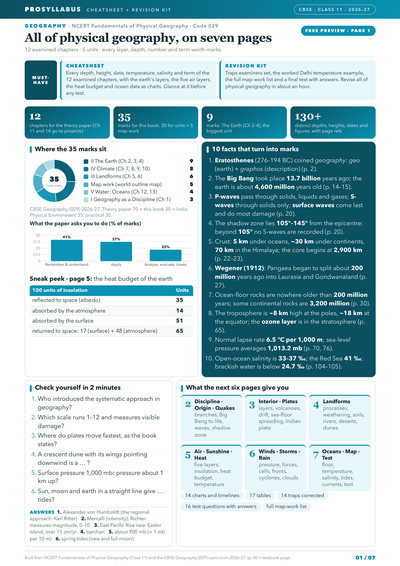
Earth's interior + plates: Unit II, 9 marks- Marks booster + cheatsheet: key concepts in 2 lines each, common traps
- 8 marks: Climate unit, Ch 7–10
- 5 marks: map work, covered
- 4 marks: ocean data as charts, Unit V
- Heat budget and five air layers as charts
- Common traps, corrected
CBSE Class 11 · Geography
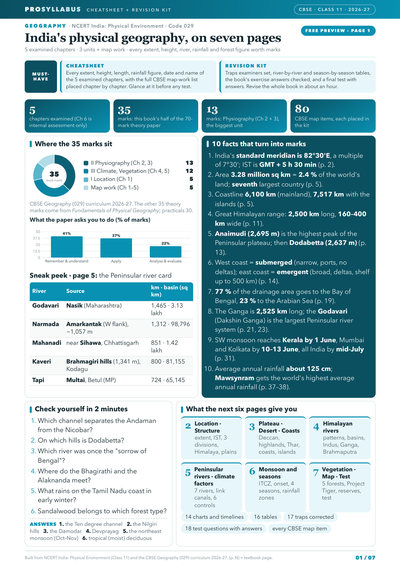
Physiography + Drainage: Unit II, 13 marks- Marks booster + cheatsheet: key concepts in 2 lines each, common traps
- 12 marks: Climate, Vegetation (Unit III)
- Full CBSE map-work list, chapter by chapter
- Indus, Ganga, Brahmaputra river systems
- Monsoon mechanism, onset and four seasons
- Common traps, corrected
CBSE Class 11 · Geography
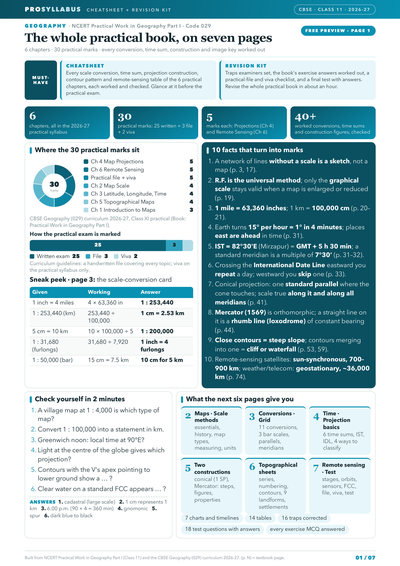
Projections, Remote Sensing: 5 marks each- Marks booster + cheatsheet: key concepts in 2 lines each
- 4 marks: Map Scale, conversions worked
- 4 marks: Latitude, Longitude and Time
- 4 marks: Topographical Maps, contours
- 5 marks: practical file and viva
- Conical and Mercator's construction steps
Summary
Water is present in the atmosphere in gaseous, liquid and solid forms, derived from water bodies by evaporation and from plants by transpiration. The water vapour present is called humidity: absolute humidity is the weight of water vapour per unit volume, while relative humidity is the percentage of moisture present compared to the air's full capacity at a given temperature. Air holding moisture to its full capacity is saturated, and the temperature at which saturation occurs is the dew point. Evaporation transforms water from liquid to gas using heat (latent heat of vaporisation), while condensation transforms vapour into water through loss of heat, usually around hygroscopic condensation nuclei. After condensation, moisture takes the forms of dew, frost, fog, mist and clouds. Clouds are grouped by height and form into cirrus (high, feathery), cumulus (cotton-wool, flat-based), stratus (layered) and nimbus (dark rain clouds). Precipitation is the release of moisture as rainfall, snowfall, sleet or hail. Rainfall is of three types: convectional (heated air rises), orographic or relief (air forced up a mountain, giving a rain-shadow on the leeward side) and cyclonic or frontal. Rainfall generally decreases from the equator towards the poles, and coastal areas receive more than continental interiors.