Biodiversity and Conservation
Class 11 Geography · Fundamentals of Physical Geography · Chapter 14
163 members in the CBSE community
View all











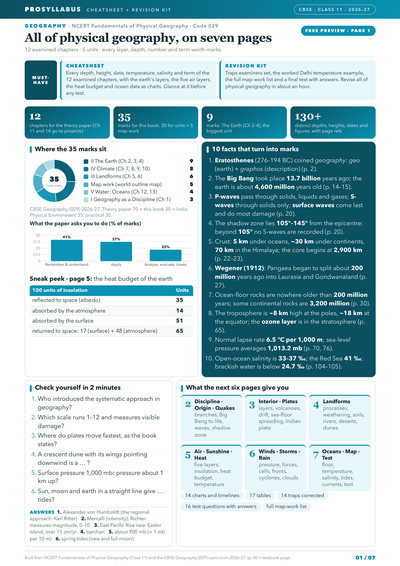
CBSE Class 11 · Geography
Earth's interior + plates: Unit II, 9 marks- Marks booster + cheatsheet: key concepts in 2 lines each, common traps
- 8 marks: Climate unit, Ch 7–10
- 5 marks: map work, covered
- 4 marks: ocean data as charts, Unit V
- Heat budget and five air layers as charts
- Common traps, corrected
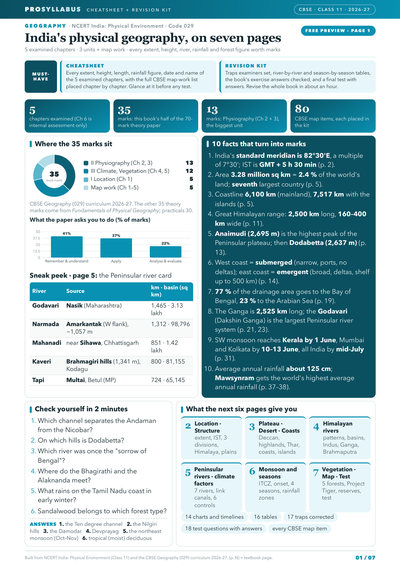
CBSE Class 11 · Geography
Physiography + Drainage: Unit II, 13 marks- Marks booster + cheatsheet: key concepts in 2 lines each, common traps
- 12 marks: Climate, Vegetation (Unit III)
- Full CBSE map-work list, chapter by chapter
- Indus, Ganga, Brahmaputra river systems
- Monsoon mechanism, onset and four seasons
- Common traps, corrected
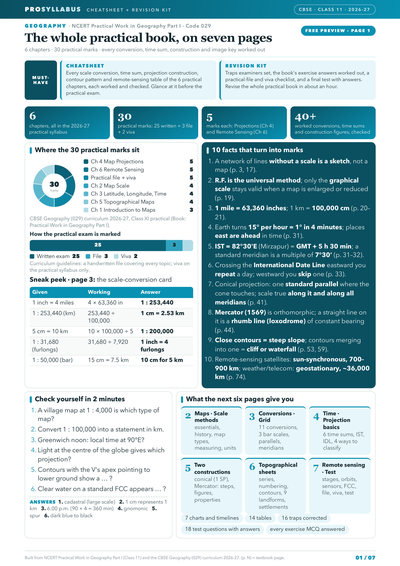
CBSE Class 11 · Geography
Projections, Remote Sensing: 5 marks each- Marks booster + cheatsheet: key concepts in 2 lines each
- 4 marks: Map Scale, conversions worked
- 4 marks: Latitude, Longitude and Time
- 4 marks: Topographical Maps, contours
- 5 marks: practical file and viva
- Conical and Mercator's construction steps
Summary
Biodiversity, a combination of "bio" (life) and "diversity" (variety), is the number and variety of organisms within a region, the result of 2.5–3.5 billion years of evolution. It is richest in the tropics and decreases towards the poles. Biodiversity is discussed at three levels: genetic diversity (variation of genes within a species), species diversity (the variety and number of species, richest in "hotspots"), and ecosystem diversity (the differences between ecosystem types). Biodiversity plays ecological, economic and scientific roles: species capture and store energy, decompose organic matter, cycle water and nutrients, fix atmospheric gases and regulate climate; a more diverse ecosystem is more stable and productive. Loss of biodiversity has accelerated due to growing human population, over-exploitation, deforestation, pollution and the introduction of exotic species. The IUCN classifies threatened species into endangered, vulnerable and rare categories, publishing the Red List. Conservation requires preserving endangered species and habitats, regulating trade in wild plants and animals, and protecting them in national parks, sanctuaries and biosphere reserves. India is one of twelve mega-diversity centres, and 155 nations signed the Convention on Biodiversity at the Rio Earth Summit (1992) to conserve biodiversity with sustainable use through the involvement of local communities.