We Distribute, Yet Things Multiply
Class 8 Mathematics · Ganita Prakash Part 1 · Chapter 6
173 members in the CBSE community
View all













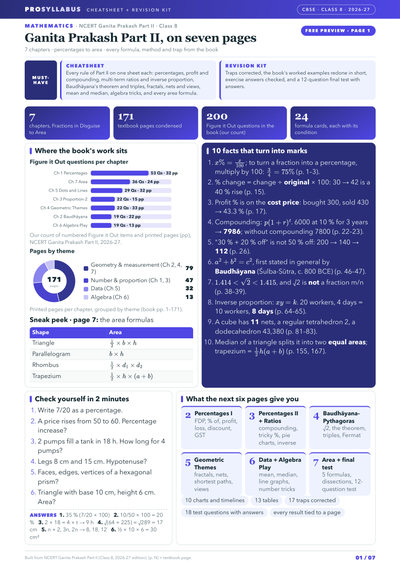
CBSE Class 8 · Mathematics
Percentages to area: 7 chapters of rules- Marks booster + cheatsheet: key concepts in 2 lines each, common traps
- Profit, loss and GST, Ch 1
- Baudhāyana's theorem and triples, Ch 2
- Common traps that cost marks, listed
- Inverse proportion, Ch 3
- Fractals, nets and views, Ch 4
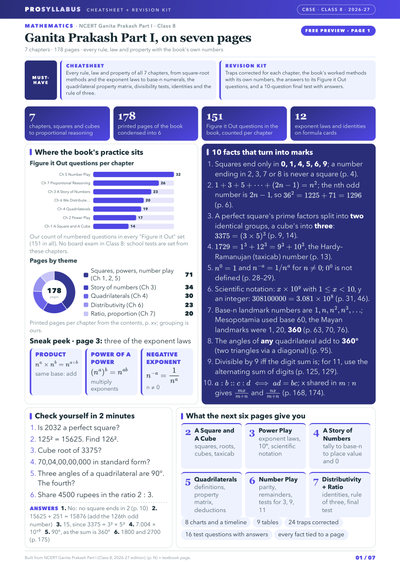
CBSE Class 8 · Mathematics
7 chapters: square roots to rule of three- Marks booster + cheatsheet: key concepts in 2 lines each
- Exponent laws, Ch 2
- Quadrilateral property matrix, Ch 4
- Divisibility tests, Ch 5
- Base-n numerals, Ch 3
- Identities by distributivity, Ch 6
Summary
This algebra chapter is built around the distributive property \(a(b+c) = ab + ac\) and its many uses. It first studies how a product changes when its factors change: increasing both \(a\) and \(b\) by \(1\) raises \(ab\) by \(a+b+1\), captured by the master identity \((a+m)(b+n) = ab + an + mb + mn\). From this flow the special identities \((a+b)^2 = a^2 + 2ab + b^2\), \((a-b)^2 = a^2 - 2ab + b^2\), and \((a+b)(a-b) = a^2 - b^2\), each justified both algebraically and geometrically by areas of squares and rectangles. These identities give fast mental methods — for example \(65^2 = 60^2 + 5^2 + 2\times60\times5 = 4225\), and Sridharacharya’s rule \(a^2 = (a+b)(a-b) + b^2\). The distributive property also powers quick multiplications by \(11, 101, 1001, \ldots\) The chapter then connects multiple algebraic expressions that describe the same growing pattern, showing that different-looking expressions (such as \((k+1)^2 - 1\) and \(k^2 + 2k\)) are equal, reinforcing that one pattern can be modelled in many valid ways.