CBSE Class 8 — Notes, Chapters & Practice Quizzes
Every Class 8 chapter, made friendly — notes with pictures, key words, and a quiz for each chapter.
10 questions · instant score · weak-chapter diagnosis
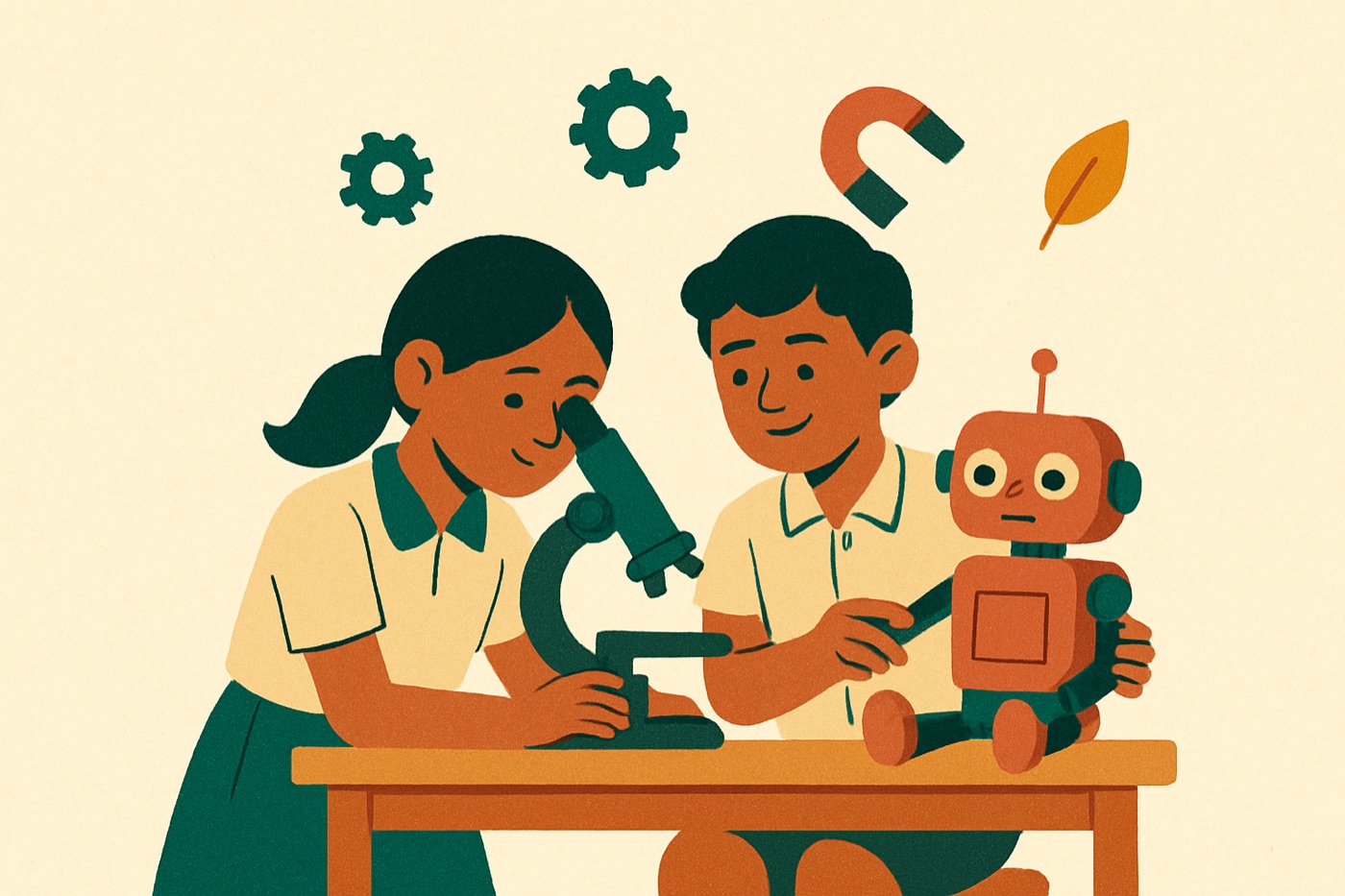
Students preparing for CBSE Class 8 Annual Assessment
View all





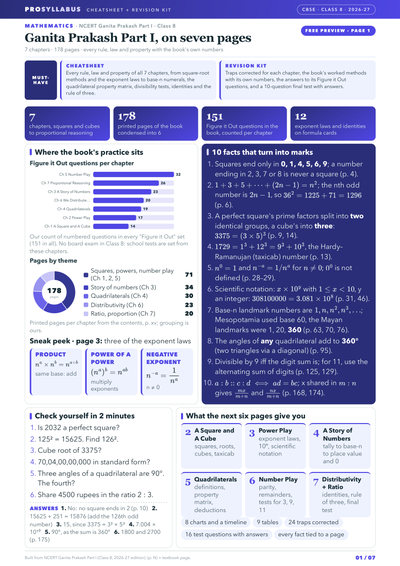
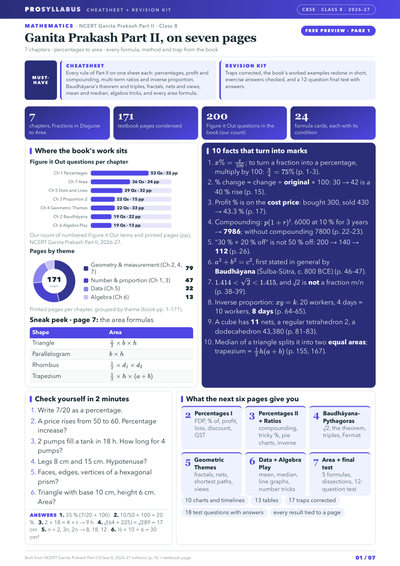 2
2- Mathematics
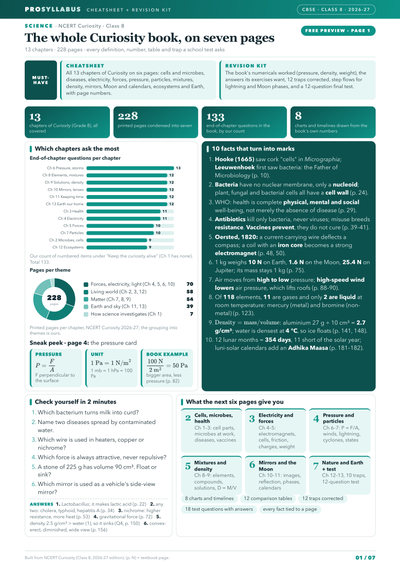
- Mathematics
- Science
- + 3 more
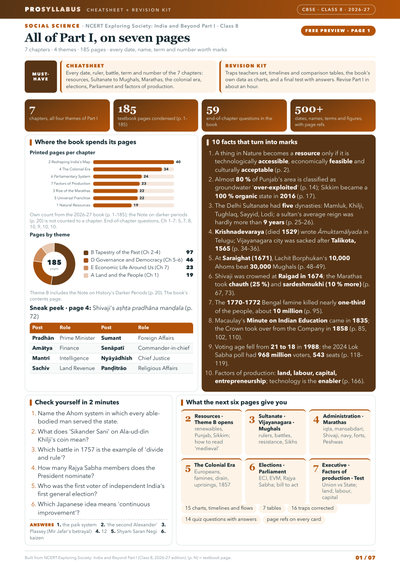
- Space weighted by chapter size
- Charts from the book's own data
- Traps corrected
- Space weighted by chapter size
- Charts from the book's own data
- Traps corrected
- Space weighted by chapter size
- Charts from the book's own data
- Traps corrected
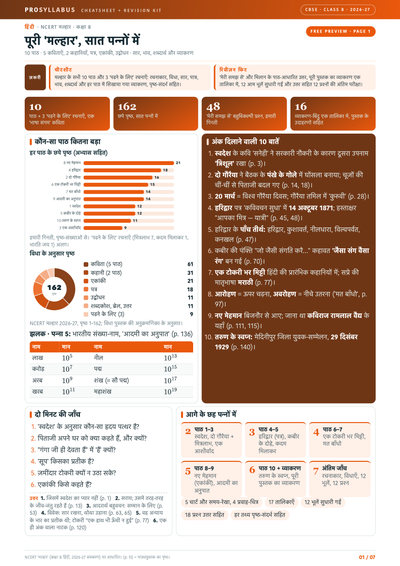
- Space weighted by chapter size
- Charts from the book's own data
- Traps corrected
- Space weighted by chapter size
- Charts from the book's own data
- Traps corrected
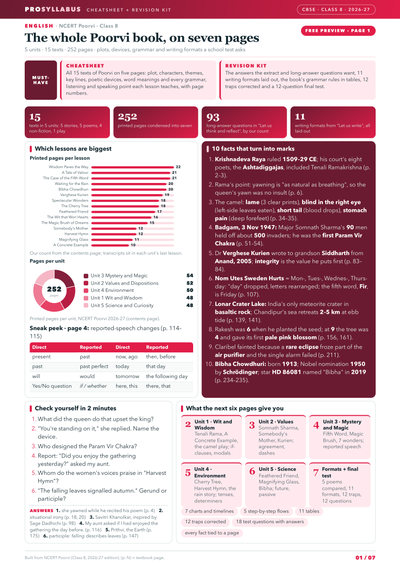
- Space weighted by chapter size
- Charts from the book's own data
- Traps corrected
Class 8 Mathematics — Chapter-wise Notes & Quizzes
Chapter 1: A Square and A Cube Class 8 Mathematics — summary, notes, extra questions & MCQ quiz
Summary
This chapter builds the ideas of squares and cubes from the counting of factors. A number written as a product of a number with itself, \(n \times n = n^2\), is a square number, and the squares of natural numbers — \(1, 4, 9, 16, 25, \ldots\) — are the perfect squares. A neat insight opens the chapter: only perfect squares have an odd number of factors, because their square-root factor pairs with itself. Perfect squares end only in \(0, 1, 4, 5, 6\) or \(9\) and carry an even number of trailing zeros. Adding consecutive odd numbers from \(1\) builds the squares, since the sum of the first \(n\) odd numbers equals \(n^2\). The square root reverses squaring: if \(y = x^2\) then \(x = \sqrt{y}\), and every perfect square has two integral roots \(\pm x\). Prime factorisation tests for squares by splitting factors into two identical groups. The cube \(n \times n \times n = n^3\) gives \(1, 8, 27, 64, \ldots\); a number is a perfect cube when its prime factors split into three identical groups, and \(\sqrt[3]{y}\) denotes the cube root. The famous taxicab number \(1729 = 1^3 + 12^3 = 9^3 + 10^3\) closes the journey.
Key terms
Extra questions & answers
Explore interactively
Keyboard: ← → to move · Space to flip
Practice quiz · A Square and A Cube
Score on this chapter, climb the leaderboard, and get an AI diagnosis of your mistakes.
Dual AI-verified questions Real exam pattern 1 free quiz every month, then ₹9 per quiz — or a monthly plan
A Square and A Cube
Start hereInstant score, answer review and weak-topic diagnosis
Mathematics revision kits
- Mathematics
- Space weighted by chapter size
- Charts from the book's own data
- Traps corrected
- Space weighted by chapter size
- Charts from the book's own data
- Traps corrected