A Square and A Cube
Class 8 Mathematics · Ganita Prakash Part 1 · Chapter 1
 2
2- Mathematics
- Mathematics
- Science
- + 3 more
- Space weighted by chapter size
- Charts from the book's own data
- Traps corrected
- Space weighted by chapter size
- Charts from the book's own data
- Traps corrected
- Space weighted by chapter size
- Charts from the book's own data
- Traps corrected
- Space weighted by chapter size
- Charts from the book's own data
- Traps corrected
- Space weighted by chapter size
- Charts from the book's own data
- Traps corrected
- Space weighted by chapter size
- Charts from the book's own data
- Traps corrected
Summary
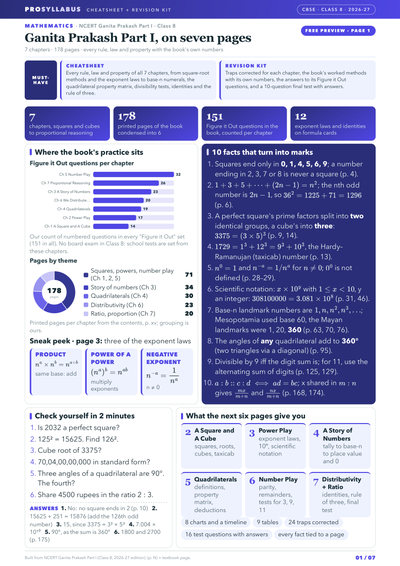
This chapter builds the ideas of squares and cubes from the counting of factors. A number written as a product of a number with itself, \(n \times n = n^2\), is a square number, and the squares of natural numbers — \(1, 4, 9, 16, 25, \ldots\) — are the perfect squares. A neat insight opens the chapter: only perfect squares have an odd number of factors, because their square-root factor pairs with itself. Perfect squares end only in \(0, 1, 4, 5, 6\) or \(9\) and carry an even number of trailing zeros. Adding consecutive odd numbers from \(1\) builds the squares, since the sum of the first \(n\) odd numbers equals \(n^2\). The square root reverses squaring: if \(y = x^2\) then \(x = \sqrt{y}\), and every perfect square has two integral roots \(\pm x\). Prime factorisation tests for squares by splitting factors into two identical groups. The cube \(n \times n \times n = n^3\) gives \(1, 8, 27, 64, \ldots\); a number is a perfect cube when its prime factors split into three identical groups, and \(\sqrt[3]{y}\) denotes the cube root. The famous taxicab number \(1729 = 1^3 + 12^3 = 9^3 + 10^3\) closes the journey.