Fractions in Disguise
Class 8 Mathematics · Ganita Prakash Part 2 · Chapter 1
 2
2- Mathematics
- Mathematics
- Science
- + 3 more
- Space weighted by chapter size
- Charts from the book's own data
- Traps corrected
- Space weighted by chapter size
- Charts from the book's own data
- Traps corrected
- Space weighted by chapter size
- Charts from the book's own data
- Traps corrected
- Space weighted by chapter size
- Charts from the book's own data
- Traps corrected
- Space weighted by chapter size
- Charts from the book's own data
- Traps corrected
- Space weighted by chapter size
- Charts from the book's own data
- Traps corrected
Summary
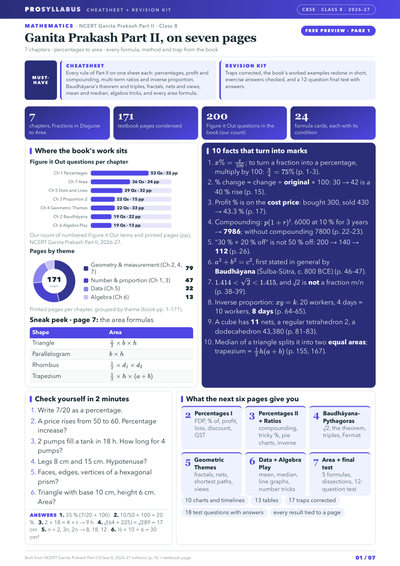
This chapter reveals percentages as fractions in disguise. The word per cent comes from the Latin per centum, meaning out of a hundred, so a percentage is simply a fraction with denominator \(100\): \(25\% = \dfrac{25}{100}\). Any fraction can be expressed as a percentage by finding an equivalent fraction with denominator \(100\), for example \(\dfrac{3}{4} = \dfrac{75}{100} = 75\%\), or by multiplying the fraction by \(100\). Conversely, a percentage is converted back to a fraction or decimal by dividing by \(100\). The chapter shows how percentages let us compare proportions on a common scale even when the underlying totals differ, which is exactly why they are so widely used in marks, discounts and statistics. Finding a percentage of a quantity means taking that fraction of it, so \(50\%\) of \(s\) is \(\dfrac{1}{2}s\). These tools connect fractions, decimals and percentages into a single flexible language for describing parts of a whole.