Proportional Reasoning-1
Class 8 Mathematics · Ganita Prakash Part 1 · Chapter 7
 2
2- Mathematics
- Mathematics
- Science
- + 3 more
- Space weighted by chapter size
- Charts from the book's own data
- Traps corrected
- Space weighted by chapter size
- Charts from the book's own data
- Traps corrected
- Space weighted by chapter size
- Charts from the book's own data
- Traps corrected
- Space weighted by chapter size
- Charts from the book's own data
- Traps corrected
- Space weighted by chapter size
- Charts from the book's own data
- Traps corrected
- Space weighted by chapter size
- Charts from the book's own data
- Traps corrected
Summary
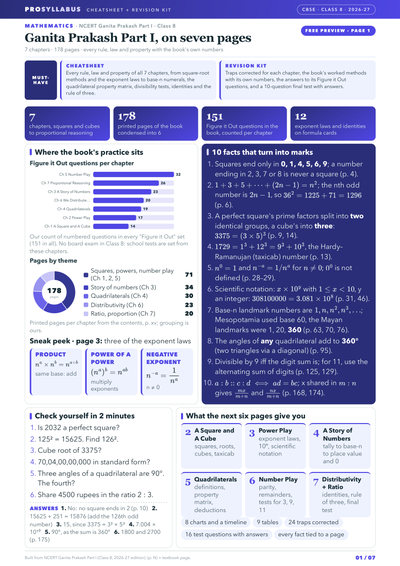
This chapter introduces ratios and proportional reasoning through similar images. Two images look similar when their width and height change by the same factor — a multiplicative relationship rather than an additive one. A ratio \(a : b\) means for every \(a\) units of one quantity there are \(b\) units of another; reducing it by dividing both terms by their HCF gives its simplest form. Two ratios are proportional, written \(a : b :: c : d\), when their simplest forms match, equivalently when cross-multiplication gives \(ad = bc\). This Rule of Three, known to Aryabhata as the relation among pramana, phala and ichchha, finds an unknown fourth quantity: \(d = \dfrac{bc}{a}\). The chapter applies proportional reasoning to recipes, maps, prices and speeds, and to sharing a whole in a given ratio \(m : n\), where the parts are \(m \times \dfrac{x}{m+n}\) and \(n \times \dfrac{x}{m+n}\). It also covers unit conversions and warns that adding or subtracting the same number from both terms of a ratio does not preserve proportionality.