Power Play
Class 8 Mathematics · Ganita Prakash Part 1 · Chapter 2
173 members in the CBSE community
View all













CBSE Class 8 · Mathematics
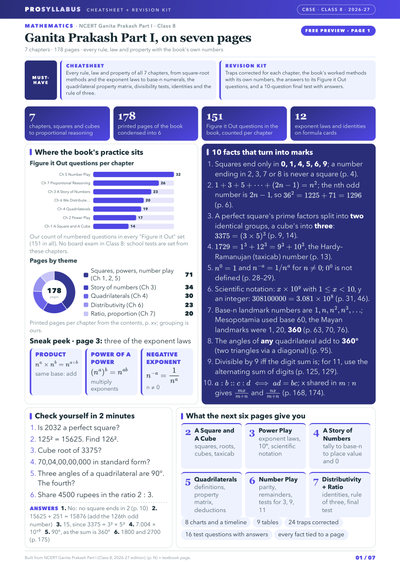
7 chapters: square roots to rule of three- Marks booster + cheatsheet: key concepts in 2 lines each
- Exponent laws, Ch 2
- Quadrilateral property matrix, Ch 4
- Divisibility tests, Ch 5
- Base-n numerals, Ch 3
- Identities by distributivity, Ch 6
CBSE Class 8 · Mathematics
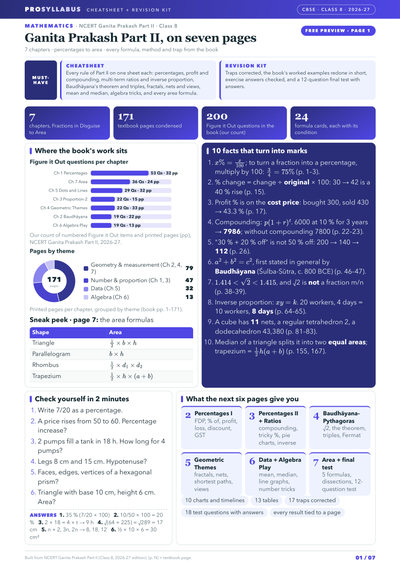
Percentages to area: 7 chapters of rules- Marks booster + cheatsheet: key concepts in 2 lines each, common traps
- Profit, loss and GST, Ch 1
- Baudhāyana's theorem and triples, Ch 2
- Common traps that cost marks, listed
- Inverse proportion, Ch 3
- Fractals, nets and views, Ch 4
Summary
Power Play extends squares and cubes to general exponents and shows the astonishing pace of multiplicative (exponential) growth — for instance, a paper folded \(46\) times would reach the Moon. The notation \(n^a\) means \(n\) multiplied by itself \(a\) times; \(n\) is the base and \(a\) the exponent. The laws of exponents are developed from first principles: \(n^a \times n^b = n^{a+b}\), \((n^a)^b = n^{ab}\), \(n^a \div n^b = n^{a-b}\), \(m^a \times n^a = (mn)^a\), and \(\dfrac{m^a}{n^a} = \left(\dfrac{m}{n}\right)^a\). To keep the division law consistent, \(n^0 = 1\) for \(n \ne 0\), and negative exponents emerge as \(n^{-a} = \dfrac{1}{n^a}\). Powers of ten let us write numbers in expanded form and, more powerfully, in scientific (standard) notation \(x \times 10^y\) with \(1 \le x < 10\), where the exponent matters more than the coefficient. The chapter uses this to compare gigantic real-world quantities — populations, distances, ages of the universe — and contrasts linear (additive) growth with exponential (multiplicative) growth.