Exploring Some Geometric Themes
Class 8 Mathematics · Ganita Prakash Part 2 · Chapter 4
173 members in the CBSE community
View all












CBSE Class 8 · Mathematics
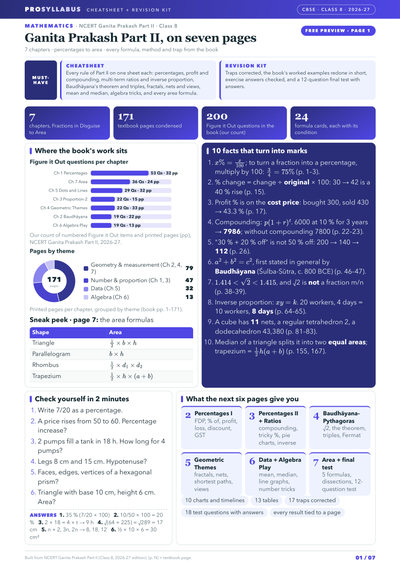
Percentages to area: 7 chapters of rules- Marks booster + cheatsheet: key concepts in 2 lines each, common traps
- Profit, loss and GST, Ch 1
- Baudhāyana's theorem and triples, Ch 2
- Common traps that cost marks, listed
- Inverse proportion, Ch 3
- Fractals, nets and views, Ch 4
CBSE Class 8 · Mathematics
7 chapters: square roots to rule of three- Marks booster + cheatsheet: key concepts in 2 lines each
- Exponent laws, Ch 2
- Quadrilateral property matrix, Ch 4
- Divisibility tests, Ch 5
- Base-n numerals, Ch 3
- Identities by distributivity, Ch 6
Summary
This chapter explores two geometric themes: fractals and the visualisation of solids. Fractals are self-similar shapes that repeat the same pattern at smaller and smaller scales, seen in ferns, coastlines and lightning. The Sierpinski Carpet removes the central square of a \(3\times3\) grid repeatedly, so the remaining squares follow \(R_n = 8^n\); the Sierpinski Triangle removes the middle of four triangles; and the Koch Snowflake replaces each side with a bump, growing the perimeter without bound. Fractals appear in temple architecture and African textiles. The second theme is representing solids on a plane. Prisms and pyramids are named by their base shapes, with set counts of faces, edges and vertices. A net is a solid unfolded flat; a cube has \(11\) distinct nets, a regular tetrahedron has \(2\). Nets also solve shortest-path problems on a cuboid. Projections give the front, top and side views of a solid, and an isometric projection — where all edges project to equal lengths — is drawn on an isometric grid to convey three-dimensional shape clearly.