Area
Class 8 Mathematics · Ganita Prakash Part 2 · Chapter 7
173 members in the CBSE community
View all















CBSE Class 8 · Mathematics
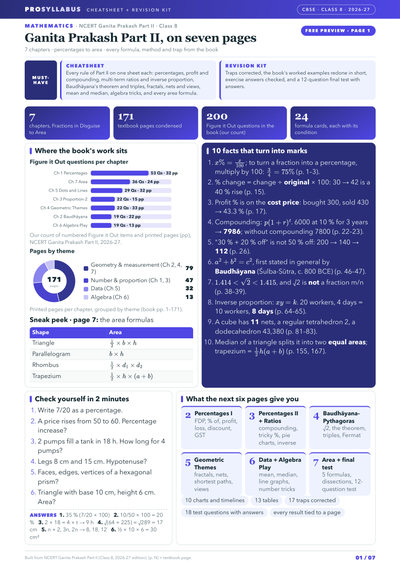
Percentages to area: 7 chapters of rules- Marks booster + cheatsheet: key concepts in 2 lines each, common traps
- Profit, loss and GST, Ch 1
- Baudhāyana's theorem and triples, Ch 2
- Common traps that cost marks, listed
- Inverse proportion, Ch 3
- Fractals, nets and views, Ch 4
CBSE Class 8 · Mathematics
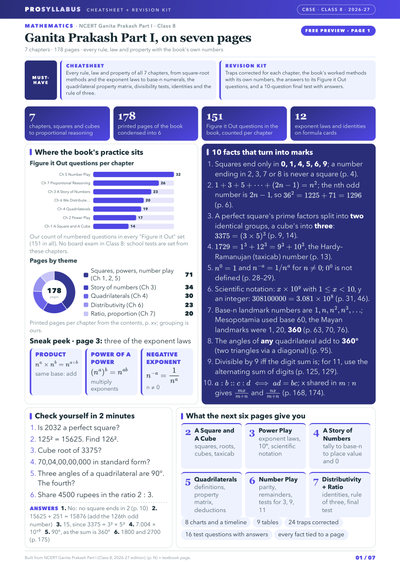
7 chapters: square roots to rule of three- Marks booster + cheatsheet: key concepts in 2 lines each
- Exponent laws, Ch 2
- Quadrilateral property matrix, Ch 4
- Divisibility tests, Ch 5
- Base-n numerals, Ch 3
- Identities by distributivity, Ch 6
Summary
This chapter develops area formulas for polygons by counting unit squares and by dissection. The area of a rectangle is length \(\times\) width, and a diagonal halves it, so a triangle’s area is \(\dfrac{1}{2} \times \text{base} \times \text{height}\); this formula holds for every triangle, even when the foot of the altitude lies outside the base. The chapter stresses that perimeter is not a measure of area — two regions can have the same perimeter yet different areas. Any polygon can be split into triangles, so its area is the sum of triangle areas. Special formulas follow by dissection: a parallelogram has area base \(\times\) height (cut into a triangle and rearranged into a rectangle); a rhombus has area \(\dfrac{1}{2} \times\) product of diagonals; and a trapezium has area \(\dfrac{1}{2} \times \text{height} \times \text{(sum of parallel sides)}\). The chapter also explores Sulba-Sutra dissection problems — transforming one shape into another of equal area — and applies area to real-life surfaces and unit conversions between cm\(^2\), in\(^2\), ft\(^2\) and acres.