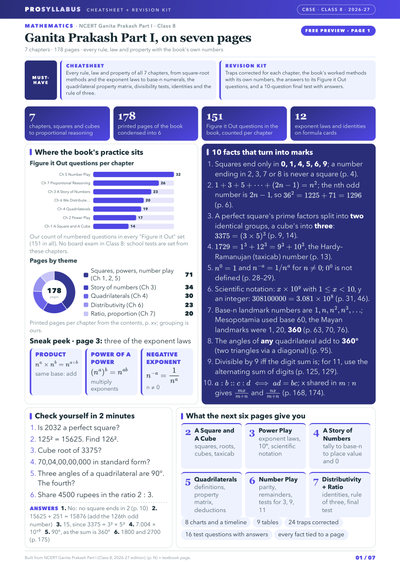
This is a historical-mathematical chapter tracing how humans learned to count and to write numbers. Counting begins with one-to-one mapping — matching each object to a stick, a sound, or a symbol — leading to the idea of a number system as a standard ordered sequence. Early systems counted in groups (the Gumulgal of Australia counted in twos) and then used landmark numbers, as in the Roman system with \(I, V, X, L, C, D, M\). A major breakthrough was the idea of a base: choosing landmark numbers that are powers of a fixed number \(n\) gives a base-\(n\) system, of which the Egyptian system (base \(10\)) is an example. The next leap was place value, where a symbol’s position fixes which power of the base it represents — seen in the Mesopotamian (base \(60\)), Mayan and Chinese systems. The crowning idea was the Hindu number system: a base-\(10\) place-value system with ten digits including \(0\), treated as a number in its own right by Aryabhata and codified by Brahmagupta. Because of \(0\), every number can be written unambiguously with finitely many symbols.
Counting and one-to-one mappingEarly number systemsRoman and landmark numbersThe idea of a basePlace value and the role of zero
Key terms
Number system
A standard ordered sequence of objects, names, or symbols used to count and represent quantities.
Numeral
A written symbol that represents a number within a number system, such as \(0, 7\) or \(36\).
Landmark number
A reference number given its own symbol, used to group and build other numbers (e.g. \(V, X, L\) in Roman).
Base-\(n\) system
A system whose landmark numbers are the powers of a fixed number \(n\): \(1, n, n^2, n^3, \ldots\)
Place value system
A system in which a symbol’s position determines which landmark (power of the base) it stands for.
Role of zero
A placeholder and a number in its own right that lets all numbers be written unambiguously with finitely many digits.
Extra questions & answers
Try one from this chapter
What is one-to-one mapping in counting?
Flashcards & interactive practice
Practice quiz · A Story of Numbers
Score on this chapter, climb the leaderboard, and get an AI diagnosis of your mistakes.
Double-checked questions Real exam pattern 1 free test every month, then ₹9 per test
#1
A Story of Numbers
Start here
Maths 10 Qs · ~10 min
Instant score, answer review and weak-topic diagnosis
Data & insights
Trending in Class 8 this monthThe chapters students are reading most right now