Class 8 › English › Poorvi Chapter 2: Values and Dispositions Class 8 English — summary, notes, extra questions & NCERT solutions Tap a card to open it full-screen — swipe through like a story.
Major Somnath Sharma was the first Indian to receive which gallantry award?
A The Bharat Ratna B The Vir Chakra C The Param Vir Chakra D The Ashoka Chakra
Unit 2 of Poorvi explores courage, sacrifice and compassion. Its main prose reading, “A Tale of Valour: Major Somnath Sharma and the Battle of Badgam”, pays tribute to Major Somnath Sharma of the Kumaon Regiment, India’s first recipient of the Param Vir Chakra. In November 1947, soon after Independence, infiltrators tried to capture the Kashmir Valley and advance towards Srinagar airfield. Despite a fractured arm in plaster, Major Sharma led his company at Badgam against a vastly larger enemy force. Refusing to retreat, he held the position to protect Srinagar, personally carrying ammunition and directing fire until he was killed in action. His leadership delayed the enemy long enough to save the airfield, and his last message—that he would not withdraw even to the last man and the last round—became legendary. The unit links his sacrifice to symbols of national gratitude such as the Param Vir Chakra and the National War Memorial. It is paired with Mary Dow Brine’s poem “Somebody’s Mother”, in which a kind schoolboy helps a poor, old woman cross a snowy street, reminding readers that bravery includes everyday acts of kindness and empathy. Together the readings teach patriotism, selflessness, respect for elders and the values that shape good character.
1 The chapter opens with Major Somnath Sharma’s courage being honoured as a lasting inspiration for the nation. 2 Pakistan sends infiltrators into Kashmir to seize key places, including Srinagar airport, after launching Operation Gulmarg. 3 Major Somnath Sharma reaches Srinagar with D Company and insists on fighting beside his men despite his injured hand. 4 At Badgam, his 90 soldiers face about 500 invaders, resist strongly, and call for air strikes to slow the attack. 5 Though heavily outnumbered and short of ammunition, Major Somnath refuses to withdraw and fights while guiding and encouraging his men. 6 A mortar shell kills him, but his company holds on long enough to save Srinagar, and he receives the Param Vir Chakra. M Major Somnath Sharma Officer of the Kumaon Regiment and India’s first Param Vir Chakra recipient, who died defending Badgam in 1947.
P Param Vir Chakra India’s highest wartime gallantry award; its design is inspired by Sage Dadhichi’s sacrifice.
B Battle of Badgam The 1947 action near Srinagar where Major Sharma’s company held off infiltrators to protect the airfield.
V Valour Great courage in the face of danger; the central virtue celebrated in the prose lesson.
“ “Somebody’s Mother” (poem) A poem by Mary Dow Brine about a boy who helps an old woman cross a snowy road, highlighting kindness and empathy.
D Disposition A person’s natural qualities of character, such as courage, compassion, humility and respect, that the unit develops.
etched
fixed permanently in memory
beacon
source of inspiration
infiltrators
people who secretly invade
eerily
in a strange, frightening way
resolute
firmly determined
tenacity
strong determination
ammunition
supply of bullets and shells
legacy
values passed to later generations
Q1 Who was Major Somnath Sharma? Answer Q2 Why was the Battle of Badgam important? Answer Q3 How did Major Sharma show extraordinary courage despite his injury? Answer Q4 What does the Param Vir Chakra represent and what inspired its design? Answer Q5 How is Major Sharma’s memory honoured today? Answer Q6 What is the poem “Somebody’s Mother” about? Answer Q7 Why does the boy help the old woman in the poem? Answer Q8 What values does the poem teach? Answer Q9 How does the old woman respond to the boy’s kindness? Answer Q10 What common theme links the prose and the poem in this unit? Answer Q1 I Work in pairs. Share your answers with your classmates and teacher. 1. What do you think about the Republic Day Parade on 26 January? Answer Q2 I Work in pairs. Share your answers with your classmates and teacher. 2. What are the highlights of this parade? Answer Q3 I Work in pairs. Share your answers with your classmates and teacher. 3. What bravery awards are given on this day, and who receives them? Answer Q4 II Work in groups of four and discuss. 1. What qualities do you think a soldier should have? Answer Q5 II Work in groups of four and discuss. 2. If you had to share a message with a soldier, what would it be? Answer Q1 I Arrange the following events in chronological order. The first and the last events have been marked for you. Share your answers with your classmates and teacher. 1. Major Somnath Sharma was born in 1923 in Kangra, Himachal Pradesh. (1) 2. Even after losing Major Somnath Sharma, the soldiers fought bravely to save Srinagar for India. 3. The D Company, under the command of Major Somnath Sharma, was flown into Srinagar. 4. Major Somnath Sharma underwent training at the Royal Military College, Sandhurst. 5. Major Somnath Sharma requested air strikes to combat the enemy at Badgam. 6. Major Somnath Sharma was commissioned into the 19th Hyderabad Regiment in 1942. 7. Major Somnath Sharma was killed immediately after a mortar shell hit him. 8. Major Somnath Sharma was the first recipient of the Param Vir Chakra. (8) Answer Q1 I Read the given extracts and answer the questions that follow. 1. Vastly outnumbered and facing devastating fire, Major Somnath Sharma and his men stood resolute... (i) What can be inferred about the conditions from the line: ‘The air was thick with gunfire...’ A. The gunshots had stopped for a while. B. There was intense fighting on the battlefield. C. The invaders were retreating from the fight. D. The Indian soldiers had achieved victory. Answer Q2 I Read the given extracts and answer the questions that follow. 1. (ii) Complete the sentence with a suitable reason. Despite heavy casualties, Major Somnath Sharma continued to lead his men because ________________________________________. Answer Q3 I Read the given extracts and answer the questions that follow. 1. (iii) Select the correct option for both Assertion (A) and Reason (R) given below: (A): Major Somnath Sharma moved fearlessly through the battlefield, even though he was injured. (R): He believed his courage was important to motivate the soldiers. A. Both (A) and (R) are true, and (R) is the correct explanation of (A). B. Both (A) and (R) are true, but (R) is not the correct explanation of (A). C. (A) is true, but (R) is false. D. (A) is false, but (R) is true. Answer Q4 I Read the given extracts and answer the questions that follow. 1. (iv) Fill in the blank with the correct word from those given in the brackets: Major Somnath Sharma was filling magazines, and encouraging his men to hold their ground despite ___________________________. (injuries/worry) Answer Q5 I Read the given extracts and answer the questions that follow. 2. Born on 31 January 1923, in the picturesque town of Dadh in Kangra, Himachal Pradesh, Somnath Sharma belonged to a family with a rich military legacy... (i) What can be inferred about Somnath Sharma’s early influences on his career? A. He was primarily influenced by his father’s achievements in the military. B. His inspiration came solely from the tales of the Mahabharata. C. His family and heritage inspired his bravery and sense of duty. D. He decided to join the military out of necessity rather than passion. Answer Q6 I Read the given extracts and answer the questions that follow. 2. (ii) Identify whether the following statement is true or false: Somnath Sharma belonged to a wealthy family. Answer Q7 I Read the given extracts and answer the questions that follow. 2. (iii) What does the phrase ‘served the nation with distinction’ tell us about Major General Amar Nath Sharma? Answer Q8 I Read the given extracts and answer the questions that follow. 2. (iv) Replace the underlined phrase with a word from the extract that has a similar meaning. My family and I visited a popular hill station and stayed in an old but visually charming house surrounded by trees. Answer Q9 II Answer the following questions. 1. ‘Major Somnath’s legacy of courage and devotion to the nation remains forever alive, forever alive…’ What is the significance of the repetition in this line? Answer Q10 II Answer the following questions. 2. Why do you think Major Somnath’s leadership was critical during the Battle of Badgam? Answer Q11 II Answer the following questions. 3. What were Major Somnath’s last words? What do they reflect about his sense of duty? Answer Q12 II Answer the following questions. 4. What might have been the outcome of the Battle of Badgam if Major Somnath and his company had not held their ground? Answer Q13 II Answer the following questions. 5. Why do you think Major Somnath’s story continues to inspire soldiers and civilians today? Answer Q14 II Answer the following questions. 6. How can the values demonstrated by Major Somnath Sharma—courage, duty, and self-sacrifice—be applied in our daily lives? Answer Q1 I Match the expressions from the text in Column 1 with the most suitable situations given in Column 2. 1. Fight to the last man Answer Q2 I Match the expressions from the text in Column 1 with the most suitable situations given in Column 2. 2. Foil the plan Answer Q3 I Match the expressions from the text in Column 1 with the most suitable situations given in Column 2. 3. Deliver a blow Answer Q4 I Match the expressions from the text in Column 1 with the most suitable situations given in Column 2. 4. Hold their ground Answer Q5 I Now, complete the following sentences using the expressions from Column 1. A. The detective managed to ______________ by finding the hidden evidence before the culprit could get rid of it. Answer Q6 I Now, complete the following sentences using the expressions from Column 1. B. The company’s new advertising campaign was meant to ______________ to their competitors’ sales. Answer Q7 I Now, complete the following sentences using the expressions from Column 1. C. The hikers chose to ______________ despite the heavy rain, refusing to turn back on their journey. Answer Q8 I Now, complete the following sentences using the expressions from Column 1. D. Despite being heavily outnumbered, the soldiers vowed to defend their homeland and ______________, refusing to surrender to the enemy forces. Answer Q9 II Match the collective nouns in Column 1 to their meanings in Column 2. 1. regiment Answer Q10 II Match the collective nouns in Column 1 to their meanings in Column 2. 2. squadron Answer Q11 II Match the collective nouns in Column 1 to their meanings in Column 2. 3. fleet Answer Q12 II Match the collective nouns in Column 1 to their meanings in Column 2. 4. battalion Answer Q13 II Now, fill in the blanks suitably with words from Column 1 in the table. A. The commanding officer addressed the entire ________ of soldiers during the morning assembly. Answer Q14 II Now, fill in the blanks suitably with words from Column 1 in the table. B. The admiral ordered the entire ________ to set sail for battle. Answer Q15 II Now, fill in the blanks suitably with words from Column 1 in the table. C. The ________ of infantry advanced slowly through the dense forest. Answer Q16 II Now, fill in the blanks suitably with words from Column 1 in the table. D. A ________ of fighter jets was sent to intercept the enemy planes. Answer Q17 III Read the following words from the text and fill in the blanks with the correct words by taking clues from the meanings given below in the box. overwhelm overthrow overrun Meanings 1. To take and seize control: ____________ Answer Q18 III Meanings 2. To invade or occupy an area in large numbers: ____________ Answer Q19 III Meanings 3. To flood or overpower someone or something emotionally: ____________ Answer Q20 III Now, create a list of at least five other verbs that begin with ‘over’ and frame sentences of your own. Answer Q21 IV Now, fill in the blanks correctly with the words given in the brackets. 1. The teacher’s (i) ____________ is always helpful, and she continues to (ii) ____________ students on their career choices. (advice/advise) Answer Q22 IV Now, fill in the blanks correctly with the words given in the brackets. 2. The musician believes that daily (i) ____________ helps a lot, so she is always ready to (ii) ____________ her harmonium lessons. (practice/practise) Answer Q23 IV Now, fill in the blanks correctly with the words given in the brackets. 3. The scientist uses a strange (i) ____________ for experiments and plans to (ii) ____________ new methods for his analysis. (device/devise) Answer Q24 IV Now, fill in the blanks correctly with the words given in the brackets. 4. The village (i) ____________ met to discuss issues and decided to (ii) ____________ the villagers on important matters. (council/counsel) Answer Q25 V Now, fill in the blanks for the following sentences by choosing the correct verb given within brackets. 1. The bouquet of flowers __________ (is/are) beautiful. Answer Q26 V Now, fill in the blanks for the following sentences by choosing the correct verb given within brackets. 2. Neither the teacher nor the students __________ (was/were) aware of the change in the schedule. Answer Q27 V Now, fill in the blanks for the following sentences by choosing the correct verb given within brackets. 3. Each of the participants __________ (has/have) submitted their projects on time. Answer Q28 V Now, fill in the blanks for the following sentences by choosing the correct verb given within brackets. 4. The data collected by the researchers __________ (shows/show) significant trends. Answer Q29 V Now, fill in the blanks for the following sentences by choosing the correct verb given within brackets. 5. One of the players __________ (was/were) injured during the match. Answer Q30 V Now, fill in the blanks for the following sentences by choosing the correct verb given within brackets. 6. Either the children or their guardian __________ (has/have) to attend the meeting. Answer Q31 V Now, fill in the blanks for the following sentences by choosing the correct verb given within brackets. 7. A pair of shoes __________ (is/are) missing from the rack. Answer Q32 V Now, fill in the blanks for the following sentences by choosing the correct verb given within brackets. 8. Neither of the statements __________ (is/are) true. Answer Q33 V Now, fill in the blanks for the following sentences by choosing the correct verb given within brackets. 9. The members of the jury __________ (has deliver/have delivered) their verdict to the court. Answer Q34 V Now, fill in the blanks for the following sentences by choosing the correct verb given within brackets. 10. Mathematics __________ (is/are) an interesting subject for many students. Answer Q35 VI Read the following passage and correct the incorrect usage of verbs. Each soldier salute with pride while the commander and his assistants inspects the parade. The sound of marching feet echo through the air as a group of cadets prepare for their drill. Meanwhile, a convoy of military vehicles pass by, drawing cheers from the gathered crowd. Answer Q1 I You will listen to a talk about the Param Vir Chakra. As you listen, complete the sentences by filling in the blanks with one or two exact words or phrases you hear. 1. The Param Vir Chakra signifies the ‘Wheel of the Ultimate ____________’. Answer Q2 I You will listen to a talk about the Param Vir Chakra. As you listen, complete the sentences by filling in the blanks with one or two exact words or phrases you hear. 2. The Param Vir Chakra is awarded to someone who shows exemplary bravery while fighting with the ____________. Answer Q3 I You will listen to a talk about the Param Vir Chakra. As you listen, complete the sentences by filling in the blanks with one or two exact words or phrases you hear. 3. The Param Vir Chakra was introduced as a Gallantry Medal in 1947 by the ____________. Answer Q4 I You will listen to a talk about the Param Vir Chakra. As you listen, complete the sentences by filling in the blanks with one or two exact words or phrases you hear. 4. The design of the Param Vir Chakra is inspired by Sage Dadhichi, who was a ____________. Answer Q5 I You will listen to a talk about the Param Vir Chakra. As you listen, complete the sentences by filling in the blanks with one or two exact words or phrases you hear. 5. The state emblem in the centre of the Param Vir Chakra is surrounded by the Vajra and ____________. Answer Q1 I As the citizens of a nation, we all must fulfil our duty. In groups of 4–5, speak about how you propose to serve your nation. You can choose from the themes given below: Saving the environment, Health and well-being, Helping others, Righteous conduct Answer Q1 I A letter of enquiry is a formal letter written to seek detailed information about something the writer wants to know. Now, write a letter of enquiry. Your school wishes to organise a visit to a Memorial in your state/region. Write the letter to the incharge of that memorial requesting for information regarding available dates for visits, the duration of the tour, any entry fees, and guidelines for student groups. Answer Q1 I Out of twenty-one PVC awardees, Major Somnath Sharma was the first recipient of the PVC, and Captain Vikram Batra was the last recipient of the PVC, the highest gallantry award. (Task to find out more) Answer Q2 II Gallantry awards in India are given to military personnel and others for displaying extraordinary courage in the line of duty. Some of the gallantry awards in India are: Param Vir Chakra, Maha Vir Chakra, Vir Chakra. Find out more about gallantry awards. Answer Q3 III The Indian government has been steadfast in its initiatives to boost the representation of women in the Indian Armed Forces. These women have been serving the nation selflessly and with pride. Find out the key roles of women in the Indian Army. Share the information with your classmates and teacher. Answer Q4 IV Birsa Munda: A Saga of Courage and Sacrifice (Task to read) Answer Q5 V Make a list of the patriotic songs in any language, including songs from your region. Share the songs with your classmates and teacher. Answer Q1 I Recall a time you helped someone. Write two words describing: 1. What were your feelings after you did so? 2. What might have been the feelings of the person whom you helped? Share your answers with your classmates and teacher. Answer Q2 II Work in pairs. Read the words given below. Circle the words you would associate with an elderly person and underline the words you would associate with a school student. Share the reasons for your choices with your classmates and teacher. strong worried trembling hastening firm bent merry grey slow guide helpful Answer Q3 III Read the lines. The woman was old and ragged and grey And bent with the chill of the Winter’s day. Select the suitable meaning of ‘ragged’ as used in these lines. There are other four meanings given below. Discuss with your classmates and teacher. 1. (of clothes) old and torn; synonym: shabby 2. Having an outline, an edge, or a surface that is not straight or even 3. Not smooth or regular; not showing control or careful preparation 4. (Informal) very tired, especially after physical effort Answer Q1 I Arrange the events of the poem in the correct order of occurrence. Share your answers with your classmates and teacher. 1. The boy returned to his friends, feeling proud of what he had done. 2. The old woman stood alone at the crossing, hesitant to move. 3. A group of schoolboys passed by, playing, and laughing. 4. The boy offered to help the old woman cross the street. 5. The woman prayed for the boy who helped her. 6. The children hurried past the old woman without offering help. 7. The woman placed her hand on the boy’s arm, and he guided her safely across the street. 8. The boy thought about his own mother and hoped someone would help her one day. Answer Q2 II Fill in the blanks by choosing the correct answer from the options given in the brackets. 1. The central theme of the poem is _____________. (kindness and empathy/adventure and courage) Answer Q3 II Fill in the blanks by choosing the correct answer from the options given in the brackets. 2. The tone of the poem is _____________. (humorous and playful/sympathetic and hopeful) Answer Q4 II Fill in the blanks by choosing the correct answer from the options given in the brackets. 3. The poem is written in couplets with _____________ lines in each stanza. (four/two) Answer Q5 II Fill in the blanks by choosing the correct answer from the options given in the brackets. 4. The structure of the poem gives a rhythmic flow that reflects both the _____________. (narrative and emotions/story’s pace and message) Answer Q6 II Fill in the blanks by choosing the correct answer from the options given in the brackets. 5. The poem follows a rhyme scheme of _____________. (AABB/ABAB) Answer Q7 III Pick examples from the poem for the following poetic devices. 1. Simile Answer Q8 III Pick examples from the poem for the following poetic devices. 2. Alliteration Answer Q9 III Pick examples from the poem for the following poetic devices. 3. Repetition Answer Q10 IV Complete the following sentences appropriately explaining the imagery. 1. The poem uses imagery to describe scenes of a bustling street. We know this by the phrase _______________________. Answer Q11 IV Complete the following sentences appropriately explaining the imagery. 2. The line ‘The street was wet with a recent snow’ suggests a cold and _______________________ weather, emphasising the woman’s helplessness. Answer Q12 V Complete the following sentence with a suitable reason. The poet repeats the phrase Somebody’s mother because it _______________________. Answer Q13 VI Complete the analogy: The old woman: vulnerable and neglected :: The young boy: _______________________. Answer Q1 I Read the given extracts and answer the questions that follow. 1. The woman was old and ragged and grey... (i) What does the phrase ‘ragged and grey’ refer to ? A. the woman’s emotional state that day B. the woman’s old and worn-out appearance C. the weather conditions of the particular day D. the colour of the street and the surroundings Answer Q2 I Read the given extracts and answer the questions that follow. 1. (ii) Complete the following sentence with a suitable reason: The woman was ‘bent’ with the chill of the Winter’s day because she was _______________________. Answer Q3 I Read the given extracts and answer the questions that follow. 1. (iii) Identify the fact and opinion from the following sentences: A. The street was wet with recent snow. _______________________ B. The woman was too weak to cross the street on her own. _______________________ Answer Q4 I Read the given extracts and answer the questions that follow. 1. (iv) Why do you think the woman’s feet were described as ‘aged and slow’? Answer Q5 I Read the given extracts and answer the questions that follow. 2. He guided the trembling feet along, Proud that his own were firm and strong... (i) What does the contrast between the ‘trembling feet’ of the old woman and the ‘firm and strong’ feet of the boy emphasise? Answer Q6 I Read the given extracts and answer the questions that follow. 2. (ii) Fill in the blank given below by selecting the correct option from the brackets. The poem tells us that the boy was ‘proud’ that his feet were strong. This tells us that the boy was ________. (arrogant about being strong/grateful for his ability to help) Answer Q7 I Read the given extracts and answer the questions that follow. 2. (iii) What is the boy most likely to tell his friends on getting back? A. I’m so glad I could help her. B. I’m worried about her safety. C. I’m surprised she forgot to thank me. D. I’m thankful for all your support. Answer Q8 I Read the given extracts and answer the questions that follow. 2. (iv) Rectify the false sentence given below. The young boy’s actions were driven by a logical decision. Answer Q9 II Answer the following questions. 1. What might be the old woman’s fears as she waited for a long time at the crossing? Answer Q10 II Answer the following questions. 2. How does the poet show the helplessness of the old woman? Support your answer with evidence from the poem. Answer Q11 II Answer the following questions. 3. Why does the boy decide to help the old woman? What does this tell us about him? Answer Q12 II Answer the following questions. 4. How was the boy’s approach towards the old woman different from that of the other boys in the group? Answer Q13 II Answer the following questions. 5. Justify the appropriateness of the title of the poem. Answer Q14 II Answer the following questions. 6. What does the poem suggest about the role of empathy and humanity in society? Answer Q1 I The grid given below has the antonyms of the words from the text. Locate these words in the grid horizontally, vertically, and diagonally. One example has been done for you. You may refer to a dictionary. firm meek merry kind anxious bent Answer Q2 II Match the words from the text given in Column 1 with the underlined phrases in Column 2. 1. hastened Answer Q3 II Match the words from the text given in Column 1 with the underlined phrases in Column 2. 2. heeded Answer Q4 II Match the words from the text given in Column 1 with the underlined phrases in Column 2. 3. stir Answer Q5 II Match the words from the text given in Column 1 with the underlined phrases in Column 2. 4. lend Answer Q6 II Match the words from the text given in Column 1 with the underlined phrases in Column 2. 5. piled Answer Q7 II Match the words from the text given in Column 1 with the underlined phrases in Column 2. 6. offered Answer Q8 III In the poem, the poet uses the idiom ‘lend a hand’ which means ‘help somebody’. Some more idioms using ‘hand’ are given in Column 1. Match these idioms with their meanings in Column 2. 1. get out of hand Answer Q9 III In the poem, the poet uses the idiom ‘lend a hand’ which means ‘help somebody’. Some more idioms using ‘hand’ are given in Column 1. Match these idioms with their meanings in Column 2. 2. try your hand at something Answer Q10 III In the poem, the poet uses the idiom ‘lend a hand’ which means ‘help somebody’. Some more idioms using ‘hand’ are given in Column 1. Match these idioms with their meanings in Column 2. 3. give somebody a free hand Answer Q11 III In the poem, the poet uses the idiom ‘lend a hand’ which means ‘help somebody’. Some more idioms using ‘hand’ are given in Column 1. Match these idioms with their meanings in Column 2. 4. give somebody a big hand Answer Q12 III In the poem, the poet uses the idiom ‘lend a hand’ which means ‘help somebody’. Some more idioms using ‘hand’ are given in Column 1. Match these idioms with their meanings in Column 2. 5. work hand in hand Answer Q13 III In the poem, the poet uses the idiom ‘lend a hand’ which means ‘help somebody’. Some more idioms using ‘hand’ are given in Column 1. Match these idioms with their meanings in Column 2. 6. have your hands full Answer Q14 IV Complete the following analogy by filling in the blanks with the correct words from the poem. 1. ___________ : winter :: heat : summer Answer Q15 IV Complete the following analogy by filling in the blanks with the correct words from the poem. 2. hurt : ___________ :: old: aged Answer Q16 IV Complete the following analogy by filling in the blanks with the correct words from the poem. 3. whispered : shouted :: humble : ___________ Answer Q17 IV Complete the following analogy by filling in the blanks with the correct words from the poem. 4. eyes : ___________ :: legs : walk Answer Q18 IV Complete the following analogy by filling in the blanks with the correct words from the poem. 5. having a lot of money: wealthy :: densely packed people: ___________ Answer Q1 I You will listen to a woman read the special broadcast of the news. As you listen, arrange the pictures in the correct sequence of the events that took place. (Transcript for teacher on page 99) Answer Q2 II You will once again listen to the special broadcast of the news. As you listen, complete the following sentences with one to three exact words. 1. The woman was having a difficult time staying afloat due to the _________________. Answer Q3 II You will once again listen to the special broadcast of the news. As you listen, complete the following sentences with one to three exact words. 2. Rohan leapt into the river to save the woman without any _________________. Answer Q4 II You will once again listen to the special broadcast of the news. As you listen, complete the following sentences with one to three exact words. 3. Rohan’s act of bravery was witnessed by _________________. Answer Q5 II You will once again listen to the special broadcast of the news. As you listen, complete the following sentences with one to three exact words. 4. Rohan was honoured at the Vigyan Bhawan for his incredible courage and _________________. Answer Q6 II You will once again listen to the special broadcast of the news. As you listen, complete the following sentences with one to three exact words. 5. Rohan proved that when it comes to saving lives, age is _________________. Answer Q1 I Read aloud the list of words from the poem that end in ‘-ed’. As you read, focus on the final sound of each word and place them in the appropriate columns. One example has been done for you. ragged aged waited heeded offered paused guided whispered Answer Q2 II Work in pairs. Narrate an incident where you helped someone in the past. Take turns to speak and use the cue cards given below. at school, at the market place, in the neighbourhood, in the playground Answer Q1 I Write a diary entry of a day you helped someone in need. Remember to include the following points while writing it. Start with a sentence describing the day. Mention whom you helped. Explain the situation in which the other person needed help. Add the place and time of the day when the situation arose. Describe how you helped the other person. Describe the reaction of the person you helped. Mention how you felt during and after helping the person. Conclude by mentioning why you would do something like this again. Answer Q1 I Did you know that even Earth has been referred to as mother in the ancient scriptures of India? In section 12.1.12 of Pṛthvi-Sūkta (hymn-to-the-earth) of Atharva Veda, Earth is referred to as mother and us as her children by stating: माता भूमि: पुत्रोऽहं पृथिव्या: । It can be translated as ‘Earth is my mother and I am her child’. Answer Q2 II Work in groups of four. Find out the names of countries that refer to their country as ‘motherland’ and a few others as ‘fatherland’. Share your findings with your classmates and teacher. Answer Q3 III Read the poem and enjoy. A Nation’s Strength Not gold, but only men can make A people great and strong… Ralph Waldo Emerson Answer Q4 IV Make a gratitude card for your mother/grandmother to thank her for at least five things that she does for you. Also write two things that you would do regularly to help them. Use recycled material to make and decorate the card. Answer Q1 I Arrange the worldwide means of communication given below in the timeline provided. Share your answers with your classmates and teacher. 1. telephone 2. email 3. postcard 4. telegraph 5. mobile phone 6. carrier pigeons Answer Q2 II Work in pairs and discuss the following things. Share your answers with your classmates and teacher. 1. The reasons for change in the means of communication over the years. Answer Q3 II Work in pairs and discuss the following things. Share your answers with your classmates and teacher. 2. The means of communication that you prefer to use and the reason for your choice. Answer Q4 II Work in pairs and discuss the following things. Share your answers with your classmates and teacher. 3. Communication through social media: its benefits and precautions that one should take against its misuse. Answer Q1 I Identify which of the following statements are facts and which are opinions. Share your answers with your classmates and teacher. 1. But speaking on the telephone only gives us an immediate but fleeting joy. Answer Q2 I Identify which of the following statements are facts and which are opinions. Share your answers with your classmates and teacher. 2. I started my working life soon after our country became independent. Answer Q3 I Identify which of the following statements are facts and which are opinions. Share your answers with your classmates and teacher. 3. To be quite honest, service to our nation’s farmers was not the career I had envisioned for myself. Answer Q4 I Identify which of the following statements are facts and which are opinions. Share your answers with your classmates and teacher. 4. I knew I could make a more meaningful contribution by working here in Anand, Gujarat. Answer Q5 I Identify which of the following statements are facts and which are opinions. Share your answers with your classmates and teacher. 5. … values that I saw in my mentor and supporter here in Anand—Tribhuvandas Patel. Answer Q6 I Identify which of the following statements are facts and which are opinions. Share your answers with your classmates and teacher. 6. Life is a privilege, and to waste it would be wrong. Answer Q7 I Identify which of the following statements are facts and which are opinions. Share your answers with your classmates and teacher. 7. I hope that you, too, will discover, as I did, that failure is not about not succeeding. Answer Q8 I Identify which of the following statements are facts and which are opinions. Share your answers with your classmates and teacher. 8. … the magnificent ceremony in which the President awarded me the Padma Vibhushan in 1999? Answer Q1 I Read the given extracts and answer the questions that follow. 1. In today’s fast-paced world we have become so addicted to instant communication that we prefer to use a telephone... (i) Fill in the blank given below by selecting the correct option from the brackets. When the writer refers to a ‘fast-paced world’, he is speaking of a world where _________________. (communication happens quickly but lacks depth/people have more time to write and reflect) Answer Q2 I Read the given extracts and answer the questions that follow. 1. (ii) Select the option that applies correctly to both Assertion (A) and Reason (R). (A): Writing letters can be treasured and re-read over the years. (R): Speaking on the telephone provides long lasting joy. A. Both (A) and (R) are true, and (R) is the correct explanation of (A). B. Both (A) and (R) are true, but (R) is not the correct explanation of (A). C. (A) is true, but (R) is false. D. Both (A) and (R) are false. Answer Q3 I Read the given extracts and answer the questions that follow. 1. (iii) Identify whether the statement given below is true or false. The writer feels that letter-writing is a class apart from other kinds of writing. Answer Q4 I Read the given extracts and answer the questions that follow. 1. (iv) Which of the following is the most appropriate title for the given extract? A. The Rise of Instant Communication B. The Fleeting Delight of Phone Calls C. The Lasting Joy of Written Words D. Living in a Fast-paced World Answer Q5 I Read the given extracts and answer the questions that follow. 2. Your grandmother too made an important choice... (i) How can we say that the grandmother shared her husband’s dedication to a greater cause? Answer Q6 I Read the given extracts and answer the questions that follow. 2. (ii) Complete the following with the correct option from the two given in brackets. The fact that the writer (grandfather) praises his wife tells us that he _____________________ (truly values/quietly accepts) her role in his life. Answer Q7 I Read the given extracts and answer the questions that follow. 2. (iii) Complete the following sentence with the correct option from those given below. Based on the information in the extract, we can infer that the grandmother had all of the following traits EXCEPT ____________. A. encouraging B. understanding C. comforting D. thoughtful Answer Q8 I Read the given extracts and answer the questions that follow. 2. (iv) Select the phrase that conveys— ‘showed grace under pressure and carried out my duties with dignity and confidence’. Answer Q9 II Answer the following questions. 1. What event does Dr. Kurien refer to when he mentions receiving the Padma Vibhushan? Answer Q10 II Answer the following questions. 2. How did Dr. Kurien’s decision to join the cooperative in Anand affect his life? Answer Q11 II Answer the following questions. 3. Dr. Kurien’s decision to work in Anand reveals his values and sense of duty. Explain. Answer Q12 II Answer the following questions. 4. Why did Dr. Kurien write the letter to his grandson? Answer Q13 II Answer the following questions. 5. According to Dr. Kurien “life is a privilege and it is wrong to waste it”. What is your opinion on this? Answer Q14 II Answer the following questions. 6. What message does Dr. Kurien want to convey about selfless service and its long-term impact on the society? Answer Q1 I Replace the underlined words in each sentence with the correct synonym from the box. You may refer to a dictionary. essential swift lifelong momentary useful splendid 1. He received the award in a magnificent ceremony. Answer Q2 I Replace the underlined words in each sentence with the correct synonym from the box. 2. I felt a fleeting joy when I received the appreciation for my song. Answer Q3 I Replace the underlined words in each sentence with the correct synonym from the box. 3. With today’s instant communication, we can share information across the world in seconds. Answer Q4 I Replace the underlined words in each sentence with the correct synonym from the box. 4. Our school focuses on the core values—collaboration, innovation, and unity. Answer Q5 I Replace the underlined words in each sentence with the correct synonym from the box. 5. My teacher’s advice on time management is a valuable reminder of the importance of planning. Answer Q6 I Replace the underlined words in each sentence with the correct synonym from the box. 6. Reading books and listening to music can give abiding pleasure that will last forever. Answer Q7 II Match the expressions from the text in Column 1 with their meanings in Column 2. 1. in all humility Answer Q8 II Match the expressions from the text in Column 1 with their meanings in Column 2. 2. hold their heads high Answer Q9 II Match the expressions from the text in Column 1 with their meanings in Column 2. 3. to be quite honest Answer Q10 II Match the expressions from the text in Column 1 with their meanings in Column 2. 4. to the best of your ability Answer Q11 II Match the expressions from the text in Column 1 with their meanings in Column 2. 5. looked at in awe Answer Q12 II Match the expressions from the text in Column 1 with their meanings in Column 2. 6. somewhere deep down Answer Q13 III Make as many words as you can out of the following words. 1. community — city, toy, tune, unity, mutiny, cot 2. important Answer Q14 III Make as many words as you can out of the following words. 3. magnificent Answer Q15 III Make as many words as you can out of the following words. 4. satisfied Answer Q16 III Make as many words as you can out of the following words. 5. generation Answer Q17 III Make as many words as you can out of the following words. 6. achievement Answer Q18 IV Let us play a word game—antakshari. 1. Write the synonym of the word according to the clues given below. (i) major (synonym) Answer Q19 IV Let us play a word game—antakshari. (ii) problem (synonym) Answer Q20 IV Let us play a word game—antakshari. (iii) uneven (antonym) Answer Q21 IV Let us play a word game—antakshari. (iv) related to post office Answer Q22 IV Let us play a word game—antakshari. (v) our moral duty Answer Q23 IV Let us play a word game—antakshari. (vi) related to time Answer Q24 IV Let us play a word game—antakshari. (vii) prosperous (synonym) Answer Q25 IV Let us play a word game—antakshari. (viii) related to being alive Answer Q26 V Study the highlighted punctuation marks in the following sentences from the text. Read the sentences below and insert either an em dash (—) or an en dash (–) suitably. (i) The conference will be held from March 15 March 20. Answer Q27 V Study the highlighted punctuation marks in the following sentences from the text. (ii) I have lived in Kanpur Raipur for five years now. Answer Q28 V Study the highlighted punctuation marks in the following sentences from the text. (iii) The artist known for her vibrant paintings will be showcasing her work in Guwahati. Answer Q29 V Study the highlighted punctuation marks in the following sentences from the text. (iv) The scores for the final match were 2 3. Answer Q30 V Study the highlighted punctuation marks in the following sentences from the text. (v) My favourite snacks samosas, pakoras, and jalebis are all from India. Answer Q31 V Study the highlighted punctuation marks in the following sentences from the text. (vi) The train journey from Belagavi Bengaluru takes less than ten hours. Answer Q32 V Study the highlighted punctuation marks in the following sentences from the text. (vii) I just finished reading the book it was absolutely amazing! Answer Q33 V Study the highlighted punctuation marks in the following sentences from the text. (viii) The event will take place on September 1 September 5. Answer Q34 VI Fill in the blanks by choosing the correct word from the options given in the brackets. (i) Please remember to bring ___________ (your/you’re) assignment book. Answer Q35 VI Fill in the blanks by choosing the correct word from the options given in the brackets. (ii) The team celebrated ___________ (their/they’re) victory after the match. Answer Q36 VI Fill in the blanks by choosing the correct word from the options given in the brackets. (iii) ___________ (its/it’s) important to stay hydrated during the hot summer days. Answer Q37 VI Fill in the blanks by choosing the correct word from the options given in the brackets. (iv) I can’t believe ___________ (your/you’re) going to the mango festival today. Answer Q38 VI Fill in the blanks by choosing the correct word from the options given in the brackets. (v) The students said ___________ (they’re/their) excited for the field trip tomorrow. Answer Q39 VI Fill in the blanks by choosing the correct word from the options given in the brackets. (vi) The tree lost ___________ (its/it’s) leaves in the winter. Answer Q40 VII Now, complete the following sentences with suitable prepositional phrases. (i) The children played happily in ___________________________________. Answer Q41 VII Now, complete the following sentences with suitable prepositional phrases. (ii) Nisha placed the vase on ___________________________________. Answer Q42 VII Now, complete the following sentences with suitable prepositional phrases. (iii) We discussed the project in ___________________________________. Answer Q43 VII Now, complete the following sentences with suitable prepositional phrases. (iv) Preethi found the lost book under ___________________________________. Answer Q44 VII Now, complete the following sentences with suitable prepositional phrases. (v) The cat slept on ___________________________________. Answer Q45 VIII Rearrange the following jumbled words and phrases into meaningful sentences. 1. barked/at the strangers/the dog/loudly/the house/walking by Answer Q46 VIII Rearrange the following jumbled words and phrases into meaningful sentences. 2. wrote/my classmate/during the/a story/summer vacations Answer Q47 VIII Rearrange the following jumbled words and phrases into meaningful sentences. 3. enjoyed/under the trees/they/by the lake/a picnic Answer Q48 VIII Rearrange the following jumbled words and phrases into meaningful sentences. 4. in his/grandfather’s room/hung/he/the painting Answer Q49 VIII Rearrange the following jumbled words and phrases into meaningful sentences. 5. studied/with great determination/for/students/the/exam Answer Q1 I You will listen to the passage about Evelyn Glennie’s journey in overcoming her hearing loss through music and turning a physical disability into a success story. After listening, match the words given in Column 1 with their meanings given in Column 2. 1. percussionist Answer Q2 I You will listen to the passage about Evelyn Glennie’s journey in overcoming her hearing loss through music and turning a physical disability into a success story. After listening, match the words given in Column 1 with their meanings given in Column 2. 2. impaired Answer Q3 I You will listen to the passage about Evelyn Glennie’s journey in overcoming her hearing loss through music and turning a physical disability into a success story. After listening, match the words given in Column 1 with their meanings given in Column 2. 3. vibrations Answer Q4 I You will listen to the passage about Evelyn Glennie’s journey in overcoming her hearing loss through music and turning a physical disability into a success story. After listening, match the words given in Column 1 with their meanings given in Column 2. 4. determination Answer Q5 I You will listen to the passage about Evelyn Glennie’s journey in overcoming her hearing loss through music and turning a physical disability into a success story. After listening, match the words given in Column 1 with their meanings given in Column 2. 5. gradual Answer Q6 II Listen to the passage once again and state whether the statements given below are true or false. 1. Evelyn Glennie became deaf suddenly. Answer Q7 II Listen to the passage once again and state whether the statements given below are true or false. 2. Her headmistress ignored the signs of her hearing loss. Answer Q8 II Listen to the passage once again and state whether the statements given below are true or false. 3. Ron Forbes was a percussionist who helped Evelyn. Answer Q9 II Listen to the passage once again and state whether the statements given below are true or false. 4. Evelyn used her skin and bones to sense music. Answer Q10 II Listen to the passage once again and state whether the statements given below are true or false. 5. She gave up on music after her diagnosis. Answer Q11 III Answer the following questions in one or two words. 1. How did Evelyn turn her disability into strength? Answer Q12 III Answer the following questions in one or two words. 2. What role did Ron Forbes play in her life? Answer Q13 III Answer the following questions in one or two words. 3. What lessons can we learn from Evelyn’s story about how to treat others who have different abilities or challenges? Answer Q1 I Read the highlighted word in the following sentence from the text. That common good will present itself to you in many forms every day. Now, read aloud the given words with the correct syllable stress according to the part of speech given in the brackets. PROduce (noun) proDUCE (verb) conTRACT (verb) CONtract (noun) PROject (noun) proJECT (verb) conTENT (verb) CONtent (noun) REfuse (noun) reFUSE (verb) Answer Q2 II Read the highlighted words in the following sentence from the text. …but it becomes a possession that can be treasured and re-read over the years, with great, abiding pleasure. Now, read aloud the words given below with the ‘shuh’ or ‘zhuh’ sound. measure leisure reassure enclosure exposure ensure seizure fissure composure unsure Answer Q3 III Pausing and chunking are techniques used when speaking, to organise information for the listener. 1. Read aloud the following lines from the poem. Don’t Quit... 2. Chunk the stanzas with (/) or (//) and read it aloud. Life is queer with its twists and turns... Answer Q1 I Write a letter to your grandparents thanking them for the valuable lessons they have taught you. Include how their wisdom has shaped your values and behaviour in life. Answer Q1 I The White Revolution led to a increase in milk production in India primarily due to the efforts of Dr. Verghese Kurien. Therefore, he is known as ‘the Milkman of India’. The Green Revolution in India introduced high-yielding varieties of wheat and rice. It was initiated by Dr. M.S. Swaminathan. The Blue Revolution focused on increasing fisheries production and productivity in India. This initiative was led by Dr. Hiralal Chaudhuri. In groups of four, research more information about these revolutions. Share your findings with your classmates and teacher. Answer Q2 II Vocational training for people in rural regions is provided by the Jan Shikshan Sansthan (JSS), under the Ministry of Skill Development and Entrepreneurship, Government of India. The objective of JSS is to economically uplift the rural population by imparting essential skill-based training. This enables local trades to grow and creates new opportunities for the people in the region. Find out more about JSS with the help of the link given below. Answer Q3 III Financial Literacy Read the passage and discuss the questions given below. 1. The importance of learning about money and saving from a young age. Share one example of it. 2. Imagine you received some money as a gift. How would you decide whether to save it, spend it, or invest it? What factors would you consider? 3. If you were in charge of planning a small event at school with a limited budget, how would you manage the money? 4. Why is financial literacy important for everyone? Answer Key-term flashcards
Flip cards · mark known · keyboard ← → and Space
Meaning 1 / 6
Officer of the Kumaon Regiment and India’s first Param Vir Chakra recipient, who died defending Badgam in 1947.
Tap to flip back
Keyboard: ← → to move · Space to flip






 6
6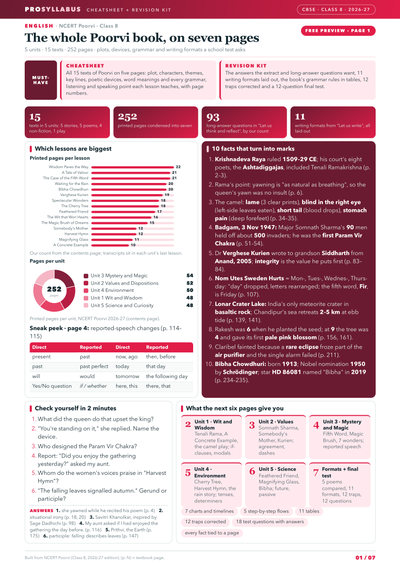
 2
2