ProSyllabusLearn a little. Grow every day.Log in
YOUR STUDY SPACE · CBSE

Sets — Class 11 Mathematics

Mathematics · Chapter 1

173 members in the CBSE community

View all

CBSE Class 11 · MathematicsTrending

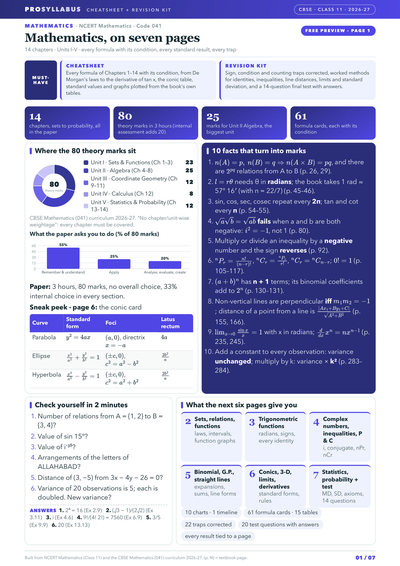
Every formula of Ch 1–14, with its condition
  • Marks booster + cheatsheet: key concepts in 2 lines each, common traps
  • 25 marks: Unit II, Ch 4–8
  • 23 marks: Unit I, Ch 1–3
  • Common traps, corrected
  • Conic table and standard values
  • Graphs plotted from the book's own tables
Page 1 free about 8 min read, Full kit about 55 min read
$ 12₹159$ 12€ 11£ 9CHF 10DKK 83SEK 122NOK 130PLN 47CZK 278AED 47SAR 48QAR 47KWD 3.975OMR 4.989BHD 4.881CA$ 17A$ 19NZ$ 21S$ 16HK$ 101RM 55See the full kit
View all amazing Class 11 Marks Booster kits →

Chapter summary

A set is a well-defined collection of distinct objects, so one can always decide whether a given object belongs to it. Sets are written in roster form, listing elements within braces, or in set-builder form, stating a common property such as . Special number sets recur throughout the book. The empty set has no element; a set is finite or infinite by its count . Two sets are equal when they have exactly the same elements, and means every element of lies in . Intervals like and are subsets of . Operations on sets — union , intersection , difference and complement with respect to a universal set — obey commutative, associative, distributive, idempotent and De Morgan's laws . Venn diagrams picture these relationships, making the theory of sets the foundation for relations, functions and probability that follow.
Sets and their representationsEmpty, finite and infinite setsEqual sets and subsetsIntervals as subsets of \(\mathbb{R}\)Universal set and Venn diagramsUnion, intersection, difference and complementDe Morgan's laws

Key ideas & terms

Set
A well-defined collection of distinct objects; membership can always be decided.
Empty set
A set with no elements, denoted or .
Subset
when every element of is in .
Universal set
The fixed set containing all elements relevant to the discussion.
Union and intersection
; .
Complement
.

Extra questions & answers

What is a set? Give the two ways of representing it.

A set is a well-defined collection of distinct objects. It is represented in roster (tabular) form by listing elements in braces, or in set-builder form by stating a common property of its elements.

Define the empty set and give one example.

A set with no element is the empty set . Example: since is irrational.

When are two sets said to be equal?

Two sets and are equal, , if they have exactly the same elements; repetition and order of listing do not matter.

State the number of subsets of a finite set with elements.

A set with elements has subsets, of which are proper subsets.

Write as an interval.

It is the interval , open at and closed at ; its length is .

State De Morgan's laws.

and : the complement of a union is the intersection of complements and vice versa.

Distinguish a finite from an infinite set.

A set is finite if it is empty or its elements can be counted to a definite natural number ; otherwise it is infinite, e.g. .

Define disjoint sets.

Sets and are disjoint if , i.e. they have no element in common, e.g. and .

List the complement laws for a subset of .

, , , and .

Prove that (absorption law).

Every element of already lies in , so the union adds nothing new; hence .