ProSyllabusLearn a little. Grow every day.Log in
YOUR STUDY SPACE · CBSE

Complex Numbers and Quadratic Equations — Class 11 Mathematics

Mathematics · Chapter 4

173 members in the CBSE community

View all

CBSE Class 11 · MathematicsTrending

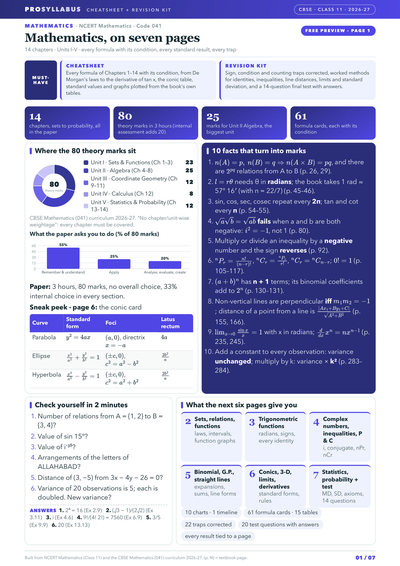
Every formula of Ch 1–14, with its condition
  • Marks booster + cheatsheet: key concepts in 2 lines each, common traps
  • 25 marks: Unit II, Ch 4–8
  • 23 marks: Unit I, Ch 1–3
  • Common traps, corrected
  • Conic table and standard values
  • Graphs plotted from the book's own tables
Page 1 free about 8 min read, Full kit about 55 min read
$ 12₹159$ 12€ 11£ 9CHF 10DKK 83SEK 122NOK 130PLN 47CZK 278AED 47SAR 48QAR 47KWD 3.975OMR 4.989BHD 4.881CA$ 17A$ 19NZ$ 21S$ 16HK$ 101RM 55See the full kit
View all amazing Class 11 Marks Booster kits →

Chapter summary

The real number system is extended so that equations like have solutions. Defining with , a complex number has the form where and . Two complex numbers are equal iff their real and imaginary parts match. Addition, subtraction and multiplication follow term-by-term rules, e.g. , and every non-zero has a multiplicative inverse . Powers of cycle: . The modulus and conjugate satisfy . Addition obeys the closure, commutative, associative laws, with additive identity and additive inverse ; multiplication has identity and is distributive over addition. The square root of a negative number (with ) is , but the rule fails when both are negative. Geometrically a complex number corresponds to the point in the Argand (complex) plane, where the real axis and imaginary axis replace the coordinate axes, is the distance from the origin and is the mirror image of in the real axis. Useful properties include and . These tools provide solutions to quadratic equations whose discriminant is negative.
The imaginary unit and complex numbersEquality, real and imaginary partsAlgebra of complex numbersPowers of \(i\) and square roots of negativesModulus and conjugateArgand plane and geometric representation

Key ideas & terms

Imaginary unit
, so that .
Complex number
with real part and imaginary part .
Conjugate
, the mirror image of in the real axis.
Modulus
, the distance of from the origin; .
Multiplicative inverse
for .
Argand plane
The plane in which is plotted as the point .

Extra questions & answers

Define a complex number and name its parts.

A number with ; is the real part and is the imaginary part .

Multiply .

.

Find the multiplicative inverse of .

, since .

State the cycle of powers of .

For any integer : .

When are two complex numbers equal?

iff and , i.e. real parts equal and imaginary parts equal.

Define the modulus and conjugate of .

The modulus is and the conjugate is ; together .

Express in the form .

Multiplying by the conjugate, — i.e. it simplifies to .

Why does fail for two negatives?

If and , then ; the identity holds only when at least one of is non-negative.

What does the conjugate represent in the Argand plane?

If is the point , then is its mirror image across the real axis.

State the property and .

and .