ProSyllabusLearn a little. Grow every day.Log in
YOUR STUDY SPACE · CBSE

Probability — Class 11 Mathematics

Mathematics · Chapter 14

173 members in the CBSE community

View all

CBSE Class 11 · MathematicsTrending

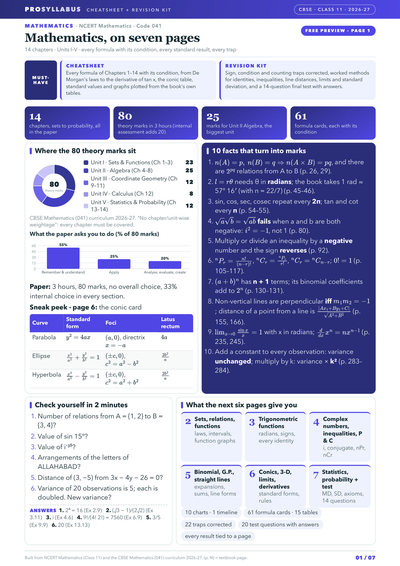
Every formula of Ch 1–14, with its condition
  • Marks booster + cheatsheet: key concepts in 2 lines each, common traps
  • 25 marks: Unit II, Ch 4–8
  • 23 marks: Unit I, Ch 1–3
  • Common traps, corrected
  • Conic table and standard values
  • Graphs plotted from the book's own tables
Page 1 free about 8 min read, Full kit about 55 min read
$ 12₹159$ 12€ 11£ 9CHF 10DKK 83SEK 122NOK 130PLN 47CZK 278AED 47SAR 48QAR 47KWD 3.975OMR 4.989BHD 4.881CA$ 17A$ 19NZ$ 21S$ 16HK$ 101RM 55See the full kit
View all amazing Class 11 Marks Booster kits →

Chapter summary

Building on random experiments and sample spaces, this chapter takes the axiomatic approach to probability. Any subset of the sample space is an event; is the impossible event and the sure event. Events combine like sets: is "A or B", is "A and B", is "not A", and is "A but not B". Two events are mutually exclusive if , and a collection is exhaustive if its union is . Probability assigns to each event a number satisfying , , and for mutually exclusive events, from which . For equally likely outcomes . General results include the addition rule and the complement rule . These let us compute chances for coins, dice, cards and selections.
Events and types of eventsAlgebra of eventsMutually exclusive and exhaustive eventsAxiomatic approach to probabilityProbability of equally likely outcomesAddition and complement rules

Key ideas & terms

Event
Any subset of the sample space .
Impossible and sure events
is impossible; is the sure event.
Mutually exclusive events
Events with that cannot occur together.
Exhaustive events
Events whose union is the whole sample space .
Equally likely outcomes
Outcomes with the same probability, so .
Addition rule
.

Extra questions & answers

What is an event in probability?

Any subset of the sample space of a random experiment.

Define the impossible and sure events.

The empty set is the impossible event; the whole sample space is the sure event.

When are two events mutually exclusive?

When they cannot occur simultaneously, i.e. (disjoint sets).

State the axioms of probability.

For every event , ; ; and for mutually exclusive , . It follows that .

Give the probability for equally likely outcomes.

.

State the addition rule for any two events.

; if mutually exclusive, .

State the complement rule.

.

One card is drawn from 52. Find the probability it is a diamond.

There are 13 diamonds, so .

A coin is tossed twice. Find the probability of at least one tail.

Sample space ; favourable , so .

When are events exhaustive and mutually exclusive together?

When and for all .

Write the formula for the theoretical probability of an event E.

.

What is the probability of a sure event and of an impossible event?

for a sure (certain) event and for an impossible event.

What is the range of the probability of any event?

The probability of any event lies between 0 and 1, that is .

What are complementary events, and how are their probabilities related?

An event and "not " are complementary; , so .

A die is thrown once. What is the probability of getting an even number?

Favourable outcomes are 2, 4, 6 (three of them) out of six, so .

A card is drawn from a well-shuffled pack of 52. What is the probability that it is a king?

There are 4 kings, so .

Two coins are tossed together. What is the probability of getting two heads?

The outcomes are HH, HT, TH, TT; only one is favourable, so .

If the probability of an event is 0.7, what is the probability of its not happening?

.