ProSyllabusLearn a little. Grow every day.Log in
YOUR STUDY SPACE · CBSE

Permutations and Combinations — Class 11 Mathematics

Mathematics · Chapter 6

173 members in the CBSE community

View all

CBSE Class 11 · MathematicsTrending

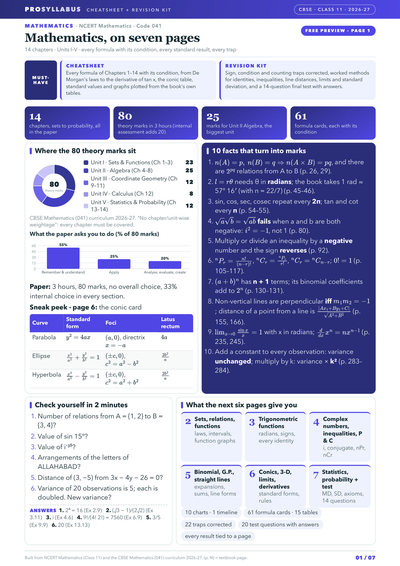
Every formula of Ch 1–14, with its condition
  • Marks booster + cheatsheet: key concepts in 2 lines each, common traps
  • 25 marks: Unit II, Ch 4–8
  • 23 marks: Unit I, Ch 1–3
  • Common traps, corrected
  • Conic table and standard values
  • Graphs plotted from the book's own tables
Page 1 free about 8 min read, Full kit about 55 min read
$ 12₹159$ 12€ 11£ 9CHF 10DKK 83SEK 122NOK 130PLN 47CZK 278AED 47SAR 48QAR 47KWD 3.975OMR 4.989BHD 4.881CA$ 17A$ 19NZ$ 21S$ 16HK$ 101RM 55See the full kit
View all amazing Class 11 Marks Booster kits →

Chapter summary

This chapter develops counting techniques. The fundamental principle of counting (multiplication principle) states that if one event can occur in ways and a following event in ways, the two together occur in ways. A permutation is an arrangement in a definite order; the number of permutations of distinct objects taken at a time is , where and . When repetition is allowed there are arrangements, and when some objects repeat ( of each kind) the count is . A combination is a selection where order does not matter; the number of combinations is . Key relations include , , and the Pascal rule . Selecting objects out of is the same as rejecting the remaining , which explains the symmetry of . These ideas count three-digit numbers, signals from flags, words formed from the letters of a given word, committees with conditions, card hands drawn from a deck, and arrangements where some objects must stay together or apart.
Fundamental principle of countingFactorial notationPermutations of distinct objectsPermutations with repetition and with like objectsCombinationsRelations between \({}^{n}P_r\) and \({}^{n}C_r\)

Key ideas & terms

Fundamental principle of counting
If one event occurs in ways and another in ways, both occur in ways.
Factorial
, with .
Permutation
An ordered arrangement; .
Combination
A selection without order; .
Permutations with repetition
arrangements when repetition of objects is allowed.
Like objects
With repeated objects, arrangements .

Extra questions & answers

State the fundamental principle of counting.

If an event can occur in ways and a following event in ways, the total number of ways the events occur in order is ; this extends to any finite number of events.

Write the formula for and the meaning of .

for , and by convention so that and .

How many 3-letter words (no repetition) come from ROSE's letters?

Choosing ordered letters from 4: words.

Distinguish a permutation from a combination.

A permutation counts arrangements where order matters; a combination counts selections where order does not matter. .

State the relation and .

, since choosing objects is equivalent to rejecting .

Prove .

Each combination of objects can be ordered in ways, producing all permutations, so .

How many arrangements has the word ALLAHABAD (9 letters, 4 A, 2 L)?

arrangements.

In how many ways can a committee of 3 be chosen from 5 people?

ways.

State the Pascal identity .

.

How many 4-letter words come from EQUATION using each letter once?

All 8 letters are distinct, so 4-letter words .