ProSyllabusLearn a little. Grow every day.Log in
YOUR STUDY SPACE · CBSE

Binomial Theorem — Class 11 Mathematics

Mathematics · Chapter 7

173 members in the CBSE community

View all

CBSE Class 11 · MathematicsTrending

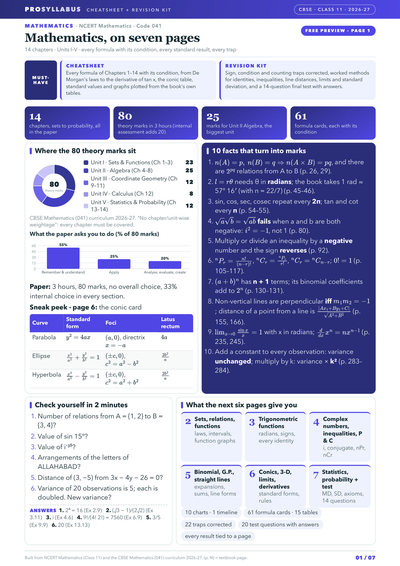
Every formula of Ch 1–14, with its condition
  • Marks booster + cheatsheet: key concepts in 2 lines each, common traps
  • 25 marks: Unit II, Ch 4–8
  • 23 marks: Unit I, Ch 1–3
  • Common traps, corrected
  • Conic table and standard values
  • Graphs plotted from the book's own tables
Page 1 free about 8 min read, Full kit about 55 min read
$ 12₹159$ 12€ 11£ 9CHF 10DKK 83SEK 122NOK 130PLN 47CZK 278AED 47SAR 48QAR 47KWD 3.975OMR 4.989BHD 4.881CA$ 17A$ 19NZ$ 21S$ 16HK$ 101RM 55See the full kit
View all amazing Class 11 Marks Booster kits →

Chapter summary

The binomial theorem gives an efficient way to expand for a positive integer without repeated multiplication. The expansion is , written compactly as . It has terms; the power of decreases from to while the power of increases from to , and the index sum stays in every term. The coefficients are the binomial coefficients, the same numbers that form Pascal's triangle, where each entry is the sum of the two above it. Special cases include , so that putting gives and gives the alternating sum . The binomial coefficients are generated by the Pascal rule , so each row of the triangle can be written from the one above without expanding. The theorem is proved by the principle of mathematical induction. It is used to compute powers like and , compare magnitudes such as versus , and prove divisibility results, for instance that leaves remainder 1 when divided by 25.
Binomial theorem for positive integral indicesBinomial coefficientsPascal's triangleGeneral observations on the expansionSpecial cases \((1\pm x)^n\)Applications: evaluation and divisibility

Key ideas & terms

Binomial theorem
for positive integer .
Binomial coefficient
The coefficient of each term.
Pascal's triangle
A triangular array of binomial coefficients; each entry is the sum of the two directly above it.
Number of terms
The expansion of has terms.
Index sum
In each term the powers of and add up to .
Special case
.

Extra questions & answers

State the binomial theorem for a positive integer .

.

How many terms are in the expansion of ?

There are terms, one more than the index .

What is Pascal's triangle?

A triangular arrangement of binomial coefficients in which 1s border each row and every interior entry equals the sum of the two entries above it.

Expand .

.

Show that .

Put in the theorem (or in ): .

Write the expansion of .

.

Evaluate using the theorem.

Write and expand to get .

State the property of binomial coefficients used to build Pascal's triangle.

, so each row is generated from the previous one.

Put in : what identity results?

, the alternating sum of binomial coefficients is zero.

Why is ?

Writing .