ProSyllabusLearn a little. Grow every day.Log in
YOUR STUDY SPACE · CBSE

Limits and Derivatives — Class 11 Mathematics

Mathematics · Chapter 12

173 members in the CBSE community

View all

CBSE Class 11 · MathematicsTrending

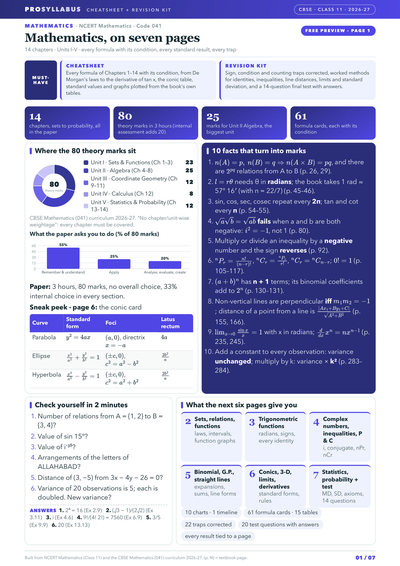
Every formula of Ch 1–14, with its condition
  • Marks booster + cheatsheet: key concepts in 2 lines each, common traps
  • 25 marks: Unit II, Ch 4–8
  • 23 marks: Unit I, Ch 1–3
  • Common traps, corrected
  • Conic table and standard values
  • Graphs plotted from the book's own tables
Page 1 free about 8 min read, Full kit about 55 min read
$ 12₹159$ 12€ 11£ 9CHF 10DKK 83SEK 122NOK 130PLN 47CZK 278AED 47SAR 48QAR 47KWD 3.975OMR 4.989BHD 4.881CA$ 17A$ 19NZ$ 21S$ 16HK$ 101RM 55See the full kit
View all amazing Class 11 Marks Booster kits →

Chapter summary

This chapter introduces calculus, the study of change. Starting from average velocities of a falling body, it builds an intuitive idea of the derivative as an instantaneous rate of change. The limit is the value approaches as approaches ; it exists only when the left-hand limit and right-hand limit coincide. Algebra of limits lets the limit of a sum, difference, product or quotient be computed from the limits of the parts; for polynomials and rational functions the limit is found by substitution (where the denominator is non-zero). Two standard trigonometric limits are and . The derivative of at is defined from first principles as . The algebra of derivatives gives sum, difference, product and quotient rules, and yields standard results such as , and .
Intuitive idea of the derivativeLimits: left- and right-hand limitsAlgebra of limitsLimits of polynomials and rational functionsLimits of trigonometric functionsDerivative from first principles and algebra of derivatives

Key ideas & terms

Limit
means approaches as approaches .
Left- and right-hand limits
The values approached as and ; the limit exists when they are equal.
Algebra of limits
Limit of a sum, difference, product or quotient equals the corresponding combination of the limits.
Standard trig limit
and .
Derivative (first principle)
.
Standard derivatives
, , .

Extra questions & answers

What does mean?

As takes values closer and closer to (from either side), gets arbitrarily close to .

When does a limit at exist?

The limit exists iff the left-hand limit and the right-hand limit at are equal.

How is the limit of a polynomial at found?

By direct substitution: for a polynomial function.

State the two standard trigonometric limits.

and .

Define the derivative of at from first principles.

, when this limit exists.

State the product rule for derivatives.

.

State the quotient rule for derivatives.

, where .

Give the derivative of .

for a positive integer .

Find the derivative of and .

and .

What is the derivative of at ?

From first principles it equals , i.e. .