ProSyllabus Journal CBSE Class 11 Annual Assessment Complete Summary and Solutions for Some Aspects of Indo-Islamic Architecture – NCERT Class XI Fine Arts, Chapter 8 – Explanation, Questions, Answers Detailed summary and explanation of Chapter 8 'Some Aspects of Indo-Islamic Architecture' from the NCERT Fine Arts textbook for Class XI, covering the development and distinctive features of Indo-Islamic architecture, including the evolution of mosque and tomb architecture, the influence of Persian, Central Asian, and local Indian styles, notable monuments such as the Qutub Minar, Tughlaq Tombs, Fatehpur Sikri, and the Qutub Shahi monuments. Discusses architectural innovations, decorative arts, and the fusion of traditional Indian and Islamic styles, along with all NCERT questions, answers, and exercises.
Updated 11 months ago NCERT · Class XI · Fine Arts · Chapter 8 · Indo-Islamic Architecture · Mughal Architecture · Sultanate Architecture · Monumental Constructions · Architectural Features · Summary · Questions · Answers · Explanation
#Indo-Islamic Architecture #Mughal Mosques #Tombs #Qutub Minar #Fatehpur Sikri #Mughal Art #Islamic Architecture #Indian Heritage #NCERT #Class 11 #Summary #Explanation #Questions #Answers #Chapter 8
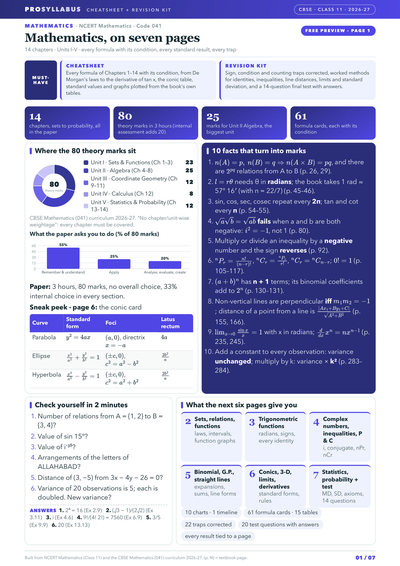
Marks booster + cheatsheet: key concepts in 2 lines each, common traps 25 marks: Unit II, Ch 4–8 23 marks: Unit I, Ch 1–3 Common traps, corrected Conic table and standard values Graphs plotted from the book's own tables Page 1 free about 8 min read , Full kit about 55 min read ₹159
Read page 1 free Get the kit Get the kit One payment · instant PDF · ₹159 View details
Some Aspects of Indo-Islamic Architecture - Class 11 Art Chapter 8 Ultimate Study Guide 2025
Full Chapter Summary & Detailed Notes
Key Definitions & Terms
Text Book Questions & Answers
Key Concepts
Historical Perspectives
Visual Analysis Examples
Interactive Quiz (10 Q)
Quick Revision Notes & Mnemonics
Key Terms & Processes
Artistic Techniques Step-by-Step
Full Chapter Summary & Detailed Notes - Indo-Islamic Architecture Class 11 NCERT
Overview & Key Concepts
Chapter Goal : Examine the evolution of Indo-Islamic architecture as a fusion of Persian/Turkish/Indian styles from 7th-18th centuries. Exam Focus: Styles (Imperial, Provincial, Mughal, Deccani), structures (forts, minars, tombs, mosques), techniques (arches, domes, jali). 2025 Updates: Digital heritage mapping, conservation of Taj Mahal. Fun Fact: Qutub Minar (13th c.) symbolizes power; Taj Mahal's symmetry is mathematically perfect. Core Idea: Syncretic blend via acceptance/modification of local elements.Wider Scope : From migrations to regional adaptations; sources: Maps (Delhi Sultanate sites), visuals (Taj Mahal, Gol Gumbad), activities (project on local monuments), think/reflect (forts as power symbols).Expanded Content : Include modern influences like Indo-Saracenic revival; point-wise for recall; add 2025 relevance like UNESCO sites (Taj, Qutub).
Introduction to Indo-Islamic Evolution
Definition : Fusion of Islamic (arcuate: arches/domes) with Indian (trabeate: pillars/lintels) forms; spread via merchants/conquerors (7th-13th c.).Purpose : Religious (mosques/tombs), secular (forts/sarais); absorb local traditions for syncretic styles.Periods : Delhi Sultanate (Imperial), Provincial (e.g., Mandu), Mughal (Taj), Deccani (Gol Gumbad).Example : Qutub Minar (red sandstone, inscriptions); Hindu motifs in Muslim art vs. arabesque in Islamic.Expanded : Evidence: Inscriptions/excavations; debates: Indo-Saracenic nomenclature; real: 600 years of gradual integration.
Conceptual Diagram: Architectural Styles Map (Page 110)
Outline map: Imperial (Delhi), Provincial (Mandu/Gujarat), Mughal (Agra/Lahore), Deccani (Bijapur); visualizes regional fusions.
Why This Guide Stands Out
Comprehensive: All styles/structures point-wise, visual integrations; 2025 with conservation (e.g., pollution effects on Taj), analyzed for cultural syncretism.
Typologies and Categories
Typologies : Religious (Jama Masjids, dargahs), secular (forts, sarais, gardens); built by rulers/merchants.Categories : Imperial (Delhi Sultanate), Provincial (Bengal/Jaunpur/Gujarat/Mandu), Mughal (Agra/Delhi), Deccani (Bijapur/Golconda).Influences : Local (toranas, jali) + Persian (arabesque); Gujarat: Temple motifs in mihrabs.Expanded : Evidence: Sarkhej dargah (marble, Mughal influence); debates: Regional vs. central styles.
Decorative Forms and Materials
Decorations : Stucco, tiles (blue/turquoise), pietra dura, calligraphy; motifs: Lotus fringe, arabesque, jali screens.Materials : Rubble masonry, chunam plaster, sandstone/marble; later bricks for flexibility.Techniques : Arches (voussoirs/keystones), domes (pendentives/squinches); foliated arches from 16th c.Activity : Analyze Taj visuals (symmetry, inlays); reflect on syncretism (Hindu lotus in Islamic dome).Expanded : Evidence: Lapis lazuli in canopies; debates: Functionality vs. aesthetics; real: Tessellation in Agra panels.
Exam Activities
Observe structures (Q1); report on local sites (Project); modern adaptations (Q5).
Major Structures
Forts : Chittor/Gwalior/Daulatabad/Golconda; strategic (concentric walls, labyrinths).Minars : Qutub (234 ft, balconies); Chand (210 ft, tiles).Tombs : Humayun/Itmaduddaula; charbagh gardens for paradise imagery.Sarais : Traveler inns for cultural exchange.Mandu : Provincial; Hindola/Jahaaz Mahals (airy, nature-adapted).Taj Mahal : Mughal pinnacle; symmetry, marble, Quranic calligraphy.Gol Gumbad : Deccani; massive dome (2nd largest), whispering gallery.Jama Masjid : Congregational; courtyard, mihrab, minarets.
Summary Key Points
Styles: Imperial (Delhi), Provincial (Mandu), Mughal (Taj), Deccani (Gol); Structures: Forts (power), Tombs (paradise), Mosques (prayers); Techniques: Arches/domes/jali.
Impact: Cultural fusion, regional adaptations; challenges: Material limitations, environmental adaptation.
Project & Group Ideas
Group: Model Taj charbagh; individual: Local monument report (e.g., Qutub).
Debate: Syncretism vs. purity in architecture.
Ethical role-play: Taj conservation vs. tourism.
Key Definitions & Terms - Complete Glossary
All terms from chapter/glossary (pages 126-131); detailed with examples, relevance. Expanded: 30+ terms grouped by subtopic; added advanced like "Charbagh", "Pietra Dura" for depth/easy flashcards.
Indo-Islamic
Fusion of Indian/Islamic styles. Ex: Arches + trabeate. Relevance: Syncretic evolution.
Arcuate
Arch/dome construction. Ex: Voussoirs in Qutub. Relevance: Spans large spaces.
Trabeate
Pillars/lintels for flat roofs. Ex: Pre-Islamic temples. Relevance: Indian base.
Delhi Sultanate
Imperial style (13th c.). Ex: Qutub Minar. Relevance: Turkish conquest start.
Provincial Style
Regional (Mandu/Gujarat). Ex: Toranas in mihrabs. Relevance: Local adaptations.
Mughal Style
Agra/Delhi (16th-17th c.). Ex: Taj Mahal symmetry. Relevance: Pinnacle of fusion.
Deccani Style
Bijapur/Golconda. Ex: Gol Gumbad dome. Relevance: Persian + local.
Jali
Perforated screens. Ex: Amer Fort lattice. Relevance: Light/shade effects.
Pietra Dura
Semi-precious inlays. Ex: Taj floral motifs. Relevance: Surface decoration.
Charbagh
Four-part garden. Ex: Taj/Humayun tombs. Relevance: Paradise imagery.
Mihrab
Prayer niche to Mecca. Ex: Jama Masjid. Relevance: Qibla direction.
Dome
On pendentives/squinches. Ex: Gol Gumbad (125 ft dia.). Relevance: Spans interiors.
Minar
Tower for azan/power. Ex: Qutub (234 ft). Relevance: Symbol of might.
Sarai
Traveler inn. Ex: Roadside squares. Relevance: Cultural exchange.
Fort
Embattled power seat. Ex: Daulatabad labyrinth. Relevance: Strategic defense.
Arabesque
Intertwined floral lines. Ex: Plaster designs. Relevance: Non-figural Islamic art.
Calligraphy
Decorative Quranic script. Ex: Taj walls. Relevance: Spiritual connection.
Voussoir
Interlocking arch blocks. Ex: Pointed arches. Relevance: Load-bearing.
Pendentive
Triangular dome support. Ex: Tomb domes. Relevance: Square to circle transition.
Squinch
Corner arch for dome. Ex: Early mosques. Relevance: Spanning angles.
Stucco
Incised plaster designs. Ex: Floral motifs. Relevance: Surface decoration.
Tessellation
Mosaic tile patterns. Ex: Dado panels. Relevance: Colorful walls.
Chunam
Limestone plaster casing. Ex: Thick walls. Relevance: Finishing rubble.
Batter
Wall slope for stability. Ex: Hindola Mahal. Relevance: Illusion of swing.
Trefoil
Three-lobed arch. Ex: 16th c. onwards. Relevance: Foliated designs.
Spandrel
Arch space decoration. Ex: Medallions/bosses. Relevance: Ornamental fill.
Chatri
Pillared cupola. Ex: Dome tops. Relevance: Mughal skyline.
Dargah
Sufi saint shrine. Ex: Sarkhej. Relevance: Devotional site.
Madrasa
Islamic school. Ex: Asharfi Mahal (ruins). Relevance: Educational architecture.
Kos Minar
Milestone tower. Ex: Road markers. Relevance: Travel aids.
Hammam
Bathhouse. Ex: Palace complexes. Relevance: Hygiene/pleasure.
Naqqar Khana
Drum house for music. Ex: Gateways. Relevance: Ceremonial entry.
Mimbar
Pulpit for khutba. Ex: Jama Masjid. Relevance: Friday sermons.
Maqsurah
Royal prayer screen. Ex: Mosque enclosures. Relevance: Privacy.
Indo-Saracenic
Alternative name for style. Ex: British colonial revival. Relevance: Multi-style category.
Tip: Group by category/structure; examples for recall. Depth: Glossary links (e.g., arabesque). Errors: Confuse arcuate/trabeate. Interlinks: To Mughal chapter. Advanced: Structural engineering. Real-Life: Taj tourism. Graphs: Timeline of styles. Coherent: Fusion → Adaptation. For easy learning: Flashcard per term with example.
Text Book Questions & Answers - NCERT Exercises (Page 125)
Direct from chapter exercises. Answers based on content, point-wise for exams.
Discussion Questions
1. What do you understand by the term ‘Indo-Islamic’ or ‘Indo-Saracenic’ architecture? Can you think of another nomenclature? How did this architecture evolve in India?
Answer:
Fusion of Indian (trabeate) + Islamic (arcuate) via acceptance/modification; alternative: Syncretic Islamic.
Evolution: 7th-8th c. merchants, 13th c. Sultanate large-scale; gradual blend (arches/domes + jali).
2. What types of buildings were added in India in the thirteenth century?
Answer:
Mosques, Jama Masjids, tombs, dargahs, minars, hammams, gardens, madrasas, sarais, Kos minars.
Additions to existing sub-continent types; religious/secular necessities.
3. Name four styles of Indo-Islamic architecture.
Answer:
Imperial (Delhi Sultanate), Provincial (Mandu/Gujarat/Bengal/Jaunpur), Mughal (Delhi/Agra/Lahore), Deccani (Bijapur/Golconda).
4. What was the significance of a fort in medieval India? What were the strategic devices adopted in the construction of forts to confuse or defeat the enemy?
Answer:
Symbol of power; capture meant suzerainty loss.
Devices: Heights for view, concentric walls (Golconda), staggered entrances (Daulatabad), labyrinths, twin forts.
5. Which forms of secular architecture evolved during medieval times? What significance did these buildings have in the socio-cultural lives of contemporary people?
Answer:
Forts, sarais, hammams, gardens, pavilions, bazaars.
Significance: Trade/cultural exchange (sarais), power/awe (forts), syncretic interactions.
6. How does Mandu showcase the fact that humans adapt to their environment?
Answer:
2000 ft elevation, airy pavilions (Hindola/Jahaaz) to avoid heat; local stone/marble, reservoirs, nature views (Rupmati Pavilion).
7. In spite of being unfinished how does Gol Gumbad symbolise the grandeur and majesty of Indo-Islamic architecture?
Answer:
Massive dome (125 ft dia., 2nd largest), 135 ft walls, whispering gallery, seven-storey towers; Deccani fusion with Persian proportions.
8. Which are the places where the dead are buried? How do these differ from each other?
Answer:
Tombs (royalty: charbagh, paradise motifs), dargahs (saints: devotional).
Differ: Tombs grand/symmetric (Taj), dargahs regional/simple (Sarkhej).
9. Why is the word ‘perfection’ associated with the Taj Mahal?
Answer:
Orderly plan, perfect symmetry/proportions (186 ft sides), marble ethereal quality, river/bagh setting, double dome void.
Project
Document a medieval structure: Period, Typology, Purpose, Forms, Decorations, Materials, Conservation.
Example:
Structure: Qutub Minar; Mughal, Minar (secular/religious), Azaan/power, Tapering storeys/balconies, Inscriptions/foliated, Sandstone/marble, Conserved (UNESCO).
Tip: Practice project (table format); full marks: Visuals + analysis.
Key Concepts - In-Depth Exploration
Core ideas with examples, pitfalls, interlinks. Expanded: All concepts with steps/examples/pitfalls.
Syncretism
Steps: 1. Absorb local (jali), 2. Modify Islamic (arabesque). Ex: Gujarat toranas in mihrabs. Pitfall: Overlook Indian roots. Interlink: Styles. Depth: Cultural acceptance.
Arcuate Innovation
Steps: 1. Voussoirs interlock, 2. Keystone locks. Ex: Domes on pendentives. Pitfall: Confuse with trabeate. Interlink: Materials. Depth: Spanning free interiors.
Paradise Imagery
Steps: 1. Quranic verses, 2. Charbagh/water. Ex: Taj/Humayun tombs. Pitfall: Ignore socio-political. Interlink: Tombs. Depth: Eternal reward + majesty.
Regional Adaptation
Steps: 1. Local materials, 2. Environment (airy Mandu). Ex: Marble in Gujarat. Pitfall: Uniform view. Interlink: Provincial. Depth: Patrons' aesthetics.
Surface Decoration
Steps: 1. Stucco incision, 2. Tile tessellation. Ex: Pietra dura in Taj. Pitfall: Neglect structure. Interlink: Motifs. Depth: Non-figural Islamic + floral Indian.
Power Symbolism
Steps: 1. Monumental scale, 2. Heights/embattlements. Ex: Qutub Minar. Pitfall: Ritual only. Interlink: Forts/minars. Depth: Awe in people.
Cultural Exchange
Steps: 1. Sarais for travelers, 2. Cross-interactions. Ex: Varied backgrounds. Pitfall: Elite focus. Interlink: Common structures. Depth: Syncretic mores.
Structural Majesty
Steps: 1. Thick rubble walls, 2. Domes/drums. Ex: Gol Gumbad acoustics. Pitfall: Aesthetic over engineering. Interlink: Deccani. Depth: Timurid proportions.
Symmetry/Perfection
Steps: 1. Chamfered square, 2. Proportional elevations. Ex: Taj 186 ft sides. Pitfall: Over-romanticize. Interlink: Mughal. Depth: Ethereal marble.
Strategic Defense
Steps: 1. Concentric circles, 2. Labyrinth paths. Ex: Daulatabad elephants-proof. Pitfall: Ignore palaces inside. Interlink: Forts. Depth: Topography use.
Non-Royal Spaces
Steps: 1. Khanqahs/dargahs, 2. Bazaar pavilions. Ex: Sufi hermitages. Pitfall: Royal bias. Interlink: Social. Depth: Style convergence.
Environmental Harmony
Steps: 1. Elevated sites, 2. Water reservoirs. Ex: Mandu monsoon pleasure. Pitfall: Monumental only. Interlink: Provincial. Depth: Light/airy designs.
Acoustical Features
Steps: 1. Dome drum gallery, 2. Echo magnification. Ex: Gol Gumbad whispers. Pitfall: Overlook tech. Interlink: Deccani. Depth: Architectural innovation.
Calligraphic Connection
Steps: 1. Jasper inlay, 2. Quranic verses. Ex: Taj walls. Pitfall: Decorative only. Interlink: Decoration. Depth: Almighty link.
Advanced: Engineering analysis, motif evolution. Pitfalls: Style confusion. Interlinks: To temple architecture. Real: VR Taj tours. Depth: 14 concepts. Examples: Real structures. Graphs: Style timelines. Errors: Regional mix. Tips: Steps + evidence; compare tables (styles/structures).
Historical Perspectives - Detailed Guide
Evolution of styles/discoveries; expanded with points; links to patrons/debates. Added global context, Indian milestones.
Early Spread (7th-8th c.)
Merchants to Sind/Gujarat; small builds. Turkish conquest (13th c.) large-scale. Depth: Gradual arcuate intro.
Imperial Era (13th-16th c.)
Delhi Sultanate; Qutub Minar. Tughlaq/Humayun tombs. Depth: Power consolidation.
Provincial Flourish (14th-16th c.)
Mandu (Ghauri Dynasty); Gujarat regional. Bengal/Jaunpur distinct. Depth: Local temple influences.
Mughal Golden Age (16th-18th c.)
Shah Jahan Taj (1632-53); 20k workers. Humayun charbagh pioneer. Depth: Persian + Indian perfection.
Deccani Independence (15th-17th c.)
Adil Shahi Gol Gumbad (unfinished). Bijapur majesty. Depth: Timurid structural feats.
Modern Conservation (2025)
UNESCO Taj/Qutub; pollution controls. Digital restorations. Depth: Global heritage protection.
Tip: Link to patron timelines. Depth: Reflexive conquests. Examples: Baz Bahadur romance. Graphs: Century chronology. Advanced: Post-2025 sustainability. Easy: Bullets impacts.
Visual Analysis Examples - From Text with Simple Explanations
Expanded with evidence, interpretations; focus on appreciation, analysis. Added Taj/Gol breakdowns.
Example 1: Taj Mahal Symmetry Analysis
Simple Explanation: Perfect harmony.
Step 1: Charbagh entry frames tomb.
Step 2: Chamfered square + deep arches.
Step 3: 186 ft proportions, double dome.
Step 4: Marble patina hues, jali light.
Simple Way: Frame → Balance → Ethereal glow.
Example 2: Gol Gumbad Dome Appreciation
Simple Explanation: Majestic scale.
Step 1: 135 ft basalt walls.
Step 2: 125 ft dome on pendentives.
Step 3: Whispering gallery echoes.
Step 4: Seven-storey towers, foliated drum.
Simple Way: Wall → Dome → Sound magic.
Example 3: Qutub Minar Tapering
Simple Explanation: Soaring power.
Step 1: 234 ft polygonal/circular.
Step 2: Red/buff sandstone balconies.
Step 3: Inscriptions + foliated bands.
Step 4: Symbol of saint/ruler might.
Simple Way: Base wide → Taper high → Gaze up.
Example 4: Mandu Jahaaz Mahal Adaptation
Simple Explanation: Nature blend.
Step 1: Ship between reservoirs.
Step 2: Open pavilions/balconies overhang water.
Step 3: Terrace pool, airy to beat heat.
Step 4: Pleasure harem with views.
Simple Way: Float → Overhang → Cool escape.
Example 5: Fort Labyrinth Defense
Simple Explanation: Enemy confound.
Step 1: Concentric walls (Golconda).
Step 2: Staggered gates (Daulatabad).
Step 3: Labyrinth paths to falls.
Step 4: Heights for unscalable (Gwalior).
Simple Way: Circle → Stagger → Trap maze.
Example 6: Pietra Dura Inlay
Simple Explanation: Gem-like motifs.
Step 1: Semi-precious slices (jade/jasper).
Step 2: Inlay floral arabesques.
Step 3: Taj walls/tombstones.
Step 4: Contrasts white marble.
Simple Way: Slice → Embed → Bloom color.
Tip: Practice self-appreciate; troubleshoot (e.g., syncretism in motifs). Added for structures, decorations.
Interactive Quiz - Master Indo-Islamic Architecture
10 MCQs in full sentences; 80%+ goal. Covers styles, structures, techniques.
Start Quiz
Quick Revision Notes & Mnemonics
Concise summaries for subtopics. Tables for scan: Key points, examples, mnemonics. Covers styles, structures, techniques.
Subtopic
Key Points
Examples
Mnemonics/Tips
Styles Imperial : Delhi Sultanate arches.Provincial : Mandu regional.Mughal : Taj symmetry.Deccani : Gol dome.Qutub; Hindola; Taj; Gol Gumbad.
IPMD (Imperial, Provincial, Mughal, Deccani). Tip: "India's Proud Mughals Dominate" – Style sequence.
Structures Forts : Strategic labyrinths.Minars : Azaan/power towers.Tombs : Charbagh paradise.Mosques : Courtyards/mihrabs.Daulatabad; Qutub; Taj; Jama.
FMTM (Forts, Minars, Tombs, Mosques). Tip: "Fight Mighty Towers Magnificently" – Core builds.
Techniques Arches : Voussoirs/trefoil.Domes : Pendentives/squinches.Decor : Jali/pietra dura.Pointed arches; Gol dome; Taj inlays.
ADP (Arches, Domes, Pietra). Tip: "Arch Dome Perfectly" – Fusion keys.
Materials Stone : Sandstone/marble.Plaster : Chunam/stucco. Later flexibility. Red Taj marble; Mandu local.
SPC (Stone, Plaster, Chunam). Tip: "Strong Palaces Charm" – Build basics.
Motifs Islamic : Arabesque/calligraphy.Indian : Lotus/jali.Fusion : Foliated arches.Taj verses; Amer screens.
ICF (Islamic, Calligraphy, Fusion). Tip: "Intertwine Curves Flow" – Decor blend.
Overall Tip: Use IPMD-FMTM-ADP-SPC-ICF for full scan (5 mins). Flashcards: Front (term), Back (points + mnemonic). Print table for wall revision. Covers 100% chapter – easy for exams!
Key Terms & Processes - All Key
Expanded table 30+ rows; quick ref. Added advanced (e.g., Pendentive, Charbagh). Overflow fixed.
Term/Process Description Example Usage
Indo-Islamic Indian-Islamic fusion Qutub Minar Syncretic style Arcuate Arch/dome build Voussoirs arches Span spaces Trabeate Pillar/lintel support Flat roofs Pre-Islamic Delhi Sultanate Imperial 13th c. Qutub Turkish start Provincial Regional adaptations Mandu toranas Local motifs Mughal 16th-18th c. perfection Taj symmetry Fusion peak Deccani Bijapur/Golconda Gol dome Persian local Jali Perforated screen Amer lattice Light effects Pietra Dura Gem inlays Taj florals Surface decor Charbagh Four gardens Taj layout Paradise Mihrab Mecca niche Jama Masjid Prayer dir. Dome On pendentives Gol 125 ft Interior span Minar Azaan tower Qutub 234 ft Might symbol Sarai Traveler inn Road squares Exchange Fort Power seat Daulatabad maze Defense Arabesque Floral lines Plaster motifs Non-figural Calligraphy Quranic script Taj jasper Spiritual Voussoir Arch wedge Pointed arches Load bear Pendentive Dome triangle Tomb supports Square-circle Squinch Corner arch Early domes Angle span Stucco Incised plaster Flower designs Surface Tessellation Tile mosaic Dado panels Colors Chunam Lime plaster Wall casing Finish Batter Wall slope Hindola swing Stability Trefoil Three-lobe arch 16th c. folios Design Spandrel Arch space Medallions Ornament Chatri Pillared cupola Dome tops Skyline Dargah Saint shrine Sarkhej Devotion Madrasa School Asharfi ruins Education Kos Minar Milestone Road towers Travel Hammam Bath Palaces Hygiene Naqqar Khana Music drum Gates Ceremony Mimbar Sermon pulpit Jama Khutba Maqsurah Royal screen Mosques Privacy Indo-Saracenic Style name Colonial revival Multi-fusion
Tip: Examples memory; sort subtopic. Easy: Table scan. Added 10 rows depth.
Artistic Techniques Step-by-Step
Step-by-step breakdowns of core processes. Visual descriptions for easy understanding; actionable steps with examples.
Process 1: Arch Construction
Step 1: Shape voussoirs (wedges).
Step 2: Interlock in curve.
Step 3: Fit keystone at top.
Step 4: Add trefoil foliation (16th c.).
Step 5: Decorate spandrels (medallions).
Visual: Wedge → Curve → Lock strong.
Process 2: Dome Erection
Step 1: Square base pendentives.
Step 2: Squinch corners if needed.
Step 3: Build drum circular.
Step 4: Hemispherical masonry.
Step 5: Top with lotus/pinnacle.
Visual: Square → Circle → Crown dome.
Process 3: Pietra Dura Inlay
Step 1: Design arabesque motif.
Step 2: Slice semi-precious stones.
Step 3: Carve marble recesses.
Step 4: Embed precisely.
Step 5: Polish for gleam.
Visual: Sketch → Slice → Gem bloom.
Process 4: Jali Screen Carving
Step 1: Select marble/sandstone.
Step 2: Outline geometric stars.
Step 3: Perforate lattice patterns.
Step 4: Add arabesques.
Step 5: Install for light/shade.
Visual: Block → Perforate → Shadow play.
Process 5: Stucco Decoration
Step 1: Mix lime plaster.
Step 2: Incise floral designs.
Step 3: Leave plain or color.
Step 4: Add lotus fringe arches.
Step 5: Dry for relief.
Visual: Mix → Carve → Bloom texture.
Process 6: Charbagh Layout
Step 1: Divide square into four.
Step 2: Intersect water channels.
Step 3: Add pools/fountains.
Step 4: Plant symmetric gardens.
Step 5: Central tomb/river view.
Visual: Divide → Channel → Paradise flow.
Tip: Follow steps like architect; apply to visuals (Taj arches). Easy: Number + example per step.
CBSE Class 11 kits Marks booster + cheatsheet: key concepts in 2 lines each, common traps 25 marks: Unit II, Ch 4–8 23 marks: Unit I, Ch 1–3 Common traps, corrected Conic table and standard values Graphs plotted from the book's own tables Page 1 free about 8 min read , Full kit about 55 min read ₹159
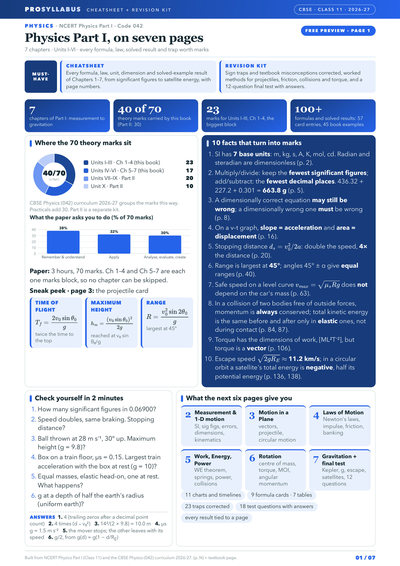
Read page 1 free Get the kit Get the kit One payment · instant PDF · ₹159 View details Marks booster + cheatsheet: key concepts in 2 lines each, common traps 23-mark block: Ch 1–4 17-mark block: Ch 5–7 Common traps, corrected 7 chapters: every solved-example result Every unit and dimension, listed Page 1 free about 8 min read , Full kit about 55 min read ₹159
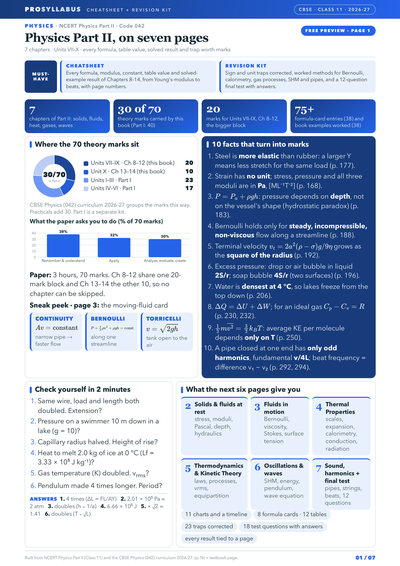
Read page 1 free Get the kit Get the kit One payment · instant PDF · ₹159 View details Marks booster + cheatsheet: key concepts in 2 lines each, common traps 20-mark block: Ch 8–12 10-mark block: Oscillations and Waves Common traps, corrected 7 chapters: every solved-example result Sound, standing waves and beats covered Page 1 free about 8 min read , Full kit about 55 min read ₹159
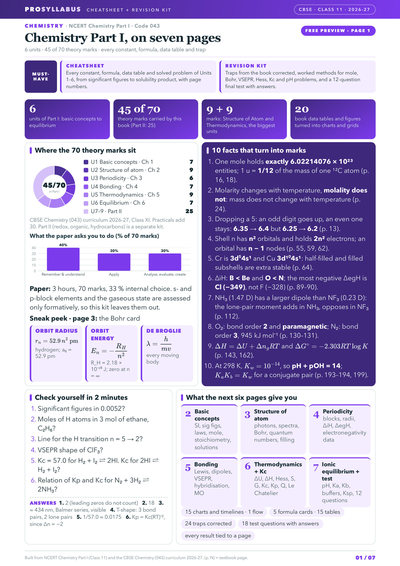
Read page 1 free Get the kit Get the kit One payment · instant PDF · ₹159 View details Marks booster + cheatsheet: key concepts in 2 lines each, common traps 9 marks each: Atom and Thermodynamics Constants and formulas, with page numbers Common traps, corrected Periodic trends from the real data pH, buffers and solubility product Page 1 free about 8 min read , Full kit about 55 min read ₹159
Read page 1 free Get the kit Get the kit One payment · instant PDF · ₹159 View details Marks booster + cheatsheet: key concepts in 2 lines each, common traps 10 marks: Hydrocarbons Every reaction with reagent and condition Common traps that cost marks, listed IUPAC naming rules Oxidation-number rules and balancing Page 1 free about 8 min read , Full kit about 55 min read ₹159
Read page 1 free Get the kit Get the kit One payment · instant PDF · ₹159 View details Marks booster + cheatsheet: key concepts in 2 lines each, common traps 18 marks: Unit V, breathing to hormones 15 marks each: Units I and III Common traps, corrected Five kingdoms classification table Physiological numbers, with page numbers Page 1 free about 8 min read , Full kit about 55 min read ₹159
Read page 1 free Get the kit Get the kit One payment · instant PDF · ₹159 View details Marks booster + cheatsheet: key concepts in 2 lines each, common traps 44 marks: Unit 2, recording to depreciation Journal formats and special purpose books Traps from all seven chapters Bank reconciliation adjustments Depreciation formulas, book's worked figures Page 1 free about 8 min read , Full kit about 55 min read ₹159
Read page 1 free Get the kit Get the kit One payment · instant PDF · ₹159 View details Marks booster + cheatsheet: key concepts in 2 lines each 12 exam traps, listed Five calculations the paper keeps asking Each adjustment: one entry, two effects Both formats: trading and P&L, balance sheet Yogita illustration solved line by line Page 1 free about 8 min read , Full kit about 55 min read ₹159
Read page 1 free Get the kit Get the kit One payment · instant PDF · ₹159 View details Marks booster + cheatsheet: key concepts in 2 lines each, common traps 20 marks: finance and MSME units 20 marks: internal and international trade Five comparison tables, insurance to retail Case cues for each chapter Common traps, corrected Page 1 free about 8 min read , Full kit about 55 min read ₹159
Read page 1 free Get the kit Get the kit One payment · instant PDF · ₹159 View details Marks booster + cheatsheet: key concepts in 2 lines each, common traps 15 marks: Ch 1–4, data to diagrams 7 chapters: every formula, worked numbers Common mistakes, corrected Book exercise answers included Part C project route Page 1 free about 8 min read , Full kit about 55 min read ₹159
Read page 1 free Get the kit Get the kit One payment · instant PDF · ₹159 View details Marks booster + cheatsheet: key concepts in 2 lines each, common traps 14 marks: Production and Costs, Unit 6 8 marks: Market Equilibrium, Unit 7 Common traps, corrected PPF, TU–MU, MRS and cost table drawn Demand and supply schedules from the book Page 1 free about 8 min read , Full kit about 55 min read ₹159
Read page 1 free Get the kit Get the kit One payment · instant PDF · ₹159 View details Marks booster + cheatsheet: key concepts in 2 lines each, common traps 20 marks: Empires section 20 marks: Changing Cultural Traditions 15 marks: Paths to Modernisation, Japan 5 marks: map work on the book's maps Common traps, corrected Page 1 free about 8 min read , Full kit about 55 min read ₹159
Read page 1 free Get the kit Get the kit One payment · instant PDF · ₹159 View details Marks booster + cheatsheet: key concepts in 2 lines each, common traps 8 marks: Climate unit, Ch 7–10 5 marks: map work, covered 4 marks: ocean data as charts, Unit V Heat budget and five air layers as charts Common traps, corrected Page 1 free about 8 min read , Full kit about 55 min read ₹159
Read page 1 free Get the kit Get the kit One payment · instant PDF · ₹159 View details Marks booster + cheatsheet: key concepts in 2 lines each, common traps 12 marks: Climate, Vegetation (Unit III) Full CBSE map-work list, chapter by chapter Indus, Ganga, Brahmaputra river systems Monsoon mechanism, onset and four seasons Common traps, corrected Page 1 free about 8 min read , Full kit about 55 min read ₹159
Read page 1 free Get the kit Get the kit One payment · instant PDF · ₹159 View details Marks booster + cheatsheet: key concepts in 2 lines each 4 marks: Map Scale, conversions worked 4 marks: Latitude, Longitude and Time 4 marks: Topographical Maps, contours 5 marks: practical file and viva Conical and Mercator's construction steps Page 1 free about 8 min read , Full kit about 55 min read ₹159
Read page 1 free Get the kit Get the kit One payment · instant PDF · ₹159 View details Marks booster + cheatsheet: key concepts in 2 lines each, common traps 8 marks together: Citizenship, Nationalism 6 marks each: Social Justice, Secularism 8 chapters: thinkers and a timeline Liberty, equality, justice side by side Common traps, corrected Page 1 free about 8 min read , Full kit about 55 min read ₹159
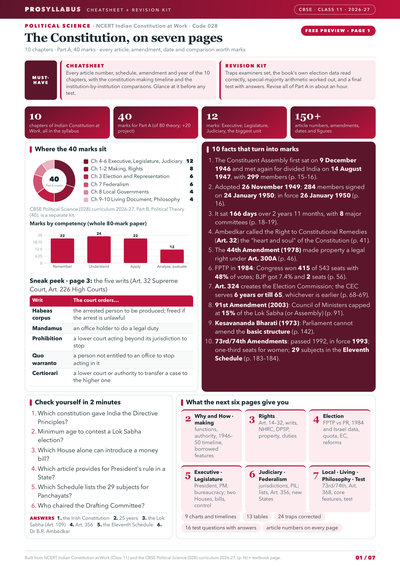
Read page 1 free Get the kit Get the kit One payment · instant PDF · ₹159 View details Marks booster + cheatsheet: key concepts in 2 lines each 12 marks: Executive to Judiciary Constitution-making timeline Institution-by-institution comparisons 6 marks: elections, FPTP, PR, reserved seats Fundamental Rights and Directive Principles Page 1 free about 8 min read , Full kit about 55 min read ₹159
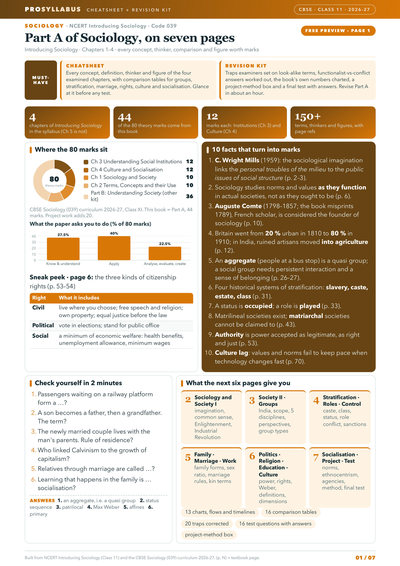
Read page 1 free Get the kit Get the kit One payment · instant PDF · ₹159 View details Marks booster + cheatsheet: key concepts in 2 lines each, common traps 10 marks each: Units 1 and 2 20 marks: project work, covered Tables: groups, stratification, marriage Every thinker and concept of Chapters 1–4 Common traps, corrected Page 1 free about 8 min read , Full kit about 55 min read ₹159
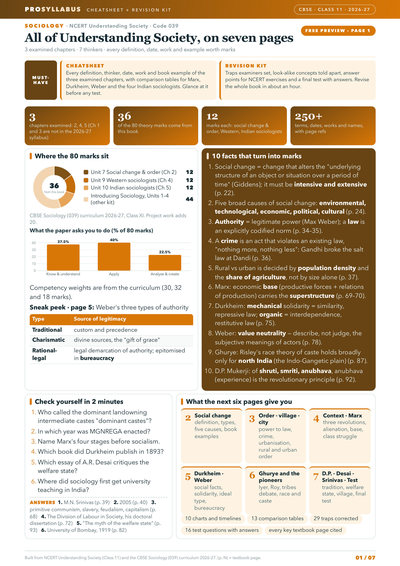
Read page 1 free Get the kit Get the kit One payment · instant PDF · ₹159 View details Marks booster + cheatsheet: key concepts in 2 lines each, common traps 12 marks each: Units 7, 9 and 10 7 thinkers: dates, works, examples Four Indian sociologists, in tables Ideal type, bureaucracy, division of labour Common traps, corrected Page 1 free about 8 min read , Full kit about 55 min read ₹159
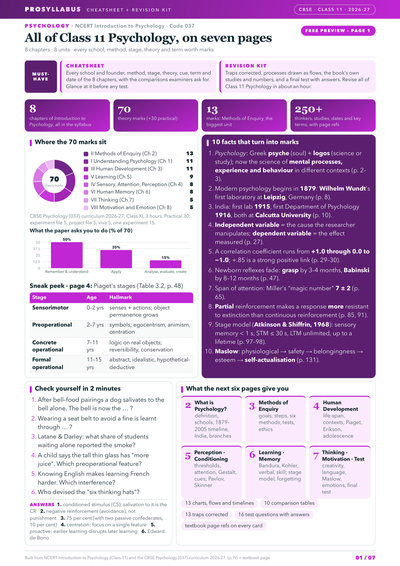
Read page 1 free Get the kit Get the kit One payment · instant PDF · ₹159 View details Marks booster + cheatsheet: key concepts in 2 lines each 11 marks each: Units I and III 9 marks: Learning, Unit V 8 marks each: Perception and Memory Every school with its founder Comparisons examiners ask for Page 1 free about 8 min read , Full kit about 55 min read ₹159
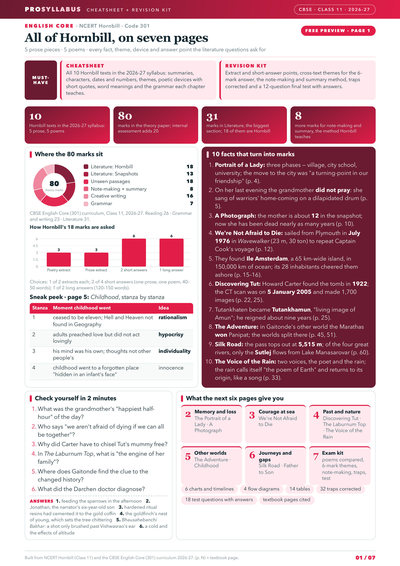
Read page 1 free Get the kit Get the kit One payment · instant PDF · ₹159 View details Marks booster + cheatsheet: key concepts in 2 lines each, common traps 8 marks: note-making and summary 5 poems compared, cross-text themes Common traps, corrected Poetic devices with short quotes Grammar each chapter teaches Page 1 free about 8 min read , Full kit about 55 min read ₹159
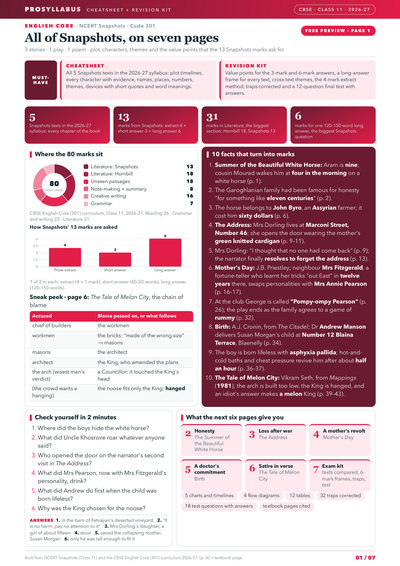
Read page 1 free Get the kit Get the kit One payment · instant PDF · ₹159 View details Marks booster + cheatsheet: key concepts in 2 lines each, common traps 4-, 3- and 6-mark answers: how to write them Plot timeline for every text Common traps, corrected Every character, with evidence Cross-text themes, side by side Page 1 free about 8 min read , Full kit about 55 min read ₹159
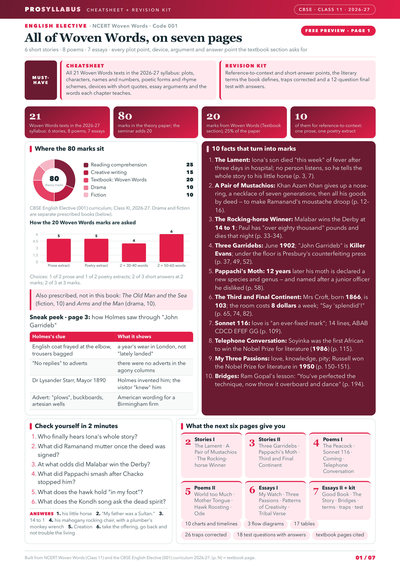
Read page 1 free Get the kit Get the kit One payment · instant PDF · ₹159 View details Marks booster + cheatsheet: key concepts in 2 lines each, common traps Poetic forms and rhyme schemes Devices with short quotes Common traps, corrected Essay arguments, essay by essay Words each chapter teaches Page 1 free about 8 min read , Full kit about 55 min read ₹159
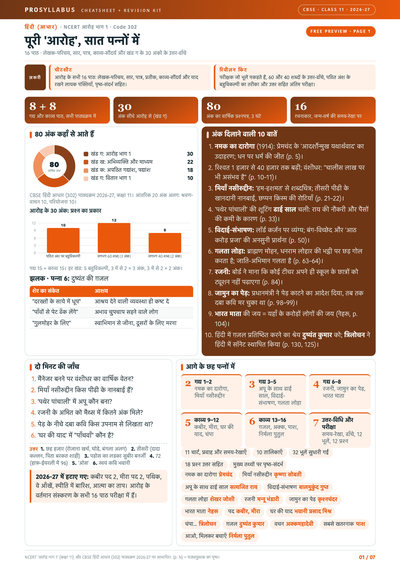
Read page 1 free Get the kit Get the kit One payment · instant PDF · ₹159 View details Marks booster + cheatsheet: key concepts in 2 lines each 16 writers placed on one timeline 60- and 40-word answer frames 8 काव्य पाठ: प्रतीक and काव्य-सौंदर्य Lines worth remembering, with page refs 12 common mistakes, corrected Page 1 free about 8 min read , Full kit about 55 min read ₹159
Read page 1 free Get the kit Get the kit One payment · instant PDF · ₹159 View details Marks booster + cheatsheet: key concepts in 2 lines each 10 marks (2 × 5): answer frames 5-mark answers in about 60 words 4 lessons: argument, events, characters Lines worth remembering, by page 12 common mistakes, corrected Page 1 free about 8 min read , Full kit about 55 min read ₹159
Read page 1 free Get the kit Get the kit One payment · instant PDF · ₹159 View details Marks booster + cheatsheet: key concepts in 2 lines each 16 writers placed on one timeline 40-word and व्याख्या answer frames 8 काव्य पाठ: प्रतीक, उपमान, काव्य-सौंदर्य Lines worth remembering, with page refs 12 common mistakes, corrected Page 1 free about 8 min read , Full kit about 55 min read ₹159
Read page 1 free Get the kit Get the kit One payment · instant PDF · ₹159 View details Marks booster + cheatsheet: key concepts in 2 lines each 5-mark, 100-word answer frames 9 exercise questions: आवारा मसीहा 7 exercise questions: हुसैन की कहानी Life events linked to the works 12 common mistakes, corrected Page 1 free about 8 min read , Full kit about 55 min read ₹159
Read page 1 free Get the kit Get the kit One payment · instant PDF · ₹159 View details Marks booster + cheatsheet: key concepts in 2 lines each 20 marks: grammar, from text words Sandhi, pratyaya and lakar examples Anvaya and bhavartha answer method Source text and author for every lesson 10 common errors, corrected Page 1 free about 8 min read , Full kit about 55 min read ₹159
Read page 1 free Get the kit Get the kit One payment · instant PDF · ₹159 View details Marks booster + cheatsheet: key concepts in 2 lines each 20 marks: grammar, भाग ग, from the text 10 marks: history of literature Sandhi, samasa, pratyaya, upapada examples Source text and author for every lesson Common errors, corrected Page 1 free about 8 min read , Full kit about 55 min read ₹159
Read page 1 free Get the kit Get the kit One payment · instant PDF · ₹159 View details Marks booster + cheatsheet: key concepts in 2 lines each Author, genre and characters per lesson Couplets explained: Insha and Fani ghazals Grammar for Section A Letter and advertisement formats 10 common mistakes, corrected Page 1 free about 8 min read , Full kit about 55 min read ₹159
Read page 1 free Get the kit Get the kit One payment · instant PDF · ₹159 View details Marks booster + cheatsheet: key concepts in 2 lines each 38 marks: the answer frame 13 genres, each introduced 18 writers and poets: dates and works Literary devices (صنعتیں) and key words Common mistakes, corrected Page 1 free about 8 min read , Full kit about 55 min read ₹159
Read page 1 free Get the kit Get the kit One payment · instant PDF · ₹159 View details Marks booster + cheatsheet: key concepts in 2 lines each 10 marks: literary forms, covered 5 geets, each with its poet Nazm defined, with its four kinds Answer points for the book's questions Common mistakes, corrected Page 1 free about 8 min read , Full kit about 55 min read ₹159
Read page 1 free Get the kit Get the kit One payment · instant PDF · ₹159 View details Marks booster + cheatsheet: key concepts in 2 lines each, common traps 15 marks: Unit 3, society, law and ethics 10 marks: Unit 1, number-system conversions Common traps that cost marks, listed Truth tables for Boolean logic String, list and dictionary methods Page 1 free about 8 min read , Full kit about 55 min read ₹159
Read page 1 free Get the kit Get the kit One payment · instant PDF · ₹159 View details Marks booster + cheatsheet: key concepts in 2 lines each, common traps 25 marks: Python, lists, NumPy (Unit 2) 10 marks: Computer System (Unit 1) Common traps, corrected Every list and dictionary method, with output SQL queries re-run on the book's tables Page 1 free about 8 min read , Full kit about 55 min read ₹159
Read page 1 free Get the kit Get the kit One payment · instant PDF · ₹159 View details Marks booster + cheatsheet: key concepts in 2 lines each, common traps 23 marks: Unit II 15 marks: Unit III, health and hygiene Common traps, corrected Five food groups, RDA and the pyramid Nine fibres and the burning test Page 1 free about 8 min read , Full kit about 55 min read ₹159
Read page 1 free Get the kit Get the kit One payment · instant PDF · ₹159 View details Marks booster + cheatsheet: key concepts in 2 lines each 15 marks each: Childhood and Adulthood units RDAs and diet quantities by age Vaccine ages Budget steps and investment principles Stain-removal methods Page 1 free about 8 min read , Full kit about 55 min read ₹159
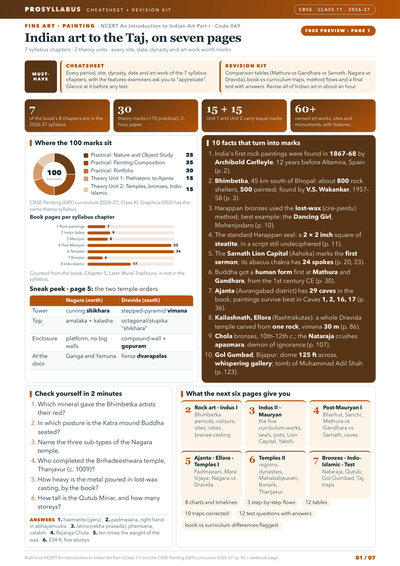
Read page 1 free Get the kit Get the kit One payment · instant PDF · ₹159 View details Marks booster + cheatsheet: key concepts in 2 lines each 15 marks each: the two theory units What to write when asked to appreciate Bharhut, Sanchi and the cave sites Temple architecture: how a temple is built Bronzes and Indo-Islamic buildings Page 1 free about 8 min read , Full kit about 55 min read ₹159
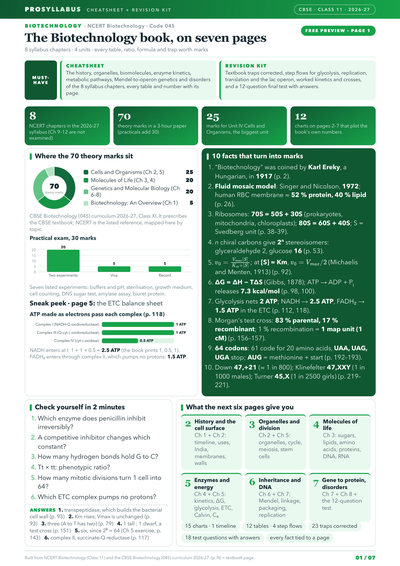
Read page 1 free Get the kit Get the kit One payment · instant PDF · ₹159 View details Marks booster + cheatsheet: key concepts in 2 lines each, common traps 20 marks each: Units II and III Enzyme kinetics and bioenergetics Common traps, corrected Mendel-to-operon genetics Tables and numbers, each with its page Page 1 free about 8 min read , Full kit about 55 min read ₹159
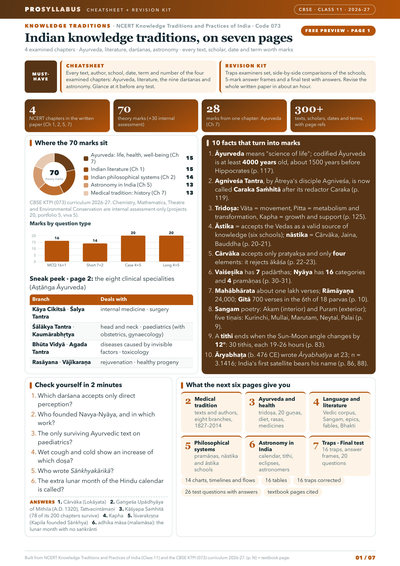
Read page 1 free Get the kit Get the kit One payment · instant PDF · ₹159 View details Marks booster + cheatsheet: key concepts in 2 lines each, common traps 15 marks: language and literature 14 marks: the nine darśanas Common traps, corrected 13 marks: astronomy in India 4 chapters, each with answer frames Page 1 free about 8 min read , Full kit about 55 min read ₹159
Read page 1 free Get the kit Get the kit One payment · instant PDF · ₹159 View details Marks booster + cheatsheet: key concepts in 2 lines each Frames for news, interview and review Inverted pyramid and the six ककार Play-writing frame Translation rules, with solved examples Common mistakes, corrected Page 1 free about 8 min read , Full kit about 55 min read ₹159
Read page 1 free Get the kit Get the kit One payment · instant PDF · ₹159 View details Marks booster + cheatsheet: key concepts in 2 lines each 50 marks: games and sports strand 25 marks: health and fitness strand Eight team games, side by side Fitness tests, norms and formulas Yoga asanas for wellness Page 1 free about 8 min read , Full kit about 55 min read ₹159
Read page 1 free Get the kit Get the kit One payment · instant PDF · ₹159 View details Marks booster + cheatsheet: key concepts in 2 lines each 22 श्रुतियाँ and 10 थाट, defined बिहाग, भीमपलासी, भैरवी with बंदिश notation तीनताल, एकताल, चौताल: ठाह, दुगुन, चौगुन तानसेन, भातखंडे, पलुस्कर profiled 12 common mistakes, corrected Page 1 free about 8 min read , Full kit about 55 min read ₹159
Read page 1 free Get the kit Get the kit One payment · instant PDF · ₹159 View details Marks booster + cheatsheet: key concepts in 2 lines each वादी-संवादी, पकड़ and बंदिश for each राग तीनताल, एकताल, चौताल: ठाह, दुगुन, चौगुन तानसेन, भातखंडे, पलुस्कर profiled Four classes of instruments, तानपुरा, सितार 12 common mistakes, corrected Page 1 free about 8 min read , Full kit about 55 min read ₹159
Read page 1 free Get the kit Get the kit One payment · instant PDF · ₹159 View details Marks booster + cheatsheet: key concepts in 2 lines each 6 marks each: all five units ठाह, दुगुन, तिगुन, चौगुन written out 14 artists with dates कुदऊ सिंह and नाना पानसे: two lives 14 common mistakes, corrected Page 1 free about 8 min read , Full kit about 55 min read ₹159
Read page 1 free Get the kit Get the kit One payment · instant PDF · ₹159 View details Get alerts for CBSE Class 11 Annual Assessment
Dates, results and cutoffs, by email when they are announced. Free.
Google, Apple, or a code to your phone or email. It is saved to your account.
This chapter is part of the CBSE Class 11 Annual Assessment Board Examination Explore every chapter — summary, notes, extra questions & MCQ quizzes Preparing for CBSE Class 11 Annual Assessment? Students also sit JEE is set on the Class 11 and 12 Physics, Chemistry and Maths syllabus; students prepare for boards and JEE together.
Tests are played signed in — sign in (free, 10 seconds) so your attempts, rank and XP are saved to you #1
Discovering Tut: the Saga Continues
Start here
#2
#3
Constitution: Why and How?
#4
#5
#6
#7
#8
Methods of Enquiry in Psychology
#9
#10
An Empire Across Three Continents
#11
#12
The Summer of the Beautiful White Horse
#13
#14
#15
We're Not Afraid to Die... if We Can All Be Together
#16
#17
Election and Representation
#18
Political Theory: An Introduction
#19
#20
Biological Classification
#21
Motion in a Straight Line
#22
Accountancy (Class 11) Practice Quiz | CBSE Class 11 Annual Assessment
#23
Sets and Venn Operations Fundamentals — Free CBSE Class 11 Annual Assessment Quiz
#24
#25
#26
#27
Rights in the Indian Constitution
#28
#29
#30
#31
#32
Changing Cultural Traditions
#33
#34
#35
#36
#37
Private, Public and Global Enterprises
#38
Depreciation, Provisions and Reserves
#39
Introduction to Accounting
#40
Cell Cycle and Cell Division
#41
#42
Anatomy of Flowering Plants
#43
Organic Chemistry – Some Basic Principles and Techniques
#44
#45
#46
#47
#48
#49
#50
#51
#52
#53
#54
#55
The Ailing Planet: the Green Movement's Role
#56
#57
#58
#59
Sensory, Attentional and Perceptual Processes
#60
#61
#62
Introducing Western Sociologists
#63
#64
Social Change and Social Order in Rural and Urban Society
#65
Social Structure, Stratification and Social Processes in Society
#66
Doing Sociology: Research Methods
#67
Culture and Socialisation
#68
Understanding Social Institutions
#69
Terms, Concepts and Their Use in Sociology
#70
#71
The Philosophy of the Constitution
#72
Constitution as a Living Document
#73
#74
#75
#76
#77
#78
#79
#80
#81
#82
Natural Hazards and Disasters
#83
#84
#85
#86
Structure and Physiography
#87
Biodiversity and Conservation
#88
#89
#90
World Climate and Climate Change
#91
Atmospheric Circulation and Weather Systems
#92
Solar Radiation, Heat Balance and Temperature
#93
Composition and Structure of Atmosphere
#94
Landforms and their Evolution
#95
#96
Distribution of Oceans and Continents
#97
#98
The Origin and Evolution of the Earth
#99
Geography as a Discipline
#100
Displacing Indigenous Peoples
#101
#102
Comparative Development Experiences of India and its Neighbours
#103
Environment and Sustainable Development
#104
Employment: Growth, Informalisation and Other Issues
#105
#106
Human Capital Formation in India
#107
Liberalisation, Privatisation and Globalisation: An Appraisal
#108
Indian Economy on the Eve of Independence
#109
#110
#111
#112
Measures of Central Tendency
#113
#114
#115
#116
#117
MSME and Business Entrepreneurship
#118
Sources of Business Finance
#119
#120
Social Responsibilities of Business and Business Ethics
#121
Emerging Modes of Business
#122
#123
Forms of Business Organisation
#124
Business, Trade and Commerce
#125
Financial Statements - II
#126
#127
Trial Balance and Rectification of Errors
#128
Bank Reconciliation Statement
#129
Recording of Transactions - II
#130
Recording of Transactions - I
#131
Theory Base of Accounting
#132
#133
#134
#135
Introduction to Three Dimensional Geometry
#136
#137
#138
#139
#140
Permutations and Combinations
#141
#142
Complex Numbers and Quadratic Equations
#143
#144
#145
Chemical Coordination and Integration
#146
Neural Control and Coordination
#147
#148
Excretory Products and their Elimination
#149
Body Fluids and Circulation
#150
Breathing and Exchange of Gases
#151
Plant Growth and Development
#152
#153
Photosynthesis in Higher Plants
#154
#155
Structural Organisation in Animals
#156
Morphology of Flowering Plants
#157
#158
#159
Chemical Bonding and Molecular Structure
#160
Classification of Elements and Periodicity in Properties
#161
Some Basic Concepts of Chemistry
#162
#163
#164
#165
#166
Thermal Properties of Matter
#167
Mechanical Properties of Fluids
#168
Mechanical Properties of Solids
#169
#170
Systems of Particles and Rotational Motion
#171
#172
#173
Business Studies (Class 11) Practice Quiz | CBSE Class 11 Annual Assessment
#174
Economics (Class 11) Practice Quiz | CBSE Class 11 Annual Assessment
#175
Humanities Subjects Practice Quiz | CBSE Class 11 Annual Assessment
#176
Motion in a Straight Line Practice Quiz | CBSE Class 11 Annual Assessment
#177
Thermodynamic Processes and Laws Advanced Challenge | CBSE Class 11 Annual Assessment
More on CBSE Class 11 Annual Assessment20 guides Tuples and Dictionaries – NCERT Class 11 Computer Science Chapter 10 – Tuple Operations and Dictionary Handling in Python Strings – NCERT Class 11 Computer Science Chapter 8 – String Operations, Traversal, and Methods in Python Getting Started with Python – NCERT Class 11 Computer Science Chapter 5 – Basics, Data Types, Operators, and Debugging Functions – NCERT Class 11 Computer Science Chapter 7 – Defining, Calling, and Understanding Functions in Python Complete Summary and Solutions for Emerging Trends – NCERT Class XI Informatics Practices, Chapter 2 – Explanation, Questions, Answers Mathematical Modelling – NCERT Class 11 Mathematics Appendix 2 – Concepts, Importance, and Applications in Real-world Problems Complete Summary and Solutions for Database Concepts – NCERT Class XI Informatics Practices, Chapter 7 – Explanation, Questions, Answers Encoding Schemes and Number System – NCERT Class 11 Computer Science Chapter 2 – ASCII, ISCII, UNICODE, Binary, Octal, Decimal, Hexadecimal Complete Summary and Solutions for Brief Overview of Python – NCERT Class XI Informatics Practices, Chapter 3 – Explanation, Questions, Answers Complete Summary and Solutions for Computer System – NCERT Class XI Informatics Practices, Chapter 1 – Explanation, Questions, Answers Introduction to Problem Solving – NCERT Class 11 Computer Science Chapter 4 – Algorithms, Flowcharts, Pseudocode, and Control Structures Flow of Control – NCERT Class 11 Computer Science Chapter 6 – Conditional and Looping Constructs in Python Alerts and Updates for CBSE Class 11 Annual Assessment Complete Summary and Solutions for Adventure Sports – Health and Physical Education Textbook for Class XI, Chapter 11 – Explanation, Questions, Answers Complete Summary and Solutions for Tournaments and Competitions – Health and Physical Education Textbook for Class XI, Chapter 10 – Explanation, Questions, Answers Complete Summary and Solutions for Measurement and Evaluation – Health and Physical Education Textbook for Class XI, Chapter 9 – Explanation, Questions, Answers Complete Summary and Solutions for Health Related Physical Fitness – Health and Physical Education Textbook for Class XI, Chapter 8 – Explanation, Questions, Answers Complete Summary and Solutions for Safety and Security – Health and Physical Education Textbook for Class XI, Chapter 7 – Explanation, Questions, Answers Complete Summary and Solutions for Yoga and Its Relevance in the Modern Times – Health and Physical Education Textbook for Class XI, Chapter 6 – Explanation, Questions, Answers Complete Summary and Solutions for Team Games – Health and Physical Education Textbook for Class XI, Chapter 5 – Explanation, Questions, Answers Notebook backup + AI Save your notes. Revise with AI. Learn more → Share this article