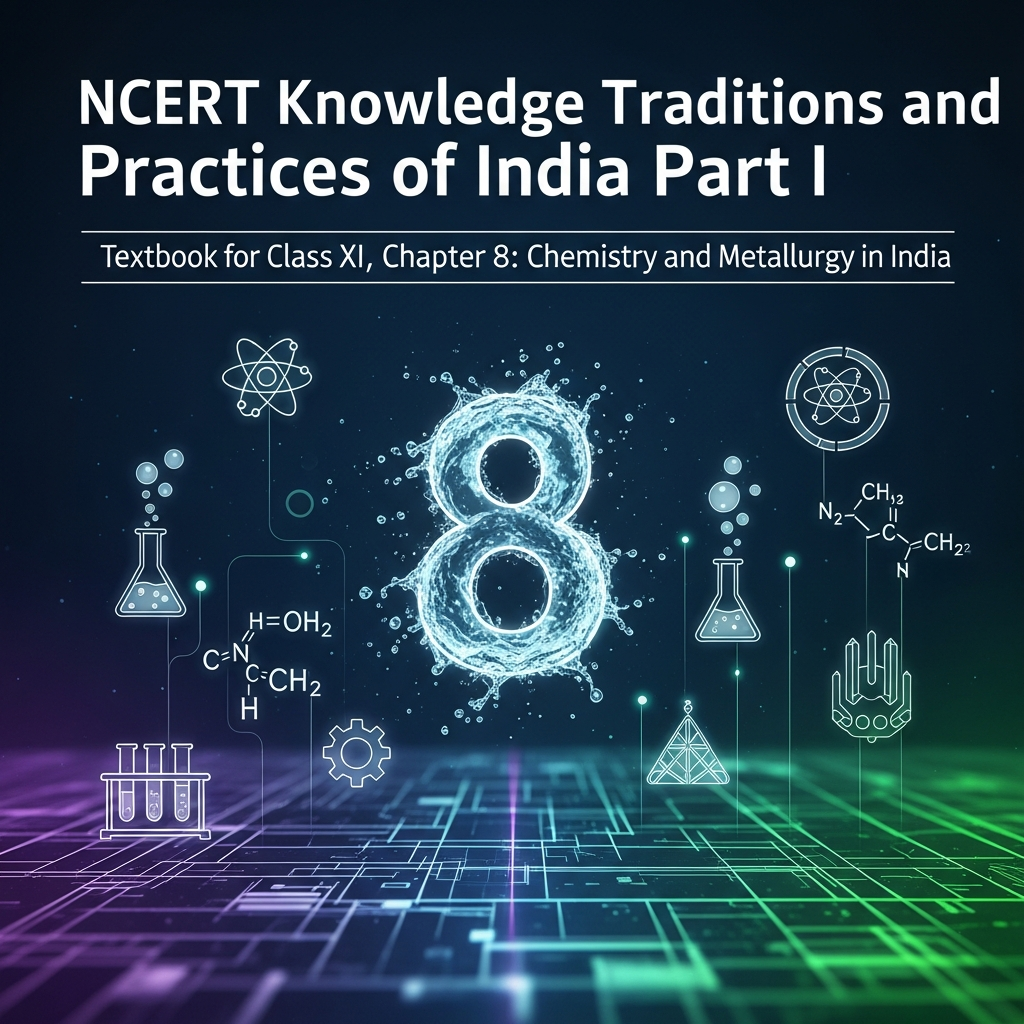
ProSyllabus Journal CBSE Class 11 Annual Assessment Knowledge Traditions and Practices of India Part I – Chemistry and Metallurgy in India (Chapter 8) An in-depth study of ancient Indian chemistry and metallurgy, tracing the evolution from alchemy to modern chemistry, archaeological evidences of glass making, paints, dyes, perfumes, metal extraction and processing techniques, advanced metallurgical skills including iron and zinc production, and the decline during colonial period, as covered in Chapter 8 of the NCERT Class XI textbook.
Updated 11 months ago NCERT · Class XI · Knowledge Traditions and Practices of India · Chapter 8 · Chemistry · Metallurgy · Ancient Sciences · Indian Metals · Glass · Cosmetics · Industrial History · Education
#Chemistry and Metallurgy in India #NCERT Class 11 #Alchemy #Indian Chemistry #Metallurgy #Glass Making #Paints #Dyes #Perfumes #Ancient Indian Metallurgy #Copper #Iron #Zinc #Gold #Silver #Wootz Steel #Archaeology #History of Science #Chapter 8
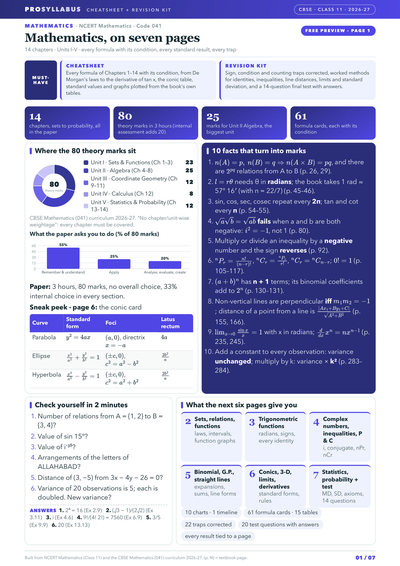
Marks booster + cheatsheet: key concepts in 2 lines each, common traps 25 marks: Unit II, Ch 4–8 23 marks: Unit I, Ch 1–3 Common traps, corrected Conic table and standard values Graphs plotted from the book's own tables Page 1 free about 8 min read , Full kit about 55 min read ₹159
Read page 1 free Get the kit Get the kit One payment · instant PDF · ₹159 View details
Chemistry and Metallurgy in India - Class 11 Ultimate Study Guide 2025
Full Chapter Summary & Detailed Notes
Key Definitions & Terms
Text Book Questions & Answers
Key Concepts
Historical Perspectives
Process Examples
Interactive Quiz (10 Q)
Quick Revision Notes & Mnemonics
Key Terms & Processes
Techniques Step-by-Step
Full Chapter Summary & Detailed Notes - Chemistry and Metallurgy in India Class 11 NCERT
Overview & Key Concepts
Chapter Goal : Trace evolution from alchemy to modern chemistry in India, focusing on ancient techniques in metallurgy, glass, dyes, and medicine. Exam Focus: Rasayana Shastra, Indus Valley innovations, metals (copper, iron, zinc), concepts (atom, nano). 2025 Updates: Nano-bhasma research, sustainable metallurgy. Fun Fact: India pioneered zinc distillation ~400 BCE. Core Idea: Chemistry integrated with life (medicine, arts, rituals).Wider Scope : From global alchemy to Indian Rasavidya; sources: Vedas, texts (Suśruta, Arthaśāstra), archaeology (Harappa slags). Activities: Analyze bhasma processes; think/reflect (philosopher's stone myths).Expanded Content : Modern links (Ayurvedic pharma); point-wise for recall; add 2025 relevance like eco-friendly ancient dyes.
From Alchemy to Chemistry
Origins : Evolved from Egyptian mummification (1300–1600 CE); Greeks/ Arabs spread to Europe via al-Khemia.Goals : Philosopher’s stone (base to gold), Elixir of life (immortality).Indian Context : Rasāyana Śāstra (metallurgy, medicine, cosmetics); Vedas mention metal extraction (gold, iron).Example : Harappan faience (glazed quartz ornaments).Expanded : Evidence: Archaeological slags; debates: Spiritual vs practical alchemy; real: 7000-year metallurgy tradition.
Conceptual Diagram: Alchemy Evolution (Page 137)
Timeline: Egypt → Greece → Arabs → Europe/India; visuals of philosopher's stone, elixirs.
Why This Guide Stands Out
Comprehensive: All areas (glass to zinc) point-wise, process integrations; 2025 with nano-applications, analyzed for cultural-tech fusion.
Early Techniques & Indus Valley
Indus Innovations : Baked bricks (gypsum cement), mass pottery (glazed Mohenjo-daro), faience (melted quartz at 940°C).Arts : Pottery, jewelry, dyes, tanning; evidence: Plasters, medical preps.Key Sites : Alamgirpur to Daimabad; Aravalli copper sources.Think & Reflect : Why faience stronger? (Flux additives); kiln mastery.Expanded : Evidence: Jonathan Kenoyer's glazing experiments; debates: Export vs local use; real: UNESCO parallels.
Areas of Development
Glass Making : Suśruta (vessels, 6th BCE); Arthaśāstra (taxes); Pliny (superior dyes); sites: Hastinapur (1000 BCE).Paints & Dyes : Bṛhatsaṁhitā (glutinous extracts); Atharvaveda (turmeric, madder); Ajanta frescoes.Perfumes & Cosmetics : Bṛhatsaṁhitā (hair dyes); Aṣṭāṅga Hridaya (seasonal formulas); Serfoji's Dhanvantari Mahal (tested recipes).Chemicals : Acids (sulphuric/nitric in Caraka); gunpowder (Rasopaniṣada); soap (Cakrapāṇi, mustard oil).Paper & Ink : 7th CE evidence; inks from nuts, rice, tannin-ferric.Alcoholic Liquors : Fermentation in Vedas/Arthaśāstra (Āsavas from sugarcane).Ayurveda : Caraka/Suśruta; mercury 18 processes; bhasma nano-particles.Concepts : Kaṇāda's atom (Anu/Paramāṇu, 600 BCE); nano in Caraka (bhasma for bioavailability).Expanded : Evidence: Texts/archaeology; debates: Nano intentional?; real: Modern herbo-mineral drugs.
Exam Activities
Extended: Purify zinc methods; rust-resistant monuments (Delhi Pillar); ancient cosmetics/drugs info.
Metallurgy in India
Overview : 7000 years; sources: Mehrgarh bead (6000 BCE), Harappan bronzes.Copper : Chalcolithic (Ahar slags, 1800 BCE); Aravalli ores (98% purity).Iron : Ganges Valley (1800 BCE); Agaria furnaces (sponge iron); Wootz steel (exported, Damascus origin).Zinc : Zawar distillation (400 BCE); downward retorts.Gold/Silver : Harappan electrum; Vedic placer gold; Arthaśāstra refining.Decline : Invasions, British imports/taxes; cottage industries suppressed.Icons : Delhi Iron Pillar (99% pure, phosphate layer anti-rust).Expanded : Evidence: Slags, analyses; debates: Indigenous vs imported; real: 2025 sustainable mining echoes.
Summary Key Points
Alchemy: Rasayana to chemistry; Indus: Faience, pottery. Developments: Glass (Mauryan), dyes (Vedic), nano-bhasma. Metallurgy: Copper (Aravalli), Iron (Wootz), Zinc (distillation). Decline: Colonial suppression.
Impact: Life integration, tech legacy; challenges: Skill loss, revival needs.
Project & Group Ideas
Group: Replicate zinc retort model; individual: Bhasma nano-report.
Debate: Alchemy myth vs science.
Ethical: Modern vs ancient eco-chemistry.
Key Definitions & Terms - Complete Glossary
All terms from chapter/glossary; detailed with examples, relevance. Expanded: 30+ terms grouped; added advanced like "Bhasma", "Wootz Steel" for depth/flashcards.
Alchemy
Medieval precursor to chemistry; base metals to gold/elixirs. Ex: Al-Khemia. Relevance: Rasayana origin.
Rasāyana Śāstra
Ancient Indian chemistry (metallurgy, medicine). Ex: Vedas metals. Relevance: Holistic application.
Faience
Glazed quartz ceramic. Ex: Harappan ornaments. Relevance: Stronger than Egyptian.
Iatrochemistry
Chemistry in medicine (16th-17th CE). Ex: Disease treatments. Relevance: Ayurveda link.
Bhasma
Incinerated metal ash (nano). Ex: Caraka treatments. Relevance: Bioavailability.
Philosopher’s Stone
Paras: Transmutes metals to gold. Ex: Alchemical goal. Relevance: Mythical drive.
Elixir of Life
Grants immortality. Ex: Search in alchemy. Relevance: Spiritual quest.
Atom (Paramāṇu)
Indivisible particle (Kaṇāda). Ex: Vaiśeṣika Sūtras. Relevance: Pre-Dalton theory.
Wootz Steel
High-carbon crucible steel. Ex: Exported to Damascus. Relevance: Wonder material.
Zinc Distillation
Downward vapor condensation. Ex: Zawar retorts. Relevance: Indian invention.
Āsava
Fermented liquor. Ex: Sugarcane-based. Relevance: Vedic chemistry.
Gunpowder
Sulphur-charcoal-saltpetre mix. Ex: Rasopaniṣada. Relevance: Early fireworks.
Electrum
Gold-silver alloy. Ex: Harappan ornaments. Relevance: Joint use.
Chalcolithic
Copper-Stone Age. Ex: Ahar slags. Relevance: Early metallurgy.
Sponge Iron
Porous reduced iron. Ex: Agaria furnaces. Relevance: Wrought iron base.
Haematite
Iron ore for red ochre. Ex: Dyes/paints. Relevance: Pigment source.
Nagarjuna
Alchemist; mercury compounds. Ex: Rasratnākara. Relevance: Extraction methods.
Cakrapāṇi
Invented soap/mercury sulphide. Ex: Mustard oil alkali. Relevance: Hygiene advance.
Dhanvantari Mahal
Serfoji's research institute. Ex: Tested recipes. Relevance: Cosmetic evolution.
Anubhoga Vaidya Bhāga
Experienced recipes. Ex: Sealed medicines. Relevance: Empirical testing.
Rasaratnākara
Nagarjuna's metallurgy text. Ex: Gold extraction. Relevance: Flame identification.
Aravalli Hills
Copper/zinc source. Ex: Khetri mines. Relevance: Indigenous ores.
Agaria Tribe
Iron smelters. Ex: Bloomery furnaces. Relevance: Traditional skills.
Delhi Iron Pillar
Non-rusting (99% pure). Ex: Phosphate layer. Relevance: Tech mystery.
Superimposition
Not direct; but layered alchemy processes. Ex: Mercury 18 steps. Relevance: Refinement.
Nano Particles
Bhasma metals (1-100 nm). Ex: Reduced toxicity. Relevance: Ancient nanotechnology.
Kaṇāda
Atomic theory founder (600 BCE). Ex: Anu aggregates. Relevance: Philosophical chemistry.
Placer Gold
Alluvial deposits. Ex: Sindhu river. Relevance: Vedic mining.
Retort
Distillation vessel. Ex: Brinjal-shaped zinc. Relevance: Vapor capture.
Tuyere
Air pipe in furnace. Ex: Iron smelting. Relevance: Bloom control.
Crucible Process
Steel making (iron+charcoal). Ex: Wootz. Relevance: High-carbon steel.
Carburisation
Carbon hardening. Ex: Steeling knives. Relevance: Tool durability.
Flux
Additive for melting. Ex: Plant ash in faience. Relevance: Glazing secret.
Ore Dressing
Concentration/roasting. Ex: Copper 98% purity. Relevance: Chalcolithic advance.
Slag
Metallurgical waste. Ex: Ahar heaps. Relevance: Smelting evidence.
Tip: Group by area (alchemy/metallurgy); examples for recall. Depth: Debates (e.g., nano intent). Interlinks: To modern chem. Advanced: Bhasma analysis. Real-Life: Ayurvedic meds. Graphs: Metal timelines. Coherent: Evidence → Application.
Text Book Questions & Answers - NCERT Exercises
Direct from chapter exercises (page 152). Answers based on content, point-wise for exams.
Exercises
1. Which materials were used to make the colour of inks?
Answer:
Chalk, red lead, minium (Sindoor); nuts/myrobalans (black, durable); roasted rice/lamp black/sugar/kesurte juice (Jain); tannin + ferric salts (blue-black).
Ex: Rasaratnākara recipe; Malabar iron pots.
2. How was the concept of atom described in early Indian philosophical system?
Answer:
Kaṇāda (600 BCE): Matter from indivisible Paramāṇu (eternal, spherical, suprasensible); aggregates to Anu; unseen forces interact; pairs/triplets form substances.
Ex: Vaiśeṣika Sūtras; pre-Dalton (2500 years earlier).
3. Justify that copper metallurgy in India has indigenous origin.
Answer:
Aravalli ores (Khetri, 3rd-2nd millennium BCE); Ahar slags (1800-1600 BCE, 98% purity); Nal axe (94% Cu +5% Ni); no foreign imports; advanced dressing/roasting/fluxing.
Ex: Rajpur Dariba deep mines; Chalcolithic sites (Gilund).
4. What makes the extraction of zinc difficult? How did the Indian smelters carry out the process of smelting of zinc?
Answer:
Low boiling point (vaporizes, reoxidizes in furnace).
Process: Distillation in Zawar retorts (brinjal-shaped, roasted ore + charcoal/salt/borax flux); downward vapors to cooled earthen pots; two-chamber unit (perforated bricks).
Ex: 400 BCE; applied to mercury.
5. How can one show that the smelters and smiths of Indian sub-continent had advanced knowledge of copper metallurgy?
Answer:
98% purity from poor chalcopyrite; alloying (As, Ni, Pb); crucible refining; ore dressing/roasting/fluxing; wax casting (3rd millennium BCE); evidence: Mohenjo-daro slags, Nal axe.
Ex: Arsenic levels match Aravalli ores.
6. What caused the decline of knowledge of metallurgical skills in India?
Answer:
Turkish invasions (artisan enslavement, riches looted); Mughal resettlement limited; British imports (Swedish iron), heavy taxes, raw ore export bans; cottage furnaces (e.g., Birbhum 70) suppressed.
Ex: Wootz/zinc stopped; 100-150 years to adopt new tech.
7. Why iron pillar of Delhi has not rusted even after exposure to moist air for so many years?
Answer:
99% purity (low C/Si/Mn/P/Ni/Cu); traces of injurious elements absent; clean environment; passive iron hydrogen phosphate layer prevents corrosion.
Ex: Gupta period; similar at Kodachadri/Konark (6th-13th CE).
Tip: Use evidence (archaeology/texts) for justification Qs. Full marks: Point-wise, examples.
Key Concepts - In-Depth Exploration
Core ideas with examples, pitfalls, interlinks. Expanded: All concepts with steps/examples/pitfalls.
Alchemy Evolution
Steps: 1. Egyptian mummification, 2. Greek merge, 3. Arab al-Khemia, 4. Indian Rasayana. Ex: Philosopher’s stone. Pitfall: Ignore spiritual side. Interlink: Iatrochemistry. Depth: Practical discoveries (amalgams).
Indus Chemical Tech
Steps: 1. Mix/mould/fire pottery, 2. Flux-glaze faience. Ex: 940°C quartz. Pitfall: Underrate kiln control. Interlink: Metallurgy. Depth: Mass production evidence.
Glass Industry
Steps: 1. Metallic oxides color, 2. Export imitations. Ex: Pliny superior. Pitfall: Date confusion (1700 BCE Harappa). Interlink: Cosmetics. Depth: Mauryan taxes.
Dyes & Paints
Steps: 1. Boil extracts/resins, 2. Ajanta application. Ex: Turmeric/madder. Pitfall: Ignore Vedic tanning. Interlink: Ayurveda. Depth: Fresco durability.
Nano in Bhasma
Steps: 1. Burn/cool 100x, 2. Herb-mix detox. Ex: Metal bioavailability. Pitfall: Chance vs intent. Interlink: Atom. Depth: Reduced toxicity/doses.
Copper Indigenous
Steps: 1. Aravalli mining, 2. 98% smelting. Ex: Ahar slags. Pitfall: Import assumption. Interlink: Chalcolithic. Depth: Alloy advances (As/Ni).
Iron Smelting
Steps: 1. Charcoal reduction, 2. Forge sponge. Ex: Agaria bloom. Pitfall: Date errors (1800 BCE). Interlink: Wootz. Depth: Carburisation hardening.
Zinc Innovation
Steps: 1. Retort charge, 2. Cool vapors. Ex: Zawar downward. Pitfall: Vapor loss ignore. Interlink: Mercury. Depth: First global mastery.
Anti-Rust Pillar
Steps: 1. High purity, 2. Phosphate layer. Ex: Delhi 1600 yrs. Pitfall: Pollution threat. Interlink: Modern alloys. Depth: Environmental factors.
Skill Decline
Steps: 1. Invasions loot, 2. Colonial taxes/imports. Ex: Birbhum furnaces. Pitfall: Overlook Mughal patronage. Interlink: Revival. Depth: 19th CE suppression.
Atomic Theory
Steps: 1. Paramāṇu indivisible, 2. Aggregate forms. Ex: Kaṇāda unseen forces. Pitfall: Philosophical only. Interlink: Nano. Depth: Pre-modern science.
Ayurvedic Integration
Steps: 1. Mercury processes, 2. Herbo-mineral. Ex: Suśruta surgery. Pitfall: Ignore 18 steps. Interlink: Cosmetics. Depth: Disease treatment.
Fermentation
Steps: 1. Plant/sugarcane mix, 2. Āsava brew. Ex: Caraka ingredients. Pitfall: Alcohol only view. Interlink: Liquors. Depth: Medicinal use.
Export Legacy
Steps: 1. Wootz to Arabs, 2. Glass varieties. Ex: Porus gift (326 BCE). Pitfall: Local only. Interlink: Trade. Depth: Global influence.
Advanced: Process chains, timelines. Pitfalls: Origin myths. Interlinks: To bio-chem. Real: Pharma revival. Depth: 14 concepts. Examples: Texts/slags. Graphs: Metal purity. Tips: Steps evidence; compare tables (metals/processes).
Historical Perspectives - Detailed Guide
Evolution of chemistry/metallurgy; expanded with points; links to texts/sites. Added global-Indian contrasts, milestones.
Global Alchemy (1300-1600 CE)
Egypt mummification; Greek philosophers. Arabs to Europe (18th CE shape). Depth: Two groups (practical/spiritual).
Indus Era (3000 BCE)
Faience/glazed pottery; Aravalli copper. Mehrgarh bead (6000 BCE). Depth: Tech spread (Alamgirpur-Daimabad).
Vedic/Mauryan (1000-300 BCE)
Rgveda metals; Arthaśāstra glass taxes. Suśruta vessels; Pliny accounts. Depth: Export avenues.
Medieval (600-1400 CE)
Kaṇāda atom; Nagarjuna mercury; Rasārṇavam furnaces. Zawar zinc (400 BCE). Depth: Distillation mastery.
Colonial Decline (18th-19th CE)
British imports; Birbhum suppression. Serfoji revival (1800s cosmetics). Depth: 100-yr lag.
Modern Revival (19th-2025)
Industrial growth; nano-bhasma studies. UNESCO metallurgy heritage. Depth: Sustainable echoes.
Tip: Timeline links. Depth: Textual evidence. Examples: Wootz export. Graphs: Period metallurgy. Advanced: Post-2025 green chem. Easy: Bullets phases.
Process Examples - From Text with Simple Explanations
Expanded with evidence, interpretations; focus on techniques, analysis. Added smelting/glazing breakdowns.
Example 1: Faience Glazing
Simple Explanation: Quartz to lustrous ceramic.
Step 1: Powder rock quartz.
Step 2: Melt with plant ash flux (high kiln).
Step 3: Regrind frit to paste.
Step 4: Fire at 940°C for dense glaze.
Simple Way: Powder → Melt → Paste → Shine.
Example 2: Zinc Distillation
Simple Explanation: Vapor capture mastery.
Step 1: Roast ore + charcoal/flux in retort.
Step 2: Heat upper chamber.
Step 3: Vapors down to cooled pot (water trough).
Step 4: Condense metal.
Simple Way: Charge → Heat → Cool → Zinc drop.
Example 3: Wootz Steel
Simple Explanation: Crucible carbon absorption.
Step 1: Mix iron/charcoal/glass in crucible.
Step 2: Heat to melt/absorb carbon (1-1.9%).
Step 3: Cool to ingot.
Step 4: Forge weapons.
Simple Way: Mix → Melt → Harden → Ukku blade.
Example 4: Bhasma Nano
Simple Explanation: Detox metal ash.
Step 1: Burn metal/mineral 100x (cooling cycles).
Step 2: Mix herbs to reduce size/toxicity.
Step 3: Nano particles (1-100 nm) for drugs.
Step 4: Quick action, low dose.
Simple Way: Burn → Mix → Nano heal.
Example 5: Soap Invention
Simple Explanation: Alkali-oil saponification.
Step 1: Mustard oil + alkalies (Cakrapāṇi).
Step 2: Eranda/mahua + CaCO3 (18th CE).
Step 3: Mix to foam.
Step 4: Hygiene product.
Simple Way: Oil → Alkali → Suds clean.
Example 6: Ink Durability
Simple Explanation: Tannin-ferric reaction.
Step 1: Nuts/myrobalans in iron pots (black).
Step 2: Add ferric salts for blue-black.
Step 3: Keep in water for longevity.
Step 4: Jain rice-lamp black.
Simple Way: Nut → Iron → Dark last.
Tip: Practice breakdowns; troubleshoot (e.g., vapor loss). Added for processes, techniques.
Interactive Quiz - Master Chemistry and Metallurgy
10 MCQs in full sentences; 80%+ goal. Covers alchemy, techniques, metals, concepts.
Start Quiz
Quick Revision Notes & Mnemonics
Concise summaries for subtopics. Tables: Key points, examples, mnemonics. Covers alchemy, developments, metallurgy.
Subtopic
Key Points
Examples
Mnemonics/Tips
Alchemy Rasayana : Metals/medicine/cosmetics.Goals : Paras/elixir.Origins : Egypt→Arabs→India.Vedas extraction; Harappan faience.
PEA (Paras, Elixir, Alchemy). Tip: "Philosophers Eat Apples" – Mythical fruits.
Developments Glass : Mauryan taxes; 1700 BCE beads.Dyes : Turmeric/Ajanta.Cosmetics : Serfoji recipes.Pliny superior; Bhasma nano.
GDC (Glass, Dyes, Cosmetics). Tip: "Golden Dyes Charm" – Artistic allure.
Metals Copper : Aravalli 98% Chalcolithic.Iron : Wootz/Agaria sponge.Zinc : Zawar retorts.Delhi Pillar; Gold placer.
CIZ (Copper, Iron, Zinc). Tip: "Copper Irons Zinc" – Metal chain.
Concepts Atom : Kaṇāda Paramāṇu.Nano : Bhasma particles.Ayurveda : Mercury 18 processes.Caraka acids; Suśruta surgery.
ANM (Atom, Nano, Medicine). Tip: "Ancient Nano Magic" – Timeless tech.
Decline Causes : Invasions/British taxes.Revival : 19th CE pharma.Legacy : 7000 yrs skills.Birbhum furnaces; Wootz export.
IBR (Invasions, British, Revival). Tip: "Invaders Break Revival" – Lost then found.
Overall Tip: Use PEA-GDC-CIZ-ANM-IBR for scan (5 mins). Flashcards: Front (term), Back (points + mnemonic). Print for wall. Covers 100% – exam-ready!
Key Terms & Processes - All Key
Expanded table 30+ rows; quick ref. Added advanced (e.g., Carburisation, Ore Dressing).
Term/Process Description Example Usage
Alchemy Base to gold/elixir quest Al-Khemia Rasayana base Rasāyana Śāstra Indian chem (metals/med) Vedas alloys Life integration Faience Glazed quartz ceramic Harappan ornaments Strong glaze Iatrochemistry Chem in medicine 16th CE treatments Ayurveda link Bhasma Nano metal ash Caraka drugs Detox nano Philosopher’s Stone Metal transmuter Paras myth Alchemical goal Elixir of Life Immortality grant Search quest Spiritual Atom (Paramāṇu) Indivisible unit Kaṇāda theory Pre-Dalton Wootz Steel High-C crucible iron Damascus export Wonder material Zinc Distillation Vapor condensation Zawar retorts Indian first Āsava Fermented brew Sugarcane liquor Vedic chem Gunpowder S-C-KNO3 mix Rasopaniṣada Fireworks Electrum Au-Ag alloy Harappan beads Ornaments Chalcolithic Cu-Stone Age Ahar slags Early metals Sponge Iron Porous reduced Fe Agaria bloom Wrought base Haematite Red ochre ore Dyes paints Pigment Nagarjuna Mercury alchemist Rasratnākara Extraction Cakrapāṇi Soap inventor Mustard alkali Hygiene Dhanvantari Mahal Research institute Serfoji tests Cosmetics Anubhoga Vaidya Tested recipes Sealed meds Empirical Aravalli Hills Cu/Zn mines Khetri ores Indigenous Agaria Tribe Iron smelters Bloom furnaces Traditional Delhi Iron Pillar Non-rust monument Phosphate layer Purity tech Nano Particles 1-100 nm bhasma Toxicity reduce Bioavailability Kaṇāda Atom founder Vaiśeṣika Philosophy Placer Gold River deposits Sindhu Vedic Mining Retort Distill vessel Brinjal zinc Vapor Tuyere Furnace air pipe Iron smelting Bloom Crucible Process Steel melt Wootz carbon High-C Carburisation Carbon harden Knife steeling Durability Flux Melt additive Ash faience Glazing Ore Dressing Concentrate Cu roasting Purity Slag Smelt waste Ahar heaps Evidence
Tip: Examples memory; sort area. Easy: Table scan. Added 10 rows depth.
Techniques Step-by-Step
Step-by-step breakdowns of core processes. Descriptions for understanding; focus on actionable with examples.
Process 1: Copper Smelting
Step 1: Mine Aravalli ore (chalcopyrite).
Step 2: Roast/crush/concentrate.
Step 3: Flux in clay crucible.
Step 4: Smelt to 98% Cu.
Step 5: Alloy (As/Ni) for hardness.
Visual: Ore → Crush → Melt → Pure ingot.
Process 2: Iron Bloomery
Step 1: Load ore/charcoal in tapered furnace.
Step 2: Tuyere air blast.
Step 3: Reduce to sponge + slag tap.
Step 4: Forge porosity out.
Step 5: Carburise for steel.
Visual: Load → Blast → Sponge → Wrought.
Process 3: Bhasma Preparation
Step 1: Select metal/mineral.
Step 2: Incinerate 100x (burn/cool).
Step 3: Herb-mix for nano-size.
Step 4: Detox/test efficacy.
Step 5: Drug formulation.
Visual: Metal → Cycles → Nano ash → Heal.
Process 4: Glass Bead Making
Step 1: Melt quartz flux.
Step 2: Form glassy frit.
Step 3: Regrind to paste.
Step 4: Shape/mold beads.
Step 5: Fire-glaze at 940°C.
Visual: Quartz → Frit → Paste → Glazed bead.
Process 5: Dye Extraction
Step 1: Collect plants (turmeric/madder).
Step 2: Boil extracts/barks.
Step 3: Concentrate with resins.
Step 4: Apply to cloth/leather.
Step 5: Fix for durability.
Visual: Plant → Boil → Tint → Color fast.
Process 6: Mercury Purification
Step 1: 18 processes (sulphide etc.).
Step 2: Distill like zinc retorts.
Step 3: Compound for meds.
Step 4: Herb-integrate.
Step 5: Ayurveda use.
Visual: Raw → Purify → Safe elixir.
Tip: Follow like artisan; apply to examples (smelting/dyeing). Easy: Number + example per step.
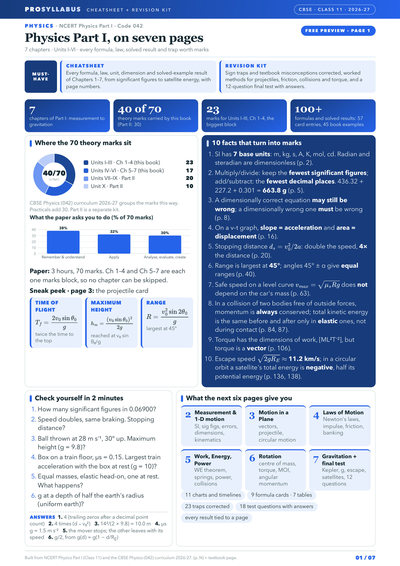
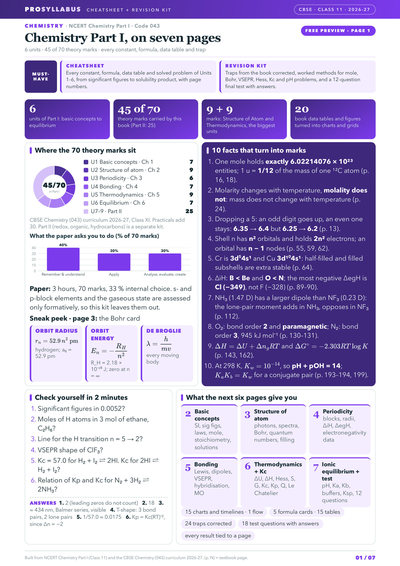
CBSE Class 11 kits Marks booster + cheatsheet: key concepts in 2 lines each, common traps 25 marks: Unit II, Ch 4–8 23 marks: Unit I, Ch 1–3 Common traps, corrected Conic table and standard values Graphs plotted from the book's own tables Page 1 free about 8 min read , Full kit about 55 min read ₹159
Read page 1 free Get the kit Get the kit One payment · instant PDF · ₹159 View details Marks booster + cheatsheet: key concepts in 2 lines each, common traps 23-mark block: Ch 1–4 17-mark block: Ch 5–7 Common traps, corrected 7 chapters: every solved-example result Every unit and dimension, listed Page 1 free about 8 min read , Full kit about 55 min read ₹159
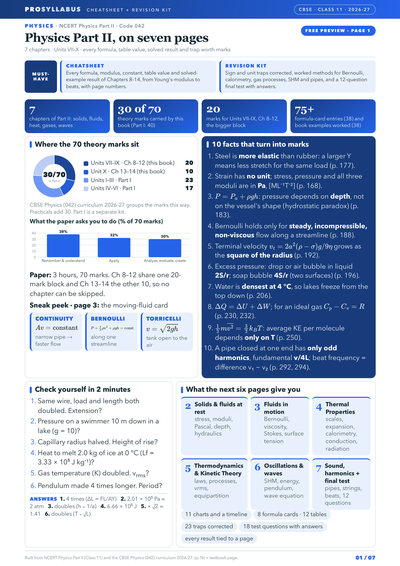
Read page 1 free Get the kit Get the kit One payment · instant PDF · ₹159 View details Marks booster + cheatsheet: key concepts in 2 lines each, common traps 20-mark block: Ch 8–12 10-mark block: Oscillations and Waves Common traps, corrected 7 chapters: every solved-example result Sound, standing waves and beats covered Page 1 free about 8 min read , Full kit about 55 min read ₹159
Read page 1 free Get the kit Get the kit One payment · instant PDF · ₹159 View details Marks booster + cheatsheet: key concepts in 2 lines each, common traps 9 marks each: Atom and Thermodynamics Constants and formulas, with page numbers Common traps, corrected Periodic trends from the real data pH, buffers and solubility product Page 1 free about 8 min read , Full kit about 55 min read ₹159
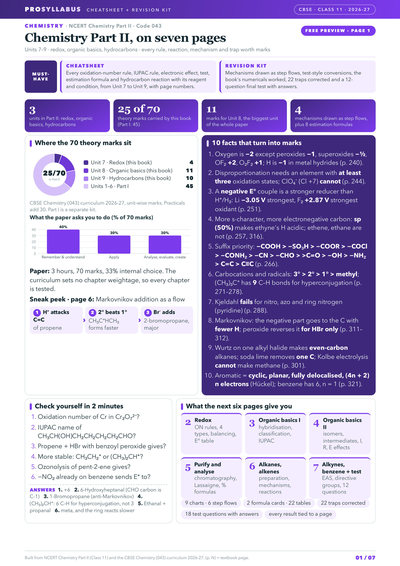
Read page 1 free Get the kit Get the kit One payment · instant PDF · ₹159 View details Marks booster + cheatsheet: key concepts in 2 lines each, common traps 10 marks: Hydrocarbons Every reaction with reagent and condition Common traps that cost marks, listed IUPAC naming rules Oxidation-number rules and balancing Page 1 free about 8 min read , Full kit about 55 min read ₹159
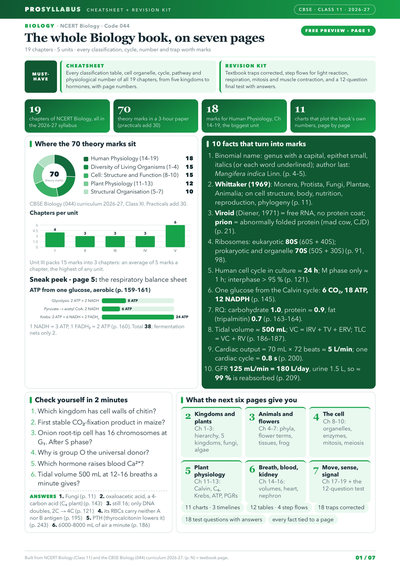
Read page 1 free Get the kit Get the kit One payment · instant PDF · ₹159 View details Marks booster + cheatsheet: key concepts in 2 lines each, common traps 18 marks: Unit V, breathing to hormones 15 marks each: Units I and III Common traps, corrected Five kingdoms classification table Physiological numbers, with page numbers Page 1 free about 8 min read , Full kit about 55 min read ₹159
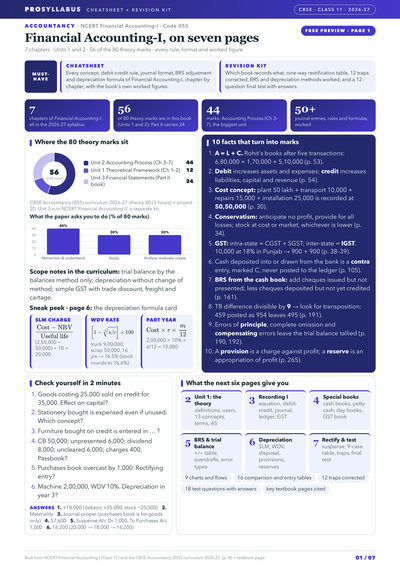
Read page 1 free Get the kit Get the kit One payment · instant PDF · ₹159 View details Marks booster + cheatsheet: key concepts in 2 lines each, common traps 44 marks: Unit 2, recording to depreciation Journal formats and special purpose books Traps from all seven chapters Bank reconciliation adjustments Depreciation formulas, book's worked figures Page 1 free about 8 min read , Full kit about 55 min read ₹159
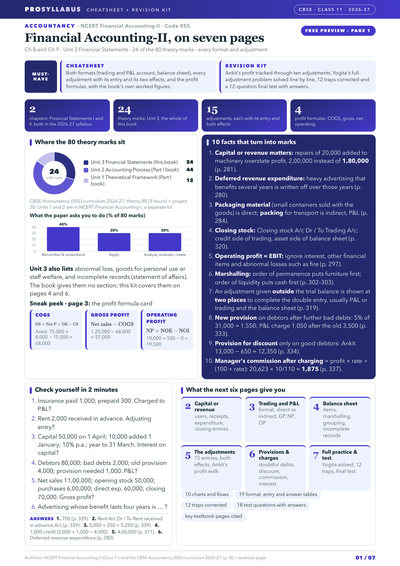
Read page 1 free Get the kit Get the kit One payment · instant PDF · ₹159 View details Marks booster + cheatsheet: key concepts in 2 lines each 12 exam traps, listed Five calculations the paper keeps asking Each adjustment: one entry, two effects Both formats: trading and P&L, balance sheet Yogita illustration solved line by line Page 1 free about 8 min read , Full kit about 55 min read ₹159
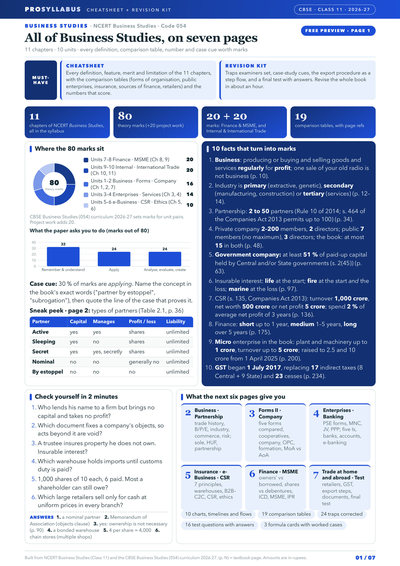
Read page 1 free Get the kit Get the kit One payment · instant PDF · ₹159 View details Marks booster + cheatsheet: key concepts in 2 lines each, common traps 20 marks: finance and MSME units 20 marks: internal and international trade Five comparison tables, insurance to retail Case cues for each chapter Common traps, corrected Page 1 free about 8 min read , Full kit about 55 min read ₹159
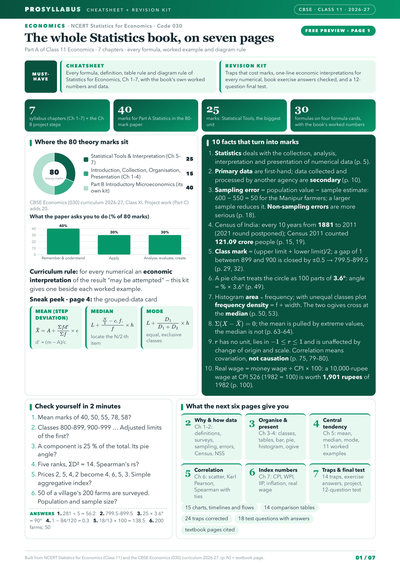
Read page 1 free Get the kit Get the kit One payment · instant PDF · ₹159 View details Marks booster + cheatsheet: key concepts in 2 lines each, common traps 15 marks: Ch 1–4, data to diagrams 7 chapters: every formula, worked numbers Common mistakes, corrected Book exercise answers included Part C project route Page 1 free about 8 min read , Full kit about 55 min read ₹159
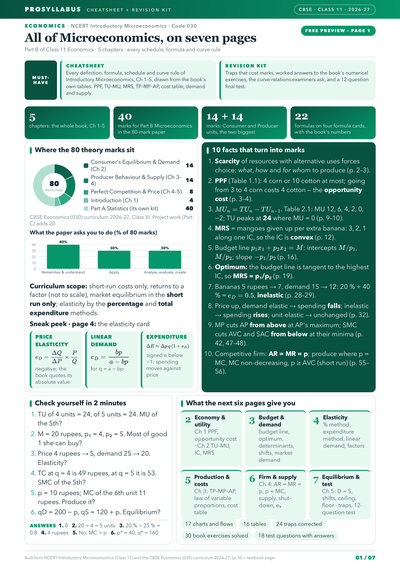
Read page 1 free Get the kit Get the kit One payment · instant PDF · ₹159 View details Marks booster + cheatsheet: key concepts in 2 lines each, common traps 14 marks: Production and Costs, Unit 6 8 marks: Market Equilibrium, Unit 7 Common traps, corrected PPF, TU–MU, MRS and cost table drawn Demand and supply schedules from the book Page 1 free about 8 min read , Full kit about 55 min read ₹159
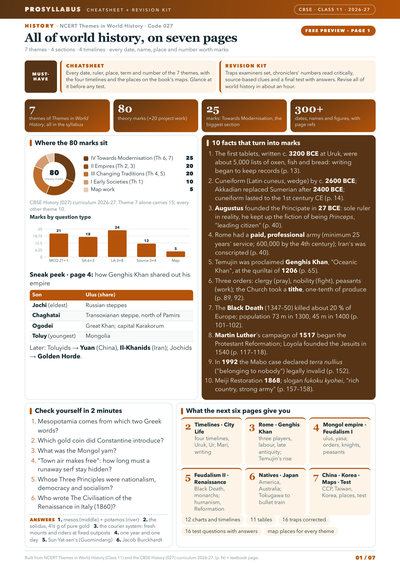
Read page 1 free Get the kit Get the kit One payment · instant PDF · ₹159 View details Marks booster + cheatsheet: key concepts in 2 lines each, common traps 20 marks: Empires section 20 marks: Changing Cultural Traditions 15 marks: Paths to Modernisation, Japan 5 marks: map work on the book's maps Common traps, corrected Page 1 free about 8 min read , Full kit about 55 min read ₹159
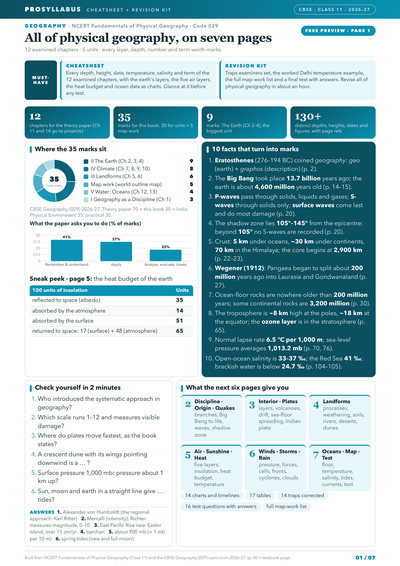
Read page 1 free Get the kit Get the kit One payment · instant PDF · ₹159 View details Marks booster + cheatsheet: key concepts in 2 lines each, common traps 8 marks: Climate unit, Ch 7–10 5 marks: map work, covered 4 marks: ocean data as charts, Unit V Heat budget and five air layers as charts Common traps, corrected Page 1 free about 8 min read , Full kit about 55 min read ₹159
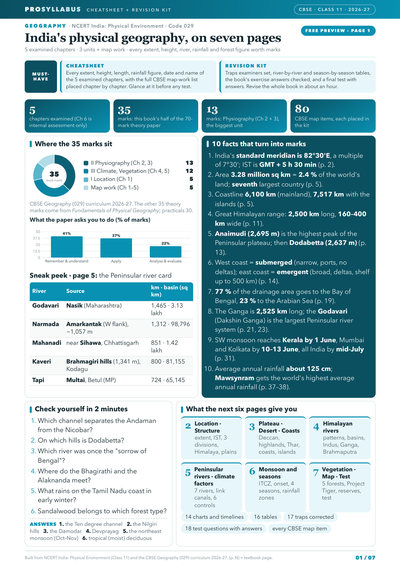
Read page 1 free Get the kit Get the kit One payment · instant PDF · ₹159 View details Marks booster + cheatsheet: key concepts in 2 lines each, common traps 12 marks: Climate, Vegetation (Unit III) Full CBSE map-work list, chapter by chapter Indus, Ganga, Brahmaputra river systems Monsoon mechanism, onset and four seasons Common traps, corrected Page 1 free about 8 min read , Full kit about 55 min read ₹159
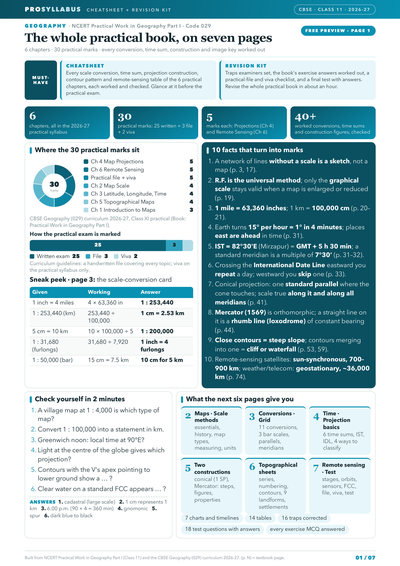
Read page 1 free Get the kit Get the kit One payment · instant PDF · ₹159 View details Marks booster + cheatsheet: key concepts in 2 lines each 4 marks: Map Scale, conversions worked 4 marks: Latitude, Longitude and Time 4 marks: Topographical Maps, contours 5 marks: practical file and viva Conical and Mercator's construction steps Page 1 free about 8 min read , Full kit about 55 min read ₹159
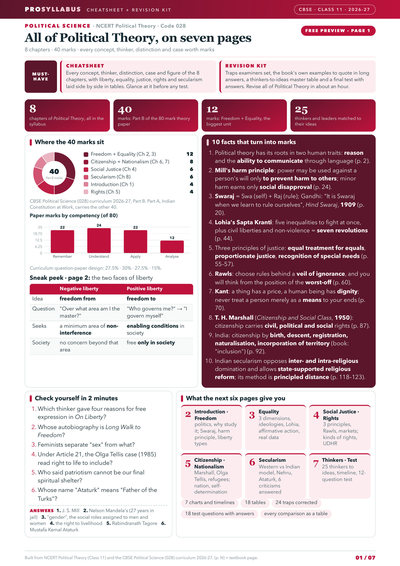
Read page 1 free Get the kit Get the kit One payment · instant PDF · ₹159 View details Marks booster + cheatsheet: key concepts in 2 lines each, common traps 8 marks together: Citizenship, Nationalism 6 marks each: Social Justice, Secularism 8 chapters: thinkers and a timeline Liberty, equality, justice side by side Common traps, corrected Page 1 free about 8 min read , Full kit about 55 min read ₹159
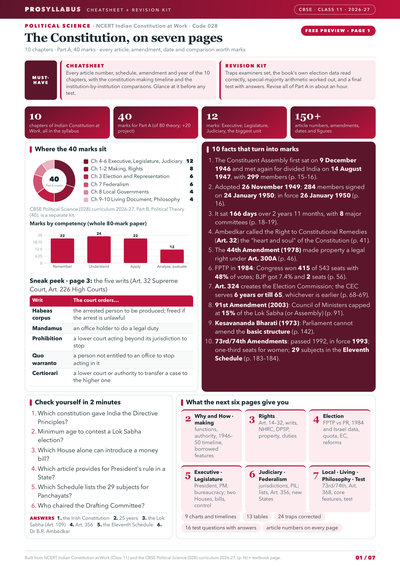
Read page 1 free Get the kit Get the kit One payment · instant PDF · ₹159 View details Marks booster + cheatsheet: key concepts in 2 lines each 12 marks: Executive to Judiciary Constitution-making timeline Institution-by-institution comparisons 6 marks: elections, FPTP, PR, reserved seats Fundamental Rights and Directive Principles Page 1 free about 8 min read , Full kit about 55 min read ₹159
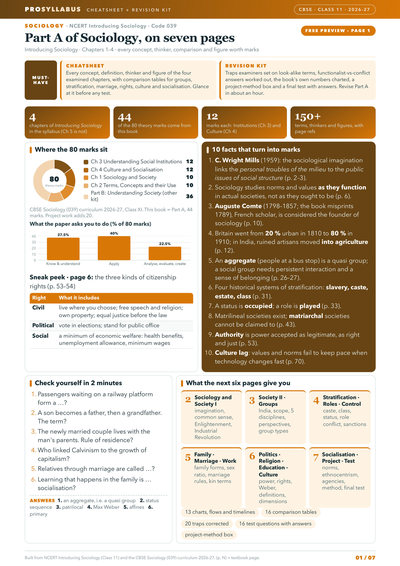
Read page 1 free Get the kit Get the kit One payment · instant PDF · ₹159 View details Marks booster + cheatsheet: key concepts in 2 lines each, common traps 10 marks each: Units 1 and 2 20 marks: project work, covered Tables: groups, stratification, marriage Every thinker and concept of Chapters 1–4 Common traps, corrected Page 1 free about 8 min read , Full kit about 55 min read ₹159
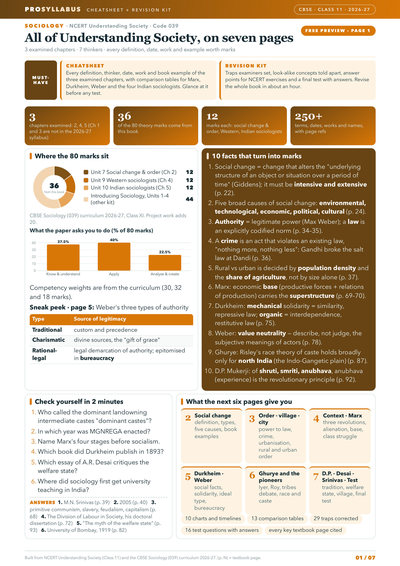
Read page 1 free Get the kit Get the kit One payment · instant PDF · ₹159 View details Marks booster + cheatsheet: key concepts in 2 lines each, common traps 12 marks each: Units 7, 9 and 10 7 thinkers: dates, works, examples Four Indian sociologists, in tables Ideal type, bureaucracy, division of labour Common traps, corrected Page 1 free about 8 min read , Full kit about 55 min read ₹159
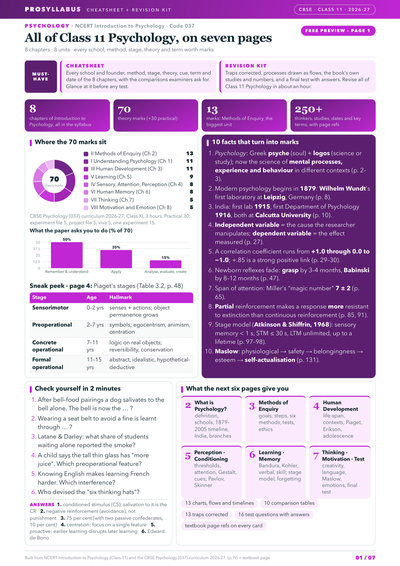
Read page 1 free Get the kit Get the kit One payment · instant PDF · ₹159 View details Marks booster + cheatsheet: key concepts in 2 lines each 11 marks each: Units I and III 9 marks: Learning, Unit V 8 marks each: Perception and Memory Every school with its founder Comparisons examiners ask for Page 1 free about 8 min read , Full kit about 55 min read ₹159
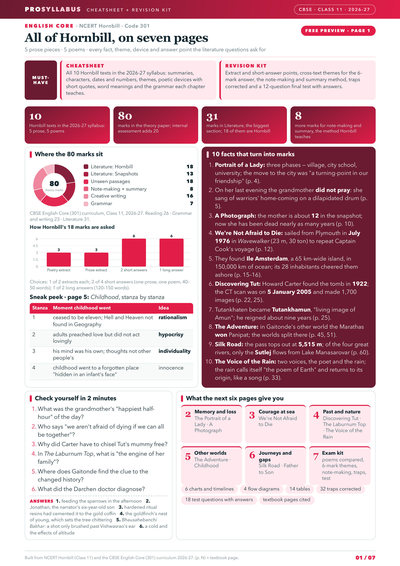
Read page 1 free Get the kit Get the kit One payment · instant PDF · ₹159 View details Marks booster + cheatsheet: key concepts in 2 lines each, common traps 8 marks: note-making and summary 5 poems compared, cross-text themes Common traps, corrected Poetic devices with short quotes Grammar each chapter teaches Page 1 free about 8 min read , Full kit about 55 min read ₹159
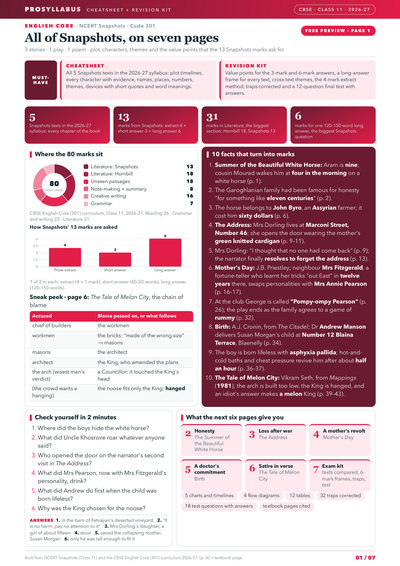
Read page 1 free Get the kit Get the kit One payment · instant PDF · ₹159 View details Marks booster + cheatsheet: key concepts in 2 lines each, common traps 4-, 3- and 6-mark answers: how to write them Plot timeline for every text Common traps, corrected Every character, with evidence Cross-text themes, side by side Page 1 free about 8 min read , Full kit about 55 min read ₹159
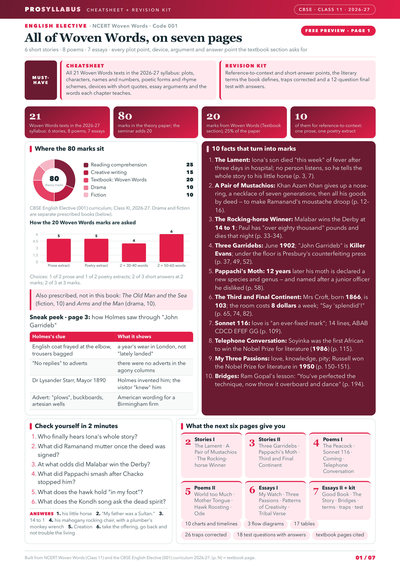
Read page 1 free Get the kit Get the kit One payment · instant PDF · ₹159 View details Marks booster + cheatsheet: key concepts in 2 lines each, common traps Poetic forms and rhyme schemes Devices with short quotes Common traps, corrected Essay arguments, essay by essay Words each chapter teaches Page 1 free about 8 min read , Full kit about 55 min read ₹159
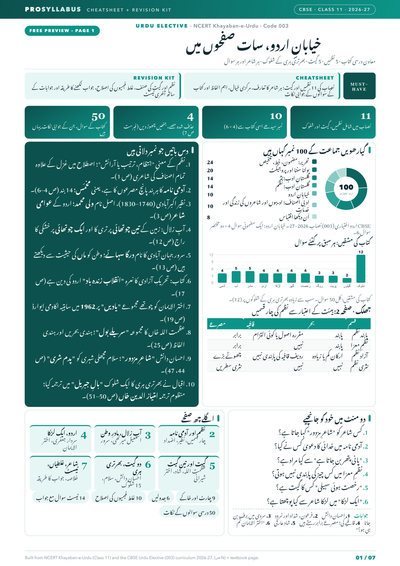
Read page 1 free Get the kit Get the kit One payment · instant PDF · ₹159 View details Marks booster + cheatsheet: key concepts in 2 lines each 16 writers placed on one timeline 60- and 40-word answer frames 8 काव्य पाठ: प्रतीक and काव्य-सौंदर्य Lines worth remembering, with page refs 12 common mistakes, corrected Page 1 free about 8 min read , Full kit about 55 min read ₹159
Read page 1 free Get the kit Get the kit One payment · instant PDF · ₹159 View details Marks booster + cheatsheet: key concepts in 2 lines each 10 marks (2 × 5): answer frames 5-mark answers in about 60 words 4 lessons: argument, events, characters Lines worth remembering, by page 12 common mistakes, corrected Page 1 free about 8 min read , Full kit about 55 min read ₹159
Read page 1 free Get the kit Get the kit One payment · instant PDF · ₹159 View details Marks booster + cheatsheet: key concepts in 2 lines each 16 writers placed on one timeline 40-word and व्याख्या answer frames 8 काव्य पाठ: प्रतीक, उपमान, काव्य-सौंदर्य Lines worth remembering, with page refs 12 common mistakes, corrected Page 1 free about 8 min read , Full kit about 55 min read ₹159
Read page 1 free Get the kit Get the kit One payment · instant PDF · ₹159 View details Marks booster + cheatsheet: key concepts in 2 lines each 5-mark, 100-word answer frames 9 exercise questions: आवारा मसीहा 7 exercise questions: हुसैन की कहानी Life events linked to the works 12 common mistakes, corrected Page 1 free about 8 min read , Full kit about 55 min read ₹159
Read page 1 free Get the kit Get the kit One payment · instant PDF · ₹159 View details Marks booster + cheatsheet: key concepts in 2 lines each 20 marks: grammar, from text words Sandhi, pratyaya and lakar examples Anvaya and bhavartha answer method Source text and author for every lesson 10 common errors, corrected Page 1 free about 8 min read , Full kit about 55 min read ₹159
Read page 1 free Get the kit Get the kit One payment · instant PDF · ₹159 View details Marks booster + cheatsheet: key concepts in 2 lines each 20 marks: grammar, भाग ग, from the text 10 marks: history of literature Sandhi, samasa, pratyaya, upapada examples Source text and author for every lesson Common errors, corrected Page 1 free about 8 min read , Full kit about 55 min read ₹159
Read page 1 free Get the kit Get the kit One payment · instant PDF · ₹159 View details Marks booster + cheatsheet: key concepts in 2 lines each Author, genre and characters per lesson Couplets explained: Insha and Fani ghazals Grammar for Section A Letter and advertisement formats 10 common mistakes, corrected Page 1 free about 8 min read , Full kit about 55 min read ₹159
Read page 1 free Get the kit Get the kit One payment · instant PDF · ₹159 View details Marks booster + cheatsheet: key concepts in 2 lines each 38 marks: the answer frame 13 genres, each introduced 18 writers and poets: dates and works Literary devices (صنعتیں) and key words Common mistakes, corrected Page 1 free about 8 min read , Full kit about 55 min read ₹159
Read page 1 free Get the kit Get the kit One payment · instant PDF · ₹159 View details Marks booster + cheatsheet: key concepts in 2 lines each 10 marks: literary forms, covered 5 geets, each with its poet Nazm defined, with its four kinds Answer points for the book's questions Common mistakes, corrected Page 1 free about 8 min read , Full kit about 55 min read ₹159
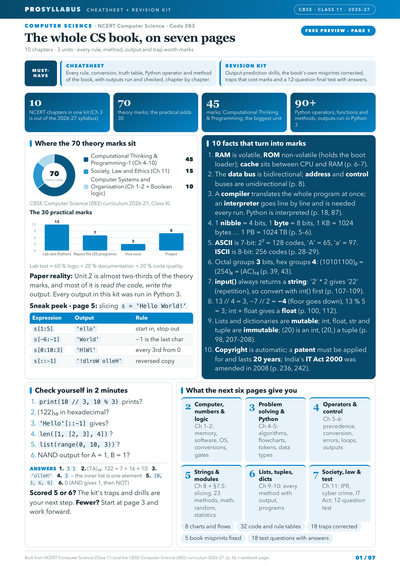
Read page 1 free Get the kit Get the kit One payment · instant PDF · ₹159 View details Marks booster + cheatsheet: key concepts in 2 lines each, common traps 15 marks: Unit 3, society, law and ethics 10 marks: Unit 1, number-system conversions Common traps that cost marks, listed Truth tables for Boolean logic String, list and dictionary methods Page 1 free about 8 min read , Full kit about 55 min read ₹159
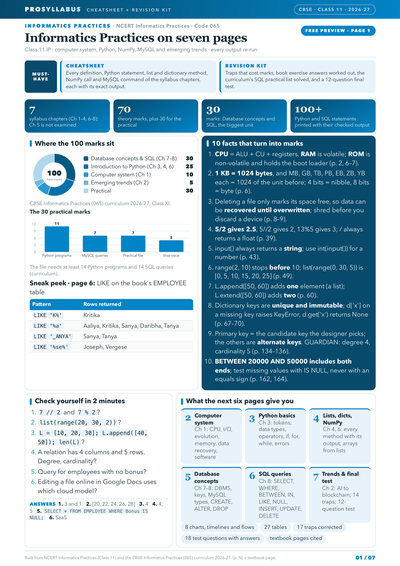
Read page 1 free Get the kit Get the kit One payment · instant PDF · ₹159 View details Marks booster + cheatsheet: key concepts in 2 lines each, common traps 25 marks: Python, lists, NumPy (Unit 2) 10 marks: Computer System (Unit 1) Common traps, corrected Every list and dictionary method, with output SQL queries re-run on the book's tables Page 1 free about 8 min read , Full kit about 55 min read ₹159
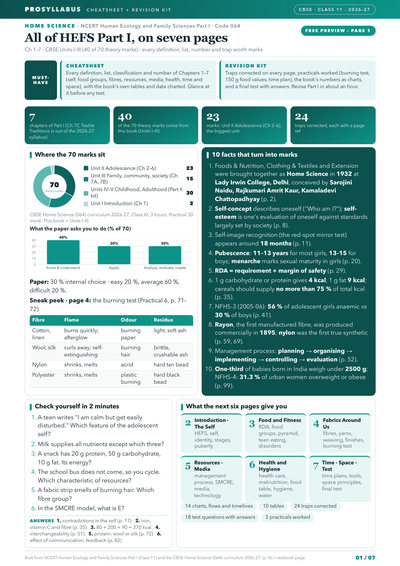
Read page 1 free Get the kit Get the kit One payment · instant PDF · ₹159 View details Marks booster + cheatsheet: key concepts in 2 lines each, common traps 23 marks: Unit II 15 marks: Unit III, health and hygiene Common traps, corrected Five food groups, RDA and the pyramid Nine fibres and the burning test Page 1 free about 8 min read , Full kit about 55 min read ₹159
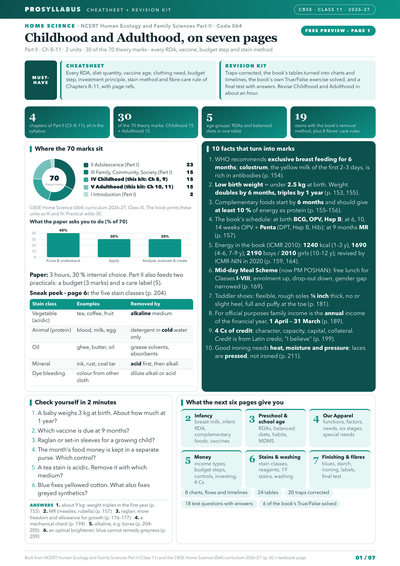
Read page 1 free Get the kit Get the kit One payment · instant PDF · ₹159 View details Marks booster + cheatsheet: key concepts in 2 lines each 15 marks each: Childhood and Adulthood units RDAs and diet quantities by age Vaccine ages Budget steps and investment principles Stain-removal methods Page 1 free about 8 min read , Full kit about 55 min read ₹159
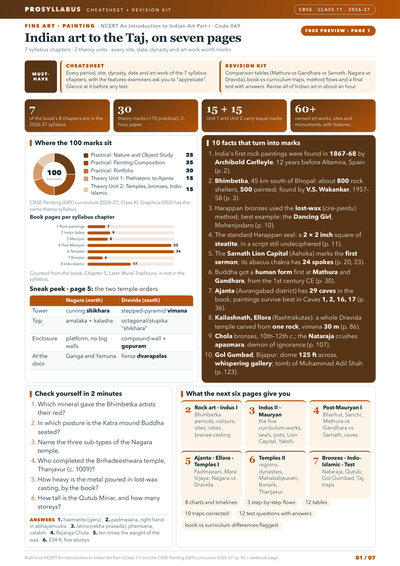
Read page 1 free Get the kit Get the kit One payment · instant PDF · ₹159 View details Marks booster + cheatsheet: key concepts in 2 lines each 15 marks each: the two theory units What to write when asked to appreciate Bharhut, Sanchi and the cave sites Temple architecture: how a temple is built Bronzes and Indo-Islamic buildings Page 1 free about 8 min read , Full kit about 55 min read ₹159
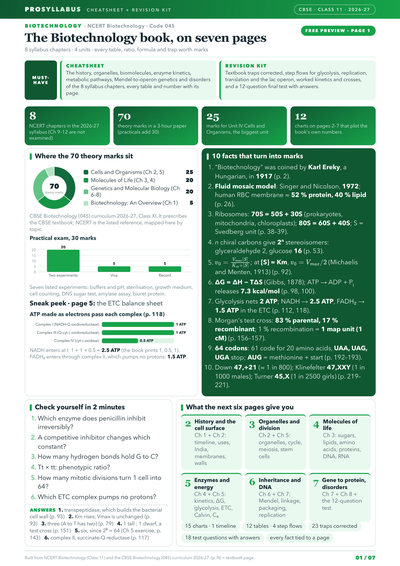
Read page 1 free Get the kit Get the kit One payment · instant PDF · ₹159 View details Marks booster + cheatsheet: key concepts in 2 lines each, common traps 20 marks each: Units II and III Enzyme kinetics and bioenergetics Common traps, corrected Mendel-to-operon genetics Tables and numbers, each with its page Page 1 free about 8 min read , Full kit about 55 min read ₹159
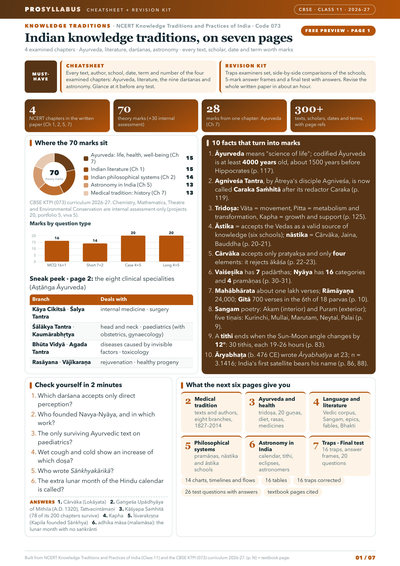
Read page 1 free Get the kit Get the kit One payment · instant PDF · ₹159 View details Marks booster + cheatsheet: key concepts in 2 lines each, common traps 15 marks: language and literature 14 marks: the nine darśanas Common traps, corrected 13 marks: astronomy in India 4 chapters, each with answer frames Page 1 free about 8 min read , Full kit about 55 min read ₹159
Read page 1 free Get the kit Get the kit One payment · instant PDF · ₹159 View details Marks booster + cheatsheet: key concepts in 2 lines each Frames for news, interview and review Inverted pyramid and the six ककार Play-writing frame Translation rules, with solved examples Common mistakes, corrected Page 1 free about 8 min read , Full kit about 55 min read ₹159
Read page 1 free Get the kit Get the kit One payment · instant PDF · ₹159 View details Marks booster + cheatsheet: key concepts in 2 lines each 50 marks: games and sports strand 25 marks: health and fitness strand Eight team games, side by side Fitness tests, norms and formulas Yoga asanas for wellness Page 1 free about 8 min read , Full kit about 55 min read ₹159
Read page 1 free Get the kit Get the kit One payment · instant PDF · ₹159 View details Marks booster + cheatsheet: key concepts in 2 lines each 22 श्रुतियाँ and 10 थाट, defined बिहाग, भीमपलासी, भैरवी with बंदिश notation तीनताल, एकताल, चौताल: ठाह, दुगुन, चौगुन तानसेन, भातखंडे, पलुस्कर profiled 12 common mistakes, corrected Page 1 free about 8 min read , Full kit about 55 min read ₹159
Read page 1 free Get the kit Get the kit One payment · instant PDF · ₹159 View details Marks booster + cheatsheet: key concepts in 2 lines each वादी-संवादी, पकड़ and बंदिश for each राग तीनताल, एकताल, चौताल: ठाह, दुगुन, चौगुन तानसेन, भातखंडे, पलुस्कर profiled Four classes of instruments, तानपुरा, सितार 12 common mistakes, corrected Page 1 free about 8 min read , Full kit about 55 min read ₹159
Read page 1 free Get the kit Get the kit One payment · instant PDF · ₹159 View details Marks booster + cheatsheet: key concepts in 2 lines each 6 marks each: all five units ठाह, दुगुन, तिगुन, चौगुन written out 14 artists with dates कुदऊ सिंह and नाना पानसे: two lives 14 common mistakes, corrected Page 1 free about 8 min read , Full kit about 55 min read ₹159
Read page 1 free Get the kit Get the kit One payment · instant PDF · ₹159 View details Get alerts for CBSE Class 11 Annual Assessment
Dates, results and cutoffs, by email when they are announced. Free.
Google, Apple, or a code to your phone or email. It is saved to your account.
This chapter is part of the CBSE Class 11 Annual Assessment Board Examination Explore every chapter — summary, notes, extra questions & MCQ quizzes Preparing for CBSE Class 11 Annual Assessment? Students also sit JEE is set on the Class 11 and 12 Physics, Chemistry and Maths syllabus; students prepare for boards and JEE together.
Tests are played signed in — sign in (free, 10 seconds) so your attempts, rank and XP are saved to you #1
Discovering Tut: the Saga Continues
Start here
#2
#3
Constitution: Why and How?
#4
#5
#6
#7
#8
Methods of Enquiry in Psychology
#9
#10
An Empire Across Three Continents
#11
#12
The Summer of the Beautiful White Horse
#13
#14
#15
We're Not Afraid to Die... if We Can All Be Together
#16
#17
Election and Representation
#18
Political Theory: An Introduction
#19
#20
Biological Classification
#21
Motion in a Straight Line
#22
Accountancy (Class 11) Practice Quiz | CBSE Class 11 Annual Assessment
#23
Sets and Venn Operations Fundamentals — Free CBSE Class 11 Annual Assessment Quiz
#24
#25
#26
#27
Rights in the Indian Constitution
#28
#29
#30
#31
#32
Changing Cultural Traditions
#33
#34
#35
#36
#37
Private, Public and Global Enterprises
#38
Depreciation, Provisions and Reserves
#39
Introduction to Accounting
#40
Cell Cycle and Cell Division
#41
#42
Anatomy of Flowering Plants
#43
Organic Chemistry – Some Basic Principles and Techniques
#44
#45
#46
#47
#48
#49
#50
#51
#52
#53
#54
#55
The Ailing Planet: the Green Movement's Role
#56
#57
#58
#59
Sensory, Attentional and Perceptual Processes
#60
#61
#62
Introducing Western Sociologists
#63
#64
Social Change and Social Order in Rural and Urban Society
#65
Social Structure, Stratification and Social Processes in Society
#66
Doing Sociology: Research Methods
#67
Culture and Socialisation
#68
Understanding Social Institutions
#69
Terms, Concepts and Their Use in Sociology
#70
#71
The Philosophy of the Constitution
#72
Constitution as a Living Document
#73
#74
#75
#76
#77
#78
#79
#80
#81
#82
Natural Hazards and Disasters
#83
#84
#85
#86
Structure and Physiography
#87
Biodiversity and Conservation
#88
#89
#90
World Climate and Climate Change
#91
Atmospheric Circulation and Weather Systems
#92
Solar Radiation, Heat Balance and Temperature
#93
Composition and Structure of Atmosphere
#94
Landforms and their Evolution
#95
#96
Distribution of Oceans and Continents
#97
#98
The Origin and Evolution of the Earth
#99
Geography as a Discipline
#100
Displacing Indigenous Peoples
#101
#102
Comparative Development Experiences of India and its Neighbours
#103
Environment and Sustainable Development
#104
Employment: Growth, Informalisation and Other Issues
#105
#106
Human Capital Formation in India
#107
Liberalisation, Privatisation and Globalisation: An Appraisal
#108
Indian Economy on the Eve of Independence
#109
#110
#111
#112
Measures of Central Tendency
#113
#114
#115
#116
#117
MSME and Business Entrepreneurship
#118
Sources of Business Finance
#119
#120
Social Responsibilities of Business and Business Ethics
#121
Emerging Modes of Business
#122
#123
Forms of Business Organisation
#124
Business, Trade and Commerce
#125
Financial Statements - II
#126
#127
Trial Balance and Rectification of Errors
#128
Bank Reconciliation Statement
#129
Recording of Transactions - II
#130
Recording of Transactions - I
#131
Theory Base of Accounting
#132
#133
#134
#135
Introduction to Three Dimensional Geometry
#136
#137
#138
#139
#140
Permutations and Combinations
#141
#142
Complex Numbers and Quadratic Equations
#143
#144
#145
Chemical Coordination and Integration
#146
Neural Control and Coordination
#147
#148
Excretory Products and their Elimination
#149
Body Fluids and Circulation
#150
Breathing and Exchange of Gases
#151
Plant Growth and Development
#152
#153
Photosynthesis in Higher Plants
#154
#155
Structural Organisation in Animals
#156
Morphology of Flowering Plants
#157
#158
#159
Chemical Bonding and Molecular Structure
#160
Classification of Elements and Periodicity in Properties
#161
Some Basic Concepts of Chemistry
#162
#163
#164
#165
#166
Thermal Properties of Matter
#167
Mechanical Properties of Fluids
#168
Mechanical Properties of Solids
#169
#170
Systems of Particles and Rotational Motion
#171
#172
#173
Business Studies (Class 11) Practice Quiz | CBSE Class 11 Annual Assessment
#174
Economics (Class 11) Practice Quiz | CBSE Class 11 Annual Assessment
#175
Humanities Subjects Practice Quiz | CBSE Class 11 Annual Assessment
#176
Motion in a Straight Line Practice Quiz | CBSE Class 11 Annual Assessment
#177
Thermodynamic Processes and Laws Advanced Challenge | CBSE Class 11 Annual Assessment
More on CBSE Class 11 Annual Assessment20 guides Tuples and Dictionaries – NCERT Class 11 Computer Science Chapter 10 – Tuple Operations and Dictionary Handling in Python Strings – NCERT Class 11 Computer Science Chapter 8 – String Operations, Traversal, and Methods in Python Getting Started with Python – NCERT Class 11 Computer Science Chapter 5 – Basics, Data Types, Operators, and Debugging Functions – NCERT Class 11 Computer Science Chapter 7 – Defining, Calling, and Understanding Functions in Python Complete Summary and Solutions for Emerging Trends – NCERT Class XI Informatics Practices, Chapter 2 – Explanation, Questions, Answers Mathematical Modelling – NCERT Class 11 Mathematics Appendix 2 – Concepts, Importance, and Applications in Real-world Problems Complete Summary and Solutions for Database Concepts – NCERT Class XI Informatics Practices, Chapter 7 – Explanation, Questions, Answers Encoding Schemes and Number System – NCERT Class 11 Computer Science Chapter 2 – ASCII, ISCII, UNICODE, Binary, Octal, Decimal, Hexadecimal Complete Summary and Solutions for Brief Overview of Python – NCERT Class XI Informatics Practices, Chapter 3 – Explanation, Questions, Answers Complete Summary and Solutions for Computer System – NCERT Class XI Informatics Practices, Chapter 1 – Explanation, Questions, Answers Introduction to Problem Solving – NCERT Class 11 Computer Science Chapter 4 – Algorithms, Flowcharts, Pseudocode, and Control Structures Flow of Control – NCERT Class 11 Computer Science Chapter 6 – Conditional and Looping Constructs in Python Alerts and Updates for CBSE Class 11 Annual Assessment Complete Summary and Solutions for Adventure Sports – Health and Physical Education Textbook for Class XI, Chapter 11 – Explanation, Questions, Answers Complete Summary and Solutions for Tournaments and Competitions – Health and Physical Education Textbook for Class XI, Chapter 10 – Explanation, Questions, Answers Complete Summary and Solutions for Measurement and Evaluation – Health and Physical Education Textbook for Class XI, Chapter 9 – Explanation, Questions, Answers Complete Summary and Solutions for Health Related Physical Fitness – Health and Physical Education Textbook for Class XI, Chapter 8 – Explanation, Questions, Answers Complete Summary and Solutions for Safety and Security – Health and Physical Education Textbook for Class XI, Chapter 7 – Explanation, Questions, Answers Complete Summary and Solutions for Yoga and Its Relevance in the Modern Times – Health and Physical Education Textbook for Class XI, Chapter 6 – Explanation, Questions, Answers Complete Summary and Solutions for Team Games – Health and Physical Education Textbook for Class XI, Chapter 5 – Explanation, Questions, Answers Notebook backup + AI Save your notes. Revise with AI. Learn more → Share this article