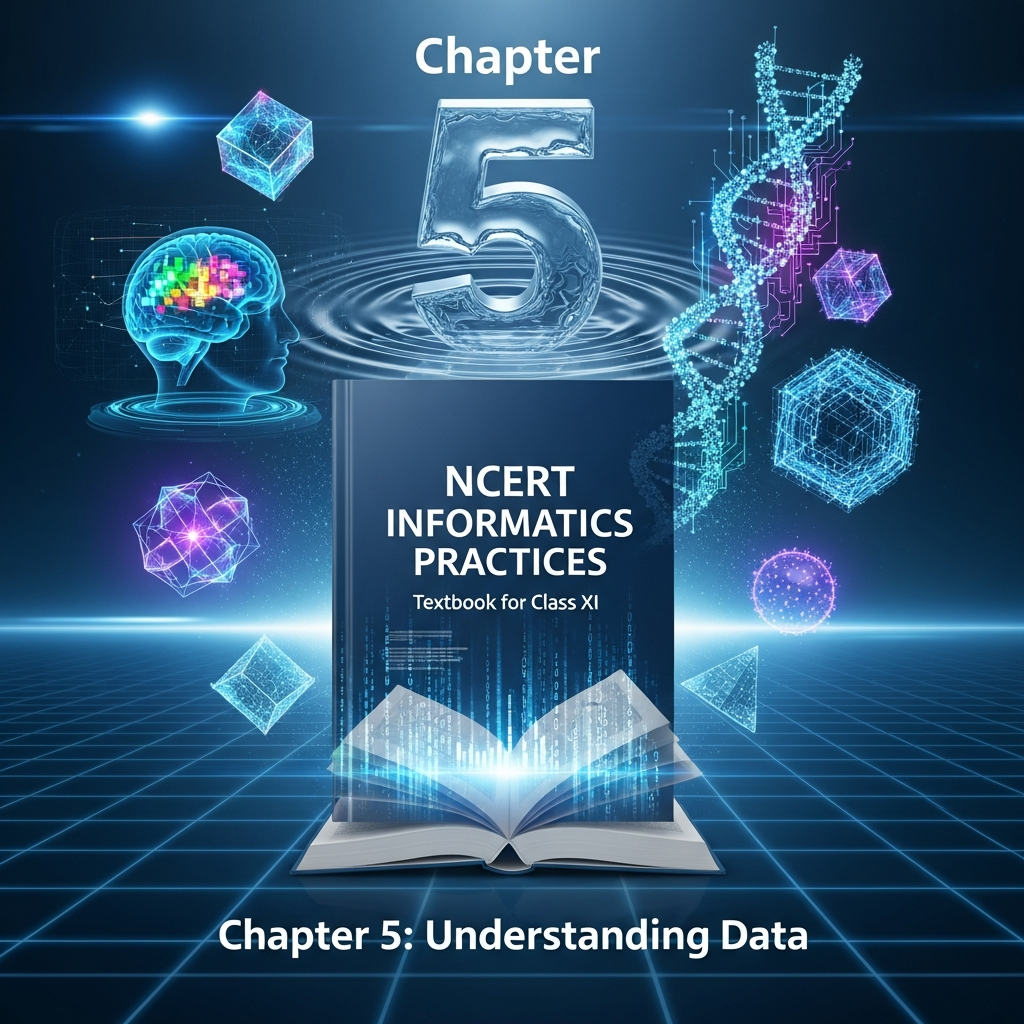
ProSyllabus Journal CBSE Class 11 Annual Assessment Complete Summary and Solutions for Understanding Data – NCERT Class XI Informatics Practices, Chapter 5 – Explanation, Concepts, Questions, Answers Detailed summary and explanation of Chapter 5 ‘Understanding Data’ from the NCERT Informatics Practices textbook for Class XI, covering concepts of data types, data collection, storage, processing, and statistical techniques—along with all NCERT questions, answers, and exercises.
Updated 11 months ago NCERT · Class XI · Informatics Practices · Chapter 5 · Data · Summary · Questions · Answers · Computer Science · Data Processing · Statistics
#Understanding Data #Informatics Practices #NCERT #Class 11 #Data Collection #Data Storage #Data Processing #Statistical Techniques #Summary #Explanation #Questions #Answers #Chapter 5
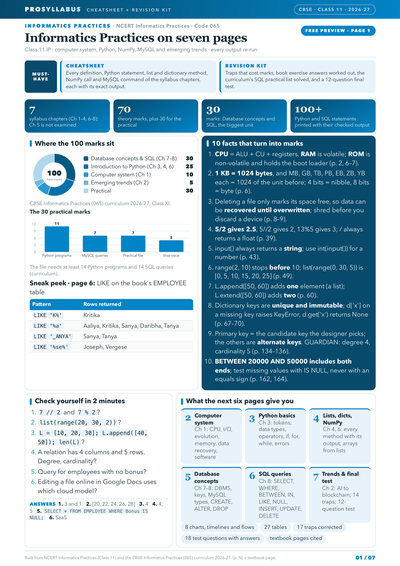
Marks booster + cheatsheet: key concepts in 2 lines each, common traps 25 marks: Unit II, Ch 4–8 23 marks: Unit I, Ch 1–3 Common traps, corrected Conic table and standard values Graphs plotted from the book's own tables Page 1 free about 8 min read , Full kit about 55 min read ₹159
Read page 1 free Get the kit Get the kit One payment · instant PDF · ₹159 View details
Understanding Data - Class 11 Informatics Practices Chapter 5 Ultimate Study Guide 2025
Full Chapter Summary & Detailed Notes
Key Definitions & Terms
Text Book Questions & Answers
Key Concepts
Historical Perspectives
Solved Examples
Interactive Quiz (10 Q)
Quick Revision Notes & Mnemonics
Key Terms & Processes
Processes Step-by-Step
Full Chapter Summary & Detailed Notes - Understanding Data Class 11 NCERT
Overview & Key Concepts
Chapter Goal : Understand data fundamentals, collection, storage, processing, and statistical summarization. Exam Focus: Types (structured/unstructured), processing cycle (Fig 5.1), techniques (mean/median/mode/range/SD; Examples 5.1-5.5). 2025 Updates: Data ethics in AI/big data links. Fun Fact: Gary Schubert quote on data-info-knowledge. Core Idea: Raw data → Processed info for decisions. Real-World: Census analysis, ATM transactions.Wider Scope : From decision-making examples to stats; sources: Tables (5.1-5.3), figures (5.1-5.2), activities (Voter ID fields). Think/Reflect: Metadata in photos, Aadhaar attributes.Expanded Content : Include modern aspects like big data ties; point-wise for recall; add 2025 relevance like GDPR data privacy.
Introduction to Data
Definition : Unorganized facts (characters/numbers/symbols) representing situations; plural: data, singular: datum.Importance : Basis for decisions (college choice, census policies, sports strategies, banking). Processed for insights (placement brochure).Examples : Personal details, transactions, multimedia, social posts, sensor/satellite data.Knowledge Base : AI facts/assumptions for decisions.Expanded : Evidence: ICT revolution generates massive data; debates: Privacy vs utility; real: Post-2020 data explosion.
Conceptual Diagram: Data Processing Cycle (Fig 5.1)
Input (Collection/Entry) → Processing (Store/Retrieve/Classify/Update) → Output (Reports/Results).
Why This Guide Stands Out
Comprehensive: All sections point-wise, table integrations; 2025 with ethics (e.g., data bias in stats), analyzed for decision-making.
Types of Data
Structured : Organized in rows/columns (attributes/observations; Table 5.1 kitchen inventory). Examples: Books (Table 5.2), fees, ATM withdrawals. Activity: Voter ID fields.Unstructured : No fixed format (newspapers, emails, web pages, multimedia, social media). Described via metadata (e.g., email subject, image resolution).Think & Reflect : Photo metadata (date/size); Aadhaar attributes (name/ID/photo).Expanded : Evidence: Spreadsheets for structured; debates: Unstructured processing challenges; real: 80% data unstructured 2025.
Data Collection
Process : Identify/gather from sources (manual entry to digital, CSV, software like Python/MySQL).Scenarios : Diary to spreadsheet; existing CSV; new software for sales.Sources : Digital interactions (hospitals, malls), social media, global orgs (World Bank/IMF).Activity : Aadhaar attributes.Expanded : Evidence: Continuous generation; debates: Ethical collection; real: IoT sensors 2025.
Data Storage
Process : Store on devices for retrieval (HDD/SSD/CD/Pen Drive/Memory Card).Challenges : High volume/rate; cost decrease helps.Files vs DBMS : Files for images/docs; DBMS overcomes file limits.Think & Reflect : Store before processing? (Not always, but useful).Expanded : Evidence: Schools/hospitals use files; debates: Cloud storage; real: Big data lakes 2025.
Data Processing
Goal : Transform raw data to info for decisions (Fig 5.1 cycle).Steps : Collection → Preparation/Entry → Processing (store/retrieve/classify/update) → Output (reports).Examples (Fig 5.2) : Admit card generation, ATM withdrawal, train ticket booking.Automated : Bill payment, complaints, ticketing.Expanded : Evidence: Vast data needs processing; debates: Manual vs automated; real: AI-assisted 2025.
Statistical Techniques for Data Processing
Central Tendency : Mean (average; Ex 5.1, sensitive to outliers), Median (middle value; Ex 5.2), Mode (most frequent; Ex 5.3).Variability : Range (max-min; Ex 5.4, outlier-sensitive), Standard Deviation (spread from mean; Ex 5.5, Table 5.3).Applications : Salary disparity (SD/Range), average performance (Mean), dominant value (Mode).Tools : Python libraries (Pandas) for large data.Think & Reflect : Mean vs Median for outliers.Expanded : Evidence: Calculations shown; debates: Outlier handling; real: Stats in ML 2025.
Exam Activities
Voter ID observation (Act 5.1); stats selection problems.
Summary Key Points
Data: Raw facts → Processed info; Types: Structured (tables) vs Unstructured (media); Storage: Devices/DBMS; Processing: Cycle for outputs; Stats: Mean/Median/Mode/Range/SD for summarization.
Impact: Decisions in education/govt/business; challenges: Volume, outliers.
Project & Group Ideas
Group: Inventory dataset (Table 5.1) in spreadsheet with stats.
Individual: Calculate SD for class marks.
Debate: Structured vs unstructured handling.
Ethical role-play: Data privacy in collection.
Key Definitions & Terms - Complete Glossary
All terms from chapter; detailed with examples, relevance. Expanded: 30+ terms grouped by subtopic; added advanced like "Outlier", "Metadata" for depth/easy flashcards. Table overflow fixed with word-break.
Data
Unorganized facts (characters/numbers). Ex: Names/ages. Relevance: Basis for info.
Datum
Singular of data. Ex: One entry. Relevance: Basic unit.
Structured Data
Organized in rows/columns (attributes). Ex: Table 5.1 inventory. Relevance: Easy analysis.
Unstructured Data
No fixed format. Ex: Emails/images. Relevance: Multimedia.
Metadata
Data about data. Ex: Image resolution. Relevance: Description.
Data Collection
Gather/identify sources. Ex: CSV entry. Relevance: Input for processing.
Data Storage
Save for retrieval. Ex: HDD/SSD. Relevance: Persistence.
DBMS
Database Management System. Ex: MySQL. Relevance: Overcomes file limits.
Data Processing
Transform raw to info. Ex: Fig 5.2 ATM. Relevance: Decisions.
Mean
Average (sum/n). Ex: 101.33 cm (Ex 5.1). Relevance: Central tendency.
Median
Middle value sorted. Ex: 102 cm (Ex 5.2). Relevance: Outlier-resistant.
Mode
Most frequent. Ex: 110 cm (Ex 5.3). Relevance: Dominant value.
Range
Max - Min. Ex: 30 cm (Ex 5.4). Relevance: Spread.
Standard Deviation
Sqrt(average squared diff from mean). Ex: 10.22 cm (Ex 5.5). Relevance: Variability.
Outlier
Extreme value. Ex: Unusual height. Relevance: Affects mean/range.
Attribute
Column parameter. Ex: ProductName (Table 5.1). Relevance: Structured.
Observation
Row data. Ex: One item (Table 5.1). Relevance: Instance.
Census
Population data collection. Ex: Govt records. Relevance: Planning.
ICT
Information Communication Tech. Ex: Computers/Internet. Relevance: Fast processing.
CSV
Comma Separated Values. Ex: Digital sales file. Relevance: Storage.
Knowledge Base
AI facts store. Ex: Rules/assumptions. Relevance: Decisions.
HDD
Hard Disk Drive. Ex: Computer storage. Relevance: Devices.
SSD
Solid State Drive. Ex: Faster storage. Relevance: Modern devices.
Central Tendency
Single value idea (mean/median/mode). Ex: Class average. Relevance: Summary.
Dispersion
Spread measures (range/SD). Ex: Salary variation. Relevance: Diversity.
Variability
Differences around mean. Ex: Marks spread. Relevance: Group analysis.
Sigma (σ)
Standard deviation symbol. Ex: Ex 5.5 calc. Relevance: Notation.
Pandas
Python lib for data. Ex: Analysis tool. Relevance: Processing.
Veracity
Big data tie-in (trust). Ex: Noisy data. Relevance: Quality.
Dynamic Pricing
Price based on data. Ex: Cabs/airlines. Relevance: Business.
EVM
Electronic Voting Machine. Ex: Quick results. Relevance: Automated.
WWW
World Wide Web. Ex: Search engines. Relevance: Data sources.
Happy Hours
Discount via sales data. Ex: Restaurants. Relevance: Analysis.
PNR
Passenger Name Record. Ex: Train tickets (Fig 5.2). Relevance: Processing.
Tip: Group by section; examples for recall. Depth: Debates (e.g., outliers). Errors: Confuse mean/median. Interlinks: To Ch2 emerging trends. Advanced: Big data veracity. Real-Life: Census apps. Graphs: SD table. Coherent: Evidence → Interpretation. For easy learning: Flashcard per term with example.
Text Book Questions & Answers - NCERT Exercises
Direct from chapter exercises (pages 92-94). Answers based on chapter content, point-wise for exams.
Question 1
Identify data required to be maintained to perform the following services:
a) Declare exam results and print e-certificates
Student ID, name, marks/subjects, pass/fail status, certificate template.
b) Register participants in an exhibition and issue biometric ID cards
Name, photo, biometrics (fingerprint), contact, entry/exit logs.
c) To search for an image by a search engine
Image metadata (tags, description), pixels, source URL.
d) To book an OPD appointment with a hospital in a specific department
Patient ID/name, department, date/time, symptoms, doctor availability.
Question 2
A school having 500 students wants to identify beneficiaries of the merit-cum means scholarship... Briefly describe data processing steps...
Answer:
Collect: Marks (2 years), family income data.
Process: Filter >75% marks AND income <5L; calculate eligibility.
Output: Beneficiary list/report.
Question 3
A bank ‘xyz’ wants to know about its popularity... Briefly describe the steps... what results can be checked...
Answer:
Steps: Survey families (accounts/balances); collect via forms/CSV.
Process: Calculate average accounts/balances per family.
Results: Mean balance (popularity metric), mode (common balance).
Question 4
Identify type of data being collected/generated in the following scenarios:
a) Recording a video Unstructured (frames/multimedia). b) Marking attendance by teacher Structured (names/yes-no). c) Writing tweets Unstructured (text/emojis). d) Filling an application form online Structured (fields like name/date).
Question 5
Consider the temperature... Identify the appropriate statistical technique...
a) Average: Mean (34+34+27+28+27+34+34)/7 = 31.14°C. b) Range: Max-Min
c) SD: Variability formula Calc as per Ex 5.5; ~3.2°C.
Question 6
A school teacher wants to analyse results... Identify the appropriate statistical technique...
a) Compare divisions: Mode (most common division).
Justification: Frequency of divisions. b) Compare unit tests: Mean (average performance).
Justification: Central tendency over months.
Question 7
Suppose annual day... a) Which statistical technique... b) How varied are the age...
a) Mode Most frequent alumni pairs. b) Standard Deviation/Range
Question 8
For the annual day... a) Which mode of data collection... b) How would you represent the skill...
a) Survey/Observation Assess singing/writing/monitoring. b) Structured (scores 1-10 per skill)
Question 9
Differentiate between structured and unstructured data giving one example.
Answer:
Structured: Fixed format (rows/columns); Ex: Inventory table (Table 5.1).
Unstructured: No fixed format; Ex: Email content.
Question 10
The principal... Create an appropriate dataset... Apply basic statistical techniques...
Dataset Example:
Item Purchase Price Sale Price Fruit Juice (ml) 20 25 Biscuits 10 12 Samosa 15 20
a) Compare purchase/sale: Range (juice:5, biscuits:2, samosa:5).
b) Compare sales: Mode (if equal, multimodal).
c) Variation in juices: SD across companies (e.g., 2.5).
Tip: Practice calcs (Q5); datasets (Q10). Full marks: Point-wise, examples.
Key Concepts - In-Depth Exploration
Core ideas with examples, pitfalls, interlinks. Expanded: All concepts with steps/examples/pitfalls for easy learning. Depth: Debates, analysis. Table overflow fixed.
Data Types
Steps: Classify format. Ex: Table 5.1 structured. Pitfall: Ignore metadata. Interlink: Collection. Depth: 80% unstructured.
Processing Cycle
Steps: Input → Process → Output (Fig 5.1). Ex: ATM (Fig 5.2). Pitfall: Skip validation. Interlink: Storage. Depth: Automated.
Mean Calculation
Steps: Sum/n (Ex 5.1). Ex: Heights 101.33. Pitfall: Outliers skew. Interlink: Central. Depth: Average.
Median Sorting
Steps: Sort → Middle (Ex 5.2). Ex: 102 cm. Pitfall: Even count average. Interlink: Outlier-resistant. Depth: Central.
Mode Frequency
Steps: Count occurrences (Ex 5.3). Ex: 110 cm. Pitfall: Multimodal. Interlink: Non-numeric. Depth: Dominant.
Range Extremes
Steps: Max-Min (Ex 5.4). Ex: 30 cm. Pitfall: Outlier-sensitive. Interlink: Variability. Depth: Coverage.
SD Spread
Steps: Sqrt(avg (x-mean)^2) (Ex 5.5). Ex: 10.22 cm. Pitfall: Manual calc error. Interlink: All data. Depth: Dispersion.
Structured Analysis
Steps: Rows/columns sum (Table 5.1). Ex: Inventory total. Pitfall: Wrong attribute. Interlink: DBMS. Depth: Tabular.
Collection Sources
Steps: Identify → Gather (CSV/Python). Ex: Sales diary. Pitfall: Incomplete. Interlink: Processing. Depth: Digital.
Storage Devices
Steps: Choose (HDD/SSD) → Save. Ex: Files/DBMS. Pitfall: Capacity. Interlink: Retrieval. Depth: Scalable.
Central Tendency
Steps: Select based on data (mean for avg). Ex: Class weight. Pitfall: Wrong choice. Interlink: Variability. Depth: Summary.
Variability Measures
Steps: Range/SD for spread. Ex: Salaries. Pitfall: Ignore outliers. Interlink: Stats. Depth: Diversity.
Outlier Handling
Steps: Remove before mean. Ex: Extreme height. Pitfall: Data loss. Interlink: SD. Depth: Accuracy.
Metadata Use
Steps: Describe unstructured. Ex: Email parts. Pitfall: Incomplete tags. Interlink: Unstructured. Depth: Organization.
Advanced: Outlier detection rules, SD formulas. Pitfalls: Calc errors. Interlinks: To Ch2 big data. Real: Stats in analytics. Depth: 14 concepts details. Examples: Real exs. Graphs: Tables. Errors: Vs mix. Tips: Steps evidence; compare tables (tendency vs variability).
Historical Perspectives - Detailed Guide
Evolution of data concepts; expanded with points; links to pioneers/debates. Added census origins, stats history.
Data Origins (Ancient)
Census: Roman times population counts. Early records: Clay tablets. Depth: From manual to digital.
Structured Data (20th C)
Spreadsheets: VisiCalc (1979). Databases: Relational model (Codd 1970). Depth: Tabular evolution.
Processing Boom (1950s)
Computers: ENIAC data calc. ICT: Internet 1960s. Depth: Automated cycles.
Stats Foundations (19th C)
Mean/Median: Gauss/Laplace. SD: Pearson (1894). Depth: Mathematical basis.
Storage Advances (1980s)
HDD: IBM 1956, SSD 1950s flash. DBMS: Oracle 1979. Depth: From tapes to cloud.
Big Data Ties (2000s)
Volume explosion: Web 2.0. Stats in AI: Modern processing. Depth: To emerging trends.
Tip: Link to milestones. Depth: Reflexive evolution. Examples: Census. Graphs: Timeline. Advanced: Post-2025 quantum data. Easy: Bullets impacts.
Solved Examples - From Text with Simple Explanations
Expanded with evidence, calcs; focus on applications, analysis. Added mean/SD steps.
Example 5.1: Mean Height
Simple Explanation: Average calc.
Step 1: List [90,102,110,115,85,90,100,110,110].
Step 2: Sum=912.
Step 3: n=9, Mean=912/9=101.33 cm.
Simple Way: Total ÷ Count.
Example 5.2: Median Height
Simple Explanation: Middle value.
Step 1: Sort [85,90,90,100,102,110,110,110,115].
Step 2: Odd n=9, position 5=102 cm.
Simple Way: Sort → Pick middle.
Example 5.3: Mode Height
Simple Explanation: Frequent value.
Step 1: Count: 110 appears 3 times.
Step 2: Highest=110 cm.
Simple Way: Most repeats.
Example 5.4: Range Height
Simple Explanation: Spread extremes.
Step 1: Max=115, Min=85.
Step 2: 115-85=30 cm.
Simple Way: Biggest - Smallest.
Example 5.5: SD Height
Simple Explanation: Spread calc.
Step 1: Mean=101.33.
Step 2: Diff squares sum=938.
Step 3: Avg=938/9=104.22, Sqrt=10.22 cm (Table 5.3).
Simple Way: Avg deviation squared root.
Additional: Inventory Total (Table 5.1)
Simple Explanation: Structured sum.
Step 1: Sum Items_in_Inventory=128.
Step 2: Value=Sum(Price*Items-Discount).
Simple Way: Column multiply/add.
Tip: Practice self-assess; troubleshoot (e.g., outlier removal). Added for all exs.
Interactive Quiz - Master Understanding Data
10 MCQs in full sentences; 80%+ goal. Covers types, processing, stats.
Start Quiz
Quick Revision Notes & Mnemonics
Concise, easy-to-learn summaries for all subtopics. Structured in tables for quick scan: Key points, examples, mnemonics. Covers types, cycle, stats. Bold key terms; short phrases for fast reading. Overflow fixed.
Subtopic
Key Points
Examples
Mnemonics/Tips
Introduction & Types Data : Facts for decisions; Structured : Rows/cols; Unstructured : No format.Metadata: Data about data. Census (importance); Table 5.1 (structured).
DSU (Data, Structured, Unstructured). Tip: "Data Structures Unlock Insights".
Collection & Storage Collection : Gather sources (CSV/Python).Storage : Devices (HDD/SSD/DBMS).Sales diary → Spreadsheet; Files vs DBMS.
CS (Collect Store). Tip: "Collect to Store, Retrieve to Score".
Processing Cycle : Input → Process → Output (Fig 5.1).Automated: ATM/tickets (Fig 5.2). Admit card gen; Train booking.
IPO (Input Process Output). Tip: "Input Processes Output Decisions".
Central Tendency Mean : Avg; Median : Middle; Mode : Frequent.Outlier-sensitive: Mean/Range. Ex 5.1-5.3 heights.
MMM (Mean Median Mode). Tip: "Mean Middle Most - Central Trio".
Variability Range : Max-Min; SD : Sqrt(avg diff^2).All data: SD; Extremes: Range. Ex 5.4-5.5; Table 5.3.
RS (Range SD). Tip: "Range Spreads, SD Details".
Overall Tip: Use DSU-CS-IPO-MMM-RS for full scan (5 mins). Flashcards: Front (term), Back (points + mnemonic). Print table for wall revision. Covers 100% chapter – easy for exams!
Key Terms & Processes - All Key
Expanded table 30+ rows; quick ref. Added advanced (e.g., Outlier, Veracity tie). Overflow fixed with word-break/overflow-wrap.
Term/Process Description Example Usage
Data Unorganized facts Name/age Decisions Datum Singular data One fact Unit Structured Data Rows/cols organized Table 5.1 Analysis Unstructured Data No fixed format Email Multimedia Metadata Data about data Image size Description Data Collection Gather sources CSV entry Input Data Storage Save retrieval HDD Persistence DBMS Database system MySQL Management Data Processing Raw to info ATM Fig 5.2 Outputs Mean Avg sum/n 101.33 cm Average Median Middle sorted 102 cm Central Mode Most frequent 110 cm Dominant Range Max-Min 30 cm Spread Standard Deviation Sqrt avg diff^2 10.22 cm Variability Outlier Extreme value Unusual height Error Attribute Column param ProductName Structured Observation Row instance One item Data point Census Population record Govt data Planning ICT Info comm tech Internet Generation CSV Comma values Sales file Digital Knowledge Base AI facts Rules Decisions HDD Hard disk Storage Devices SSD Solid state Fast drive Modern Central Tendency Single value idea Mean/mode Summary Dispersion Spread measures Range/SD Diversity Variability Around mean diff Marks spread Group Sigma (σ) SD symbol Ex 5.5 Notation Pandas Python data lib Analysis Tools Dynamic Pricing Demand-based Cabs Business EVM Electronic voting Quick counts Automated WWW World wide web Search engines Sources Happy Hours Sales discount Restaurants Analysis PNR Passenger record Train tickets Processing Veracity Data trust Noisy filter Quality
Tip: Examples memory; sort subtopic. Easy: Table scan. Added 10 rows depth.
Processes Step-by-Step
Step-by-step breakdowns of core processes. Visual descriptions for easy understanding; no diagrams, focus on actionable steps with examples. Overflow fixed in tables.
Process 1: Data Collection
Step 1: Identify sources (e.g., diary).
Step 2: Gather (manual/digital).
Step 3: Format (CSV/spreadsheet).
Step 4: Validate completeness.
Step 5: Store for use.
Visual: Gather → Format → Validate.
Process 2: Data Processing Cycle
Step 1: Input collection/entry.
Step 2: Process (store/classify).
Step 3: Retrieve/update.
Step 4: Generate output (reports).
Step 5: Feedback loop.
Visual: Cycle – Input → Process → Output → Repeat.
Process 3: Mean Calculation
Step 1: List values.
Step 2: Sum all.
Step 3: Divide by n.
Step 4: Remove outliers if needed.
Step 5: Interpret average.
Visual: List → Sum → Divide.
Process 4: Median Finding
Step 1: Sort ascending/descending.
Step 2: Odd: Middle position.
Step 3: Even: Avg two middles.
Step 4: Verify central split.
Step 5: Use for outlier data.
Visual: Sort → Middle pick.
Process 5: SD Computation
Step 1: Calc mean.
Step 2: Diff each from mean, square.
Step 3: Avg squares.
Step 4: Sqrt result.
Step 5: Interpret spread.
Visual: Mean → Diff^2 → Avg → Sqrt.
Process 6: Structured Analysis
Step 1: Identify attributes/observations.
Step 2: Sum/multiply columns (e.g., total value).
Step 3: Apply stats (mean/range).
Step 4: Visualize (charts).
Step 5: Decide (e.g., inventory reorder).
Visual: Table → Calc → Insight.
Tip: Follow steps like recipe; apply to exs (5.1/5.5). Easy: Number + example per step.
CBSE Class 11 kits Marks booster + cheatsheet: key concepts in 2 lines each, common traps 25 marks: Unit II, Ch 4–8 23 marks: Unit I, Ch 1–3 Common traps, corrected Conic table and standard values Graphs plotted from the book's own tables Page 1 free about 8 min read , Full kit about 55 min read ₹159
Read page 1 free Get the kit Get the kit One payment · instant PDF · ₹159 View details Marks booster + cheatsheet: key concepts in 2 lines each, common traps 23-mark block: Ch 1–4 17-mark block: Ch 5–7 Common traps, corrected 7 chapters: every solved-example result Every unit and dimension, listed Page 1 free about 8 min read , Full kit about 55 min read ₹159
Read page 1 free Get the kit Get the kit One payment · instant PDF · ₹159 View details Marks booster + cheatsheet: key concepts in 2 lines each, common traps 20-mark block: Ch 8–12 10-mark block: Oscillations and Waves Common traps, corrected 7 chapters: every solved-example result Sound, standing waves and beats covered Page 1 free about 8 min read , Full kit about 55 min read ₹159
Read page 1 free Get the kit Get the kit One payment · instant PDF · ₹159 View details Marks booster + cheatsheet: key concepts in 2 lines each, common traps 9 marks each: Atom and Thermodynamics Constants and formulas, with page numbers Common traps, corrected Periodic trends from the real data pH, buffers and solubility product Page 1 free about 8 min read , Full kit about 55 min read ₹159
Read page 1 free Get the kit Get the kit One payment · instant PDF · ₹159 View details Marks booster + cheatsheet: key concepts in 2 lines each, common traps 10 marks: Hydrocarbons Every reaction with reagent and condition Common traps that cost marks, listed IUPAC naming rules Oxidation-number rules and balancing Page 1 free about 8 min read , Full kit about 55 min read ₹159
Read page 1 free Get the kit Get the kit One payment · instant PDF · ₹159 View details Marks booster + cheatsheet: key concepts in 2 lines each, common traps 18 marks: Unit V, breathing to hormones 15 marks each: Units I and III Common traps, corrected Five kingdoms classification table Physiological numbers, with page numbers Page 1 free about 8 min read , Full kit about 55 min read ₹159
Read page 1 free Get the kit Get the kit One payment · instant PDF · ₹159 View details Marks booster + cheatsheet: key concepts in 2 lines each, common traps 44 marks: Unit 2, recording to depreciation Journal formats and special purpose books Traps from all seven chapters Bank reconciliation adjustments Depreciation formulas, book's worked figures Page 1 free about 8 min read , Full kit about 55 min read ₹159
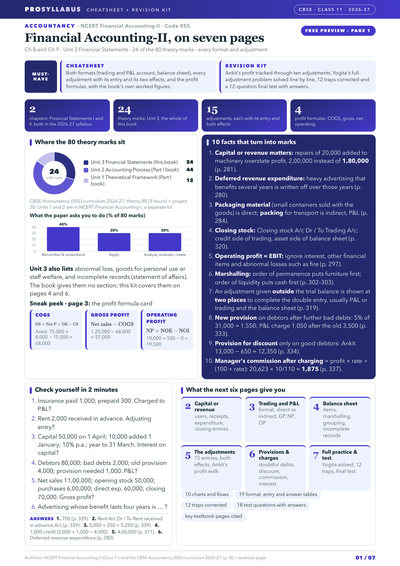
Read page 1 free Get the kit Get the kit One payment · instant PDF · ₹159 View details Marks booster + cheatsheet: key concepts in 2 lines each 12 exam traps, listed Five calculations the paper keeps asking Each adjustment: one entry, two effects Both formats: trading and P&L, balance sheet Yogita illustration solved line by line Page 1 free about 8 min read , Full kit about 55 min read ₹159
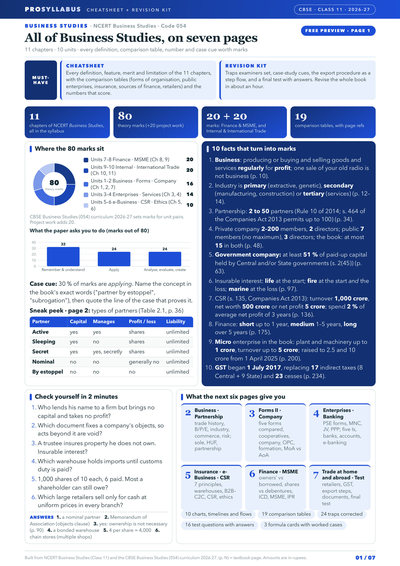
Read page 1 free Get the kit Get the kit One payment · instant PDF · ₹159 View details Marks booster + cheatsheet: key concepts in 2 lines each, common traps 20 marks: finance and MSME units 20 marks: internal and international trade Five comparison tables, insurance to retail Case cues for each chapter Common traps, corrected Page 1 free about 8 min read , Full kit about 55 min read ₹159
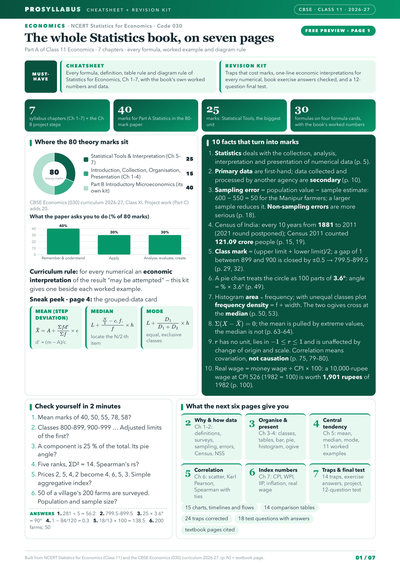
Read page 1 free Get the kit Get the kit One payment · instant PDF · ₹159 View details Marks booster + cheatsheet: key concepts in 2 lines each, common traps 15 marks: Ch 1–4, data to diagrams 7 chapters: every formula, worked numbers Common mistakes, corrected Book exercise answers included Part C project route Page 1 free about 8 min read , Full kit about 55 min read ₹159
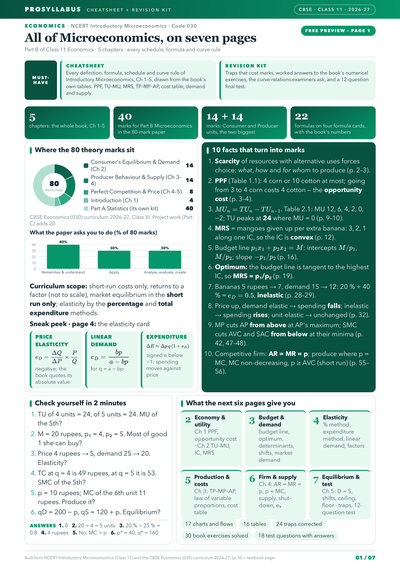
Read page 1 free Get the kit Get the kit One payment · instant PDF · ₹159 View details Marks booster + cheatsheet: key concepts in 2 lines each, common traps 14 marks: Production and Costs, Unit 6 8 marks: Market Equilibrium, Unit 7 Common traps, corrected PPF, TU–MU, MRS and cost table drawn Demand and supply schedules from the book Page 1 free about 8 min read , Full kit about 55 min read ₹159
Read page 1 free Get the kit Get the kit One payment · instant PDF · ₹159 View details Marks booster + cheatsheet: key concepts in 2 lines each, common traps 20 marks: Empires section 20 marks: Changing Cultural Traditions 15 marks: Paths to Modernisation, Japan 5 marks: map work on the book's maps Common traps, corrected Page 1 free about 8 min read , Full kit about 55 min read ₹159
Read page 1 free Get the kit Get the kit One payment · instant PDF · ₹159 View details Marks booster + cheatsheet: key concepts in 2 lines each, common traps 8 marks: Climate unit, Ch 7–10 5 marks: map work, covered 4 marks: ocean data as charts, Unit V Heat budget and five air layers as charts Common traps, corrected Page 1 free about 8 min read , Full kit about 55 min read ₹159
Read page 1 free Get the kit Get the kit One payment · instant PDF · ₹159 View details Marks booster + cheatsheet: key concepts in 2 lines each, common traps 12 marks: Climate, Vegetation (Unit III) Full CBSE map-work list, chapter by chapter Indus, Ganga, Brahmaputra river systems Monsoon mechanism, onset and four seasons Common traps, corrected Page 1 free about 8 min read , Full kit about 55 min read ₹159
Read page 1 free Get the kit Get the kit One payment · instant PDF · ₹159 View details Marks booster + cheatsheet: key concepts in 2 lines each 4 marks: Map Scale, conversions worked 4 marks: Latitude, Longitude and Time 4 marks: Topographical Maps, contours 5 marks: practical file and viva Conical and Mercator's construction steps Page 1 free about 8 min read , Full kit about 55 min read ₹159
Read page 1 free Get the kit Get the kit One payment · instant PDF · ₹159 View details Marks booster + cheatsheet: key concepts in 2 lines each, common traps 8 marks together: Citizenship, Nationalism 6 marks each: Social Justice, Secularism 8 chapters: thinkers and a timeline Liberty, equality, justice side by side Common traps, corrected Page 1 free about 8 min read , Full kit about 55 min read ₹159
Read page 1 free Get the kit Get the kit One payment · instant PDF · ₹159 View details Marks booster + cheatsheet: key concepts in 2 lines each 12 marks: Executive to Judiciary Constitution-making timeline Institution-by-institution comparisons 6 marks: elections, FPTP, PR, reserved seats Fundamental Rights and Directive Principles Page 1 free about 8 min read , Full kit about 55 min read ₹159
Read page 1 free Get the kit Get the kit One payment · instant PDF · ₹159 View details Marks booster + cheatsheet: key concepts in 2 lines each, common traps 10 marks each: Units 1 and 2 20 marks: project work, covered Tables: groups, stratification, marriage Every thinker and concept of Chapters 1–4 Common traps, corrected Page 1 free about 8 min read , Full kit about 55 min read ₹159
Read page 1 free Get the kit Get the kit One payment · instant PDF · ₹159 View details Marks booster + cheatsheet: key concepts in 2 lines each, common traps 12 marks each: Units 7, 9 and 10 7 thinkers: dates, works, examples Four Indian sociologists, in tables Ideal type, bureaucracy, division of labour Common traps, corrected Page 1 free about 8 min read , Full kit about 55 min read ₹159
Read page 1 free Get the kit Get the kit One payment · instant PDF · ₹159 View details Marks booster + cheatsheet: key concepts in 2 lines each 11 marks each: Units I and III 9 marks: Learning, Unit V 8 marks each: Perception and Memory Every school with its founder Comparisons examiners ask for Page 1 free about 8 min read , Full kit about 55 min read ₹159
Read page 1 free Get the kit Get the kit One payment · instant PDF · ₹159 View details Marks booster + cheatsheet: key concepts in 2 lines each, common traps 8 marks: note-making and summary 5 poems compared, cross-text themes Common traps, corrected Poetic devices with short quotes Grammar each chapter teaches Page 1 free about 8 min read , Full kit about 55 min read ₹159
Read page 1 free Get the kit Get the kit One payment · instant PDF · ₹159 View details Marks booster + cheatsheet: key concepts in 2 lines each, common traps 4-, 3- and 6-mark answers: how to write them Plot timeline for every text Common traps, corrected Every character, with evidence Cross-text themes, side by side Page 1 free about 8 min read , Full kit about 55 min read ₹159
Read page 1 free Get the kit Get the kit One payment · instant PDF · ₹159 View details Marks booster + cheatsheet: key concepts in 2 lines each, common traps Poetic forms and rhyme schemes Devices with short quotes Common traps, corrected Essay arguments, essay by essay Words each chapter teaches Page 1 free about 8 min read , Full kit about 55 min read ₹159
Read page 1 free Get the kit Get the kit One payment · instant PDF · ₹159 View details Marks booster + cheatsheet: key concepts in 2 lines each 16 writers placed on one timeline 60- and 40-word answer frames 8 काव्य पाठ: प्रतीक and काव्य-सौंदर्य Lines worth remembering, with page refs 12 common mistakes, corrected Page 1 free about 8 min read , Full kit about 55 min read ₹159
Read page 1 free Get the kit Get the kit One payment · instant PDF · ₹159 View details Marks booster + cheatsheet: key concepts in 2 lines each 10 marks (2 × 5): answer frames 5-mark answers in about 60 words 4 lessons: argument, events, characters Lines worth remembering, by page 12 common mistakes, corrected Page 1 free about 8 min read , Full kit about 55 min read ₹159
Read page 1 free Get the kit Get the kit One payment · instant PDF · ₹159 View details Marks booster + cheatsheet: key concepts in 2 lines each 16 writers placed on one timeline 40-word and व्याख्या answer frames 8 काव्य पाठ: प्रतीक, उपमान, काव्य-सौंदर्य Lines worth remembering, with page refs 12 common mistakes, corrected Page 1 free about 8 min read , Full kit about 55 min read ₹159
Read page 1 free Get the kit Get the kit One payment · instant PDF · ₹159 View details Marks booster + cheatsheet: key concepts in 2 lines each 5-mark, 100-word answer frames 9 exercise questions: आवारा मसीहा 7 exercise questions: हुसैन की कहानी Life events linked to the works 12 common mistakes, corrected Page 1 free about 8 min read , Full kit about 55 min read ₹159
Read page 1 free Get the kit Get the kit One payment · instant PDF · ₹159 View details Marks booster + cheatsheet: key concepts in 2 lines each 20 marks: grammar, from text words Sandhi, pratyaya and lakar examples Anvaya and bhavartha answer method Source text and author for every lesson 10 common errors, corrected Page 1 free about 8 min read , Full kit about 55 min read ₹159
Read page 1 free Get the kit Get the kit One payment · instant PDF · ₹159 View details Marks booster + cheatsheet: key concepts in 2 lines each 20 marks: grammar, भाग ग, from the text 10 marks: history of literature Sandhi, samasa, pratyaya, upapada examples Source text and author for every lesson Common errors, corrected Page 1 free about 8 min read , Full kit about 55 min read ₹159
Read page 1 free Get the kit Get the kit One payment · instant PDF · ₹159 View details Marks booster + cheatsheet: key concepts in 2 lines each Author, genre and characters per lesson Couplets explained: Insha and Fani ghazals Grammar for Section A Letter and advertisement formats 10 common mistakes, corrected Page 1 free about 8 min read , Full kit about 55 min read ₹159
Read page 1 free Get the kit Get the kit One payment · instant PDF · ₹159 View details Marks booster + cheatsheet: key concepts in 2 lines each 38 marks: the answer frame 13 genres, each introduced 18 writers and poets: dates and works Literary devices (صنعتیں) and key words Common mistakes, corrected Page 1 free about 8 min read , Full kit about 55 min read ₹159
Read page 1 free Get the kit Get the kit One payment · instant PDF · ₹159 View details Marks booster + cheatsheet: key concepts in 2 lines each 10 marks: literary forms, covered 5 geets, each with its poet Nazm defined, with its four kinds Answer points for the book's questions Common mistakes, corrected Page 1 free about 8 min read , Full kit about 55 min read ₹159
Read page 1 free Get the kit Get the kit One payment · instant PDF · ₹159 View details Marks booster + cheatsheet: key concepts in 2 lines each, common traps 15 marks: Unit 3, society, law and ethics 10 marks: Unit 1, number-system conversions Common traps that cost marks, listed Truth tables for Boolean logic String, list and dictionary methods Page 1 free about 8 min read , Full kit about 55 min read ₹159
Read page 1 free Get the kit Get the kit One payment · instant PDF · ₹159 View details Marks booster + cheatsheet: key concepts in 2 lines each, common traps 25 marks: Python, lists, NumPy (Unit 2) 10 marks: Computer System (Unit 1) Common traps, corrected Every list and dictionary method, with output SQL queries re-run on the book's tables Page 1 free about 8 min read , Full kit about 55 min read ₹159
Read page 1 free Get the kit Get the kit One payment · instant PDF · ₹159 View details Marks booster + cheatsheet: key concepts in 2 lines each, common traps 23 marks: Unit II 15 marks: Unit III, health and hygiene Common traps, corrected Five food groups, RDA and the pyramid Nine fibres and the burning test Page 1 free about 8 min read , Full kit about 55 min read ₹159
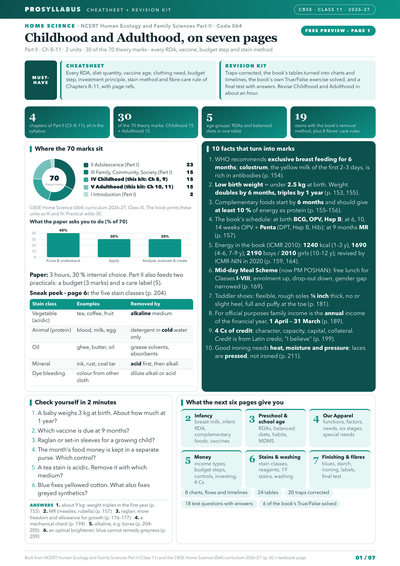
Read page 1 free Get the kit Get the kit One payment · instant PDF · ₹159 View details Marks booster + cheatsheet: key concepts in 2 lines each 15 marks each: Childhood and Adulthood units RDAs and diet quantities by age Vaccine ages Budget steps and investment principles Stain-removal methods Page 1 free about 8 min read , Full kit about 55 min read ₹159
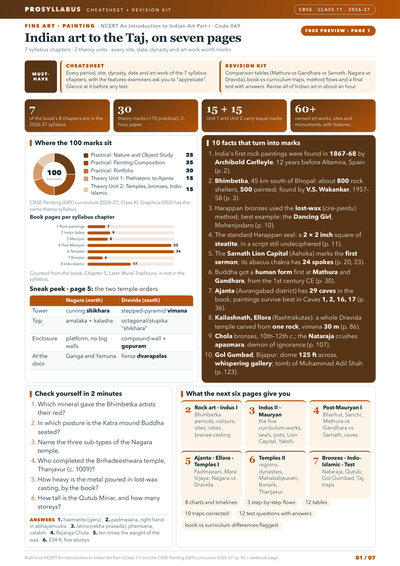
Read page 1 free Get the kit Get the kit One payment · instant PDF · ₹159 View details Marks booster + cheatsheet: key concepts in 2 lines each 15 marks each: the two theory units What to write when asked to appreciate Bharhut, Sanchi and the cave sites Temple architecture: how a temple is built Bronzes and Indo-Islamic buildings Page 1 free about 8 min read , Full kit about 55 min read ₹159
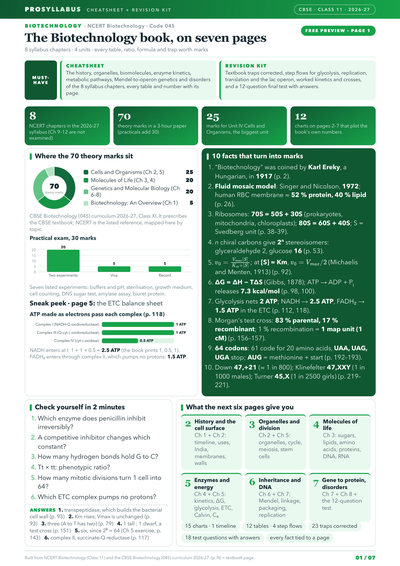
Read page 1 free Get the kit Get the kit One payment · instant PDF · ₹159 View details Marks booster + cheatsheet: key concepts in 2 lines each, common traps 20 marks each: Units II and III Enzyme kinetics and bioenergetics Common traps, corrected Mendel-to-operon genetics Tables and numbers, each with its page Page 1 free about 8 min read , Full kit about 55 min read ₹159
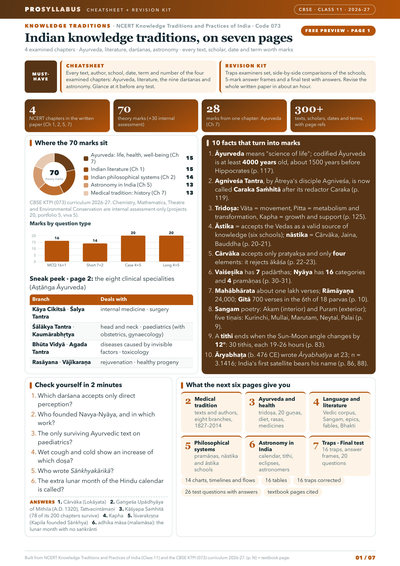
Read page 1 free Get the kit Get the kit One payment · instant PDF · ₹159 View details Marks booster + cheatsheet: key concepts in 2 lines each, common traps 15 marks: language and literature 14 marks: the nine darśanas Common traps, corrected 13 marks: astronomy in India 4 chapters, each with answer frames Page 1 free about 8 min read , Full kit about 55 min read ₹159
Read page 1 free Get the kit Get the kit One payment · instant PDF · ₹159 View details Marks booster + cheatsheet: key concepts in 2 lines each Frames for news, interview and review Inverted pyramid and the six ककार Play-writing frame Translation rules, with solved examples Common mistakes, corrected Page 1 free about 8 min read , Full kit about 55 min read ₹159
Read page 1 free Get the kit Get the kit One payment · instant PDF · ₹159 View details Marks booster + cheatsheet: key concepts in 2 lines each 50 marks: games and sports strand 25 marks: health and fitness strand Eight team games, side by side Fitness tests, norms and formulas Yoga asanas for wellness Page 1 free about 8 min read , Full kit about 55 min read ₹159
Read page 1 free Get the kit Get the kit One payment · instant PDF · ₹159 View details Marks booster + cheatsheet: key concepts in 2 lines each 22 श्रुतियाँ and 10 थाट, defined बिहाग, भीमपलासी, भैरवी with बंदिश notation तीनताल, एकताल, चौताल: ठाह, दुगुन, चौगुन तानसेन, भातखंडे, पलुस्कर profiled 12 common mistakes, corrected Page 1 free about 8 min read , Full kit about 55 min read ₹159
Read page 1 free Get the kit Get the kit One payment · instant PDF · ₹159 View details Marks booster + cheatsheet: key concepts in 2 lines each वादी-संवादी, पकड़ and बंदिश for each राग तीनताल, एकताल, चौताल: ठाह, दुगुन, चौगुन तानसेन, भातखंडे, पलुस्कर profiled Four classes of instruments, तानपुरा, सितार 12 common mistakes, corrected Page 1 free about 8 min read , Full kit about 55 min read ₹159
Read page 1 free Get the kit Get the kit One payment · instant PDF · ₹159 View details Marks booster + cheatsheet: key concepts in 2 lines each 6 marks each: all five units ठाह, दुगुन, तिगुन, चौगुन written out 14 artists with dates कुदऊ सिंह and नाना पानसे: two lives 14 common mistakes, corrected Page 1 free about 8 min read , Full kit about 55 min read ₹159
Read page 1 free Get the kit Get the kit One payment · instant PDF · ₹159 View details Get alerts for CBSE Class 11 Annual Assessment
Dates, results and cutoffs, by email when they are announced. Free.
Google, Apple, or a code to your phone or email. It is saved to your account.
This chapter is part of the CBSE Class 11 Annual Assessment Board Examination Explore every chapter — summary, notes, extra questions & MCQ quizzes Preparing for CBSE Class 11 Annual Assessment? Students also sit JEE is set on the Class 11 and 12 Physics, Chemistry and Maths syllabus; students prepare for boards and JEE together.
Tests are played signed in — sign in (free, 10 seconds) so your attempts, rank and XP are saved to you #1
Discovering Tut: the Saga Continues
Start here
#2
#3
Constitution: Why and How?
#4
#5
#6
#7
#8
Methods of Enquiry in Psychology
#9
#10
An Empire Across Three Continents
#11
#12
The Summer of the Beautiful White Horse
#13
#14
#15
We're Not Afraid to Die... if We Can All Be Together
#16
#17
Election and Representation
#18
Political Theory: An Introduction
#19
#20
Biological Classification
#21
Motion in a Straight Line
#22
Accountancy (Class 11) Practice Quiz | CBSE Class 11 Annual Assessment
#23
Sets and Venn Operations Fundamentals — Free CBSE Class 11 Annual Assessment Quiz
#24
#25
#26
#27
Rights in the Indian Constitution
#28
#29
#30
#31
#32
Changing Cultural Traditions
#33
#34
#35
#36
#37
Private, Public and Global Enterprises
#38
Depreciation, Provisions and Reserves
#39
Introduction to Accounting
#40
Cell Cycle and Cell Division
#41
#42
Anatomy of Flowering Plants
#43
Organic Chemistry – Some Basic Principles and Techniques
#44
#45
#46
#47
#48
#49
#50
#51
#52
#53
#54
#55
The Ailing Planet: the Green Movement's Role
#56
#57
#58
#59
Sensory, Attentional and Perceptual Processes
#60
#61
#62
Introducing Western Sociologists
#63
#64
Social Change and Social Order in Rural and Urban Society
#65
Social Structure, Stratification and Social Processes in Society
#66
Doing Sociology: Research Methods
#67
Culture and Socialisation
#68
Understanding Social Institutions
#69
Terms, Concepts and Their Use in Sociology
#70
#71
The Philosophy of the Constitution
#72
Constitution as a Living Document
#73
#74
#75
#76
#77
#78
#79
#80
#81
#82
Natural Hazards and Disasters
#83
#84
#85
#86
Structure and Physiography
#87
Biodiversity and Conservation
#88
#89
#90
World Climate and Climate Change
#91
Atmospheric Circulation and Weather Systems
#92
Solar Radiation, Heat Balance and Temperature
#93
Composition and Structure of Atmosphere
#94
Landforms and their Evolution
#95
#96
Distribution of Oceans and Continents
#97
#98
The Origin and Evolution of the Earth
#99
Geography as a Discipline
#100
Displacing Indigenous Peoples
#101
#102
Comparative Development Experiences of India and its Neighbours
#103
Environment and Sustainable Development
#104
Employment: Growth, Informalisation and Other Issues
#105
#106
Human Capital Formation in India
#107
Liberalisation, Privatisation and Globalisation: An Appraisal
#108
Indian Economy on the Eve of Independence
#109
#110
#111
#112
Measures of Central Tendency
#113
#114
#115
#116
#117
MSME and Business Entrepreneurship
#118
Sources of Business Finance
#119
#120
Social Responsibilities of Business and Business Ethics
#121
Emerging Modes of Business
#122
#123
Forms of Business Organisation
#124
Business, Trade and Commerce
#125
Financial Statements - II
#126
#127
Trial Balance and Rectification of Errors
#128
Bank Reconciliation Statement
#129
Recording of Transactions - II
#130
Recording of Transactions - I
#131
Theory Base of Accounting
#132
#133
#134
#135
Introduction to Three Dimensional Geometry
#136
#137
#138
#139
#140
Permutations and Combinations
#141
#142
Complex Numbers and Quadratic Equations
#143
#144
#145
Chemical Coordination and Integration
#146
Neural Control and Coordination
#147
#148
Excretory Products and their Elimination
#149
Body Fluids and Circulation
#150
Breathing and Exchange of Gases
#151
Plant Growth and Development
#152
#153
Photosynthesis in Higher Plants
#154
#155
Structural Organisation in Animals
#156
Morphology of Flowering Plants
#157
#158
#159
Chemical Bonding and Molecular Structure
#160
Classification of Elements and Periodicity in Properties
#161
Some Basic Concepts of Chemistry
#162
#163
#164
#165
#166
Thermal Properties of Matter
#167
Mechanical Properties of Fluids
#168
Mechanical Properties of Solids
#169
#170
Systems of Particles and Rotational Motion
#171
#172
#173
Business Studies (Class 11) Practice Quiz | CBSE Class 11 Annual Assessment
#174
Economics (Class 11) Practice Quiz | CBSE Class 11 Annual Assessment
#175
Humanities Subjects Practice Quiz | CBSE Class 11 Annual Assessment
#176
Motion in a Straight Line Practice Quiz | CBSE Class 11 Annual Assessment
#177
Thermodynamic Processes and Laws Advanced Challenge | CBSE Class 11 Annual Assessment
More on CBSE Class 11 Annual Assessment20 guides Tuples and Dictionaries – NCERT Class 11 Computer Science Chapter 10 – Tuple Operations and Dictionary Handling in Python Strings – NCERT Class 11 Computer Science Chapter 8 – String Operations, Traversal, and Methods in Python Getting Started with Python – NCERT Class 11 Computer Science Chapter 5 – Basics, Data Types, Operators, and Debugging Functions – NCERT Class 11 Computer Science Chapter 7 – Defining, Calling, and Understanding Functions in Python Complete Summary and Solutions for Emerging Trends – NCERT Class XI Informatics Practices, Chapter 2 – Explanation, Questions, Answers Mathematical Modelling – NCERT Class 11 Mathematics Appendix 2 – Concepts, Importance, and Applications in Real-world Problems Complete Summary and Solutions for Database Concepts – NCERT Class XI Informatics Practices, Chapter 7 – Explanation, Questions, Answers Encoding Schemes and Number System – NCERT Class 11 Computer Science Chapter 2 – ASCII, ISCII, UNICODE, Binary, Octal, Decimal, Hexadecimal Complete Summary and Solutions for Brief Overview of Python – NCERT Class XI Informatics Practices, Chapter 3 – Explanation, Questions, Answers Complete Summary and Solutions for Computer System – NCERT Class XI Informatics Practices, Chapter 1 – Explanation, Questions, Answers Introduction to Problem Solving – NCERT Class 11 Computer Science Chapter 4 – Algorithms, Flowcharts, Pseudocode, and Control Structures Flow of Control – NCERT Class 11 Computer Science Chapter 6 – Conditional and Looping Constructs in Python Alerts and Updates for CBSE Class 11 Annual Assessment Complete Summary and Solutions for Adventure Sports – Health and Physical Education Textbook for Class XI, Chapter 11 – Explanation, Questions, Answers Complete Summary and Solutions for Tournaments and Competitions – Health and Physical Education Textbook for Class XI, Chapter 10 – Explanation, Questions, Answers Complete Summary and Solutions for Measurement and Evaluation – Health and Physical Education Textbook for Class XI, Chapter 9 – Explanation, Questions, Answers Complete Summary and Solutions for Health Related Physical Fitness – Health and Physical Education Textbook for Class XI, Chapter 8 – Explanation, Questions, Answers Complete Summary and Solutions for Safety and Security – Health and Physical Education Textbook for Class XI, Chapter 7 – Explanation, Questions, Answers Complete Summary and Solutions for Yoga and Its Relevance in the Modern Times – Health and Physical Education Textbook for Class XI, Chapter 6 – Explanation, Questions, Answers Complete Summary and Solutions for Team Games – Health and Physical Education Textbook for Class XI, Chapter 5 – Explanation, Questions, Answers Notebook backup + AI Save your notes. Revise with AI. Learn more → Share this article