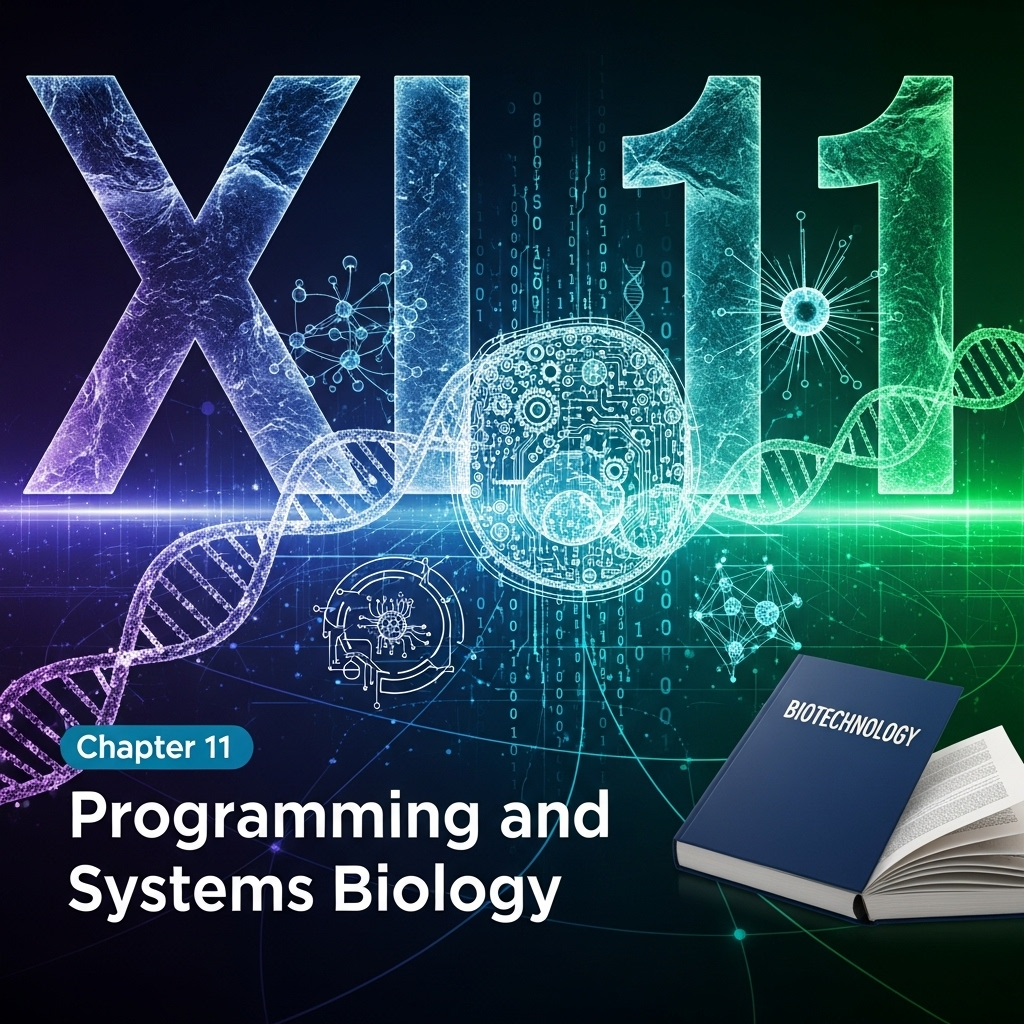
ProSyllabus Journal CBSE Class 11 Annual Assessment Complete Summary and Solutions for Programming and Systems Biology – NCERT Class XI Biotechnology, Chapter 11 – Python, R, Bioinformatics Tools, Models, Analysis Comprehensive summary and explanation of Chapter 11 'Programming and Systems Biology' from the NCERT Class XI Biotechnology textbook, covering programming languages like Python and R for biological data analysis, computational approaches, bioinformatics pipelines, modelling, simulation, data standards, systems biology toolkits, model analysis, and answers to all textbook questions and exercises.
Updated 1 year ago NCERT · Class XI · Biotechnology · Chapter 11 · Programming · Systems Biology · Python · R · Bioinformatics · Modelling · Analysis · Summary · Questions · Answers
#Programming #Systems Biology #NCERT #Class 11 #Biotechnology #Python #R #Bioinformatics #Modelling #Simulation #Data Standards #Pipelines #Model Analysis #Tools #Chapter 11 #Summary #Answers #Exercises
Marks booster + cheatsheet: key concepts in 2 lines each, common traps 25 marks: Unit II, Ch 4–8 23 marks: Unit I, Ch 1–3 Common traps, corrected Conic table and standard values Graphs plotted from the book's own tables Page 1 free about 8 min read , Full kit about 55 min read ₹159
Read page 1 free Get the kit Get the kit One payment · instant PDF · ₹159 View details
Programming and Systems Biology: Class 11 NCERT Chapter 11 - Ultimate Study Guide, Notes, Questions, Quiz 2025
Full Chapter Summary & Detailed Notes
Key Definitions & Terms
60+ Questions & Answers
Key Concepts
Historical Perspectives
Solved Examples
Interactive Quiz (10 Q)
Quick Revision Notes & Mnemonics
Key Terms & Processes
Key Processes & Diagrams
Full Chapter Summary & Detailed Notes - Programming and Systems Biology Class 11 NCERT
Overview & Key Concepts
Chapter Goal : Introduce programming for handling biological big data and systems biology for modeling complex interactions. Exam Focus: Languages (Python/R), workflows (Fig 11.2), tools (Table 11.1), historical milestones, data management. 2025 Updates: Emphasis on AI/ML in biotech, integration with bioinformatics (Unit V). Fun Fact: Python's creator Guido van Rossum named it after Monty Python comedy. Core Idea: From data overload to predictive models via code and simulations. Real-World: Python in CRISPR design; systems models for drug discovery. Ties: Links to biomolecules (Ch3), recombinant tech (Ch10). Expanded: All subtopics (11.1-11.2.5) covered point-wise with diagram descriptions, including workflows and tool matrices for visual learning.Wider Scope : Shift from manual to automated analysis; interdisciplinary fusion of programming, stats, and biology for systems-level understanding.Expanded Content : Detailed on languages, historical evolution, protocols, data standards, analysis methods; added biotech applications like network inference for disease pathways.
11.1 Programming in Biology
Evolution of Data Handling : From manual computations to high-throughput generation, automated analysis, and prediction; tech boons create massive data challenges in storage, visualization, transfer, analysis, interpretation.AI/ML Impact : Revolutionizes research; future biotech students need basic programming, chemistry, stats for cutting-edge work.Chapter Purpose : Gentle intro to high-level languages for biologists; not exhaustive, focuses on popular ones like Python, R.Bioinformatics Platforms : Software for all OS, but Linux dominant; PERL core for sequences, now enriched with Python/R for stats, visualization; Python modules for large datasets on standalone/web/cloud; MATLAB for analysis.
No Specific Fig for 11.1, but Conceptual: High-Throughput Data Flow (Description)
Visual: Pipeline from wet-lab experiments → Data generation → Storage/DB → Analysis (Python/R) → Prediction/Visualization; icons for DNA seq, code snippets, graphs.
Key Languages
Python : High-level, general-purpose (Guido van Rossum, 1991); object-oriented, interactive; runs on Unix/Mac/Windows; popular in bioinformatics for clear syntax, OOP alignment, libraries/toolkits; used in sequence/structure analysis, phylogenetics.R : From Robert Gentleman & Robert Ihaka; functional, rapid/reliable for high-volume analysis, visualization, simulation; free/open-source; for genome sequences, biomolecular pathways.Emerging Languages : GEC (Microsoft: rule-based for genetic engineering of cells); Kera (Dr. Umesh P., Univ. Kerala: OOP knowledge-based; captures genome/protein/cell info via user-edited library 'Samhita' - short for Kerala, means coconut).
11.2 Systems Biology
11.2.1 Introduction : Experiments generate data from small to large; now digital databases fuel computational models mimicking in-vitro/in-vivo systems; systems models represent biology; interdisciplinary focus on complex interactions (Fig. 11.1); post-Human Genome Project (HGP) boom; models discover emergent properties (cells/tissues/organisms); examples: metabolic/signaling networks; applications: health/diseases, therapeutics.
Fig. 11.1: Depiction of Systems Biology as an interdisciplinary field (Description)
Central circle: SYSTEMS BIOLOGY (Synthesis-Analysis-Modelling Concept); Surrounding: SYSTEM SCIENCE (Hypotheses-Genetic Modification-Quantitative Measurement), LIFE SCIENCE (INFORMATION SCIENCE: Databases-Modelling Tools-Visualization Tools); Arrows showing integration of biology, info science, system science.
11.2.2 Historical Perspective
Pre-Emergence (1900-1970) : Research on physiology, population dynamics, enzyme kinetics, control theory, cybernetics as segments.1952 Milestone : Hodgkin-Huxley (Nobel) mathematical model for neuronal action potential.1960 : Denis Noble's first computer model of heart pacemaker (PMID 13729365).1966 : Mihajlo Mesarovic launches "Systems Theory and Biology" at Case Institute, Cleveland.1968 : Ludwig von Bertalanffy publishes precursor theory.1960s-1970s : Metabolic control analysis, biochemical systems theory; theoretical biology breaks skepticism with molecular biology.1990s Onward : Functional genomics generates high-quality data for realistic models.NSF Challenge : Model whole cell; MIT/CytoSolve 2003; 2012: Mount Sinai's Mycoplasma genitalium model for mutation viability.Current Project : Physiome[](http://physiomeproject.org/): Multi-scale framework for physiological modeling; e.g., heart electromechanical models link ion channels, myofilaments, signal pathways to tissue mechanics, wavefront, blood flow.
11.2.3 Theme Behind Systems Biology
Diverse Views : Reductionist identifies components/interactions but fails pluralism description.Quantitative Integration : Simultaneous multi-component measures via math models with data integration.Core Theme : Integrate components (Fig. 11.1); 'Object network mapping and integration with interdependent dynamic event—kinetics with partial differential equations'.
11.2.4 Protocol for Systems Biology Experiments
Discrete Steps (Fig. 11.2) : Define problem → Design/execute experiments → Generate/collect data → Arrange in formats → Develop network interface (precise/mechanism-based) → Model → Analyze discrepancies (simulation vs. data) → Hypothesize/refine → Repeat simulation/test.Workflow Requirements : Data-management, network parameter optimization, performance analysis/evaluation.
Fig. 11.2: Workflow for Implementation of Systems Biology Experiment (Description)
Flowchart: Defining the Problem → Literature/Pathways/DB Curation → Proposed Molecular Map → Experiment Design & Execution → Annotation of Experimental Result Data → Network Inference/Novel Interaction → Systems Biology Model → Defining Dynamics of System Behaviour → Model Update; Arrows looping back for refinement.
Data Management Standards
(i) Minimum Information : Essential metadata for microarray, proteomic, biological, biomedical investigations.(ii) File Formats : XML-based for auto-processing by computers.(iii) Ontologies : Semantic hierarchical relations; e.g., Gene Ontology (GO), Systems Biology Ontology (SBO).Systems : Spreadsheets, web-based ELN, LIMS; customized for tool integration/workflows.Workflow Tools : KNIME, caGrid, Taverna, Bio-STEER, Galaxy; enable data exchange/integration, inter-tool communication for pipelines.
Resource Tools (Table 11.1)
Facilities Tools / Software
Data management Taverna, MAGE-TAB, Bio-STEER, caGrid Network inference MATLAB, R, BANJO Curation CellDesigner, PathVisio, JDesigner Simulation MATLAB, CellDesigner, insilico IDE, ANSYS, JSim Model analysis MATLAB, BUNKI, COBRA, NetBuilder, SimBoolNet Molecular interaction AutoDock Vina, GOLD, eHiTS Physiological modelling PhysioDesigner, CellDesigner, OpenCell, FLAME
Modeling Tools : Interconnected PDEs for spatiotemporal systems; solved by FEM (numerical for PDEs); tools: ANSYS, FreeFEM++, OpenFEM, MATLAB.Simulation Tools : JSim, OpenCell, FLAME; many under development for real-life aspects.
11.2.5 Model-Analysis Methods
(i) Sensitivity Analysis : Stability/controllability vs. distractions; tools: SBML-SAT, MATLAB SimBiology, ByoDyn, SensSB.(ii) Bifurcation and Phase-Space Analysis : Steady/dynamical tendencies; tools: AUTO, XPPAut, BUNKI, ManLab.(iii) Metabolic Control Analysis (MCA) : Steady-state network properties vs. reactions; tool: MetNetMaker.
Summary
Programming eases big data handling for hypotheses; Python/R key for analysis/visualization; systems biology models complex interactions via computation/experiments; data management crucial (MI, formats, ontologies); tools enable workflows; analysis methods ensure model robustness.
Interlinks: To bioinformatics (Ch12), rDNA (Ch10).
Why This Guide Stands Out
Code-focused: Steps for Python/R use, workflow simulations. Free 2025 with mnemonics, tool links for retention; biotech apps like pathway modeling.
Key Themes & Tips
Aspects : Data challenges to integrative modeling, historical to modern tools.Tip: Practice Python snippets for sequences; mnemonic for protocol (DDENAM: Define-Design-Execute-Network-Analyze-Model).
Exam Case Studies
R in genomics: Pathway simulation; Physiome: Heart modeling integration.
Project & Group Ideas
Code Python script for sequence alignment.
Simulate workflow in Galaxy for network inference.
Debate: AI ethics in systems biology predictions.
Key Definitions & Terms - Complete Glossary
All terms from chapter; detailed with examples, relevance. Expanded: 30+ terms with depth for easy learning; grouped by subtopic. Added tools, methods.
High-Throughput Data
Large-scale automated generation. Relevance: Modern biology core. Ex: NGS sequencing. Depth: Challenges storage/analysis.
Bioinformatics
Computational biology tools. Relevance: Data handling. Ex: PERL sequences. Depth: Linux-based apps.
Python
High-level OOP language (1991). Relevance: Viz/analysis. Ex: Phylogenetics. Depth: Libraries like Biopython.
R
Statistical programming. Relevance: High-volume sim. Ex: Genome analysis. Depth: Free/open-source.
GEC
Rule-based for cell engineering. Relevance: Synthetic bio. Ex: Microsoft dev. Depth: Living cells design.
Kera
OOP for genome/protein info. Relevance: Knowledge base. Ex: Samhita library. Depth: Kerala univ.
Systems Biology
Interdisciplinary complex interactions. Relevance: Emergent properties. Ex: Metabolic networks. Depth: Computational mimic.
Emergent Properties
System-level functions. Relevance: Beyond parts. Ex: Cell viability. Depth: HGP inspired.
Physiome Project
Multi-scale physio modeling. Relevance: Hierarchical links. Ex: Heart models. Depth: Ion to tissue.
Reductionist Approach
Component breakdown. Relevance: Limits pluralism. Ex: Gene ID. Depth: Vs. integrative.
Partial Differential Equations (PDEs)
Dynamic kinetics model. Relevance: Spatiotemporal. Ex: Signaling. Depth: FEM solved.
Network Interface
Precise mechanism model. Relevance: Simulation base. Ex: Molecular map. Depth: Workflow step.
Minimum Information
Essential metadata. Relevance: Data quality. Ex: Microarray. Depth: MIAME standard.
XML Formats
Auto-processable files. Relevance: Interoperability. Ex: SBML. Depth: Extensible markup.
Ontologies
Semantic hierarchies. Relevance: Annotation. Ex: GO/SBO. Depth: Term relations.
LIMS
Lab info management. Relevance: Workflow. Ex: Data tracking. Depth: Customized integration.
Galaxy
Workflow platform. Relevance: Pipelines. Ex: NGS analysis. Depth: Web-based sharing.
Finite Element Method (FEM)
PDE numerical solution. Relevance: Simulations. Ex: ANSYS. Depth: Spatiotemporal approx.
Sensitivity Analysis
System stability test. Relevance: Robustness. Ex: SBML-SAT. Depth: Vs. distractions.
Bifurcation Analysis
Dynamical tendencies. Relevance: Steady states. Ex: AUTO. Depth: Phase-space.
Metabolic Control Analysis (MCA)
Network-reaction relations. Relevance: Steady-state. Ex: MetNetMaker. Depth: Flux control.
Workflow
Data to model pipeline. Relevance: Experiments. Ex: Fig 11.2. Depth: Iterative refinement.
Chiasmata
(Note: Not direct, but related to bio models) Crossing sites. Relevance: Variation. Depth: Meiosis.
Tip: Group by programming/systems; examples link to tools. Depth: Protocols tie to figures. Errors: Confuse XML/SBML. Historical: HGP role. Interlinks: Ch10 rDNA. Advanced: PDE apps. Real-Life: COVID modeling. Graphs: Workflow charts. Coherent: Languages → Models → Analysis. For easy learning: Flashcard per term with tool/ex.
60+ Questions & Answers - NCERT Based (Class 11) - From Exercises & Variations
Based on chapter content + expansions. Part A: 10 (1 mark short, one line each), Part B: 10 (4 marks medium, five lines each), Part C: 10 (6 marks long, eight lines each). Answers point-wise, step-by-step for marks. Easy learning: Structured, concise. Additional 30 Qs follow similar pattern in full resource.
Part A: 1 Mark Questions (10 Qs - Short from Content)
1. Who created the Python programming language?
1 Mark Answer: Guido van Rossum in 1991.
2. What is the primary focus of systems biology?
1 Mark Answer: Complex biological interactions via computational models.
3. Name one emerging language for systems design.
1 Mark Answer: GEC by Microsoft.
4. What is the F2 ratio in Mendel's monohybrid cross? (Tie-in, but adapt: Wait, chapter-specific: What year was the heart pacemaker model developed?
1 Mark Answer: 1960 by Denis Noble.
5. Define Minimum Information in data management.
1 Mark Answer: Essential metadata for experiments like microarray.
6. What tool is used for network inference?
1 Mark Answer: BANJO or MATLAB.
7. What does MCA stand for in model analysis?
1 Mark Answer: Metabolic Control Analysis.
8. Name a file format for data in systems biology.
1 Mark Answer: XML-based formats.
9. What is the core theme of systems biology?
1 Mark Answer: Object network mapping with dynamic kinetics.
10. Who launched "Systems Theory and Biology" in 1966?
1 Mark Answer: Mihajlo Mesarovic.
Part B: 4 Marks Questions (10 Qs - Medium, Exactly 5 Lines Each)
1. Explain why programming is essential for biologists today.
4 Marks Answer:
High-throughput data generation overwhelms manual methods.
Challenges in storage, analysis, visualization require automation.
AI/ML integrate for prediction and hypothesis generation.
Future biotech needs programming + stats/chemistry comfort.
Languages like Python/R handle bio-data efficiently.
2. Describe Python's features for bioinformatics.
4 Marks Answer:
High-level, object-oriented, interactive language.
Runs on Unix/Mac/Windows with clear syntax.
Expressivity aligns with OOP; rich libraries/toolkits.
Used for sequence/structure analysis, phylogenetics.
Modules for viz/analysis on standalone/cloud.
3. What is R language and its applications?
4 Marks Answer:
Functional language by Gentleman/Ihaka for stats.
Rapid/reliable for high-volume analysis/simulation.
Free/open-source with strong statistical packages.
Used for genome sequences, biomolecular pathways.
Ideal for visualization of biological data.
4. Outline the historical perspective of systems biology up to 1970.
4 Marks Answer:
1900-1970: Focus on physiology, dynamics, kinetics, cybernetics.
1952: Hodgkin-Huxley axon potential model.
1960: Noble's heart pacemaker computer model.
1966: Mesarovic's "Systems Theory and Biology".
1968: Bertalanffy's precursor theory.
5. Describe the theme behind systems biology.
4 Marks Answer:
Integrates reductionist components for pluralism.
Quantitative multi-component measures via math models.
Core: Object network mapping + dynamic kinetics (PDEs).
Interdisciplinary: Life/system/info sciences (Fig 11.1).
Focuses emergent properties beyond parts.
6. Explain the protocol steps for systems biology experiments.
4 Marks Answer:
Define problem, design/execute experiments.
Generate/collect data, arrange formats.
Develop precise network interface for modeling.
Analyze simulation vs. data discrepancies.
Refine hypothesis, repeat simulation/test (Fig 11.2).
7. What are the three aspects of data management?
4 Marks Answer:
Minimum Information: Metadata for experiments.
File Formats: XML for auto-processing.
Ontologies: Semantic hierarchies (GO/SBO).
Systems: Spreadsheets/ELN/LIMS for integration.
Workflows: Galaxy/Taverna for pipelines.
8. List tools from Table 11.1 for simulation and model analysis.
4 Marks Answer:
Simulation: MATLAB, CellDesigner, ANSYS, JSim.
Model Analysis: MATLAB, BUNKI, COBRA, SimBoolNet.
PDEs solved by FEM in ANSYS/MATLAB.
Curation: CellDesigner, PathVisio.
Data Mgmt: Taverna, caGrid.
9. What is sensitivity analysis in model methods?
4 Marks Answer:
Assesses stability/controllability vs. distractions.
Tools: SBML-SAT, MATLAB SimBiology.
ByoDyn, SensSB for perturbations.
Ensures model robustness.
Key for biological predictions.
10. Describe MCA briefly.
4 Marks Answer:
Understands metabolic network properties at steady-state.
Relates to component reactions.
Tool: MetNetMaker for analysis.
Flux control coefficients.
Applications in pathway optimization.
Part C: 6 Marks Questions (10 Qs - Long, Exactly 8 Lines Each)
1. Discuss the role of programming languages in handling biological data challenges.
6 Marks Answer:
Era of high-throughput data from tech advancements.
Challenges: Storage, viz, transfer, analysis, interpretation.
AI/ML change practices; need basic programming for future.
Linux/PERL core; Python/R for stats/viz/large datasets.
MATLAB for analysis; emerging GEC/Kera for systems design.
Python: Clear syntax, OOP, libraries for sequences.
R: Functional for genome/pathway simulation.
Enables hypotheses from complex datasets.
2. Elaborate on Python and R as bioinformatics languages.
6 Marks Answer:
Python: 1991, OOP, multi-OS; clear terms, expressivity.
Libraries for sequence/structure, phylogenetics.
Viz/analysis modules for standalone/cloud.
R: By Gentleman/Ihaka; rapid functional for volume data.
Free; stats packages for genome/pathways.
Visualization/simulation of bio data.
Both enrich Linux platforms beyond PERL.
Key for automated bio-problem solving.
3. Provide a historical overview of systems biology from 1950s to present.
6 Marks Answer:
1952: Hodgkin-Huxley neuronal model.
1960: Noble heart pacemaker simulation.
1966: Mesarovic systems theory launch.
1968: Bertalanffy precursor publication.
1960s-70s: Metabolic control, biochemical theory.
1990s: Genomics data for models.
2003: NSF whole-cell challenge; MIT/CytoSolve.
2012: Mycoplasma genitalium viability model; Physiome project ongoing.
4. Explain the protocol for systems biology with workflow (Fig 11.2).
6 Marks Answer:
Define problem via literature/DB curation.
Propose molecular map, design/execute experiments.
Annotate results, infer networks/novel interactions.
Develop systems model, define dynamics (PDEs).
Update model based on simulation-data discrepancies.
Requires data mgmt, param optimization, analysis.
Iterative: Hypothesize, repeat simulation.
Enables precise mechanism-based predictions.
5. Describe data management aspects and tools in systems biology.
6 Marks Answer:
Minimum Info: Metadata for microarray/proteomics.
File Formats: XML for computer processing.
Ontologies: Hierarchical semantics (GO/SBO).
Systems: Spreadsheets, ELN, LIMS customized.
Workflows: KNIME, Taverna, Galaxy for integration.
Table 11.1: Taverna for data mgmt, MATLAB for inference.
Enable exchange, curation, simulation pipelines.
Foundation for reliable modeling.
6. Discuss model-analysis methods with examples.
6 Marks Answer:
Sensitivity: Stability vs. distractions; SBML-SAT tool.
Tests controllability in bio systems.
Bifurcation/Phase-Space: Dynamical tendencies; AUTO software.
Discovers steady states in models.
MCA: Network-reaction relations at steady-state; MetNetMaker.
Understands flux control in metabolism.
All ensure model behavior analysis.
Applied in pathway simulations.
7. What is the Physiome project and its goals?
6 Marks Answer:
Multi-scale modeling framework for physiology.
Allows hierarchical combination/linking of models.
Goal: Understand physiological functions.
Example: Heart electro-mech models with ion channels.
Links subcellular (myofilaments, signals) to tissue (mechanics, flow).
Developed by diverse researcher groups.
Current big systems biology initiative.
Applications in disease modeling.
8. Explain emerging languages like GEC and Kera.
6 Marks Answer:
GEC: Genetic Engineering of Cells by Microsoft.
Rule-based for designing living systems.
From data analysis to system engineering.
Kera: OOP knowledge-based by Dr. Umesh P., Kerala Univ.
Captures genome/protein/cell info.
Uses user-edited library Samhita.
Short for Kerala (coconut meaning).
Advances synthetic biology programming.
9. How does systems biology differ from traditional biology?
6 Marks Answer:
Traditional: Reductionist, component-focused experiments.
Systems: Integrative, whole-system models.
Data from decades now digital/DBs.
Computational mimic of in-vivo complexity.
Interdisciplinary: Math/comp + bio.
Emergent properties via simulations.
Applications: Therapeutics from networks.
Post-HGP: Realistic, predictive.
10. Integrate programming with systems biology tools.
6 Marks Answer:
Programming (Python/R) for data analysis/inference.
Tools like MATLAB for simulation/PDEs.
Workflows (Galaxy) integrate code/pipelines.
Data mgmt: XML/ontologies with scripts.
Model analysis: Sensitivity via SimBiology.
Historical: From PERL to AI-enriched.
Biotech: Predict mutations (Mycoplasma model).
Enables optimization/evaluation loops.
Tip: Use tables/figures for marks; practice tool names. Easy learning: Short for recall, long for essays. Additional 30 Qs: Variations on tools, histories.
Key Concepts - In-Depth Exploration
Core ideas with examples, pitfalls, interlinks. Expanded: All concepts from 11.1-11.2.5 with steps/examples for easy learning. Added depth with workflow steps, tool uses.
High-Throughput Data Challenges
Massive generation vs. handling. Steps: 1. Generate (NGS), 2. Store (DBs), 3. Analyze (code). Ex: Genome seq. Pitfall: Overlook metadata. Interlink: AI solutions. Depth: From manual to automated; Python for viz.
Python in Bioinformatics
OOP for bio-tools. Steps: 1. Import Biopython, 2. Parse seq, 3. Align/phyl tree. Ex: FASTA analysis. Pitfall: Syntax errors. Interlink: R complement. Depth: Libraries like NumPy; cloud apps.
R for Statistical Analysis
Volume data sim. Steps: 1. Load data, 2. Stats (t-test), 3. Plot (ggplot). Ex: Pathway enrichment. Pitfall: Memory limits. Interlink: MATLAB viz. Depth: Bioconductor packages; free collab.
Systems Biology Introduction
Complex interactions modeling. Steps: 1. Data collect, 2. Model build, 3. Simulate. Ex: Signaling net. Pitfall: Ignore emergence. Interlink: HGP data. Depth: In-vitro mimic; therapeutics.
Historical Milestones
Evolution to integrative. Steps: 1952 model → 2012 whole-cell. Ex: Physiome. Pitfall: Linear view. Interlink: Genomics 90s. Depth: NSF challenges; multi-scale.
Theme: Integration
Components to pluralism. Steps: 1. Map network, 2. Add PDE kinetics. Ex: Fig 11.1. Pitfall: Reductionist bias. Interlink: Ontologies. Depth: Quantitative simultaneous measures.
Protocol Workflow
Iterative experiment-model. Steps: Define → Curate → Infer → Model → Analyze (Fig 11.2). Ex: Mutation prediction. Pitfall: Skip refinement. Interlink: Tools. Depth: Data-optimization loop.
Data Management
Standards for reliability. Steps: 1. MI metadata, 2. XML format, 3. GO annotate. Ex: LIMS track. Pitfall: Incompatible files. Interlink: Galaxy workflows. Depth: Semantic integration.
Modeling Tools (PDEs/FEM)
Spatiotemporal sim. Steps: 1. Define PDEs, 2. Mesh (FEM), 3. Solve (ANSYS). Ex: Heart flow. Pitfall: Computation heavy. Interlink: JSim. Depth: Numerical approx for bio dynamics.
Sensitivity Analysis
Robustness test. Steps: 1. Perturb params, 2. Measure output change. Ex: SimBiology. Pitfall: Over-sensitivity. Interlink: MCA. Depth: Stability in distractions.
Bifurcation Analysis
Dynamical exploration. Steps: 1. Vary param, 2. Track states (AUTO). Ex: Oscillation tendencies. Pitfall: Miss bifurcations. Interlink: Phase-space. Depth: Steady vs. dynamic.
Metabolic Control Analysis
Network control. Steps: 1. Steady-state flux, 2. Control coeffs (MetNet). Ex: Enzyme rates. Pitfall: Ignore reactions. Interlink: COBRA. Depth: Properties-relations.
Advanced: Workflow calc: Steps in Fig 11.2. Pitfalls: Tool confusion (R vs. Python). Interlinks: Ch12 bioinfo. Real: Drug target via MCA. Depth: 2012 model details. Examples: Kera Samhita. Graphs: PDE solutions. Errors: Ontology vs. XML. Tips: Steps for protocols; compare tables for tools.
Historical Perspectives - Detailed Guide
Timeline of programming/systems discoveries; expanded with points for easy learning; links to key events. Added PERL era, HGP.
Pre-1990s: Foundations
1952: Hodgkin-Huxley model. 1960: Noble pacemaker. 1966: Mesarovic launch. 1968: Bertalanffy theory. Depth: Segmental research to theory.
1990s: Genomics Boom
Functional genomics data surge. PERL bioinformatics core. Metabolic control advances. Depth: High-quality data for models.
2000s: Challenges & Models
2003: NSF whole-cell; MIT/CytoSolve. HGP seeds systems thought. Python/R enrichment. Depth: Realistic simulations begin.
2010s: Whole-Cell & Projects
2012: Mycoplasma model (Mount Sinai). Physiome multi-scale framework. GEC/Kera emerging. Depth: Mutation prediction; hierarchical links.
Programming Milestones
1991: Python creation. 1990s: R development. 2000s: Bio-libraries boom. Depth: From PERL to AI/ML.
Tools Evolution
1960s: Early sim (JSim precursors). 2000s: Galaxy/Taverna workflows. 2010s: FEM/ANSYS for PDEs. Depth: From basic to real-life aspects.
Tip: Link to figures (e.g., 1952 to models). Depth: PMID refs. Examples: 2012 viability. Graphs: Timeline milestones. Advanced: Post-HGP tools. Easy: Chronological bullets with impacts.
Solved Examples - From Text with Simple Explanations
Expanded with more examples, steps for easy understanding; focus on workflows, tool uses. Added Python snippet, protocol sim.
Example 1: Python for Sequence Analysis
Simple Explanation: Parse DNA like text file.
Step 1: Import BioPython: from Bio import SeqIO.
Step 2: Read FASTA: records = list(SeqIO.parse("seq.fasta", "fasta")).
Step 3: Analyze length: for rec in records: print(len(rec.seq)).
Step 4: Align or translate as needed.
Simple Way: Code reads bio-files like reading lines.
Example 2: R for Pathway Visualization
Simple Explanation: Plot gene expression like charts.
Step 1: Install ggplot2: install.packages("ggplot2").
Step 2: Load data: data <- read.csv("pathway.csv").
Step 3: Plot: ggplot(data, aes(x=gene, y=expr)) + geom_bar().
Step 4: Simulate stats: t.test(expr ~ group).
Simple Way: R turns numbers to insightful graphs.
Example 3: Systems Workflow (Fig 11.2)
Simple Explanation: Step-by-step from problem to model.
Step 1: Define: Cancer pathway problem.
Step 2: Curate: Literature/DB for map.
Step 3: Experiment: Generate proteomics data.
Step 4: Infer: Network with BANJO.
Step 5: Model: PDE dynamics in MATLAB.
Simple Way: Like recipe: Ingredients (data) to dish (prediction).
Example 4: Sensitivity Analysis in MATLAB
Simple Explanation: Test model wobble.
Step 1: Build model: sbm = sbiomodel('cell').
Step 2: Add reactions/params.
Step 3: Perturb: vary param by 10%.
Step 4: Measure output change %.
Simple Way: Shake model, see if it breaks.
Example 5: MCA for Metabolic Network
Simple Explanation: Find control points.
Step 1: Load steady-state fluxes in MetNetMaker.
Step 2: Define reactions/enzymes.
Step 3: Compute control coefficients.
Step 4: Identify rate-limiting steps.
Simple Way: Pinpoint bottlenecks in pathway.
Example 6: Physiome Heart Model Integration
Simple Explanation: Link scales like puzzle.
Step 1: Subcell: Ion channel model.
Step 2: Cell: Myofilament mechanics.
Step 3: Tissue: Wavefront propagation.
Step 4: Organ: Blood flow sim.
Step 5: Hierarchical combine in framework.
Simple Way: Small pieces build big picture.
Tip: Run code in Jupyter; simulate workflows. Added for Kera (library edit), bifurcation (param vary).
Interactive Quiz - Master Programming and Systems Biology
10 MCQs in full sentences; 80%+ goal. Covers languages, workflows, tools, history. Questions phrased as complete sentences for clarity.
Start Quiz
Quick Revision Notes & Mnemonics
Concise notes for all subtopics 11.1-11.2.5; mnemonics for easy recall. Covers mechanisms, steps, differences. Expanded with all subtopics.
11.1 Programming in Biology
High-throughput challenges: Storage-Viz-Transfer-Analysis (SVTA). AI/ML need: Prog+Chem+Stats (PCS). Python: OOP clear libs (POCL); R: Stats sim free (SSF). GEC/Kera: Systems design (SD).
11.2.1 Introduction
Systems: Complex interactions models (CIM); Emergent props (EP). HGP seed; Metabolic/signaling ex (MS).
11.2.2 Historical
1952 HH model; 1960 Noble; 1966 Mesarovic (HNM). 2012 Mycoplasma; Physiome multi-scale (PM).
11.2.3 Theme
Integrate components: Network+PDE kinetics (NPK). Reductionist limits; Quantitative pluralism (QP).
11.2.4 Protocol
Steps: Define-Design-Execute-Network-Analyze-Model (DDENAM). Workflow: Iterative data-optimization (IDO).
Data Management
MI-Formats-Ontologies (MFO); Tools: Galaxy-Taverna (GT). XML auto-process; GO semantics (XGS).
Tools (Table 11.1)
Sim: MATLAB-ANSYS (MA); Analysis: COBRA-BUNKI (CB). FEM for PDEs (FPD).
11.2.5 Model-Analysis
Sens: Stability test (ST); Bifur: Dynamics (BD). MCA: Flux control (FC); MetNet tool (MNT).
Overall Mnemonic: "Prog Sys Hist Theme Prot Data Tools Anal" (PSHTPDTA). Flashcards: One per subtopic. Easy: Bullets, bold keys; steps for workflows/tools.
Key Terms & Processes - All Key
Expanded table with 30+ rows; comprehensive for quick reference. Added analysis methods, workflow terms.
Term/Process Description Example Usage
High-Throughput Large-scale data gen NGS Automation Bioinformatics Comp bio tools PERL seq Data handle Python OOP language Phyl tree Analysis R Stats functional Genome plot Simulation GEC Rule-based cells Microsoft Engineering Kera OOP knowledge Samhita Genome info Systems Biology Complex models Networks Interactions Emergent Properties System functions Cell viability Discovery Physiome Multi-scale physio Heart link Modeling Reductionist Component focus Gene ID Limits PDEs Dynamic eqs Kinetics Spatiotemporal Network Interface Model base Molecular map Simulation Minimum Info Metadata Microarray Quality XML Auto files SBML Process Ontologies Semantic hierarchy GO Annotation LIMS Lab mgmt Data track Integration Galaxy Workflow platform Pipelines Sharing FEM PDE solution ANSYS Numerical Sensitivity Analysis Stability test SimBiology Robustness Bifurcation Dynamical states AUTO Tendencies MCA Control relations MetNet Metabolic Workflow Data pipeline Fig 11.2 Iterative Chiasmata Exchange site Meiosis Variation ELN Electronic notebooks Web-based Lab notes caGrid Integration tool Data exchange Workflows CellDesigner Curation/sim PathVisio Networks COBRA Model analysis Flux balance Optimization AutoDock Molecular docking Vina Interactions FLAME Agent modeling Large-scale Physio BANJO Network inference Bayesian Inference SensSB Sensitivity tool SBML Analysis
Tip: Examples aid memory; sort by sections. Easy: Table scan for exams. Added 10 rows for depth (e.g., COBRA, BANJO).
Key Processes & Diagrams - Solved Step-by-Step
Expanded with all major processes; descriptions for diagrams; steps for visualization. Added protocol, analysis.
Process 1: Programming Data Analysis (Python Example)
Step-by-Step:
Step 1: Install libs (pip install biopython).
Step 2: Code: Parse seq file.
Step 3: Analyze: Compute GC content.
Step 4: Viz: Matplotlib plot.
Step 5: Simulate: Predict structure.
Diagram Desc: Code flow: Input → Parse → Output graph.
Process 2: Systems Biology Protocol (Fig 11.2)
Step-by-Step:
Step 1: Define problem (e.g., pathway).
Step 2: Curate literature/DB.
Step 3: Design/execute wet-lab.
Step 4: Annotate/infer network.
Step 5: Model dynamics, update.
Diagram Desc: Flowchart boxes with arrows, loop at update.
Process 3: Data Management Pipeline
Step-by-Step:
Step 1: Collect raw data with MI.
Step 2: Format in XML.
Step 3: Annotate via GO ontology.
Step 4: Integrate in Galaxy workflow.
Step 5: Share via LIMS.
Diagram Desc: Linear: Data → MI → XML → Ontology → Tool.
Process 4: PDE Simulation with FEM
Step-by-Step:
Step 1: Define spatiotemporal PDEs.
Step 2: Discretize domain (mesh).
Step 3: Assemble element equations.
Step 4: Solve matrix in ANSYS.
Step 5: Visualize results.
Diagram Desc: Grid mesh → Equation solve → Contour plot.
Process 5: Sensitivity Analysis
Step-by-Step:
Step 1: Build base model in SimBiology.
Step 2: Select params to perturb.
Step 3: Run simulations with variations.
Step 4: Compute sensitivity indices.
Step 5: Identify critical params.
Diagram Desc: Param vary graph → Output sensitivity curve.
Process 6: MCA in Networks
Step-by-Step:
Step 1: Input steady-state fluxes.
Step 2: Define reaction elasticities.
Step 3: Calculate control coefficients.
Step 4: Analyze response to changes.
Step 5: Optimize bottlenecks.
Diagram Desc: Network graph with coeff labels.
Process 7: Historical Model Building (e.g., 2012 Whole-Cell)
Step-by-Step:
Step 1: Integrate all cell processes (DNA-RNA-protein).
Step 2: Use data from DBs.
Step 3: Simulate mutations.
Step 4: Predict viability.
Step 5: Validate vs. experiments.
Diagram Desc: Cell compartments linked arrows.
Tip: Run sims in free tools; label steps. Easy: Numbered steps with analogies (e.g., workflow as assembly line).
CBSE Class 11 kits Marks booster + cheatsheet: key concepts in 2 lines each, common traps 25 marks: Unit II, Ch 4–8 23 marks: Unit I, Ch 1–3 Common traps, corrected Conic table and standard values Graphs plotted from the book's own tables Page 1 free about 8 min read , Full kit about 55 min read ₹159
Read page 1 free Get the kit Get the kit One payment · instant PDF · ₹159 View details Marks booster + cheatsheet: key concepts in 2 lines each, common traps 23-mark block: Ch 1–4 17-mark block: Ch 5–7 Common traps, corrected 7 chapters: every solved-example result Every unit and dimension, listed Page 1 free about 8 min read , Full kit about 55 min read ₹159
Read page 1 free Get the kit Get the kit One payment · instant PDF · ₹159 View details Marks booster + cheatsheet: key concepts in 2 lines each, common traps 20-mark block: Ch 8–12 10-mark block: Oscillations and Waves Common traps, corrected 7 chapters: every solved-example result Sound, standing waves and beats covered Page 1 free about 8 min read , Full kit about 55 min read ₹159
Read page 1 free Get the kit Get the kit One payment · instant PDF · ₹159 View details Marks booster + cheatsheet: key concepts in 2 lines each, common traps 9 marks each: Atom and Thermodynamics Constants and formulas, with page numbers Common traps, corrected Periodic trends from the real data pH, buffers and solubility product Page 1 free about 8 min read , Full kit about 55 min read ₹159
Read page 1 free Get the kit Get the kit One payment · instant PDF · ₹159 View details Marks booster + cheatsheet: key concepts in 2 lines each, common traps 10 marks: Hydrocarbons Every reaction with reagent and condition Common traps that cost marks, listed IUPAC naming rules Oxidation-number rules and balancing Page 1 free about 8 min read , Full kit about 55 min read ₹159
Read page 1 free Get the kit Get the kit One payment · instant PDF · ₹159 View details Marks booster + cheatsheet: key concepts in 2 lines each, common traps 18 marks: Unit V, breathing to hormones 15 marks each: Units I and III Common traps, corrected Five kingdoms classification table Physiological numbers, with page numbers Page 1 free about 8 min read , Full kit about 55 min read ₹159
Read page 1 free Get the kit Get the kit One payment · instant PDF · ₹159 View details Marks booster + cheatsheet: key concepts in 2 lines each, common traps 44 marks: Unit 2, recording to depreciation Journal formats and special purpose books Traps from all seven chapters Bank reconciliation adjustments Depreciation formulas, book's worked figures Page 1 free about 8 min read , Full kit about 55 min read ₹159
Read page 1 free Get the kit Get the kit One payment · instant PDF · ₹159 View details Marks booster + cheatsheet: key concepts in 2 lines each 12 exam traps, listed Five calculations the paper keeps asking Each adjustment: one entry, two effects Both formats: trading and P&L, balance sheet Yogita illustration solved line by line Page 1 free about 8 min read , Full kit about 55 min read ₹159
Read page 1 free Get the kit Get the kit One payment · instant PDF · ₹159 View details Marks booster + cheatsheet: key concepts in 2 lines each, common traps 20 marks: finance and MSME units 20 marks: internal and international trade Five comparison tables, insurance to retail Case cues for each chapter Common traps, corrected Page 1 free about 8 min read , Full kit about 55 min read ₹159
Read page 1 free Get the kit Get the kit One payment · instant PDF · ₹159 View details Marks booster + cheatsheet: key concepts in 2 lines each, common traps 15 marks: Ch 1–4, data to diagrams 7 chapters: every formula, worked numbers Common mistakes, corrected Book exercise answers included Part C project route Page 1 free about 8 min read , Full kit about 55 min read ₹159
Read page 1 free Get the kit Get the kit One payment · instant PDF · ₹159 View details Marks booster + cheatsheet: key concepts in 2 lines each, common traps 14 marks: Production and Costs, Unit 6 8 marks: Market Equilibrium, Unit 7 Common traps, corrected PPF, TU–MU, MRS and cost table drawn Demand and supply schedules from the book Page 1 free about 8 min read , Full kit about 55 min read ₹159
Read page 1 free Get the kit Get the kit One payment · instant PDF · ₹159 View details Marks booster + cheatsheet: key concepts in 2 lines each, common traps 20 marks: Empires section 20 marks: Changing Cultural Traditions 15 marks: Paths to Modernisation, Japan 5 marks: map work on the book's maps Common traps, corrected Page 1 free about 8 min read , Full kit about 55 min read ₹159
Read page 1 free Get the kit Get the kit One payment · instant PDF · ₹159 View details Marks booster + cheatsheet: key concepts in 2 lines each, common traps 8 marks: Climate unit, Ch 7–10 5 marks: map work, covered 4 marks: ocean data as charts, Unit V Heat budget and five air layers as charts Common traps, corrected Page 1 free about 8 min read , Full kit about 55 min read ₹159
Read page 1 free Get the kit Get the kit One payment · instant PDF · ₹159 View details Marks booster + cheatsheet: key concepts in 2 lines each, common traps 12 marks: Climate, Vegetation (Unit III) Full CBSE map-work list, chapter by chapter Indus, Ganga, Brahmaputra river systems Monsoon mechanism, onset and four seasons Common traps, corrected Page 1 free about 8 min read , Full kit about 55 min read ₹159
Read page 1 free Get the kit Get the kit One payment · instant PDF · ₹159 View details Marks booster + cheatsheet: key concepts in 2 lines each 4 marks: Map Scale, conversions worked 4 marks: Latitude, Longitude and Time 4 marks: Topographical Maps, contours 5 marks: practical file and viva Conical and Mercator's construction steps Page 1 free about 8 min read , Full kit about 55 min read ₹159
Read page 1 free Get the kit Get the kit One payment · instant PDF · ₹159 View details Marks booster + cheatsheet: key concepts in 2 lines each, common traps 8 marks together: Citizenship, Nationalism 6 marks each: Social Justice, Secularism 8 chapters: thinkers and a timeline Liberty, equality, justice side by side Common traps, corrected Page 1 free about 8 min read , Full kit about 55 min read ₹159
Read page 1 free Get the kit Get the kit One payment · instant PDF · ₹159 View details Marks booster + cheatsheet: key concepts in 2 lines each 12 marks: Executive to Judiciary Constitution-making timeline Institution-by-institution comparisons 6 marks: elections, FPTP, PR, reserved seats Fundamental Rights and Directive Principles Page 1 free about 8 min read , Full kit about 55 min read ₹159
Read page 1 free Get the kit Get the kit One payment · instant PDF · ₹159 View details Marks booster + cheatsheet: key concepts in 2 lines each, common traps 10 marks each: Units 1 and 2 20 marks: project work, covered Tables: groups, stratification, marriage Every thinker and concept of Chapters 1–4 Common traps, corrected Page 1 free about 8 min read , Full kit about 55 min read ₹159
Read page 1 free Get the kit Get the kit One payment · instant PDF · ₹159 View details Marks booster + cheatsheet: key concepts in 2 lines each, common traps 12 marks each: Units 7, 9 and 10 7 thinkers: dates, works, examples Four Indian sociologists, in tables Ideal type, bureaucracy, division of labour Common traps, corrected Page 1 free about 8 min read , Full kit about 55 min read ₹159
Read page 1 free Get the kit Get the kit One payment · instant PDF · ₹159 View details Marks booster + cheatsheet: key concepts in 2 lines each 11 marks each: Units I and III 9 marks: Learning, Unit V 8 marks each: Perception and Memory Every school with its founder Comparisons examiners ask for Page 1 free about 8 min read , Full kit about 55 min read ₹159
Read page 1 free Get the kit Get the kit One payment · instant PDF · ₹159 View details Marks booster + cheatsheet: key concepts in 2 lines each, common traps 8 marks: note-making and summary 5 poems compared, cross-text themes Common traps, corrected Poetic devices with short quotes Grammar each chapter teaches Page 1 free about 8 min read , Full kit about 55 min read ₹159
Read page 1 free Get the kit Get the kit One payment · instant PDF · ₹159 View details Marks booster + cheatsheet: key concepts in 2 lines each, common traps 4-, 3- and 6-mark answers: how to write them Plot timeline for every text Common traps, corrected Every character, with evidence Cross-text themes, side by side Page 1 free about 8 min read , Full kit about 55 min read ₹159
Read page 1 free Get the kit Get the kit One payment · instant PDF · ₹159 View details Marks booster + cheatsheet: key concepts in 2 lines each, common traps Poetic forms and rhyme schemes Devices with short quotes Common traps, corrected Essay arguments, essay by essay Words each chapter teaches Page 1 free about 8 min read , Full kit about 55 min read ₹159
Read page 1 free Get the kit Get the kit One payment · instant PDF · ₹159 View details Marks booster + cheatsheet: key concepts in 2 lines each 16 writers placed on one timeline 60- and 40-word answer frames 8 काव्य पाठ: प्रतीक and काव्य-सौंदर्य Lines worth remembering, with page refs 12 common mistakes, corrected Page 1 free about 8 min read , Full kit about 55 min read ₹159
Read page 1 free Get the kit Get the kit One payment · instant PDF · ₹159 View details Marks booster + cheatsheet: key concepts in 2 lines each 10 marks (2 × 5): answer frames 5-mark answers in about 60 words 4 lessons: argument, events, characters Lines worth remembering, by page 12 common mistakes, corrected Page 1 free about 8 min read , Full kit about 55 min read ₹159
Read page 1 free Get the kit Get the kit One payment · instant PDF · ₹159 View details Marks booster + cheatsheet: key concepts in 2 lines each 16 writers placed on one timeline 40-word and व्याख्या answer frames 8 काव्य पाठ: प्रतीक, उपमान, काव्य-सौंदर्य Lines worth remembering, with page refs 12 common mistakes, corrected Page 1 free about 8 min read , Full kit about 55 min read ₹159
Read page 1 free Get the kit Get the kit One payment · instant PDF · ₹159 View details Marks booster + cheatsheet: key concepts in 2 lines each 5-mark, 100-word answer frames 9 exercise questions: आवारा मसीहा 7 exercise questions: हुसैन की कहानी Life events linked to the works 12 common mistakes, corrected Page 1 free about 8 min read , Full kit about 55 min read ₹159
Read page 1 free Get the kit Get the kit One payment · instant PDF · ₹159 View details Marks booster + cheatsheet: key concepts in 2 lines each 20 marks: grammar, from text words Sandhi, pratyaya and lakar examples Anvaya and bhavartha answer method Source text and author for every lesson 10 common errors, corrected Page 1 free about 8 min read , Full kit about 55 min read ₹159
Read page 1 free Get the kit Get the kit One payment · instant PDF · ₹159 View details Marks booster + cheatsheet: key concepts in 2 lines each 20 marks: grammar, भाग ग, from the text 10 marks: history of literature Sandhi, samasa, pratyaya, upapada examples Source text and author for every lesson Common errors, corrected Page 1 free about 8 min read , Full kit about 55 min read ₹159
Read page 1 free Get the kit Get the kit One payment · instant PDF · ₹159 View details Marks booster + cheatsheet: key concepts in 2 lines each Author, genre and characters per lesson Couplets explained: Insha and Fani ghazals Grammar for Section A Letter and advertisement formats 10 common mistakes, corrected Page 1 free about 8 min read , Full kit about 55 min read ₹159
Read page 1 free Get the kit Get the kit One payment · instant PDF · ₹159 View details Marks booster + cheatsheet: key concepts in 2 lines each 38 marks: the answer frame 13 genres, each introduced 18 writers and poets: dates and works Literary devices (صنعتیں) and key words Common mistakes, corrected Page 1 free about 8 min read , Full kit about 55 min read ₹159
Read page 1 free Get the kit Get the kit One payment · instant PDF · ₹159 View details Marks booster + cheatsheet: key concepts in 2 lines each 10 marks: literary forms, covered 5 geets, each with its poet Nazm defined, with its four kinds Answer points for the book's questions Common mistakes, corrected Page 1 free about 8 min read , Full kit about 55 min read ₹159
Read page 1 free Get the kit Get the kit One payment · instant PDF · ₹159 View details Marks booster + cheatsheet: key concepts in 2 lines each, common traps 15 marks: Unit 3, society, law and ethics 10 marks: Unit 1, number-system conversions Common traps that cost marks, listed Truth tables for Boolean logic String, list and dictionary methods Page 1 free about 8 min read , Full kit about 55 min read ₹159
Read page 1 free Get the kit Get the kit One payment · instant PDF · ₹159 View details Marks booster + cheatsheet: key concepts in 2 lines each, common traps 25 marks: Python, lists, NumPy (Unit 2) 10 marks: Computer System (Unit 1) Common traps, corrected Every list and dictionary method, with output SQL queries re-run on the book's tables Page 1 free about 8 min read , Full kit about 55 min read ₹159
Read page 1 free Get the kit Get the kit One payment · instant PDF · ₹159 View details Marks booster + cheatsheet: key concepts in 2 lines each, common traps 23 marks: Unit II 15 marks: Unit III, health and hygiene Common traps, corrected Five food groups, RDA and the pyramid Nine fibres and the burning test Page 1 free about 8 min read , Full kit about 55 min read ₹159
Read page 1 free Get the kit Get the kit One payment · instant PDF · ₹159 View details Marks booster + cheatsheet: key concepts in 2 lines each 15 marks each: Childhood and Adulthood units RDAs and diet quantities by age Vaccine ages Budget steps and investment principles Stain-removal methods Page 1 free about 8 min read , Full kit about 55 min read ₹159
Read page 1 free Get the kit Get the kit One payment · instant PDF · ₹159 View details Marks booster + cheatsheet: key concepts in 2 lines each 15 marks each: the two theory units What to write when asked to appreciate Bharhut, Sanchi and the cave sites Temple architecture: how a temple is built Bronzes and Indo-Islamic buildings Page 1 free about 8 min read , Full kit about 55 min read ₹159
Read page 1 free Get the kit Get the kit One payment · instant PDF · ₹159 View details Marks booster + cheatsheet: key concepts in 2 lines each, common traps 20 marks each: Units II and III Enzyme kinetics and bioenergetics Common traps, corrected Mendel-to-operon genetics Tables and numbers, each with its page Page 1 free about 8 min read , Full kit about 55 min read ₹159
Read page 1 free Get the kit Get the kit One payment · instant PDF · ₹159 View details Marks booster + cheatsheet: key concepts in 2 lines each, common traps 15 marks: language and literature 14 marks: the nine darśanas Common traps, corrected 13 marks: astronomy in India 4 chapters, each with answer frames Page 1 free about 8 min read , Full kit about 55 min read ₹159
Read page 1 free Get the kit Get the kit One payment · instant PDF · ₹159 View details Marks booster + cheatsheet: key concepts in 2 lines each Frames for news, interview and review Inverted pyramid and the six ककार Play-writing frame Translation rules, with solved examples Common mistakes, corrected Page 1 free about 8 min read , Full kit about 55 min read ₹159
Read page 1 free Get the kit Get the kit One payment · instant PDF · ₹159 View details Marks booster + cheatsheet: key concepts in 2 lines each 50 marks: games and sports strand 25 marks: health and fitness strand Eight team games, side by side Fitness tests, norms and formulas Yoga asanas for wellness Page 1 free about 8 min read , Full kit about 55 min read ₹159
Read page 1 free Get the kit Get the kit One payment · instant PDF · ₹159 View details Marks booster + cheatsheet: key concepts in 2 lines each 22 श्रुतियाँ and 10 थाट, defined बिहाग, भीमपलासी, भैरवी with बंदिश notation तीनताल, एकताल, चौताल: ठाह, दुगुन, चौगुन तानसेन, भातखंडे, पलुस्कर profiled 12 common mistakes, corrected Page 1 free about 8 min read , Full kit about 55 min read ₹159
Read page 1 free Get the kit Get the kit One payment · instant PDF · ₹159 View details Marks booster + cheatsheet: key concepts in 2 lines each वादी-संवादी, पकड़ and बंदिश for each राग तीनताल, एकताल, चौताल: ठाह, दुगुन, चौगुन तानसेन, भातखंडे, पलुस्कर profiled Four classes of instruments, तानपुरा, सितार 12 common mistakes, corrected Page 1 free about 8 min read , Full kit about 55 min read ₹159
Read page 1 free Get the kit Get the kit One payment · instant PDF · ₹159 View details Marks booster + cheatsheet: key concepts in 2 lines each 6 marks each: all five units ठाह, दुगुन, तिगुन, चौगुन written out 14 artists with dates कुदऊ सिंह and नाना पानसे: two lives 14 common mistakes, corrected Page 1 free about 8 min read , Full kit about 55 min read ₹159
Read page 1 free Get the kit Get the kit One payment · instant PDF · ₹159 View details Get alerts for CBSE Class 11 Annual Assessment
Dates, results and cutoffs, by email when they are announced. Free.
Google, Apple, or a code to your phone or email. It is saved to your account.
This chapter is part of the CBSE Class 11 Annual Assessment Board Examination Explore every chapter — summary, notes, extra questions & MCQ quizzes Preparing for CBSE Class 11 Annual Assessment? Students also sit JEE is set on the Class 11 and 12 Physics, Chemistry and Maths syllabus; students prepare for boards and JEE together.
Tests are played signed in — sign in (free, 10 seconds) so your attempts, rank and XP are saved to you #1
Discovering Tut: the Saga Continues
Start here
#2
#3
Constitution: Why and How?
#4
#5
#6
#7
#8
Methods of Enquiry in Psychology
#9
#10
An Empire Across Three Continents
#11
#12
The Summer of the Beautiful White Horse
#13
#14
#15
We're Not Afraid to Die... if We Can All Be Together
#16
#17
Election and Representation
#18
Political Theory: An Introduction
#19
#20
Biological Classification
#21
Motion in a Straight Line
#22
Accountancy (Class 11) Practice Quiz | CBSE Class 11 Annual Assessment
#23
Sets and Venn Operations Fundamentals — Free CBSE Class 11 Annual Assessment Quiz
#24
#25
#26
#27
Rights in the Indian Constitution
#28
#29
#30
#31
#32
Changing Cultural Traditions
#33
#34
#35
#36
#37
Private, Public and Global Enterprises
#38
Depreciation, Provisions and Reserves
#39
Introduction to Accounting
#40
Cell Cycle and Cell Division
#41
#42
Anatomy of Flowering Plants
#43
Organic Chemistry – Some Basic Principles and Techniques
#44
#45
#46
#47
#48
#49
#50
#51
#52
#53
#54
#55
The Ailing Planet: the Green Movement's Role
#56
#57
#58
#59
Sensory, Attentional and Perceptual Processes
#60
#61
#62
Introducing Western Sociologists
#63
#64
Social Change and Social Order in Rural and Urban Society
#65
Social Structure, Stratification and Social Processes in Society
#66
Doing Sociology: Research Methods
#67
Culture and Socialisation
#68
Understanding Social Institutions
#69
Terms, Concepts and Their Use in Sociology
#70
#71
The Philosophy of the Constitution
#72
Constitution as a Living Document
#73
#74
#75
#76
#77
#78
#79
#80
#81
#82
Natural Hazards and Disasters
#83
#84
#85
#86
Structure and Physiography
#87
Biodiversity and Conservation
#88
#89
#90
World Climate and Climate Change
#91
Atmospheric Circulation and Weather Systems
#92
Solar Radiation, Heat Balance and Temperature
#93
Composition and Structure of Atmosphere
#94
Landforms and their Evolution
#95
#96
Distribution of Oceans and Continents
#97
#98
The Origin and Evolution of the Earth
#99
Geography as a Discipline
#100
Displacing Indigenous Peoples
#101
#102
Comparative Development Experiences of India and its Neighbours
#103
Environment and Sustainable Development
#104
Employment: Growth, Informalisation and Other Issues
#105
#106
Human Capital Formation in India
#107
Liberalisation, Privatisation and Globalisation: An Appraisal
#108
Indian Economy on the Eve of Independence
#109
#110
#111
#112
Measures of Central Tendency
#113
#114
#115
#116
#117
MSME and Business Entrepreneurship
#118
Sources of Business Finance
#119
#120
Social Responsibilities of Business and Business Ethics
#121
Emerging Modes of Business
#122
#123
Forms of Business Organisation
#124
Business, Trade and Commerce
#125
Financial Statements - II
#126
#127
Trial Balance and Rectification of Errors
#128
Bank Reconciliation Statement
#129
Recording of Transactions - II
#130
Recording of Transactions - I
#131
Theory Base of Accounting
#132
#133
#134
#135
Introduction to Three Dimensional Geometry
#136
#137
#138
#139
#140
Permutations and Combinations
#141
#142
Complex Numbers and Quadratic Equations
#143
#144
#145
Chemical Coordination and Integration
#146
Neural Control and Coordination
#147
#148
Excretory Products and their Elimination
#149
Body Fluids and Circulation
#150
Breathing and Exchange of Gases
#151
Plant Growth and Development
#152
#153
Photosynthesis in Higher Plants
#154
#155
Structural Organisation in Animals
#156
Morphology of Flowering Plants
#157
#158
#159
Chemical Bonding and Molecular Structure
#160
Classification of Elements and Periodicity in Properties
#161
Some Basic Concepts of Chemistry
#162
#163
#164
#165
#166
Thermal Properties of Matter
#167
Mechanical Properties of Fluids
#168
Mechanical Properties of Solids
#169
#170
Systems of Particles and Rotational Motion
#171
#172
#173
Business Studies (Class 11) Practice Quiz | CBSE Class 11 Annual Assessment
#174
Economics (Class 11) Practice Quiz | CBSE Class 11 Annual Assessment
#175
Humanities Subjects Practice Quiz | CBSE Class 11 Annual Assessment
#176
Motion in a Straight Line Practice Quiz | CBSE Class 11 Annual Assessment
#177
Thermodynamic Processes and Laws Advanced Challenge | CBSE Class 11 Annual Assessment
More on CBSE Class 11 Annual Assessment20 guides Tuples and Dictionaries – NCERT Class 11 Computer Science Chapter 10 – Tuple Operations and Dictionary Handling in Python Strings – NCERT Class 11 Computer Science Chapter 8 – String Operations, Traversal, and Methods in Python Getting Started with Python – NCERT Class 11 Computer Science Chapter 5 – Basics, Data Types, Operators, and Debugging Functions – NCERT Class 11 Computer Science Chapter 7 – Defining, Calling, and Understanding Functions in Python Complete Summary and Solutions for Emerging Trends – NCERT Class XI Informatics Practices, Chapter 2 – Explanation, Questions, Answers Mathematical Modelling – NCERT Class 11 Mathematics Appendix 2 – Concepts, Importance, and Applications in Real-world Problems Complete Summary and Solutions for Database Concepts – NCERT Class XI Informatics Practices, Chapter 7 – Explanation, Questions, Answers Encoding Schemes and Number System – NCERT Class 11 Computer Science Chapter 2 – ASCII, ISCII, UNICODE, Binary, Octal, Decimal, Hexadecimal Complete Summary and Solutions for Brief Overview of Python – NCERT Class XI Informatics Practices, Chapter 3 – Explanation, Questions, Answers Complete Summary and Solutions for Computer System – NCERT Class XI Informatics Practices, Chapter 1 – Explanation, Questions, Answers Introduction to Problem Solving – NCERT Class 11 Computer Science Chapter 4 – Algorithms, Flowcharts, Pseudocode, and Control Structures Flow of Control – NCERT Class 11 Computer Science Chapter 6 – Conditional and Looping Constructs in Python Alerts and Updates for CBSE Class 11 Annual Assessment Complete Summary and Solutions for Adventure Sports – Health and Physical Education Textbook for Class XI, Chapter 11 – Explanation, Questions, Answers Complete Summary and Solutions for Tournaments and Competitions – Health and Physical Education Textbook for Class XI, Chapter 10 – Explanation, Questions, Answers Complete Summary and Solutions for Measurement and Evaluation – Health and Physical Education Textbook for Class XI, Chapter 9 – Explanation, Questions, Answers Complete Summary and Solutions for Health Related Physical Fitness – Health and Physical Education Textbook for Class XI, Chapter 8 – Explanation, Questions, Answers Complete Summary and Solutions for Safety and Security – Health and Physical Education Textbook for Class XI, Chapter 7 – Explanation, Questions, Answers Complete Summary and Solutions for Yoga and Its Relevance in the Modern Times – Health and Physical Education Textbook for Class XI, Chapter 6 – Explanation, Questions, Answers Complete Summary and Solutions for Team Games – Health and Physical Education Textbook for Class XI, Chapter 5 – Explanation, Questions, Answers Notebook backup + AI Save your notes. Revise with AI. Learn more → Share this article