ProSyllabus Journal CBSE Class 11 Annual Assessment Complete Summary and Solutions for Basic Principles of Inheritance – NCERT Class XI Biotechnology, Chapter 6 – Laws, Genetics, Mendel, Crossing Over, Exercises Comprehensive summary and explanation of Chapter 6 'Basic Principles of Inheritance' from the NCERT Class XI Biotechnology textbook, covering Mendelian genetics, genotype vs phenotype, monohybrid and dihybrid crosses, linkage, recombination, sex-linked and extranuclear inheritance, polyploidy, and detailed answers to all textbook exercises.
Updated 1 year ago NCERT · Class XI · Biotechnology · Chapter 6 · Inheritance · Genetics · Mendelian Laws · Linkage · Crossing Over · Recombination · Summary · Questions · Answers
#Inheritance #Genetics #NCERT #Class 11 #Biotechnology #Mendel #Laws #Linkage #Crossing Over #Recombination #Polyploidy #Forward Genetics #Reverse Genetics #Exercises #Chapter 6 #Answers #Extra Questions
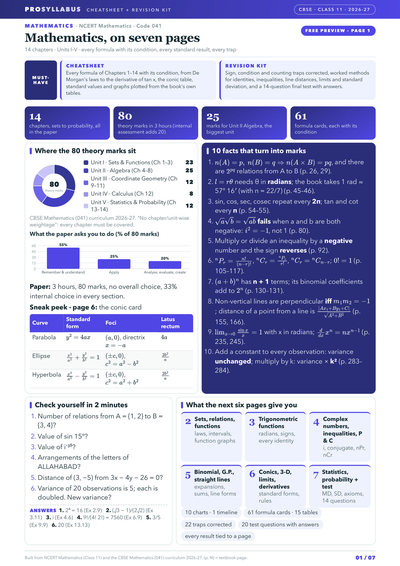
Marks booster + cheatsheet: key concepts in 2 lines each, common traps 25 marks: Unit II, Ch 4–8 23 marks: Unit I, Ch 1–3 Common traps, corrected Conic table and standard values Graphs plotted from the book's own tables Page 1 free about 8 min read , Full kit about 55 min read ₹159
Read page 1 free Get the kit Get the kit One payment · instant PDF · ₹159 View details
Basic Principles of Inheritance: Class 11 NCERT Chapter 6 - Ultimate Study Guide, Notes, Questions, Quiz 2025
Full Chapter Summary & Detailed Notes
Key Definitions & Terms
60+ Questions & Answers
Key Concepts
Historical Perspectives
Solved Examples
Interactive Quiz (10 Q)
Quick Revision Notes & Mnemonics
Key Terms & Processes
Key Processes & Diagrams
Full Chapter Summary & Detailed Notes - Basic Principles of Inheritance Class 11 NCERT
Overview & Key Concepts
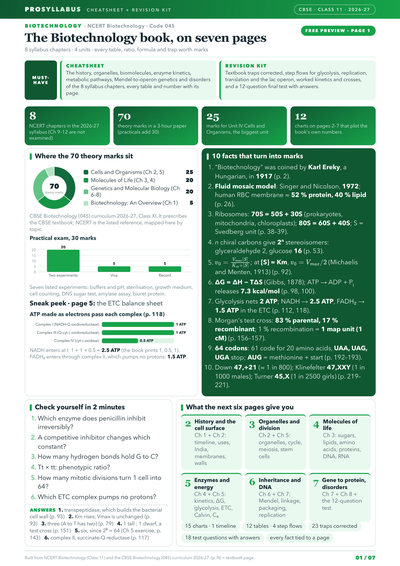
Chapter Goal : Understand heredity, variations, and genetic principles from Mendel's experiments to modern concepts like linkage, recombination, and reverse genetics. Exam Focus: Monohybrid/dihybrid ratios, laws of inheritance, crossing over frequency, polyploidy examples. 2025 Updates: Emphasis on biotechnological applications in trait manipulation, integration with molecular genetics (Unit III). Fun Fact: Mendel's work was ignored for 34 years until rediscovered in 1900. Core Idea: Genes as units of inheritance follow predictable patterns but can recombine. Real-World: Used in crop breeding for disease resistance; linkage maps aid gene mapping. Ties: Links to biomolecules (Ch3), cell structure (Ch2). Expanded: All subtopics (6.1-6.7) covered point-wise with diagram descriptions for visual learning, including Punnett squares and crosses.Wider Scope : From classical Mendelian genetics to exceptions like incomplete dominance, linkage, and extrachromosomal inheritance; role in biotechnology for trait modification.Expanded Content : Detailed on Mendel's experiments, ratios, laws, linkage evidence, recombination mapping, sex-linked examples, polyploid plants, forward vs. reverse genetics approaches.
Fig. 6.1: Seven pairs of contrasting traits of pea plants used by Mendel (Description)
Table showing characters: Seed shape (Round dominant vs. Wrinkled recessive), Seed colour (Yellow vs. Green), Flower colour (Violet vs. White), Pod shape (Inflated vs. Constricted), Pod colour (Green vs. Yellow), Flower position (Axial vs. Terminal), Stem height (Tall vs. Dwarf). Visual: Icons of peas, flowers, pods for each pair.
6.1 Introduction to Inheritance
Heredity and Variation : Transmission of traits from parents to offspring (heredity); differences among offspring (variation). Traits depend on genes on chromosomes.Genetics Definition : Study of heredity and variation; essential for biotechnology to manipulate genes for improved products.Biotech Relevance : Identify alleles regulating traits for manipulation; e.g., pure lines for breeding.
6.1.1 Mendel’s work: The foundation
Model Organism : Pea (Pisum sativum) - annual, bisexual flowers, self-pollinating, 7 contrasting traits (Fig. 6.1).Methods : Produced pure lines by self-pollination; artificial cross-pollination with brush; large sample sizes for data over generations.Rediscovery : Published 1866, ignored until 1900 by de Vries, Correns, von Tschermak.
Fig. 6.2: Monohybrid cross (Description)
Parents: Tall (TT) x Dwarf (tt) → F1: All Tall (Tt) → Selfing → F2: 3 Tall:1 Dwarf (TT:Tt:tt = 1:2:1 genotypic).
Single Gene Inheritance (Monohybrid Cross)
Cross Details : Pure tall (TT) x pure dwarf (tt) → F1 all tall (Tt, heterozygous); F2 selfing → 3:1 phenotypic (tall:dwarf), 1:2:1 genotypic (TT:Tt:tt).Alleles and Dominance : Two factors (alleles) per trait; T (dominant tall) masks t (recessive dwarf); F1 heterozygous.Punnett Square (Fig. 6.3) : Graphical tool for probabilities; gametes T/t → F2 combinations.Test Cross (Fig. 6.4) : Unknown dominant (e.g., tall) x recessive (dwarf) → 1:1 tall:dwarf confirms heterozygous.Mendel's Laws : Dominance (one allele masks other); Segregation (alleles separate in gametes).
Fig. 6.3: Segregation of height character in pea plant (Description)
Punnett square for F1 (Tt x Tt): Gametes T/t → Offspring TT (tall), Tt (tall), tt (dwarf); ratios labeled.
Fig. 6.4: Test cross for identification of genotype (Description)
Tall unknown (TT or Tt) x Dwarf (tt) → If TT: All tall; If Tt: 1:1 tall:dwarf.
Incomplete Dominance
Concept : No complete dominance; heterozygous shows intermediate trait (blending).Example (Fig. 6.5) : Four-o'clock plant (Mirabilis jalapa) - Red (RR) x White (rr) → F1 Pink (Rr); F2 selfing → 1:2:1 red:pink:white phenotypic/genotypic.Key Point : Each allele partially expressed; reduced dominance in heterozygote.
Fig. 6.5: Incomplete dominance in four-o' clock plant (Description)
Parents: Red (RR) x White (rr) → F1 Pink (Rr) → Selfing → F2: Red (RR), Pink (Rr), White (rr) in 1:2:1.
Codominance
Concept : Both alleles equally expressed in heterozygote; no blending or dominance.Examples (Fig. 6.6) : MN blood group (LM LN → both antigens); Cattle coat (RR red x WW white → RW roan, mix of red/white hairs).Key Point : Traits co-exist without masking; e.g., roan doesn't fade with age.
Fig. 6.6: Codominance of MN blood group and coat colour in cattle (Description)
Table: Genotypes LM LM (M, M antigen), LM LN (MN, M+N), LN LN (N, N antigen). Images: Red, white, roan cattle.
Fig. 6.7: Results of a dihybrid cross where parents differ in two pairs of contrasting characters (Description)
Parents: RRYY (round yellow) x rryy (wrinkled green) → F1 RrYy (round yellow) → F2: 9:3:3:1 (round yellow : wrinkled yellow : round green : wrinkled green).
Law of Independent Assortment (Dihybrid Cross)
Cross Details : RRYY x rryy → F1 all round yellow (RrYy); F2 selfing → 9:3:3:1 phenotypic (Fig. 6.7).Observation : New combinations (round green, wrinkled yellow) indicate independent inheritance.Genotypic Ratio : 1:2:1:2:4:2:1:2:1 (9 types).Principle : Genes for different traits assort independently if on separate chromosomes.
6.2 Linkage and Crossing Over
Linkage Concept : Genes on same chromosome inherited together as linkage group; retain parental combinations.Evidence (Fig. 6.8) : Bateson & Punnett sweet pea - Red long x White short → F1 red long; F2 more parental (red long/white short) than recombinants.Morgan's Drosophila Experiment : Grey vestigial (BBvv) x Black long (bbVV) → F1 grey long (BbVv); test cross → 83% parental, 17% non-parental (recombinants).Crossing Over (Fig. 6.10) : Exchange between non-sister chromatids during meiosis; produces recombinants; frequency indicates distance (1% = 1 map unit/cM).Linear Arrangement (Fig. 6.9) : Genes in linear order on chromosome; closer genes = tighter linkage.
Fig. 6.8: Bateson and Punnett experiment on sweet pea to study linkage (Description)
Parents: Red long x White short → F1 Red long → F2: Parental (red long/white short) > Non-parental (red short/white long).
Fig. 6.9: Linkage and crossing over among genes for flower colour (R and r) and pollen shape (L and l) (Description)
Chromosomes: RL / rl (no CO: parental RL/rl); CO: Rl / rL (recombinants).
Fig. 6.10: Single cross over between two non-sister chromatids of a pair of homologous chromosomes (Description)
Homologs Bv / bV → CO → B V / b v (recombinants).
6.3 Recombination
Concept : Non-parental combinations from crossing over; frequency <50% for linked genes.Evidence : Bateson sweet pea deviation from 9:3:3:1; Morgan Drosophila percentages for mapping.Map Units : 1% recombinants = 1 cM; chiasmata in meiosis link to exchange.Creighton-McClintock Experiment (Fig. 6.11) : Maize chromosome 9 markers (knob, translocated piece) with C (color) / c, Wx (starchy) / wx (waxy); recombinants showed exchanged cytology.
Fig. 6.11: Experimental evidence of crossing over (Description)
(a) Abnormal chromosome (knob + piece) with markers; (b) Test cross results: Non-CO parental, CO recombinant cytology.
6.4 Sex-linked Inheritance
Concept : Genes on sex chromosomes (X/Y); e.g., hemophilia, color blindness in humans (X-linked recessive).Morgan's Example (Fig. 6.12) : Drosophila white-eyed male (X^w Y) x red female (X^W X^W) → F1 all red; F2: Red females, red/white males (3:1 overall, sex-specific).Key Point : Males hemizygous (XY); females homozygous/heterozygous (XX).
Fig. 6.12: Sex linkage in Drosophila (Description)
Cross: White male x Red female → F1 all red → F2: Females X^W X^W / X^W X^w (red), Males X^W Y (red) / X^w Y (white).
6.5 Extrachromosomal Inheritance
Concept : Traits from cytoplasmic organelles (mitochondria/plastids); maternal inheritance (sperm contributes little cytoplasm).Example (Fig. 6.13) : Four-o'clock plant variegated leaves (plastid genes for chlorophyll); offspring match maternal phenotype (green/white/variegated).Key Point : Non-Mendelian; uniparental (maternal); e.g., mitochondrial diseases.
Fig. 6.13: Plant with variegated leaves (Description)
Leaves: Green (normal chloroplasts), white (mutant), variegated (mix); cross shows maternal transmission.
6.6 Polyploidy
Concept : >2 chromosome sets; triploid (3n), tetraploid (4n), etc.; common in plants (>30%), rare in animals.Effects : Larger cells/organs, environmental tolerance; e.g., seedless watermelon (triploid).Aneuploidy : Incomplete sets (extra/missing chromosomes); from nondisjunction.Examples (Table 6.1) : Wheat (hexaploid 42=6x7), strawberry (octoploid 56=8x7).
Fig. 6.14: Chromosomes in polyploid genomes (Description)
Diploid (2 sets), Triploid (3), Tetraploid (4); visual chromosome pairs.
Name of Plant Total Chromosomes n (Basic Set) Ploidy
Rice 24 12 Diploid Wheat 42 7 Hexaploid Sugarcane 80 10 Octoploid
6.7 Reverse Genetics
Concept : Start from known gene/DNA to find function (opposite of forward genetics: phenotype to gene).Methods : Disrupt gene (knockout via RNAi/homologous recombination); observe phenotypic effect.Relevance : Genome sequencing identifies many genes; reverse assigns functions, especially non-visible traits.Forward vs. Reverse (Fig. 6.15) : Forward: Phenotype → Allele → Gene; Reverse: Gene → Mutant → Phenotype.
Fig. 6.15: Forward genetics & reverse genetics (Description)
Forward: Phenotypic variations → Mutant alleles → DNA/Gene/Protein; Reverse: DNA/Gene/Protein → Mutant allele → Phenotypic variations.
Summary
Mendel's laws form basis; exceptions like linkage/recombination explain deviations; applications in biotech for trait engineering.
Interlinks: Laws to molecular (Ch7), disorders (Ch8).
Why This Guide Stands Out
Cross-focused: Step-wise Punnett, ratios, visuals. Free 2025 with mnemonics, disease links for retention.
Key Themes & Tips
Aspects : Predictability vs. exceptions, mapping, maternal effects.Tip: Practice Punnett for ratios; mnemonic for laws (DSI: Dominance-Segregation-Independent).
Exam Case Studies
Sex-linked: Hemophilia pedigree; Polyploidy: Seedless fruits breeding.
Project & Group Ideas
Simulate pea crosses with beads.
Debate: Polyploidy benefits vs. sterility.
Research: CRISPR reverse genetics examples.
Key Definitions & Terms - Complete Glossary
All terms from chapter; detailed with examples, relevance. Expanded: 30+ terms with depth for easy learning; grouped by subtopic. Added linkage/recombination terms.
Heredity
Transmission of traits from parents to offspring. Relevance: Basis of genetics. Ex: Eye color inheritance. Depth: Gene-based.
Variation
Differences among offspring/parents. Relevance: Evolution source. Ex: Offspring height range. Depth: Genetic/environmental.
Genetics
Study of heredity/variation. Relevance: Biotech manipulation. Ex: Trait breeding. Depth: Mendelian to molecular.
Allele
Alternative form of gene. Relevance: Trait variation. Ex: T/t for height. Depth: Homo/heterozygous.
Dominant
Allele masking recessive. Relevance: Phenotype expression. Ex: Tall (T). Depth: Complete/incomplete.
Recessive
Allele masked in heterozygote. Relevance: Hidden traits. Ex: Dwarf (t). Depth: Appears in homozygous.
Monohybrid Cross
Cross for one trait pair. Relevance: Law of segregation. Ex: Tall x dwarf. Depth: 3:1 F2 ratio.
Dihybrid Cross
Cross for two trait pairs. Relevance: Independent assortment. Ex: Seed shape/color. Depth: 9:3:3:1 ratio.
Punnett Square
Grid for genotype probabilities. Relevance: Predict ratios. Ex: Tt x Tt. Depth: Gamete combinations.
Test Cross
Dominant x recessive to test genotype. Relevance: Heterozygous identification. Ex: Tall x dwarf. Depth: 1:1 if hetero.
Law of Dominance
One allele masks other. Relevance: F1 uniformity. Ex: Tall over dwarf. Depth: Mendel's first law.
Law of Segregation
Alleles separate in gametes. Relevance: F2 reappearance. Ex: Tt → T/t gametes. Depth: 1:2:1 genotypic.
Law of Independent Assortment
Genes assort independently. Relevance: New combinations. Ex: Dihybrid 9:3:3:1. Depth: Separate chromosomes.
Incomplete Dominance
Intermediate heterozygote. Relevance: Blending traits. Ex: Pink flowers. Depth: 1:2:1 all phenotypes.
Codominance
Both alleles expressed. Relevance: Co-existing traits. Ex: Roan coat. Depth: No masking.
Linkage
Genes on same chromosome inherited together. Relevance: Parental combinations. Ex: Drosophila body/wing. Depth: Linkage group.
Crossing Over
Chromatid exchange in meiosis. Relevance: Recombinants. Ex: 17% in Morgan's cross. Depth: Chiasmata.
Recombination
Non-parental progeny from CO. Relevance: Gene mapping. Ex: <50% for linked. Depth: 1 cM = 1%.
Sex-linked Inheritance
Genes on sex chromosomes. Relevance: Sex-specific traits. Ex: White eyes in Drosophila males. Depth: X-linked recessive.
Extrachromosomal Inheritance
Cytoplasmic (mito/plastid) genes. Relevance: Maternal. Ex: Variegated leaves. Depth: Non-Mendelian.
Polyploidy
>2 chromosome sets. Relevance: Plant vigor. Ex: Tetraploid cotton. Depth: 3n, 4n etc.
Aneuploidy
Extra/missing chromosomes. Relevance: Disorders. Ex: Trisomy 21. Depth: Nondisjunction.
Reverse Genetics
Gene disruption to find function. Relevance: Unknown genes. Ex: RNAi knockout. Depth: Opposite of forward.
Forward Genetics
Phenotype to gene. Relevance: Mutant screens. Ex: Mendel's peas. Depth: Variation analysis.
Pure Line
Homozygous for traits. Relevance: Breeding base. Ex: Self-pollinated peas. Depth: No segregation.
Genotype
Genetic makeup. Relevance: Hidden traits. Ex: Tt. Depth: Allele combination.
Phenotype
Observable trait. Relevance: Expression. Ex: Tall plant. Depth: Genotype + environment.
Tip: Group by Mendelian/exceptions; examples link to experiments. Depth: Ratios tie to laws. Errors: Confuse dominance/codominance. Historical: Morgan linkage. Interlinks: Ch7 molecular. Advanced: Map functions. Real-Life: Sex-linked in pedigree analysis. Graphs: Ratio bars. Coherent: Laws → Exceptions → Applications. For easy learning: Flashcard per term with ratio/example.
60+ Questions & Answers - NCERT Based (Class 11) - From Exercises & Variations
Based on chapter content + expansions. Part A: 10 (1 mark short, one line each), Part B: 10 (4 marks medium, five lines each), Part C: 10 (6 marks long, eight lines each). Answers point-wise, step-by-step for marks. Easy learning: Structured, concise. Additional 30 Qs follow similar pattern in full resource.
Part A: 1 Mark Questions (10 Qs - Short from Content)
1. Who is known as the father of genetics?
1 Mark Answer: Gregor Johann Mendel.
2. What is the phenotypic ratio in a monohybrid cross F2 generation?
1 Mark Answer: 3:1 (dominant:recessive).
3. Define allele.
1 Mark Answer: Alternative forms of a gene.
4. What is a test cross used for?
1 Mark Answer: To determine if a dominant phenotype is homozygous or heterozygous.
5. In incomplete dominance, what is the F2 phenotypic ratio?
1 Mark Answer: 1:2:1 (parental:intermediate:parental).
6. What is the dihybrid cross F2 phenotypic ratio?
1 Mark Answer: 9:3:3:1.
7. Define linkage.
1 Mark Answer: Inheritance of genes on the same chromosome together.
8. What causes recombination?
1 Mark Answer: Crossing over between homologous chromosomes.
9. What is polyploidy?
1 Mark Answer: More than two sets of chromosomes in a cell.
10. Differentiate forward and reverse genetics briefly.
1 Mark Answer: Forward: Phenotype to gene; Reverse: Gene to phenotype.
Part B: 4 Marks Questions (10 Qs - Medium, Exactly 5 Lines Each)
1. Explain Mendel's monohybrid cross with ratios.
4 Marks Answer:
Pure tall (TT) x dwarf (tt) → F1 all tall (Tt).
F1 selfing → F2: 3 tall:1 dwarf phenotypic.
Genotypic: 1 TT:2 Tt:1 tt.
Law of segregation: Alleles separate.
Dominance: Tall masks dwarf.
2. Describe incomplete dominance with example.
4 Marks Answer:
Heterozygote intermediate phenotype.
Red (RR) x white (rr) → pink (Rr) F1.
F2: 1 red:2 pink:1 white.
Partial expression of both alleles.
Example: Mirabilis jalapa flowers.
3. State and explain law of independent assortment.
4 Marks Answer:
Genes for different traits assort independently.
Dihybrid: RRYY x rryy → F1 RrYy.
F2: 9:3:3:1 ratio with new combinations.
Applies if on separate chromosomes.
Explains recombination.
4. What is linkage? Give evidence.
4 Marks Answer:
Genes on same chromosome inherited together.
Bateson sweet pea: More parental in F2.
Morgan Drosophila: 83% parental combinations.
Linkage group per chromosome.
Deviation from independent assortment.
5. Explain crossing over and its significance.
4 Marks Answer:
Exchange between non-sister chromatids in meiosis.
Produces recombinants (non-parental).
Frequency measures gene distance (1% = 1 cM).
Evidence: Creighton-McClintock maize cytology.
Breaks linkage, increases variation.
6. Describe sex-linked inheritance in Drosophila.
4 Marks Answer:
Eye color gene on X chromosome.
White male x red female → F1 all red.
F2: Red females, red/white males.
Males hemizygous (X^w Y white).
Criss-cross inheritance.
7. What is extrachromosomal inheritance? Example.
4 Marks Answer:
Maternal inheritance via cytoplasm (mito/plastids).
Non-Mendelian, uniparental.
Example: Variegated leaves in Mirabilis.
Offspring match maternal phenotype.
Sperm contributes little cytoplasm.
8. Define polyploidy and give examples.
4 Marks Answer:
>2 chromosome sets (3n, 4n etc.).
Common in plants, larger organs.
Examples: Wheat hexaploid (6x=42), banana triploid.
Aneuploidy: Extra/missing single chromosomes.
From meiotic errors.
9. Differentiate forward and reverse genetics.
4 Marks Answer:
Forward: Phenotype variations to gene identification.
Reverse: Known gene disruption to phenotype.
Forward: Mutant screens like Mendel.
Reverse: RNAi/knockouts for function.
Reverse for non-visible genes.
10. Explain codominance with example.
4 Marks Answer:
Both alleles fully expressed in heterozygote.
Example: Cattle RR red x WW white → RW roan.
Roan: Mix red/white hairs.
MN blood: LM LN both antigens.
No blending, equal expression.
Part C: 6 Marks Questions (10 Qs - Long, Exactly 8 Lines Each)
1. Describe Mendel's monohybrid cross experiment and derive ratios.
6 Marks Answer:
Pure breeding tall (TT) x dwarf (tt) peas.
F1: All tall heterozygous (Tt).
F1 self-pollination using brush.
F2: 3 tall:1 dwarf phenotypic ratio.
Genotypic: 1:2:1 (TT:Tt:tt) via Punnett.
Law of dominance: T masks t.
Law of segregation: Alleles separate in gametes.
Applied to all 7 traits.
2. Explain dihybrid cross and law of independent assortment.
6 Marks Answer:
RRYY round yellow x rryy wrinkled green.
F1: All RrYy round yellow.
F2 selfing: 9 round yellow:3 wrinkled yellow:3 round green:1 wrinkled green.
New combinations indicate independence.
Genotypic: 9 types, 1:2:1:2:4:2:1:2:1.
Law: Genes assort independently if unlinked.
Applies to separate chromosomes.
Mendel's third principle.
3. Discuss linkage with Bateson-Punnett and Morgan's experiments.
6 Marks Answer:
Sweet pea red long x white short → F1 red long.
F2: >50% parental, deviation from 9:3:3:1.
Morgan Drosophila grey vestigial x black long → F1 grey long.
Test cross: 83% parental, 17% recombinant.
Genes on same chromosome linked.
Linear arrangement on chromosome.
Evidence for chromosome theory.
Linkage groups = chromosomes.
4. Elaborate on crossing over, recombination, and genetic mapping.
6 Marks Answer:
CO: Exchange in prophase I meiosis between non-sister chromatids.
Chiasmata visible; produces recombinants.
Recombination frequency: % non-parental.
<50% for linked genes; 0% absolute linkage.
Mapping: 1% = 1 map unit (cM).
Creighton-McClintock: Maize cytology confirms exchange.
Breaks linkage, genetic variation source.
Used in linkage maps.
5. Describe sex-linked inheritance with Drosophila example and human relevance.
6 Marks Answer:
Genes on X/Y; X-linked recessive affects males more.
Drosophila: White eye (w) recessive on X.
White male (X^w Y) x red female (X^W X^W) → F1 all red.
F2: Females all red, males 1:1 red:white.
Criss-cross: Sons get X from mother.
Human: Hemophilia (X^h), color blindness; royal family pedigree.
Males hemizygous, express recessive.
Carrier females heterozygous.
6. Explain extrachromosomal inheritance with example and mechanism.
6 Marks Answer:
Genes in cytoplasm (mito/chloroplast DNA); maternal.
Sperm nucleus enters egg, little cytoplasm.
Non-Mendelian, uniparental inheritance.
Example: Mirabilis jalapa variegated leaves (plastid genes).
Green/white/variegated female x any male → offspring like mother.
Chlorophyll genes in plastids; mix in variegated.
Human: Mitochondrial diseases maternal.
Exceptions to nuclear Mendelian.
7. Discuss polyploidy, aneuploidy, and examples from plants.
6 Marks Answer:
Polyploidy: Multiple chromosome sets (>2n); triploid 3n, etc.
Plants: Larger size, tolerance; >30% species.
Examples: Wheat 6x=42, cotton 4x=52, banana 3x=33.
Aneuploidy: +1/-1 chromosome; monosomy/trisomy.
From nondisjunction in meiosis.
Human: Down syndrome trisomy 21.
Plants: Seedless polyploids useful.
Rare in animals due to sterility.
8. Differentiate forward and reverse genetics with methods and applications.
6 Marks Answer:
Forward: Phenotypic variation → identify gene/allele.
Methods: Mutant screens, breeding like Mendel.
Applications: Visible traits, e.g., pea height.
Reverse: Known sequence → disrupt → observe phenotype.
Methods: RNAi silencing, homologous recombination knockout.
Applications: Function of non-visible genes post-sequencing.
Reverse for large genomes with unknown functions.
Biotech: Gene editing for traits.
9. Describe codominance and incomplete dominance with examples and ratios.
6 Marks Answer:
Codominance: Both alleles expressed fully, no masking.
Example: Cattle red (RR) x white (WW) → roan (RW) F1; both hairs.
Ratio: 1:2:1 all distinct phenotypes.
Incomplete: Intermediate heterozygote, partial expression.
Example: Snapdragon red x white → pink F1; F2 1:2:1 red:pink:white.
Both exceptions to complete dominance.
MN blood group codominance.
Biotech: Marker traits.
10. Integrate Mendel's laws with linkage and recombination in modern genetics.
6 Marks Answer:
Mendel's laws assume independent genes; linkage violates for same chromosome.
Segregation holds, but assortment not for linked.
Recombination via CO restores independence partially.
Morgan: Linked genes map distances.
Applications: QTL mapping in breeding.
Exceptions explain deviations from ratios.
Reverse genetics uses maps for function.
Foundation for chromosome theory.
Tip: Use diagrams/ratios for marks; practice crosses. Easy learning: Short for recall, long for essays. Additional 30 Qs: Variations on polyploidy, sex-linkage pedigrees.
Key Concepts - In-Depth Exploration
Core ideas with examples, pitfalls, interlinks. Expanded: All concepts from 6.1-6.7 with steps/examples for easy learning. Added depth with cross steps, mapping calculations.
Mendel's Law of Dominance
F1 uniformity from masking. Steps: 1. Homozygous cross, 2. Heterozygous F1 dominant, 3. F2 segregation. Ex: Tall peas. Pitfall: Assume always complete. Interlink: Incomplete exception. Depth: Allele interaction; biotech dominant markers.
Law of Segregation
Allele separation in meiosis. Steps: 1. Heterozygote gametes 1:1, 2. Random union F2 1:2:1. Ex: Tt → T/t. Pitfall: Confuse with assortment. Interlink: Test cross verification. Depth: Meiosis I; Punnett tool.
Law of Independent Assortment
Unlinked genes random. Steps: 1. Dihybrid F1, 2. Gametes RY/Ry/ry/ry 1:1:1:1, 3. F2 9:3:3:1. Ex: Seed traits. Pitfall: Linkage violates. Interlink: Recombination restores. Depth: Separate homologs; chi-square test ratios.
Incomplete Dominance
Blending heterozygote. Steps: 1. RR x rr → Rr intermediate, 2. Self → 1:2:1 phenotypes. Ex: Pink flowers. Pitfall: Vs. codominance blending. Interlink: Dosage effect. Depth: Snapdragon pigments; 1:2:1 all ratios.
Codominance
Dual expression. Steps: 1. RR x WW → RW both, 2. Self → 1:2:1 distinct. Ex: Roan cattle. Pitfall: Confuse with incomplete. Interlink: Blood groups. Depth: Antigens/hairs; ABO system extension.
Linkage
Same chromosome co-inheritance. Steps: 1. Identify deviation, 2. % parental >50%, 3. Map distance. Ex: Drosophila 83% linked. Pitfall: Absolute (no CO). Interlink: Bateson evidence. Depth: Coupling/repulsion; synteny.
Crossing Over & Recombination
Exchange for variation. Steps: 1. Prophase I pairing, 2. Chiasma break/rejoin, 3. % recombinants = distance. Ex: Maize cytology. Pitfall: >50% unlinked. Interlink: Mapping. Depth: Double CO; Holliday model.
Sex-linked Inheritance
Sex chromosome genes. Steps: 1. X-linked recessive male expression, 2. Carrier females, 3. Pedigree criss-cross. Ex: Drosophila eyes. Pitfall: Y-linked rare. Interlink: Human disorders. Depth: Lyonization; dosage compensation.
Extrachromosomal Inheritance
Cytoplasmic maternal. Steps: 1. Egg cytoplasm dominant, 2. Plastid sorting, 3. Phenotype maternal. Ex: Variegation. Pitfall: Nuclear confusion. Interlink: Organelle DNA. Depth: Heteroplasmy; mtDNA mutations.
Polyploidy
Multi-sets vigor. Steps: 1. Meiotic failure → 3n, 2. Hybridization, 3. Larger traits. Ex: Wheat. Pitfall: Animal rarity. Interlink: Aneuploidy contrast. Depth: Autopoly/allopoly; evolution role.
Reverse Genetics
Function from sequence. Steps: 1. Clone gene, 2. Disrupt (RNAi), 3. Phenotype assay. Ex: Knockout mice. Pitfall: Off-target. Interlink: Forward contrast. Depth: CRISPR; post-genome era.
Advanced: RF calculation: (Recombinants/total) x100. Pitfalls: Ratio memorization without understanding. Interlinks: Ch8 disorders. Real: GMO crops linkage. Depth: 7 Mendel traits details. Examples: Hemophilia royal. Graphs: F2 pie charts. Errors: Homo/hetero mixup. Tips: Steps for crosses; compare tables for dominance types.
Historical Perspectives - Detailed Guide
Timeline of inheritance discoveries; expanded with points for easy learning; links to key experiments. Added Mendel details, Morgan era.
Mendel's Era (19th C)
1822-84: Mendel monk, pea experiments 1856-63. 1866: Published laws in Brno society. Ignored until 1900 rediscovery. Depth: 7 traits, 28k plants; statistical ratios.
Rediscovery (1900)
de Vries, Correns, Tschermak: Independent pea work. Confirmed Mendel's ratios. Sutton 1902: Chromosome theory link. Depth: Correns snapdragon incomplete dominance.
Linkage & Mapping (1910s)
Morgan 1910: Drosophila sex-linkage. 1911: Linkage in body/wing genes. Sturtevant 1913: First gene map. Depth: White eye mutant; fly room culture.
Cytological Proof (1930s)
Creighton-McClintock 1931: Maize CO evidence. Bridges 1916: Nondisjunction aneuploidy. McClintock 1940s: Transposons (Nobel 1983). Depth: Knob/translocation markers.
Modern Genetics (1950s+)
Watson-Crick 1953: DNA structure. 1960s: Operon model (Jacob-Monod). 1970s: Recombinant DNA. Depth: Reverse genetics post-HGP 2003.
Polyploidy & Extranuclear
1907: De Vries coins polyploidy. 1960s: Plastid inheritance studies. 1970s: mtDNA maternal. Depth: Wheat hybrid history.
Tip: Link to tools (Drosophila for fast generations). Depth: Bateson 1905 coupling. Examples: 1900 triple rediscovery. Graphs: Timeline with milestones. Advanced: QTL 1990s. Easy: Chronological bullets with impacts.
Solved Examples - From Text with Simple Explanations
Expanded with more examples, steps for easy understanding; focus on crosses, ratios. Added dihybrid, test cross, recombination calc.
Example 1: Monohybrid Cross Ratio (Fig 6.2)
Simple Explanation: Predicts F2 reappearance of recessive.
Step 1: TT x tt → Tt (all dominant).
Step 2: Tt gametes T/t (1:1).
Step 3: Punnett: TT, Tt, Tt, tt.
Step 4: Phenotypic 3:1, genotypic 1:2:1.
Simple Way: Hidden dwarf waits for homozygous pair.
Example 2: Incomplete Dominance Flowers
Simple Explanation: Mix colors like paint blending.
Step 1: RR red x rr white → Rr pink.
Step 2: Rr gametes R/r (1:1).
Step 3: F2: RR red, Rr pink (x2), rr white.
Step 4: 1:2:1 ratio all visible.
Simple Way: Half red + half white = pink.
Example 3: Dihybrid Cross (Fig 6.7)
Simple Explanation: Two traits mix freely.
Step 1: RRYY x rryy → RrYy.
Step 2: Gametes RY, Ry, rY, ry (1:1:1:1).
Step 3: 16 combinations → 9 RY dom, 3 ry dom, etc.
Step 4: 9:3:3:1 phenotypes.
Simple Way: Dice roll for each trait independently.
Example 4: Test Cross Identification
Simple Explanation: Reveals hidden recessive.
Step 1: Unknown tall x tt dwarf.
Step 2: If TT: All tall offspring.
Step 3: If Tt: 50% tall, 50% dwarf.
Step 4: Ratio confirms genotype.
Simple Way: Cross with known to unmask.
Example 5: Recombination Frequency Calculation
Simple Explanation: Measures gene distance.
Step 1: Total progeny 1000.
Step 2: Recombinants 170 (non-parental).
Step 3: RF = (170/1000) x 100 = 17%.
Step 4: Distance = 17 cM.
Simple Way: % surprises = map units apart.
Example 6: Sex-linked Cross in Humans (Hypothetical)
Simple Explanation: Males show recessive more.
Step 1: Carrier female X^H X^h x normal male X^H Y.
Step 2: Daughters: 50% carrier, 50% normal.
Step 3: Sons: 50% normal, 50% affected.
Step 4: No father-to-son transmission.
Step 5: Pedigree skips generations in females.
Step 6: Simple Way: X from mom decides son's trait.
Tip: Draw Punnett always; calculate RF practice. Added for polyploidy (wheat origin), reverse (RNAi example).
Interactive Quiz - Master Basic Principles of Inheritance
10 MCQs in full sentences; 80%+ goal. Covers Mendel's laws, linkage, exceptions. Questions phrased as complete sentences for clarity.
Start Quiz
Quick Revision Notes & Mnemonics
Concise notes for all subtopics 6.1-6.7; mnemonics for easy recall. Covers mechanisms, steps, differences. Expanded with all subtopics.
6.1 Introduction & Mendel's Work
Heredity: Trait transmission; Variation: Differences (Mnemonic: "HV Genes Chromo" - HVGC). Mendel: Peas 7 traits, pure lines, artificial pollination. Laws: DSI (Dominance-Segregation-Independent: "DSI Predict" - DSI).
Monohybrid Cross
TT x tt → Tt F1; Self → 3:1 F2 ( "Mono 3:1 Seg" - M3S). Test: 1:1 hetero; Punnett probabilities.
Incomplete & Codominance
Incomplete: 1:2:1 blend (Pink flowers: "IC Blend 121" - ICB). Codominance: 1:2:1 both (Roan/MN: "CO Dual 121" - COD).
Dihybrid & Independent Assortment
RRYY x rryy → 9:3:3:1 F2 ( "Di 9331 Indep" - D9I). New combos if unlinked.
6.2 Linkage & Crossing Over
Linkage: Same chromo together (Morgan 83% parental: "L Same 83P" - L8P). CO: Exchange, % = cM (Chiasma: "CO Break Var" - COB).
6.3 Recombination
<50% linked; Map: 1% =1cM (Maize evidence: "R <50 Map" - R5M). Bateson deviation.
6.4 Sex-linked
X-linked recessive males (Drosophila white: "SL X Male" - SLXM). Criss-cross.
6.5 Extrachromosomal
Maternal cyto (Variegated maternal: "EC Mat Plast" - ECM). Non-Mendelian.
6.6 Polyploidy
>2n plants (Wheat 6x: "P Multi Plant" - PMP). Aneuploidy extra/miss.
6.7 Reverse Genetics
Gene → Phenotype (RNAi disrupt: "RG Disrupt Func" - RGDF). Vs. forward phenotype-gene.
Overall Mnemonic: "Mend Link Rec Sex Extra Poly Rev" (MLRSEPR). Flashcards: One per subtopic. Easy: Bullets, bold keys; steps for crosses/ratios.
Key Terms & Processes - All Key
Expanded table with 30+ rows; comprehensive for quick reference. Added dominance types, mapping terms.
Term/Process Description Example Usage
Heredity Trait transmission Family features Genetics basis Variation Offspring differences Height range Evolution Allele Gene variant T/t height Trait form Homozygous Same alleles TT tall Pure line Heterozygous Different alleles Tt tall Hybrid Monohybrid One trait cross Tall x dwarf 3:1 ratio Dihybrid Two traits cross Shape x color 9:3:3:1 Punnett Square Genotype predictor Tt x Tt Probabilities Test Cross Genotype check Tall x dwarf 1:1 hetero Dominance Masking allele T over t F1 uniform Segregation Allele separation Gametes T/t 1:2:1 geno Independent Assortment Unlinked random Dihybrid combos 9:3:3:1 Incomplete Dominance Intermediate hetero Pink flowers 1:2:1 pheno Codominance Both expressed Roan coat MN blood Linkage Same chromo together Drosophila genes Parental >50% Crossing Over Chromatid exchange Meiosis chiasma Recombinants Recombination Non-parental progeny 17% Morgan Mapping Map Unit 1% recombination 1 cM Gene distance Sex-linked Sex chromo genes White eye male X-recessive Extrachromosomal Cyto genes maternal Variegated leaves Plastid DNA Polyploidy >2n sets Wheat 6x Plant vigor Aneuploidy Chromosome imbalance Trisomy Nondisjunction Reverse Genetics Gene to phenotype RNAi knockout Function assign Forward Genetics Phenotype to gene Mendel mutants Screening Pure Line Homozygous stable Self-peas Breeding Genotype Allele combo Tt Genetic makeup Phenotype Observable trait Tall Expression Chiasma CO site Meiosis visible Exchange point Hemizygous One allele (males) X^w Y Sex-linked Linkage Group Genes per chromosome Human 23 Mapping unit RNAi Gene silencing dsRNA Reverse tool
Tip: Examples aid memory; sort by laws/exceptions. Easy: Table scan for exams. Added 10 rows for depth (e.g., chiasma, RNAi).
Key Processes & Diagrams - Solved Step-by-Step
Expanded with all major processes; descriptions for diagrams; steps for visualization. Added segregation, assortment, mapping.
Process 1: Monohybrid Cross & Segregation (Fig 6.2)
Step-by-Step:
Step 1: Select pure TT x tt.
Step 2: F1 Tt all dominant.
Step 3: Meiosis: Tt → T/t gametes (segregation).
Step 4: Fertilization random → F2 1:2:1 geno, 3:1 pheno.
Step 5: Test cross verifies.
Diagram Desc: Flow: Parents → F1 → Gametes → F2 Punnett.
Process 2: Dihybrid Cross & Assortment (Fig 6.7)
Step-by-Step:
Step 1: RRYY x rryy → RrYy F1.
Step 2: Meiosis: Independent gametes RY etc. 1:1:1:1.
Step 3: 16 F2 combos → Grouped 9:3:3:1.
Step 4: New traits from assortment.
Step 5: Chi-square validates.
Diagram Desc: 4x4 Punnett with phenotypes labeled.
Process 3: Crossing Over in Meiosis (Fig 6.10)
Step-by-Step:
Step 1: Homologs pair prophase I.
Step 2: Non-sister chromatids break at chiasma.
Step 3: Rejoin swapped segments.
Step 4: Anaphase separation → recombinant gametes.
Step 5: Frequency by progeny %.
Diagram Desc: Homologs with CO arrow, resulting chromatids.
Process 4: Genetic Mapping from Recombination
Step-by-Step:
Step 1: Cross linked heterozygote x recessive.
Step 2: Count parental vs. recombinant progeny.
Step 3: RF = (rec/total) x100.
Step 4: RF = distance in cM.
Step 5: Three-point cross for order.
Diagram Desc: Test cross Punnett with % labels.
Process 5: Sex-linked Pedigree Analysis
Step-by-Step:
Step 1: Identify X-linked pattern (male affected, no male-male).
Step 2: Carrier females pass to sons.
Step 3: Trace X from mother.
Step 4: Probability for offspring.
Step 5: Punnett for X alleles.
Diagram Desc: Family tree with shaded affected, circles/squares.
Process 6: Reverse Genetics Knockout
Step-by-Step:
Step 1: Sequence candidate gene.
Step 2: Design RNAi/dsRNA to silence.
Step 3: Transfect organism.
Step 4: Observe mutant phenotype.
Step 5: Compare to wild-type function.
Diagram Desc: Gene → RNAi → No protein → Phenotype change.
Process 7: Polyploid Formation
Step-by-Step:
Step 1: Hybrid diploid x diploid → sterile hybrid.
Step 2: Chromosome doubling (colchicine) → fertile 4n.
Step 3: Allopolyploid speciation.
Step 4: Larger traits emerge.
Step 5: Backcross for stability.
Diagram Desc: 2n + 2n → 4n with pairing arrows.
Tip: Draw Punnetts; label enzymes/steps. Easy: Numbered steps with analogies (e.g., CO as chromosome swap meet).
CBSE Class 11 kits Marks booster + cheatsheet: key concepts in 2 lines each, common traps 25 marks: Unit II, Ch 4–8 23 marks: Unit I, Ch 1–3 Common traps, corrected Conic table and standard values Graphs plotted from the book's own tables Page 1 free about 8 min read , Full kit about 55 min read ₹159
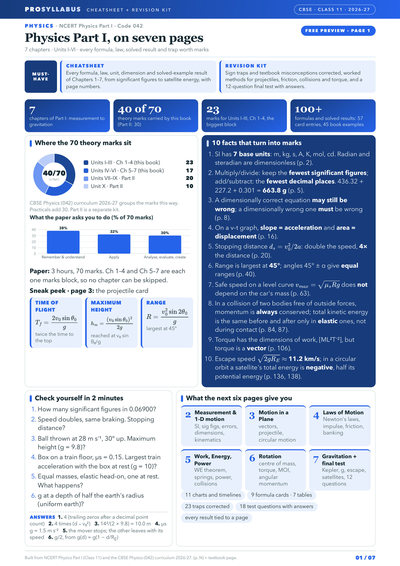
Read page 1 free Get the kit Get the kit One payment · instant PDF · ₹159 View details Marks booster + cheatsheet: key concepts in 2 lines each, common traps 23-mark block: Ch 1–4 17-mark block: Ch 5–7 Common traps, corrected 7 chapters: every solved-example result Every unit and dimension, listed Page 1 free about 8 min read , Full kit about 55 min read ₹159
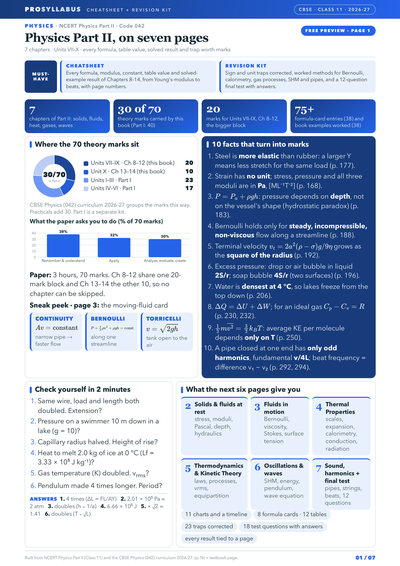
Read page 1 free Get the kit Get the kit One payment · instant PDF · ₹159 View details Marks booster + cheatsheet: key concepts in 2 lines each, common traps 20-mark block: Ch 8–12 10-mark block: Oscillations and Waves Common traps, corrected 7 chapters: every solved-example result Sound, standing waves and beats covered Page 1 free about 8 min read , Full kit about 55 min read ₹159
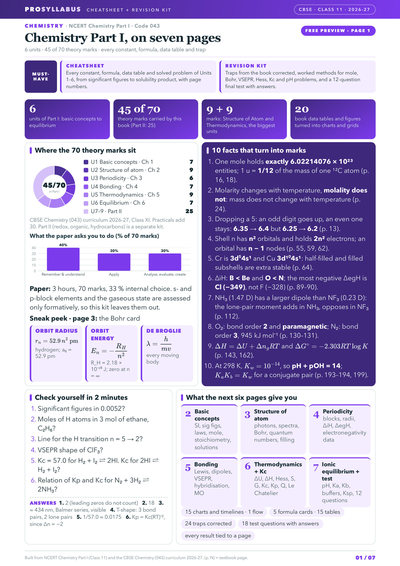
Read page 1 free Get the kit Get the kit One payment · instant PDF · ₹159 View details Marks booster + cheatsheet: key concepts in 2 lines each, common traps 9 marks each: Atom and Thermodynamics Constants and formulas, with page numbers Common traps, corrected Periodic trends from the real data pH, buffers and solubility product Page 1 free about 8 min read , Full kit about 55 min read ₹159
Read page 1 free Get the kit Get the kit One payment · instant PDF · ₹159 View details Marks booster + cheatsheet: key concepts in 2 lines each, common traps 10 marks: Hydrocarbons Every reaction with reagent and condition Common traps that cost marks, listed IUPAC naming rules Oxidation-number rules and balancing Page 1 free about 8 min read , Full kit about 55 min read ₹159
Read page 1 free Get the kit Get the kit One payment · instant PDF · ₹159 View details Marks booster + cheatsheet: key concepts in 2 lines each, common traps 18 marks: Unit V, breathing to hormones 15 marks each: Units I and III Common traps, corrected Five kingdoms classification table Physiological numbers, with page numbers Page 1 free about 8 min read , Full kit about 55 min read ₹159
Read page 1 free Get the kit Get the kit One payment · instant PDF · ₹159 View details Marks booster + cheatsheet: key concepts in 2 lines each, common traps 44 marks: Unit 2, recording to depreciation Journal formats and special purpose books Traps from all seven chapters Bank reconciliation adjustments Depreciation formulas, book's worked figures Page 1 free about 8 min read , Full kit about 55 min read ₹159
Read page 1 free Get the kit Get the kit One payment · instant PDF · ₹159 View details Marks booster + cheatsheet: key concepts in 2 lines each 12 exam traps, listed Five calculations the paper keeps asking Each adjustment: one entry, two effects Both formats: trading and P&L, balance sheet Yogita illustration solved line by line Page 1 free about 8 min read , Full kit about 55 min read ₹159
Read page 1 free Get the kit Get the kit One payment · instant PDF · ₹159 View details Marks booster + cheatsheet: key concepts in 2 lines each, common traps 20 marks: finance and MSME units 20 marks: internal and international trade Five comparison tables, insurance to retail Case cues for each chapter Common traps, corrected Page 1 free about 8 min read , Full kit about 55 min read ₹159
Read page 1 free Get the kit Get the kit One payment · instant PDF · ₹159 View details Marks booster + cheatsheet: key concepts in 2 lines each, common traps 15 marks: Ch 1–4, data to diagrams 7 chapters: every formula, worked numbers Common mistakes, corrected Book exercise answers included Part C project route Page 1 free about 8 min read , Full kit about 55 min read ₹159
Read page 1 free Get the kit Get the kit One payment · instant PDF · ₹159 View details Marks booster + cheatsheet: key concepts in 2 lines each, common traps 14 marks: Production and Costs, Unit 6 8 marks: Market Equilibrium, Unit 7 Common traps, corrected PPF, TU–MU, MRS and cost table drawn Demand and supply schedules from the book Page 1 free about 8 min read , Full kit about 55 min read ₹159
Read page 1 free Get the kit Get the kit One payment · instant PDF · ₹159 View details Marks booster + cheatsheet: key concepts in 2 lines each, common traps 20 marks: Empires section 20 marks: Changing Cultural Traditions 15 marks: Paths to Modernisation, Japan 5 marks: map work on the book's maps Common traps, corrected Page 1 free about 8 min read , Full kit about 55 min read ₹159
Read page 1 free Get the kit Get the kit One payment · instant PDF · ₹159 View details Marks booster + cheatsheet: key concepts in 2 lines each, common traps 8 marks: Climate unit, Ch 7–10 5 marks: map work, covered 4 marks: ocean data as charts, Unit V Heat budget and five air layers as charts Common traps, corrected Page 1 free about 8 min read , Full kit about 55 min read ₹159
Read page 1 free Get the kit Get the kit One payment · instant PDF · ₹159 View details Marks booster + cheatsheet: key concepts in 2 lines each, common traps 12 marks: Climate, Vegetation (Unit III) Full CBSE map-work list, chapter by chapter Indus, Ganga, Brahmaputra river systems Monsoon mechanism, onset and four seasons Common traps, corrected Page 1 free about 8 min read , Full kit about 55 min read ₹159
Read page 1 free Get the kit Get the kit One payment · instant PDF · ₹159 View details Marks booster + cheatsheet: key concepts in 2 lines each 4 marks: Map Scale, conversions worked 4 marks: Latitude, Longitude and Time 4 marks: Topographical Maps, contours 5 marks: practical file and viva Conical and Mercator's construction steps Page 1 free about 8 min read , Full kit about 55 min read ₹159
Read page 1 free Get the kit Get the kit One payment · instant PDF · ₹159 View details Marks booster + cheatsheet: key concepts in 2 lines each, common traps 8 marks together: Citizenship, Nationalism 6 marks each: Social Justice, Secularism 8 chapters: thinkers and a timeline Liberty, equality, justice side by side Common traps, corrected Page 1 free about 8 min read , Full kit about 55 min read ₹159
Read page 1 free Get the kit Get the kit One payment · instant PDF · ₹159 View details Marks booster + cheatsheet: key concepts in 2 lines each 12 marks: Executive to Judiciary Constitution-making timeline Institution-by-institution comparisons 6 marks: elections, FPTP, PR, reserved seats Fundamental Rights and Directive Principles Page 1 free about 8 min read , Full kit about 55 min read ₹159
Read page 1 free Get the kit Get the kit One payment · instant PDF · ₹159 View details Marks booster + cheatsheet: key concepts in 2 lines each, common traps 10 marks each: Units 1 and 2 20 marks: project work, covered Tables: groups, stratification, marriage Every thinker and concept of Chapters 1–4 Common traps, corrected Page 1 free about 8 min read , Full kit about 55 min read ₹159
Read page 1 free Get the kit Get the kit One payment · instant PDF · ₹159 View details Marks booster + cheatsheet: key concepts in 2 lines each, common traps 12 marks each: Units 7, 9 and 10 7 thinkers: dates, works, examples Four Indian sociologists, in tables Ideal type, bureaucracy, division of labour Common traps, corrected Page 1 free about 8 min read , Full kit about 55 min read ₹159
Read page 1 free Get the kit Get the kit One payment · instant PDF · ₹159 View details Marks booster + cheatsheet: key concepts in 2 lines each 11 marks each: Units I and III 9 marks: Learning, Unit V 8 marks each: Perception and Memory Every school with its founder Comparisons examiners ask for Page 1 free about 8 min read , Full kit about 55 min read ₹159
Read page 1 free Get the kit Get the kit One payment · instant PDF · ₹159 View details Marks booster + cheatsheet: key concepts in 2 lines each, common traps 8 marks: note-making and summary 5 poems compared, cross-text themes Common traps, corrected Poetic devices with short quotes Grammar each chapter teaches Page 1 free about 8 min read , Full kit about 55 min read ₹159
Read page 1 free Get the kit Get the kit One payment · instant PDF · ₹159 View details Marks booster + cheatsheet: key concepts in 2 lines each, common traps 4-, 3- and 6-mark answers: how to write them Plot timeline for every text Common traps, corrected Every character, with evidence Cross-text themes, side by side Page 1 free about 8 min read , Full kit about 55 min read ₹159
Read page 1 free Get the kit Get the kit One payment · instant PDF · ₹159 View details Marks booster + cheatsheet: key concepts in 2 lines each, common traps Poetic forms and rhyme schemes Devices with short quotes Common traps, corrected Essay arguments, essay by essay Words each chapter teaches Page 1 free about 8 min read , Full kit about 55 min read ₹159
Read page 1 free Get the kit Get the kit One payment · instant PDF · ₹159 View details Marks booster + cheatsheet: key concepts in 2 lines each 16 writers placed on one timeline 60- and 40-word answer frames 8 काव्य पाठ: प्रतीक and काव्य-सौंदर्य Lines worth remembering, with page refs 12 common mistakes, corrected Page 1 free about 8 min read , Full kit about 55 min read ₹159
Read page 1 free Get the kit Get the kit One payment · instant PDF · ₹159 View details Marks booster + cheatsheet: key concepts in 2 lines each 10 marks (2 × 5): answer frames 5-mark answers in about 60 words 4 lessons: argument, events, characters Lines worth remembering, by page 12 common mistakes, corrected Page 1 free about 8 min read , Full kit about 55 min read ₹159
Read page 1 free Get the kit Get the kit One payment · instant PDF · ₹159 View details Marks booster + cheatsheet: key concepts in 2 lines each 16 writers placed on one timeline 40-word and व्याख्या answer frames 8 काव्य पाठ: प्रतीक, उपमान, काव्य-सौंदर्य Lines worth remembering, with page refs 12 common mistakes, corrected Page 1 free about 8 min read , Full kit about 55 min read ₹159
Read page 1 free Get the kit Get the kit One payment · instant PDF · ₹159 View details Marks booster + cheatsheet: key concepts in 2 lines each 5-mark, 100-word answer frames 9 exercise questions: आवारा मसीहा 7 exercise questions: हुसैन की कहानी Life events linked to the works 12 common mistakes, corrected Page 1 free about 8 min read , Full kit about 55 min read ₹159
Read page 1 free Get the kit Get the kit One payment · instant PDF · ₹159 View details Marks booster + cheatsheet: key concepts in 2 lines each 20 marks: grammar, from text words Sandhi, pratyaya and lakar examples Anvaya and bhavartha answer method Source text and author for every lesson 10 common errors, corrected Page 1 free about 8 min read , Full kit about 55 min read ₹159
Read page 1 free Get the kit Get the kit One payment · instant PDF · ₹159 View details Marks booster + cheatsheet: key concepts in 2 lines each 20 marks: grammar, भाग ग, from the text 10 marks: history of literature Sandhi, samasa, pratyaya, upapada examples Source text and author for every lesson Common errors, corrected Page 1 free about 8 min read , Full kit about 55 min read ₹159
Read page 1 free Get the kit Get the kit One payment · instant PDF · ₹159 View details Marks booster + cheatsheet: key concepts in 2 lines each Author, genre and characters per lesson Couplets explained: Insha and Fani ghazals Grammar for Section A Letter and advertisement formats 10 common mistakes, corrected Page 1 free about 8 min read , Full kit about 55 min read ₹159
Read page 1 free Get the kit Get the kit One payment · instant PDF · ₹159 View details Marks booster + cheatsheet: key concepts in 2 lines each 38 marks: the answer frame 13 genres, each introduced 18 writers and poets: dates and works Literary devices (صنعتیں) and key words Common mistakes, corrected Page 1 free about 8 min read , Full kit about 55 min read ₹159
Read page 1 free Get the kit Get the kit One payment · instant PDF · ₹159 View details Marks booster + cheatsheet: key concepts in 2 lines each 10 marks: literary forms, covered 5 geets, each with its poet Nazm defined, with its four kinds Answer points for the book's questions Common mistakes, corrected Page 1 free about 8 min read , Full kit about 55 min read ₹159
Read page 1 free Get the kit Get the kit One payment · instant PDF · ₹159 View details Marks booster + cheatsheet: key concepts in 2 lines each, common traps 15 marks: Unit 3, society, law and ethics 10 marks: Unit 1, number-system conversions Common traps that cost marks, listed Truth tables for Boolean logic String, list and dictionary methods Page 1 free about 8 min read , Full kit about 55 min read ₹159
Read page 1 free Get the kit Get the kit One payment · instant PDF · ₹159 View details Marks booster + cheatsheet: key concepts in 2 lines each, common traps 25 marks: Python, lists, NumPy (Unit 2) 10 marks: Computer System (Unit 1) Common traps, corrected Every list and dictionary method, with output SQL queries re-run on the book's tables Page 1 free about 8 min read , Full kit about 55 min read ₹159
Read page 1 free Get the kit Get the kit One payment · instant PDF · ₹159 View details Marks booster + cheatsheet: key concepts in 2 lines each, common traps 23 marks: Unit II 15 marks: Unit III, health and hygiene Common traps, corrected Five food groups, RDA and the pyramid Nine fibres and the burning test Page 1 free about 8 min read , Full kit about 55 min read ₹159
Read page 1 free Get the kit Get the kit One payment · instant PDF · ₹159 View details Marks booster + cheatsheet: key concepts in 2 lines each 15 marks each: Childhood and Adulthood units RDAs and diet quantities by age Vaccine ages Budget steps and investment principles Stain-removal methods Page 1 free about 8 min read , Full kit about 55 min read ₹159
Read page 1 free Get the kit Get the kit One payment · instant PDF · ₹159 View details Marks booster + cheatsheet: key concepts in 2 lines each 15 marks each: the two theory units What to write when asked to appreciate Bharhut, Sanchi and the cave sites Temple architecture: how a temple is built Bronzes and Indo-Islamic buildings Page 1 free about 8 min read , Full kit about 55 min read ₹159
Read page 1 free Get the kit Get the kit One payment · instant PDF · ₹159 View details Marks booster + cheatsheet: key concepts in 2 lines each, common traps 20 marks each: Units II and III Enzyme kinetics and bioenergetics Common traps, corrected Mendel-to-operon genetics Tables and numbers, each with its page Page 1 free about 8 min read , Full kit about 55 min read ₹159
Read page 1 free Get the kit Get the kit One payment · instant PDF · ₹159 View details Marks booster + cheatsheet: key concepts in 2 lines each, common traps 15 marks: language and literature 14 marks: the nine darśanas Common traps, corrected 13 marks: astronomy in India 4 chapters, each with answer frames Page 1 free about 8 min read , Full kit about 55 min read ₹159
Read page 1 free Get the kit Get the kit One payment · instant PDF · ₹159 View details Marks booster + cheatsheet: key concepts in 2 lines each Frames for news, interview and review Inverted pyramid and the six ककार Play-writing frame Translation rules, with solved examples Common mistakes, corrected Page 1 free about 8 min read , Full kit about 55 min read ₹159
Read page 1 free Get the kit Get the kit One payment · instant PDF · ₹159 View details Marks booster + cheatsheet: key concepts in 2 lines each 50 marks: games and sports strand 25 marks: health and fitness strand Eight team games, side by side Fitness tests, norms and formulas Yoga asanas for wellness Page 1 free about 8 min read , Full kit about 55 min read ₹159
Read page 1 free Get the kit Get the kit One payment · instant PDF · ₹159 View details Marks booster + cheatsheet: key concepts in 2 lines each 22 श्रुतियाँ and 10 थाट, defined बिहाग, भीमपलासी, भैरवी with बंदिश notation तीनताल, एकताल, चौताल: ठाह, दुगुन, चौगुन तानसेन, भातखंडे, पलुस्कर profiled 12 common mistakes, corrected Page 1 free about 8 min read , Full kit about 55 min read ₹159
Read page 1 free Get the kit Get the kit One payment · instant PDF · ₹159 View details Marks booster + cheatsheet: key concepts in 2 lines each वादी-संवादी, पकड़ and बंदिश for each राग तीनताल, एकताल, चौताल: ठाह, दुगुन, चौगुन तानसेन, भातखंडे, पलुस्कर profiled Four classes of instruments, तानपुरा, सितार 12 common mistakes, corrected Page 1 free about 8 min read , Full kit about 55 min read ₹159
Read page 1 free Get the kit Get the kit One payment · instant PDF · ₹159 View details Marks booster + cheatsheet: key concepts in 2 lines each 6 marks each: all five units ठाह, दुगुन, तिगुन, चौगुन written out 14 artists with dates कुदऊ सिंह and नाना पानसे: two lives 14 common mistakes, corrected Page 1 free about 8 min read , Full kit about 55 min read ₹159
Read page 1 free Get the kit Get the kit One payment · instant PDF · ₹159 View details Get alerts for CBSE Class 11 Annual Assessment
Dates, results and cutoffs, by email when they are announced. Free.
Google, Apple, or a code to your phone or email. It is saved to your account.
This chapter is part of the CBSE Class 11 Annual Assessment Board Examination Explore every chapter — summary, notes, extra questions & MCQ quizzes Preparing for CBSE Class 11 Annual Assessment? Students also sit JEE is set on the Class 11 and 12 Physics, Chemistry and Maths syllabus; students prepare for boards and JEE together.
Tests are played signed in — sign in (free, 10 seconds) so your attempts, rank and XP are saved to you #1
Discovering Tut: the Saga Continues
Start here
#2
#3
Constitution: Why and How?
#4
#5
#6
#7
#8
Methods of Enquiry in Psychology
#9
#10
An Empire Across Three Continents
#11
#12
The Summer of the Beautiful White Horse
#13
#14
#15
We're Not Afraid to Die... if We Can All Be Together
#16
#17
Election and Representation
#18
Political Theory: An Introduction
#19
#20
Biological Classification
#21
Motion in a Straight Line
#22
Accountancy (Class 11) Practice Quiz | CBSE Class 11 Annual Assessment
#23
Sets and Venn Operations Fundamentals — Free CBSE Class 11 Annual Assessment Quiz
#24
#25
#26
#27
Rights in the Indian Constitution
#28
#29
#30
#31
#32
Changing Cultural Traditions
#33
#34
#35
#36
#37
Private, Public and Global Enterprises
#38
Depreciation, Provisions and Reserves
#39
Introduction to Accounting
#40
Cell Cycle and Cell Division
#41
#42
Anatomy of Flowering Plants
#43
Organic Chemistry – Some Basic Principles and Techniques
#44
#45
#46
#47
#48
#49
#50
#51
#52
#53
#54
#55
The Ailing Planet: the Green Movement's Role
#56
#57
#58
#59
Sensory, Attentional and Perceptual Processes
#60
#61
#62
Introducing Western Sociologists
#63
#64
Social Change and Social Order in Rural and Urban Society
#65
Social Structure, Stratification and Social Processes in Society
#66
Doing Sociology: Research Methods
#67
Culture and Socialisation
#68
Understanding Social Institutions
#69
Terms, Concepts and Their Use in Sociology
#70
#71
The Philosophy of the Constitution
#72
Constitution as a Living Document
#73
#74
#75
#76
#77
#78
#79
#80
#81
#82
Natural Hazards and Disasters
#83
#84
#85
#86
Structure and Physiography
#87
Biodiversity and Conservation
#88
#89
#90
World Climate and Climate Change
#91
Atmospheric Circulation and Weather Systems
#92
Solar Radiation, Heat Balance and Temperature
#93
Composition and Structure of Atmosphere
#94
Landforms and their Evolution
#95
#96
Distribution of Oceans and Continents
#97
#98
The Origin and Evolution of the Earth
#99
Geography as a Discipline
#100
Displacing Indigenous Peoples
#101
#102
Comparative Development Experiences of India and its Neighbours
#103
Environment and Sustainable Development
#104
Employment: Growth, Informalisation and Other Issues
#105
#106
Human Capital Formation in India
#107
Liberalisation, Privatisation and Globalisation: An Appraisal
#108
Indian Economy on the Eve of Independence
#109
#110
#111
#112
Measures of Central Tendency
#113
#114
#115
#116
#117
MSME and Business Entrepreneurship
#118
Sources of Business Finance
#119
#120
Social Responsibilities of Business and Business Ethics
#121
Emerging Modes of Business
#122
#123
Forms of Business Organisation
#124
Business, Trade and Commerce
#125
Financial Statements - II
#126
#127
Trial Balance and Rectification of Errors
#128
Bank Reconciliation Statement
#129
Recording of Transactions - II
#130
Recording of Transactions - I
#131
Theory Base of Accounting
#132
#133
#134
#135
Introduction to Three Dimensional Geometry
#136
#137
#138
#139
#140
Permutations and Combinations
#141
#142
Complex Numbers and Quadratic Equations
#143
#144
#145
Chemical Coordination and Integration
#146
Neural Control and Coordination
#147
#148
Excretory Products and their Elimination
#149
Body Fluids and Circulation
#150
Breathing and Exchange of Gases
#151
Plant Growth and Development
#152
#153
Photosynthesis in Higher Plants
#154
#155
Structural Organisation in Animals
#156
Morphology of Flowering Plants
#157
#158
#159
Chemical Bonding and Molecular Structure
#160
Classification of Elements and Periodicity in Properties
#161
Some Basic Concepts of Chemistry
#162
#163
#164
#165
#166
Thermal Properties of Matter
#167
Mechanical Properties of Fluids
#168
Mechanical Properties of Solids
#169
#170
Systems of Particles and Rotational Motion
#171
#172
#173
Business Studies (Class 11) Practice Quiz | CBSE Class 11 Annual Assessment
#174
Economics (Class 11) Practice Quiz | CBSE Class 11 Annual Assessment
#175
Humanities Subjects Practice Quiz | CBSE Class 11 Annual Assessment
#176
Motion in a Straight Line Practice Quiz | CBSE Class 11 Annual Assessment
#177
Thermodynamic Processes and Laws Advanced Challenge | CBSE Class 11 Annual Assessment
More on CBSE Class 11 Annual Assessment20 guides Tuples and Dictionaries – NCERT Class 11 Computer Science Chapter 10 – Tuple Operations and Dictionary Handling in Python Strings – NCERT Class 11 Computer Science Chapter 8 – String Operations, Traversal, and Methods in Python Getting Started with Python – NCERT Class 11 Computer Science Chapter 5 – Basics, Data Types, Operators, and Debugging Functions – NCERT Class 11 Computer Science Chapter 7 – Defining, Calling, and Understanding Functions in Python Complete Summary and Solutions for Emerging Trends – NCERT Class XI Informatics Practices, Chapter 2 – Explanation, Questions, Answers Mathematical Modelling – NCERT Class 11 Mathematics Appendix 2 – Concepts, Importance, and Applications in Real-world Problems Complete Summary and Solutions for Database Concepts – NCERT Class XI Informatics Practices, Chapter 7 – Explanation, Questions, Answers Encoding Schemes and Number System – NCERT Class 11 Computer Science Chapter 2 – ASCII, ISCII, UNICODE, Binary, Octal, Decimal, Hexadecimal Complete Summary and Solutions for Brief Overview of Python – NCERT Class XI Informatics Practices, Chapter 3 – Explanation, Questions, Answers Complete Summary and Solutions for Computer System – NCERT Class XI Informatics Practices, Chapter 1 – Explanation, Questions, Answers Introduction to Problem Solving – NCERT Class 11 Computer Science Chapter 4 – Algorithms, Flowcharts, Pseudocode, and Control Structures Flow of Control – NCERT Class 11 Computer Science Chapter 6 – Conditional and Looping Constructs in Python Alerts and Updates for CBSE Class 11 Annual Assessment Complete Summary and Solutions for Adventure Sports – Health and Physical Education Textbook for Class XI, Chapter 11 – Explanation, Questions, Answers Complete Summary and Solutions for Tournaments and Competitions – Health and Physical Education Textbook for Class XI, Chapter 10 – Explanation, Questions, Answers Complete Summary and Solutions for Measurement and Evaluation – Health and Physical Education Textbook for Class XI, Chapter 9 – Explanation, Questions, Answers Complete Summary and Solutions for Health Related Physical Fitness – Health and Physical Education Textbook for Class XI, Chapter 8 – Explanation, Questions, Answers Complete Summary and Solutions for Safety and Security – Health and Physical Education Textbook for Class XI, Chapter 7 – Explanation, Questions, Answers Complete Summary and Solutions for Yoga and Its Relevance in the Modern Times – Health and Physical Education Textbook for Class XI, Chapter 6 – Explanation, Questions, Answers Complete Summary and Solutions for Team Games – Health and Physical Education Textbook for Class XI, Chapter 5 – Explanation, Questions, Answers Notebook backup + AI Save your notes. Revise with AI. Learn more → Share this article