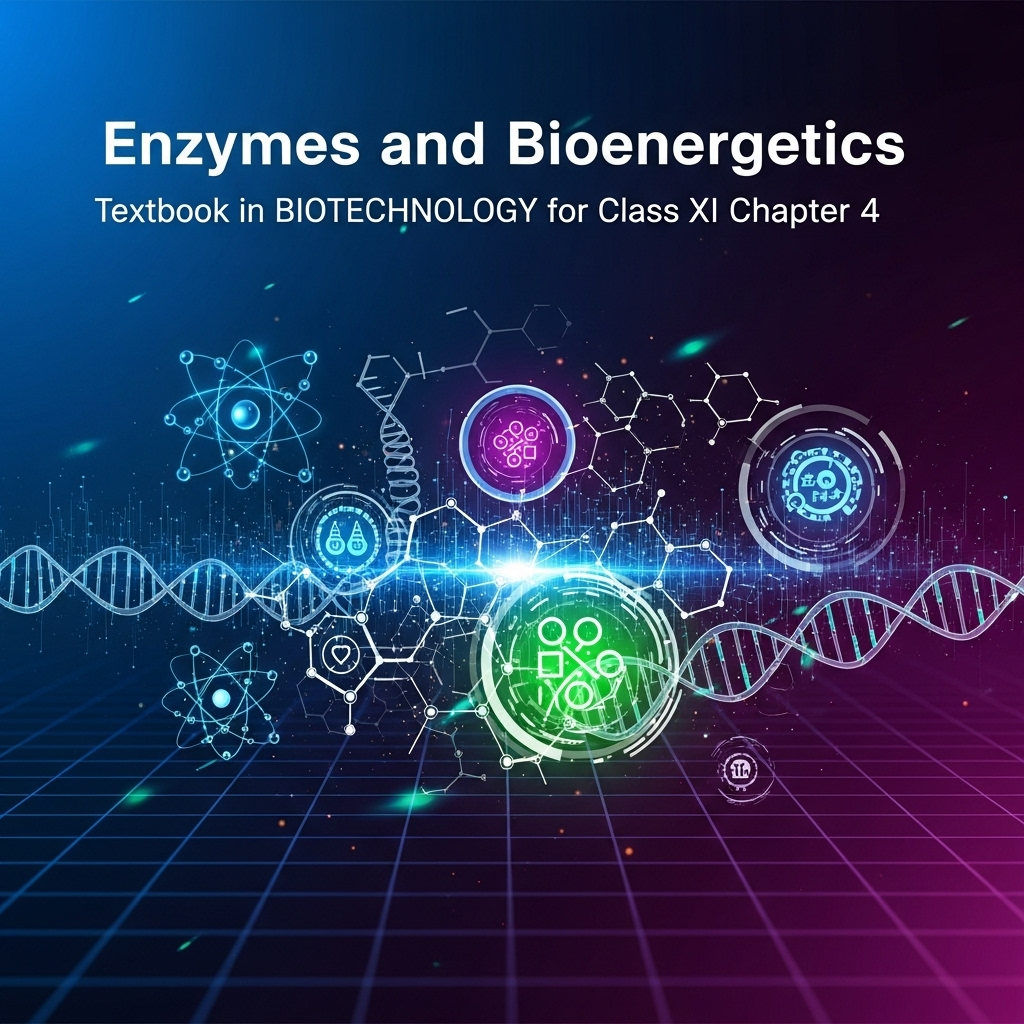
ProSyllabus Journal CBSE Class 11 Annual Assessment Complete Summary and Solutions for Enzymes and Bioenergetics – NCERT Class XI Biotechnology, Chapter 4 – Enzyme Mechanisms, Thermodynamics, Exercises Comprehensive summary and explanation of Chapter 4 'Enzymes and Bioenergetics' from the NCERT Class XI Biotechnology textbook, covering enzyme classification, substrate interaction models, factors affecting activity, inhibition, energy transformations, thermodynamic laws, ATP function, and answers to all textbook exercises and questions.
Updated 1 year ago NCERT · Class XI · Biotechnology · Chapter 4 · Enzymes · Bioenergetics · Thermodynamics · ATP · Reaction Mechanisms · Summary · Questions · Answers
#Enzymes #Bioenergetics #NCERT #Class 11 #Biotechnology #Mechanisms #Thermodynamics #ATP #Summary #Laws of Energy #Exercises #Chapter 4 #Answers #Extra Questions
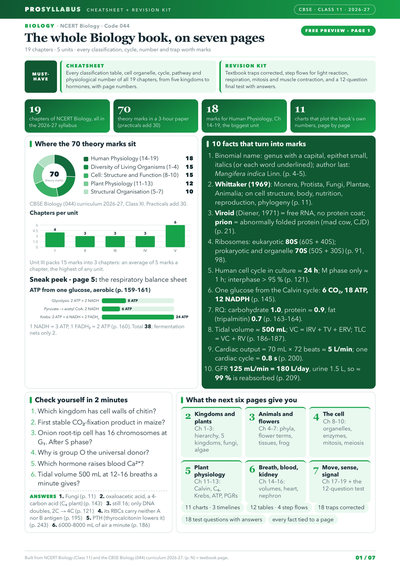
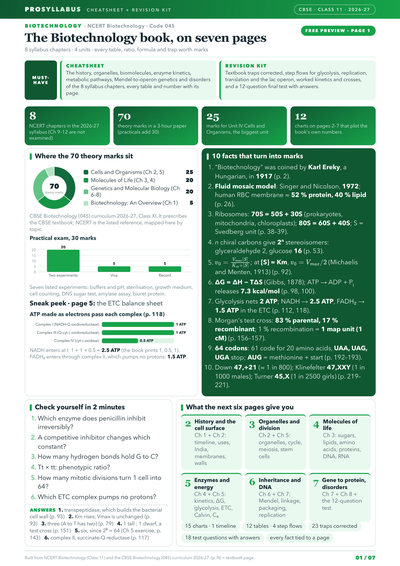
Marks booster + cheatsheet: key concepts in 2 lines each, common traps 25 marks: Unit II, Ch 4–8 23 marks: Unit I, Ch 1–3 Common traps, corrected Conic table and standard values Graphs plotted from the book's own tables Page 1 free about 8 min read , Full kit about 55 min read ₹159
Read page 1 free Get the kit Get the kit One payment · instant PDF · ₹159 View details
Enzymes and Bioenergetics: Class 11 NCERT Chapter 4 - Ultimate Study Guide, Notes, Questions, Quiz 2025
Full Chapter Summary & Detailed Notes
Key Definitions & Terms
60+ Questions & Answers
Key Concepts
Historical Perspectives
Solved Examples
Interactive Quiz (10 Q)
Quick Revision Notes & Mnemonics
Key Terms & Processes
Key Processes & Diagrams
Full Chapter Summary & Detailed Notes - Enzymes and Bioenergetics Class 11 NCERT
Overview & Key Concepts
Chapter Goal : Explore enzymes as biocatalysts and bioenergetics principles. Exam Focus: Classification, kinetics (Michaelis-Menten), inhibition types, thermodynamics laws, ATP role. 2025 Updates: Emphasis on allosteric regulation, real-world enzyme applications (e.g., antibiotics). Fun Fact: Enzymes speed reactions a million-fold without changing. Core Idea: Enzymes lower activation energy; energy transformations follow thermodynamics. Real-World: Enzyme defects cause diseases like PKU; ATP fuels cellular work. Ties: Links to biomolecules (Ch3), cellular processes (Ch5). Expanded: All subtopics point-wise with tables, diagram descriptions for visual learning.Wider Scope : From enzyme structure-function to energy laws; integrates catalysis with thermodynamics.Expanded Content : Detailed on 4.1 (all subsections) and 4.2, including tables/figures.
4.1 Enzymes: Classification and Mode of Action
Definition & Properties : Biocatalysts speeding biochemical reactions in vivo/in vitro; highly specific, unchanged, enhance rate tremendously.Composition : Mostly proteins (MW 20k-1M Da); exceptions: ribozymes (catalytic RNA); activity affected by conformation/denaturation.Cofactors : Required for activity; coenzymes (organic, vitamin-derived, Table 4.1) or metal ions (Table 4.2); holoenzyme = apoenzyme + cofactor; prosthetic group if tightly bound.Table 4.1 Summary : Biocytin (B7, CO2 transfer); CoB12 (B12, alkyl); FAD (B2, electrons); CoA (B5, acyl/alkyl); NAD (B3, hydride); PLP (B6, amino); TPP (B1, aldehydes); THF (B9, C1); transient carriers from vitamins.Table 4.2 Summary : Fe2+/3+ (catalase/peroxidase); Cu2+ (cytochrome oxidase); Mg2+ (DNA pol); Mn2+ (arginase); K+ (pyruvate kinase); Mo2+ (nitrogenase); Zn2+ (carbonic anhydrase); Ni2+ (urease).
Diagram Note: Tables 4.1 & 4.2 (Description)
Tabular format listing coenzymes/vitamins/roles and metals/enzymes; use for memorization—e.g., NAD from B3 transfers H- in redox.
4.1.1 Classification of Enzymes
IUB System (1964, 7 Classes) : Based on reaction type; avoids ambiguity for new enzymes (Table 4.3).Table 4.3 Summary : 1. Oxidoreductases (e- transfer); 2. Transferases (group transfer); 3. Hydrolases (to water); 4. Lyases (double bonds); 5. Isomerases (isomeric forms); 6. Ligases (ATP-coupled condensation); 7. Translocases (ion/molecule across membrane).Isozymes : Multiple forms same reaction, different AA composition/properties; e.g., hexokinase (4 forms tissues); LDH (5 forms human anaerobic metabolism).
Diagram Note: Table 4.3 (Description)
Class number, name, reaction type; visualize as reaction categories for classification recall.
Enzyme Active Site
Structure : Small pocket/cleft for substrate fit; 3D from polypeptide portions; bonds: electrostatic, H-bonds, van der Waals, hydrophobic.Role : Site of catalysis; substrate portion fits precisely.
Models of Enzyme-Substrate Interaction
Fischer’s Lock and Key (1894) : Rigid complementary fit; substrate as key into enzyme lock (Fig. 4.1).Koshland’s Induced Fit (1958) : Flexible; substrate induces enzyme conformational change for binding/catalysis; hand-glove analogy (Fig. 4.2).
Fig. 4.1: Lock and Key Model (Description)
Enzyme (lock) + substrate (key) → ES complex; rigid pre-shaped active site.
Fig. 4.2: Induced Fit Model (Description)
Enzyme + substrate → conformational change in enzyme → ES complex; flexible site adjusts.
Enzyme Specificity
Types : Group (related substrates); absolute (one substrate); stereospecific (one isomer, e.g., D-amino oxidase); geometrical (cis/trans, e.g., fumarase fumarate-malate).Basis : Ideal catalytic group arrangement from specificity.
4.1.2 Factors Affecting Enzyme Activity
Temperature : Rate increases to optimum (40-45°C most; 37°C human), then falls (denaturation); bell curve (Fig. 4.3); exceptions: Taq pol (100°C thermophiles).pH : Bell curve; optimum unique (6-8 most; pepsin 1-2, acid phos 4-5, alkaline phos 10-11); extremes inactivate (Fig. 4.4).Substrate Concentration : Rate proportional till saturation (Vmax); hyperbolic curve (Fig. 4.5).Modulators : Inhibitors/activators (detailed later).
Fig. 4.3: Temperature Effect (Description)
Bell-shaped: Velocity vs. Temp; peak at optimum, drop post-denaturation.
Fig. 4.4: pH Effect (Description)
Bell-shaped: Velocity vs. pH; peak at optimum, low at extremes.
Fig. 4.5: Substrate Concentration (Description)
Hyperbolic: Velocity increases, plateaus at Vmax (saturation).
4.1.3 Unit of Enzyme Activity
Enzyme Unit (U) : Catalyzes 1 µmol substrate/min under standard conditions (IUB 1964).Katal (kat) : 1 mol/s (1 kat = 6×10^7 U); preferred SI unit.
4.1.4 Specific Activity
Definition : Units/mg enzyme protein; measures purity in mixtures.
4.1.5 Mechanism of Enzyme Action
Thermodynamics : ΔG determines spontaneity; ΔG‡ (activation energy) rate; enzymes lower ΔG‡, not ΔG/equilibrium.Transition State : High-energy intermediate; enzymes stabilize to speed equilibrium.Kinetics : E + S ⇌ ES → E + P; Michaelis-Menten (1913): v0 = Vmax [S] / (Km + [S]); Km = [S] at Vmax/2; hyperbolic plot (Fig. 4.6).Interpretations : Low [S] proportional; high [S] Vmax; Km affinity measure (low Km = high affinity).
Fig. 4.6: Michaelis-Menten Plot (Description)
Hyperbola: v0 vs. [S]; asymptote Vmax, Km at ½ Vmax.
4.1.6 Enzyme Inhibition
Types : Irreversible (tight bind, e.g., penicillin transpeptidase, aspirin cyclooxygenase); Reversible (dissociates: competitive, non-competitive, uncompetitive).Competitive : Inhibitor mimics substrate, competes active site; increases Km, Vmax unchanged; overcome by high [S] (Figs. 4.7, 4.8).Non-Competitive : Binds other site, E or ES; decreases Vmax, Km unchanged; not overcome by [S] (Figs. 4.9, 4.10).Uncompetitive : Binds only ES; decreases Vmax/Km; not overcome (Fig. 4.11).
Fig. 4.7: Competitive Inhibition (Description)
E + S → ES → P; E + I → EI (no ESI); competition at site.
Fig. 4.8: Competitive Plot (Description)
Lines intersect y-axis (same Vmax); inhibitor shifts Km right.
Fig. 4.9: Non-Competitive (Description)
E + I → EI; ES + I → ESI (no product); separate sites.
Fig. 4.10: Non-Competitive Plot (Description)
Lines parallel; lower Vmax, same Km.
Fig. 4.11: Uncompetitive (Description)
ES + I → ESI (traps ES); no free E bind.
4.1.7 Allosteric Enzymes
Characteristics : Multi-subunit; regulatory site + active site; sigmoidal kinetics (Fig. 4.12); don't obey Michaelis-Menten.Regulation : Modulators bind regulatory site, alter substrate affinity; key metabolic regulators.
Fig. 4.12: Allosteric Kinetics (Description)
Sigmoidal curve: v0 vs. [S]; cooperative binding.
4.2 Brief Introduction to Bioenergetics
Overview : Energy transformation/use in cells; exergonic (release) to endergonic (consume); governed by thermodynamics.4.2.1 Laws of Thermodynamics : Predict direction/work; not mechanism/speed.First Law : Energy conserved (ΔE = Q - W); system + surroundings constant; path-independent.Second Law : Entropy (S, disorder) universe increases; spontaneous if ΔS_total > 0; life maintains low S via energy input (food/light), but eventual equilibrium post-death.Combined (Gibbs Free Energy) : ΔG = ΔH - TΔS; predicts spontaneity (ΔG < 0 spontaneous); at const T/P; useful work available.Closed System : ΔE = ΔH - PΔV; enthalpy for biochemicals.ATP: Universal Currency : From exergonic (oxidation/light) to endergonic (synthesis/transport/contraction); ADP + Pi → ATP (endergonic); ATP → ADP + Pi (7.3 kcal/mol); nucleotide structure (Fig. 4.13).
Fig. 4.13: ATP Structure (Description)
Adenine-ribose with α/β/γ phosphates; phosphoester bonds; hydrolysis at γ.
Summary
Enzymes: Catalysts lowering ΔG‡; classified by reaction; regulated by factors/inhibitors/allostery.
Bioenergetics: Thermodynamics govern energy flow; ATP central.
Why This Guide Stands Out
Enzyme-focused: Kinetics plots, inhibition comparisons, thermo equations. Free 2025 with point-wise, tables for quick scan; diagram desc for sketching practice.
Key Themes & Tips
Aspects : Specificity, regulation, energy principles.Tip: Mnemonics for classes (OR THY LIG = Oxidoreductases, Transferases, Hydrolases, Lyases, Isomerases, Ligases); plot MM curve for kinetics.
Exam Case Studies
Penicillin: Irreversible inhibition of cell wall enzyme. Allosteric: Hb O2 binding cooperative.
Project & Group Ideas
Model enzyme kinetics with simulations.
Debate: Irreversible vs. reversible inhibition in drugs.
Research: Enzyme engineering in biotech.
Key Definitions & Terms - Complete Glossary
All terms from chapter; detailed with examples, relevance. Expanded: 25+ terms grouped; depth for recall, interlinks to biomolecules/thermo.
Enzyme
Biocatalyst speeding reactions unchanged. Relevance: Specificity/power. Ex: Ribozymes RNA exception. Depth: Proteins mostly; denaturation loses activity.
Cofactor
Non-protein helper. Relevance: Activity essential. Ex: NAD hydride transfer. Depth: Coenzyme (vitamin) or metal; holo/apoenzyme.
Oxidoreductase
Class 1: e- transfer. Relevance: Redox. Ex: Dehydrogenases. Depth: First IUB class.
Isozyme
Multiple forms same reaction. Relevance: Tissue-specific. Ex: LDH 5 forms. Depth: Different properties, same function.
Active Site
Catalytic pocket. Relevance: Substrate fit. Ex: 3D bonds hold S. Depth: Small % enzyme; non-covalent interactions.
Lock and Key Model
Rigid complementary fit. Relevance: Early hypothesis. Ex: Fischer 1894. Depth: Pre-shaped site; Fig 4.1.
Induced Fit Model
Flexible change on binding. Relevance: Modern view. Ex: Koshland 1958. Depth: Aligns residues; hand-glove; Fig 4.2.
Stereospecificity
One isomer acted. Relevance: Chirality. Ex: D-amino oxidase. Depth: 3D arrangement key.
Km
[S] at Vmax/2. Relevance: Affinity. Ex: Low Km high affinity. Depth: Michaelis constant.
Vmax
Max velocity. Relevance: Saturation. Ex: All sites occupied. Depth: Enzyme amount dependent.
Competitive Inhibition
Site competitor. Relevance: Overcome by S. Ex: Statins HMG-CoA. Depth: ↑Km, Vmax same; Fig 4.8.
Non-Competitive Inhibition
Other site bind. Relevance: Not overcome. Ex: Heavy metals. Depth: ↓Vmax, Km same; Fig 4.10.
Allosteric Enzyme
Regulatory site. Relevance: Metabolic control. Ex: Phosphofructokinase. Depth: Sigmoidal; Fig 4.12.
Activation Energy (ΔG‡)
Barrier to reaction. Relevance: Rate determinant. Ex: Enzymes lower. Depth: Transition state energy.
Entropy (S)
Disorder measure. Relevance: Spontaneity. Ex: Universe ↑S. Depth: Second law.
Free Energy (ΔG)
ΔH - TΔS. Relevance: Predicts direction. Ex: <0 spontaneous. Depth: Gibbs; useful work.
ATP
Energy currency. Relevance: Exergonic to endergonic. Ex: Hydrolysis 7.3 kcal. Depth: Adenine-ribose-phosphates; Fig 4.13.
Holoenzyme
Apo + cofactor. Relevance: Active form. Ex: NAD-dependent dehydrogenase. Depth: Complete catalyst.
Prosthetic Group
Tightly bound cofactor. Relevance: Permanent. Ex: Heme in catalase. Depth: Covalent.
Enzyme Unit (U)
1 µmol/min. Relevance: Activity measure. Ex: Standard conditions. Depth: IUB; katal alternative.
Specific Activity
U/mg protein. Relevance: Purity. Ex: Increases purification. Depth: Tracks isolation.
Geometrical Specificity
Cis/trans isomers. Relevance: Shape. Ex: Fumarase. Depth: Double bond form.
Absolute Specificity
One substrate. Relevance: High precision. Ex: Trypsin peptides. Depth: Extreme selectivity.
Group Specificity
Related substrates. Relevance: Broad. Ex: Proteases amides. Depth: Functional group.
Uncompetitive Inhibition
ES binder only. Relevance: Traps complex. Ex: Rare, some metals. Depth: ↓Vmax/Km; Fig 4.11.
Tip: Group by enzyme (structure/kinetics) vs. bioenergetics (thermo/ATP); examples link to diseases. Depth: Equations for thermo. Errors: Confuse Km/Vmax. Historical: Fischer 1894. Interlinks: Ch3 vitamins. Advanced: Lineweaver-Burk plots. Real-Life: Lactase intolerance (low enzyme). Graphs: Fig 4.6 MM. Coherent: Action → Factors → Kinetics → Regulation → Energy. For easy learning: Flashcard terms with ex.
60+ Questions & Answers - NCERT Based (Class 11) - From Exercises & Variations
Based on chapter + expansions. Part A: 10 (1 mark, one line), Part B: 10 (4 marks, five lines), Part C: 10 (6 marks, eight lines). Point-wise for marks.
Part A: 1 Mark Questions (10 Qs - Short)
1. What are enzymes?
1 Mark Answer: Biocatalysts that speed biochemical reactions without changing.
2. Name the non-protein enzyme example.
1 Mark Answer: Ribozymes (catalytic RNA).
3. What is holoenzyme?
1 Mark Answer: Apoenzyme + cofactor.
4. Which vitamin derives NAD?
1 Mark Answer: Niacin (B3).
5. Name Class 1 enzymes.
1 Mark Answer: Oxidoreductases (e- transfer).
6. What are isozymes?
1 Mark Answer: Multiple forms catalyzing same reaction.
7. Who proposed lock and key model?
1 Mark Answer: Emil Fischer (1894).
8. Define Km.
1 Mark Answer: Substrate concentration at half Vmax.
9. What is competitive inhibition?
1 Mark Answer: Inhibitor competes for active site.
10. What is ΔG?
1 Mark Answer: Free energy change (ΔH - TΔS).
Part B: 4 Marks Questions (10 Qs - Medium, Five Lines Each)
1. Describe enzyme cofactors.
4 Marks Answer:
Non-protein components required for activity.
Coenzymes: Organic, vitamin-derived (e.g., NAD from B3).
Metal ions: e.g., Zn2+ in carbonic anhydrase.
Holoenzyme: Apo + cofactor; prosthetic if tight-bound.
Role: Carry groups (e.g., hydride in NAD).
2. Explain enzyme classification.
4 Marks Answer:
IUB 1964: 7 classes by reaction type.
1: Oxidoreductases (redox).
3: Hydrolases (hydrolysis).
6: Ligases (ATP synthesis).
7: Translocases (transport).
3. Differentiate lock and key vs. induced fit.
4 Marks Answer:
Lock-key: Rigid complementary fit (Fischer).
Induced fit: Substrate induces enzyme change (Koshland).
Lock: Pre-shaped site.
Fit: Flexible alignment for catalysis.
Ex: Hand-glove in fit.
4. Describe temperature/pH effects.
4 Marks Answer:
Temp: Bell curve; optimum 37°C human, denaturation high.
pH: Bell; optimum 6-8, extremes inactivate.
Ex: Pepsin acidic (1-2).
Substrate: Hyperbolic to Vmax.
Factors alter velocity.
5. What is Michaelis-Menten kinetics?
4 Marks Answer:
v0 = Vmax [S] / (Km + [S]).
Km: [S] at ½ Vmax (affinity).
Hyperbolic plot.
Low [S]: Proportional.
High [S]: Saturation.
6. Explain competitive inhibition.
4 Marks Answer:
Inhibitor mimics S, active site bind.
↑Km, Vmax same.
Overcome by high [S].
Ex: Penicillin transpeptidase.
Reduces active E.
7. Describe non-competitive inhibition.
4 Marks Answer:
Binds non-active site, E/ES.
↓Vmax, Km same.
Not overcome by [S].
Ex: Cyanide cytochrome oxidase.
Lowers functional E.
8. What are allosteric enzymes?
4 Marks Answer:
Multi-subunit, regulatory site.
Sigmoidal kinetics.
Modulators alter affinity.
Metabolic regulators.
Ex: Hb cooperative.
9. State first law of thermodynamics.
4 Marks Answer:
Energy conserved (ΔE = Q - W).
System + surroundings constant.
No creation/destruction.
Interconvertible forms.
Path-independent.
10. Explain ATP role.
4 Marks Answer:
Universal energy currency.
Exergonic to endergonic transfer.
Hydrolysis: ATP → ADP + Pi (7.3 kcal).
Synthesis in oxidation/light.
Used in synthesis/transport/contraction.
Part C: 6 Marks Questions (10 Qs - Long, Eight Lines Each)
1. Describe enzyme structure and models.
6 Marks Answer:
Proteins (ribozymes exception); MW 20k-1M Da.
Active site: Pocket for S fit, non-covalent bonds.
Lock-key: Rigid fit (Fischer 1894, Fig 4.1).
Induced fit: Conformational change (Koshland 1958, Fig 4.2).
Specificity: Group/absolute/stereo/geometrical.
Ex: D-amino oxidase stereo.
Cofactors essential (Tables 4.1/4.2).
Holoenzyme active form.
2. Explain enzyme classification and isozymes.
6 Marks Answer:
IUB 7 classes (Table 4.3): Reaction-based.
1: Oxidoreductases e-.
2: Transferases groups.
3: Hydrolases water.
4-7: Lyases/isomerases/ligases/translocases.
Isozymes: Same reaction, different forms.
Ex: LDH 5 human tissues.
Different AA/properties.
Adapt to needs.
3. Discuss factors affecting activity.
6 Marks Answer:
Temp: ↑ to optimum (37°C), then denaturation (Fig 4.3).
pH: Bell, unique optimum (pepsin 2) (Fig 4.4).
[S]: Hyperbolic to Vmax (Fig 4.5).
Modulators: Inhibitors/activators.
Ex: Taq 100°C stable.
Optimum balances structure/activity.
Extremes alter ionization/conformation.
Saturation: Enzyme limiting.
4. Elaborate Michaelis-Menten mechanism.
6 Marks Answer:
E + S ⇌ ES → E + P.
Lowers ΔG‡, not ΔG.
Equation: v0 = Vmax [S]/(Km + [S]).
Km: Affinity (low = high).
Hyperbola (Fig 4.6).
1913 Michaelis-Menten.
ES intermediate key.
Equilibrium faster.
5. Compare inhibition types.
6 Marks Answer:
Irreversible: Tight, permanent (penicillin).
Competitive: Site rival, ↑Km (Fig 4.8).
Non-comp: Other site, ↓Vmax (Fig 4.10).
Uncomp: ES only, ↓Vmax/Km (Fig 4.11).
Reversible dissociate.
Ex: Aspirin irreversible.
Regulates activity.
Drug targets.
6. Explain allosteric enzymes.
6 Marks Answer:
Don't obey MM; sigmoidal (Fig 4.12).
Regulatory + active sites.
Modulators bind, alter affinity.
Cooperative subunits.
Metabolic pathway keys.
Ex: ATCase feedback.
Positive/negative effectors.
Dynamic regulation.
7. Describe first/second laws.
6 Marks Answer:
First: ΔE = Q - W; conserved.
System-surroundings constant.
Second: ΔS_universe >0 spontaneous.
Entropy disorder ↑.
Life low S via energy input.
Post-death ↑S decomposition.
Direction prediction.
Not rate.
8. What is free energy and ATP?
6 Marks Answer:
ΔG = ΔH - TΔS; <0 spontaneous.
Useful work at T/P.
ATP: Currency from exergonic.
Hydrolysis energy release.
Structure: Adenine-ribose-3P (Fig 4.13).
Used in endo processes.
Synthesis in mito/photo.
Central transfer.
9. Discuss enzyme specificity types.
6 Marks Answer:
Group: Related substrates (proteases).
Absolute: One S (urease urea).
Stereo: One isomer (D-oxidase).
Geometrical: Cis/trans (fumarase).
Basis: Binding/catalytic arrangement.
Enhances efficiency.
Prevents side reactions.
Models explain (lock/fit).
10. Outline enzyme units and mechanism.
6 Marks Answer:
Unit: 1 µmol/min; katal 1 mol/s.
Specific: U/mg purity.
Mechanism: Lowers ΔG‡ transition state.
ES complex intermediate.
ΔG unchanged, rate ↑.
Thermodynamic properties key.
Spontaneous if ΔG<0.
Kinetics describe rate.
Tip: Diagrams for inhibition; equations for thermo. Easy: Structured lists.
Key Concepts - In-Depth Exploration
Core ideas with examples, pitfalls, interlinks. Expanded: All concepts 4.1-4.2 with steps/examples for easy learning.
Cofactors & Coenzymes
Vital helpers. Steps: 1. Bind apo, 2. Carry groups, 3. Regenerate. Ex: NAD reduces to NADH in glycolysis. Pitfall: Confuse coenzyme/metal. Interlink: Vitamins Ch3. Depth: Table 4.1 roles; transient in catalysis.
Enzyme Classification
Reaction-based. Steps: Identify type (e.g., hydrolysis=hydrolase), assign class. Ex: Lactase hydrolase. Pitfall: Forget translocase (7th). Interlink: Metabolism Ch5. Depth: Table 4.3; EC numbers advanced.
Isozymes
Tissue variants. Steps: Same catalysis, vary AA for regulation. Ex: CK-MB heart damage. Pitfall: Same as isoforms. Interlink: Diagnostics. Depth: LDH electrophoresis.
Active Site & Models
Catalysis locus. Steps: Lock: Fit rigid; Fit: Induce change. Ex: Hexokinase glucose. Pitfall: Rigid vs. dynamic. Interlink: Specificity. Depth: Figs 4.1-2; bonds list.
Specificity Types
Precision levels. Steps: Bind S, catalyze selectively. Ex: Trypsin Arg/Lys. Pitfall: Overlap group/stereo. Interlink: Drug design. Depth: 4 types with ex.
Factors Affecting Activity
Environmental controls. Steps: Temp ↑kinetic energy, excess denature; pH ionize residues. Ex: Pepsin stomach acid. Pitfall: Ignore optimum range. Interlink: Industrial enzymes. Depth: Figs 4.3-5; [S] saturation.
Michaelis-Menten Kinetics
Rate equation. Steps: 1. E+S=ES, 2. ES→P, 3. Plot hyperbola. Ex: Sucrase sucrose. Pitfall: Km not Vmax. Interlink: Inhibition plots. Depth: Fig 4.6; low/high [S] behaviors.
Enzyme Inhibition
Rate reducers. Steps: Comp: Compete site; Non: Allosteric; Un: Trap ES. Ex: Methanol ethanol comp alcohol deh. Pitfall: Vmax/Km effects. Interlink: Pharma. Depth: Figs 4.7-11; reversible/irrev.
Allosteric Regulation
Modulator control. Steps: Bind reg site, change conformation, alter affinity. Ex: PFK AMP activator. Pitfall: Sigmoidal vs. hyperbolic. Interlink: Pathways Ch5. Depth: Fig 4.12; cooperative.
Thermodynamics Laws
Energy rules. Steps: First: Conserve (ΔE=Q-W); Second: ↑S (ΔS>0). Ex: ATP hydrolysis ΔG<0. Pitfall: Life defies second (temp low S). Interlink: Bioenergetics. Depth: Equations; closed system.
Free Energy & ATP
Work predictor. Steps: Calc ΔG, if <0 spontaneous; ATP couples. Ex: Glu → G6P +ΔG, ATP makes feasible. Pitfall: ΔG vs. ΔG‡. Interlink: Ch5 processes. Depth: Fig 4.13; 7.3 kcal hydrolysis.
Advanced: Hill equation allostery. Pitfalls: Inhibition plots. Interlinks: Ch2 organelles (mito ATP). Real: Statins comp inhib. Depth: Transition state theory. Examples: LDH isozymes diagnosis. Graphs: MM/inhibition. Errors: Coenzyme vs. cofactor. Tips: Steps for models; table comparisons.
Historical Perspectives - Detailed Guide
Timeline of discoveries; expanded with points, microscopy/enzyme links for easy learning.
Early Catalysis (19th C)
Berzelius 1835: Organic catalysts. Fischer 1894: Lock-key, specificity. Early protein link. Depth: Specificity foundation; no kinetics.
20th C Kinetics
Michaelis-Menten 1913: Equation/ES. Lineweaver-Burk 1934: Plot. IUB 1964: Classification. Depth: Quantified rates; tables standardized.
Models & Regulation
Koshland 1958: Induced fit. Monod 1961: Allostery. Changeux: Cooperative. Depth: Dynamic views; sigmoidal key.
Bioenergetics
Gibbs 1878: ΔG. Meyerhof 1920s: ATP energy. 1960s: Endo sym for mito. Depth: Laws to cellular; ATP universal.
Modern
1970s: X-ray structures active sites. 1990s: Directed evolution enzymes. Now: CRISPR enzyme engineering. Depth: Biotech apps; inhibitors drugs.
Tip: Link to tools (spectro for kinetics). Depth: Pasteur fermentation enzymes. Examples: Fischer specificity. Graphs: Timeline. Advanced: Quantum tunneling catalysis. Easy: Bullets chronology.
Solved Examples - From Text with Simple Explanations
Expanded; steps for understanding; key figures/processes.
Example 1: Lock and Key (Fig 4.1)
Simple Explanation: Rigid puzzle fit.
Step 1: Enzyme site shaped for S.
Step 2: S inserts precisely.
Step 3: Forms ES, catalyzes.
Step 4: Releases P, E free.
Simple Way: Key turns lock without force.
Example 2: Induced Fit (Fig 4.2)
Simple Explanation: Glove molds to hand.
Step 1: S approaches loose site.
Step 2: Binding induces shape change.
Step 3: Aligns catalytic groups.
Step 4: Reaction, release.
Simple Way: Hand stretches glove for fit.
Example 3: Competitive Inhibition (Fig 4.7)
Simple Explanation: Fake key blocks real.
Step 1: I binds site like S.
Step 2: Blocks ES formation.
Step 3: High S displaces I.
Step 4: Vmax same, Km ↑.
Simple Way: Traffic jam at door, more cars clear.
Example 4: Michaelis-Menten Plot (Fig 4.6)
Simple Explanation: Speed vs. fuel curve.
Step 1: Low [S], linear rise.
Step 2: Mid [S]=Km, half max.
Step 3: High [S], plateau Vmax.
Step 4: Saturation all bound.
Simple Way: Car accelerates then cruises.
Example 5: ATP Hydrolysis
Simple Explanation: Battery discharge.
Step 1: ATP binds enzyme.
Step 2: Hydrolyzes γ bond.
Step 3: Releases energy/ADP/Pi.
Step 4: Powers endo reaction.
Simple Way: Coin from vending machine.
Tip: Sketch plots; link to real enzymes.
Interactive Quiz - Master Enzymes and Bioenergetics
10 MCQs in full sentences; 80%+ goal. Covers classification, kinetics, inhibition, thermo.
Start Quiz
Quick Revision Notes & Mnemonics
Concise for all subtopics; mnemonics for recall. Covers enzymes to ATP.
4.1 Enzymes Basics
Biocatalysts specific/powerful (Mnemonic: "E-S-P" - Enhance Speed Precisely). Cofactors: Coenzymes vitamins, metals ( "CV M" - Carry Vitamins Metals). Holo: Apo + Cof ( "HAC Full Active" - HAC).
Classification
7 Classes: O-T-H-L-I-L-T (Oxido-Trans-Hyd-Ly-Isom-Lig-Translo). Isozymes: Tissue variants ( "IT Vary Function Same" - ITVS).
Models & Specificity
Lock: Rigid fit; Fit: Induce change ( "LIF Rigid Dynamic" - LIF). Specificity: G-A-S-G (Group-Abs-Stereo-Geom).
Factors
Temp/pH: Bell curves optimum ( "BPO Peak Optimum" - BPO). [S]: Hyperbolic Vmax ( "SH V Sat" - SHV).
Kinetics & Units
MM: v=V[S]/(K+[S]); Km half ( "MM H Half Affinity" - MMH). Unit: µmol/min; Specific U/mg ( "US Purity" - USP).
Inhibition
Comp: ↑Km V same; Non: ↓V Km same; Un: Both alter ( "CUN Changes Unique" - CUN). Irrev: Permanent ( "IP Tight" - IPT).
Allosteric
Sigmoidal reg site ( "SR Coop Metabolic" - SRCM).
4.2 Bioenergetics
First: Conserve ΔE=Q-W ( "FC Balance" - FCB). Second: ↑S spontaneous ( "SS Disorder Up" - SSD). ΔG=ΔH-TΔS <0 go ( "GHT Negative" - GHT).
ATP
Currency hydrolysis energy ( "CHE Power" - CHP); ADP+Pi synth.
Overall Mnemonic: "Enz Cof Class Mod Spec Fact Kin Inh Allo Ther ATP" (ECCM SFKI TA). Flashcards: One per subtopic. Easy: Bullets, bold keys.
Key Terms & Processes - All Key
Expanded table; 25+ rows for reference.
Term/Process Description Example Usage
Enzyme Biocatalyst unchanged Amylase starch Catalysis Coenzyme Vitamin-derived carrier NAD redox Group transfer Holoenzyme Complete active Lactate deh + NAD Activity Oxidoreductase e- transfer Cytochrome oxidase Redox Hydrolase Hydrolysis Pepsin proteins Digestion Isozyme Variant forms LDH tissues Regulation Active Site Catalytic cleft Hexokinase pocket Binding Lock and Key Rigid fit Fischer model Interaction Induced Fit Conform change Koshland glove Dynamic Stereospecificity Isomer select D-amino oxidase Chirality Km ½ Vmax [S] Affinity measure Kinetics Vmax Saturation rate All ES active Capacity Competitive Inhibition Site rival Sulfa drugs ↑Km Non-Competitive Other site Lead poisoning ↓Vmax Allosteric Site Regulator bind PFK AMP Control Activation Energy Reaction barrier Enzymes lower Rate ΔG Free energy <0 spontaneous Direction Entropy Disorder Universe ↑ Second law ATP Energy currency Hydrolysis 7.3 kcal Transfer Prosthetic Group Tight cofactor FAD flavoproteins Permanent Enzyme Unit 1 µmol/min Standard assay Quantify Specific Activity U/mg protein Purity check Isolation Geometrical Specificity Cis/trans Fumarase Isomer Uncompetitive Inhibition ES trap Lithium some ↓Vmax/Km Transition State High energy intermediate ES stabilizes Catalysis Exergonic Energy release Glucose oxidation ΔG<0
Tip: Examples memorize; sort function. Easy: Scan for exams.
Key Processes & Diagrams - Solved Step-by-Step
Expanded; all major with desc/steps.
Process 1: Enzyme Catalysis (Michaelis-Menten)
Step-by-Step:
Step 1: E + S ⇌ ES (reversible).
Step 2: ES forms transition state.
Step 3: Lowers ΔG‡, speeds to P.
Step 4: E + P release.
Step 5: Equilibrium faster.
Diagram Desc: Fig 4.6 hyperbola; energy diagram ΔG‡ drop.
Process 2: Competitive Inhibition
Step-by-Step:
Step 1: I binds E like S.
Step 2: Forms EI, blocks ES.
Step 3: High S competes, displaces.
Step 4: Km ↑ (apparent lower affinity).
Step 5: Vmax unchanged.
Diagram Desc: Fig 4.7 branch to EI; 4.8 intersect y.
Process 3: Allosteric Regulation
Step-by-Step:
Step 1: Modulator binds reg site.
Step 2: Conform change active site.
Step 3: Alters S affinity (T/R states).
Step 4: Cooperative binding.
Step 5: Sigmoidal response.
Diagram Desc: Fig 4.12 sigmoid; subunit shift.
Process 4: Thermodynamics Spontaneity
Step-by-Step:
Step 1: Calc ΔH (heat).
Step 2: Measure ΔS (disorder).
Step 3: ΔG = ΔH - TΔS.
Step 4: <0 spontaneous.
Step 5: ATP makes +ΔG feasible.
Diagram Desc: Energy profile; ΔG arrow down.
Process 5: ATP Cycle
Step-by-Step:
Step 1: Exergonic (food ox) → ATP synth.
Step 2: ATP hydrolysis releases E.
Step 3: Couples to endergonic (e.g., active transport).
Step 4: ADP + Pi recycled.
Step 5: Maintains steady state.
Diagram Desc: Fig 4.13 structure; cycle arrow.
Tip: Number steps; visualize bonds. Easy: Analogies like locks/keys.
CBSE Class 11 kits Marks booster + cheatsheet: key concepts in 2 lines each, common traps 25 marks: Unit II, Ch 4–8 23 marks: Unit I, Ch 1–3 Common traps, corrected Conic table and standard values Graphs plotted from the book's own tables Page 1 free about 8 min read , Full kit about 55 min read ₹159
Read page 1 free Get the kit Get the kit One payment · instant PDF · ₹159 View details Marks booster + cheatsheet: key concepts in 2 lines each, common traps 23-mark block: Ch 1–4 17-mark block: Ch 5–7 Common traps, corrected 7 chapters: every solved-example result Every unit and dimension, listed Page 1 free about 8 min read , Full kit about 55 min read ₹159
Read page 1 free Get the kit Get the kit One payment · instant PDF · ₹159 View details Marks booster + cheatsheet: key concepts in 2 lines each, common traps 20-mark block: Ch 8–12 10-mark block: Oscillations and Waves Common traps, corrected 7 chapters: every solved-example result Sound, standing waves and beats covered Page 1 free about 8 min read , Full kit about 55 min read ₹159
Read page 1 free Get the kit Get the kit One payment · instant PDF · ₹159 View details Marks booster + cheatsheet: key concepts in 2 lines each, common traps 9 marks each: Atom and Thermodynamics Constants and formulas, with page numbers Common traps, corrected Periodic trends from the real data pH, buffers and solubility product Page 1 free about 8 min read , Full kit about 55 min read ₹159
Read page 1 free Get the kit Get the kit One payment · instant PDF · ₹159 View details Marks booster + cheatsheet: key concepts in 2 lines each, common traps 10 marks: Hydrocarbons Every reaction with reagent and condition Common traps that cost marks, listed IUPAC naming rules Oxidation-number rules and balancing Page 1 free about 8 min read , Full kit about 55 min read ₹159
Read page 1 free Get the kit Get the kit One payment · instant PDF · ₹159 View details Marks booster + cheatsheet: key concepts in 2 lines each, common traps 18 marks: Unit V, breathing to hormones 15 marks each: Units I and III Common traps, corrected Five kingdoms classification table Physiological numbers, with page numbers Page 1 free about 8 min read , Full kit about 55 min read ₹159
Read page 1 free Get the kit Get the kit One payment · instant PDF · ₹159 View details Marks booster + cheatsheet: key concepts in 2 lines each, common traps 44 marks: Unit 2, recording to depreciation Journal formats and special purpose books Traps from all seven chapters Bank reconciliation adjustments Depreciation formulas, book's worked figures Page 1 free about 8 min read , Full kit about 55 min read ₹159
Read page 1 free Get the kit Get the kit One payment · instant PDF · ₹159 View details Marks booster + cheatsheet: key concepts in 2 lines each 12 exam traps, listed Five calculations the paper keeps asking Each adjustment: one entry, two effects Both formats: trading and P&L, balance sheet Yogita illustration solved line by line Page 1 free about 8 min read , Full kit about 55 min read ₹159
Read page 1 free Get the kit Get the kit One payment · instant PDF · ₹159 View details Marks booster + cheatsheet: key concepts in 2 lines each, common traps 20 marks: finance and MSME units 20 marks: internal and international trade Five comparison tables, insurance to retail Case cues for each chapter Common traps, corrected Page 1 free about 8 min read , Full kit about 55 min read ₹159
Read page 1 free Get the kit Get the kit One payment · instant PDF · ₹159 View details Marks booster + cheatsheet: key concepts in 2 lines each, common traps 15 marks: Ch 1–4, data to diagrams 7 chapters: every formula, worked numbers Common mistakes, corrected Book exercise answers included Part C project route Page 1 free about 8 min read , Full kit about 55 min read ₹159
Read page 1 free Get the kit Get the kit One payment · instant PDF · ₹159 View details Marks booster + cheatsheet: key concepts in 2 lines each, common traps 14 marks: Production and Costs, Unit 6 8 marks: Market Equilibrium, Unit 7 Common traps, corrected PPF, TU–MU, MRS and cost table drawn Demand and supply schedules from the book Page 1 free about 8 min read , Full kit about 55 min read ₹159
Read page 1 free Get the kit Get the kit One payment · instant PDF · ₹159 View details Marks booster + cheatsheet: key concepts in 2 lines each, common traps 20 marks: Empires section 20 marks: Changing Cultural Traditions 15 marks: Paths to Modernisation, Japan 5 marks: map work on the book's maps Common traps, corrected Page 1 free about 8 min read , Full kit about 55 min read ₹159
Read page 1 free Get the kit Get the kit One payment · instant PDF · ₹159 View details Marks booster + cheatsheet: key concepts in 2 lines each, common traps 8 marks: Climate unit, Ch 7–10 5 marks: map work, covered 4 marks: ocean data as charts, Unit V Heat budget and five air layers as charts Common traps, corrected Page 1 free about 8 min read , Full kit about 55 min read ₹159
Read page 1 free Get the kit Get the kit One payment · instant PDF · ₹159 View details Marks booster + cheatsheet: key concepts in 2 lines each, common traps 12 marks: Climate, Vegetation (Unit III) Full CBSE map-work list, chapter by chapter Indus, Ganga, Brahmaputra river systems Monsoon mechanism, onset and four seasons Common traps, corrected Page 1 free about 8 min read , Full kit about 55 min read ₹159
Read page 1 free Get the kit Get the kit One payment · instant PDF · ₹159 View details Marks booster + cheatsheet: key concepts in 2 lines each 4 marks: Map Scale, conversions worked 4 marks: Latitude, Longitude and Time 4 marks: Topographical Maps, contours 5 marks: practical file and viva Conical and Mercator's construction steps Page 1 free about 8 min read , Full kit about 55 min read ₹159
Read page 1 free Get the kit Get the kit One payment · instant PDF · ₹159 View details Marks booster + cheatsheet: key concepts in 2 lines each, common traps 8 marks together: Citizenship, Nationalism 6 marks each: Social Justice, Secularism 8 chapters: thinkers and a timeline Liberty, equality, justice side by side Common traps, corrected Page 1 free about 8 min read , Full kit about 55 min read ₹159
Read page 1 free Get the kit Get the kit One payment · instant PDF · ₹159 View details Marks booster + cheatsheet: key concepts in 2 lines each 12 marks: Executive to Judiciary Constitution-making timeline Institution-by-institution comparisons 6 marks: elections, FPTP, PR, reserved seats Fundamental Rights and Directive Principles Page 1 free about 8 min read , Full kit about 55 min read ₹159
Read page 1 free Get the kit Get the kit One payment · instant PDF · ₹159 View details Marks booster + cheatsheet: key concepts in 2 lines each, common traps 10 marks each: Units 1 and 2 20 marks: project work, covered Tables: groups, stratification, marriage Every thinker and concept of Chapters 1–4 Common traps, corrected Page 1 free about 8 min read , Full kit about 55 min read ₹159
Read page 1 free Get the kit Get the kit One payment · instant PDF · ₹159 View details Marks booster + cheatsheet: key concepts in 2 lines each, common traps 12 marks each: Units 7, 9 and 10 7 thinkers: dates, works, examples Four Indian sociologists, in tables Ideal type, bureaucracy, division of labour Common traps, corrected Page 1 free about 8 min read , Full kit about 55 min read ₹159
Read page 1 free Get the kit Get the kit One payment · instant PDF · ₹159 View details Marks booster + cheatsheet: key concepts in 2 lines each 11 marks each: Units I and III 9 marks: Learning, Unit V 8 marks each: Perception and Memory Every school with its founder Comparisons examiners ask for Page 1 free about 8 min read , Full kit about 55 min read ₹159
Read page 1 free Get the kit Get the kit One payment · instant PDF · ₹159 View details Marks booster + cheatsheet: key concepts in 2 lines each, common traps 8 marks: note-making and summary 5 poems compared, cross-text themes Common traps, corrected Poetic devices with short quotes Grammar each chapter teaches Page 1 free about 8 min read , Full kit about 55 min read ₹159
Read page 1 free Get the kit Get the kit One payment · instant PDF · ₹159 View details Marks booster + cheatsheet: key concepts in 2 lines each, common traps 4-, 3- and 6-mark answers: how to write them Plot timeline for every text Common traps, corrected Every character, with evidence Cross-text themes, side by side Page 1 free about 8 min read , Full kit about 55 min read ₹159
Read page 1 free Get the kit Get the kit One payment · instant PDF · ₹159 View details Marks booster + cheatsheet: key concepts in 2 lines each, common traps Poetic forms and rhyme schemes Devices with short quotes Common traps, corrected Essay arguments, essay by essay Words each chapter teaches Page 1 free about 8 min read , Full kit about 55 min read ₹159
Read page 1 free Get the kit Get the kit One payment · instant PDF · ₹159 View details Marks booster + cheatsheet: key concepts in 2 lines each 16 writers placed on one timeline 60- and 40-word answer frames 8 काव्य पाठ: प्रतीक and काव्य-सौंदर्य Lines worth remembering, with page refs 12 common mistakes, corrected Page 1 free about 8 min read , Full kit about 55 min read ₹159
Read page 1 free Get the kit Get the kit One payment · instant PDF · ₹159 View details Marks booster + cheatsheet: key concepts in 2 lines each 10 marks (2 × 5): answer frames 5-mark answers in about 60 words 4 lessons: argument, events, characters Lines worth remembering, by page 12 common mistakes, corrected Page 1 free about 8 min read , Full kit about 55 min read ₹159
Read page 1 free Get the kit Get the kit One payment · instant PDF · ₹159 View details Marks booster + cheatsheet: key concepts in 2 lines each 16 writers placed on one timeline 40-word and व्याख्या answer frames 8 काव्य पाठ: प्रतीक, उपमान, काव्य-सौंदर्य Lines worth remembering, with page refs 12 common mistakes, corrected Page 1 free about 8 min read , Full kit about 55 min read ₹159
Read page 1 free Get the kit Get the kit One payment · instant PDF · ₹159 View details Marks booster + cheatsheet: key concepts in 2 lines each 5-mark, 100-word answer frames 9 exercise questions: आवारा मसीहा 7 exercise questions: हुसैन की कहानी Life events linked to the works 12 common mistakes, corrected Page 1 free about 8 min read , Full kit about 55 min read ₹159
Read page 1 free Get the kit Get the kit One payment · instant PDF · ₹159 View details Marks booster + cheatsheet: key concepts in 2 lines each 20 marks: grammar, from text words Sandhi, pratyaya and lakar examples Anvaya and bhavartha answer method Source text and author for every lesson 10 common errors, corrected Page 1 free about 8 min read , Full kit about 55 min read ₹159
Read page 1 free Get the kit Get the kit One payment · instant PDF · ₹159 View details Marks booster + cheatsheet: key concepts in 2 lines each 20 marks: grammar, भाग ग, from the text 10 marks: history of literature Sandhi, samasa, pratyaya, upapada examples Source text and author for every lesson Common errors, corrected Page 1 free about 8 min read , Full kit about 55 min read ₹159
Read page 1 free Get the kit Get the kit One payment · instant PDF · ₹159 View details Marks booster + cheatsheet: key concepts in 2 lines each Author, genre and characters per lesson Couplets explained: Insha and Fani ghazals Grammar for Section A Letter and advertisement formats 10 common mistakes, corrected Page 1 free about 8 min read , Full kit about 55 min read ₹159
Read page 1 free Get the kit Get the kit One payment · instant PDF · ₹159 View details Marks booster + cheatsheet: key concepts in 2 lines each 38 marks: the answer frame 13 genres, each introduced 18 writers and poets: dates and works Literary devices (صنعتیں) and key words Common mistakes, corrected Page 1 free about 8 min read , Full kit about 55 min read ₹159
Read page 1 free Get the kit Get the kit One payment · instant PDF · ₹159 View details Marks booster + cheatsheet: key concepts in 2 lines each 10 marks: literary forms, covered 5 geets, each with its poet Nazm defined, with its four kinds Answer points for the book's questions Common mistakes, corrected Page 1 free about 8 min read , Full kit about 55 min read ₹159
Read page 1 free Get the kit Get the kit One payment · instant PDF · ₹159 View details Marks booster + cheatsheet: key concepts in 2 lines each, common traps 15 marks: Unit 3, society, law and ethics 10 marks: Unit 1, number-system conversions Common traps that cost marks, listed Truth tables for Boolean logic String, list and dictionary methods Page 1 free about 8 min read , Full kit about 55 min read ₹159
Read page 1 free Get the kit Get the kit One payment · instant PDF · ₹159 View details Marks booster + cheatsheet: key concepts in 2 lines each, common traps 25 marks: Python, lists, NumPy (Unit 2) 10 marks: Computer System (Unit 1) Common traps, corrected Every list and dictionary method, with output SQL queries re-run on the book's tables Page 1 free about 8 min read , Full kit about 55 min read ₹159
Read page 1 free Get the kit Get the kit One payment · instant PDF · ₹159 View details Marks booster + cheatsheet: key concepts in 2 lines each, common traps 23 marks: Unit II 15 marks: Unit III, health and hygiene Common traps, corrected Five food groups, RDA and the pyramid Nine fibres and the burning test Page 1 free about 8 min read , Full kit about 55 min read ₹159
Read page 1 free Get the kit Get the kit One payment · instant PDF · ₹159 View details Marks booster + cheatsheet: key concepts in 2 lines each 15 marks each: Childhood and Adulthood units RDAs and diet quantities by age Vaccine ages Budget steps and investment principles Stain-removal methods Page 1 free about 8 min read , Full kit about 55 min read ₹159
Read page 1 free Get the kit Get the kit One payment · instant PDF · ₹159 View details Marks booster + cheatsheet: key concepts in 2 lines each 15 marks each: the two theory units What to write when asked to appreciate Bharhut, Sanchi and the cave sites Temple architecture: how a temple is built Bronzes and Indo-Islamic buildings Page 1 free about 8 min read , Full kit about 55 min read ₹159
Read page 1 free Get the kit Get the kit One payment · instant PDF · ₹159 View details Marks booster + cheatsheet: key concepts in 2 lines each, common traps 20 marks each: Units II and III Enzyme kinetics and bioenergetics Common traps, corrected Mendel-to-operon genetics Tables and numbers, each with its page Page 1 free about 8 min read , Full kit about 55 min read ₹159
Read page 1 free Get the kit Get the kit One payment · instant PDF · ₹159 View details Marks booster + cheatsheet: key concepts in 2 lines each, common traps 15 marks: language and literature 14 marks: the nine darśanas Common traps, corrected 13 marks: astronomy in India 4 chapters, each with answer frames Page 1 free about 8 min read , Full kit about 55 min read ₹159
Read page 1 free Get the kit Get the kit One payment · instant PDF · ₹159 View details Marks booster + cheatsheet: key concepts in 2 lines each Frames for news, interview and review Inverted pyramid and the six ककार Play-writing frame Translation rules, with solved examples Common mistakes, corrected Page 1 free about 8 min read , Full kit about 55 min read ₹159
Read page 1 free Get the kit Get the kit One payment · instant PDF · ₹159 View details Marks booster + cheatsheet: key concepts in 2 lines each 50 marks: games and sports strand 25 marks: health and fitness strand Eight team games, side by side Fitness tests, norms and formulas Yoga asanas for wellness Page 1 free about 8 min read , Full kit about 55 min read ₹159
Read page 1 free Get the kit Get the kit One payment · instant PDF · ₹159 View details Marks booster + cheatsheet: key concepts in 2 lines each 22 श्रुतियाँ and 10 थाट, defined बिहाग, भीमपलासी, भैरवी with बंदिश notation तीनताल, एकताल, चौताल: ठाह, दुगुन, चौगुन तानसेन, भातखंडे, पलुस्कर profiled 12 common mistakes, corrected Page 1 free about 8 min read , Full kit about 55 min read ₹159
Read page 1 free Get the kit Get the kit One payment · instant PDF · ₹159 View details Marks booster + cheatsheet: key concepts in 2 lines each वादी-संवादी, पकड़ and बंदिश for each राग तीनताल, एकताल, चौताल: ठाह, दुगुन, चौगुन तानसेन, भातखंडे, पलुस्कर profiled Four classes of instruments, तानपुरा, सितार 12 common mistakes, corrected Page 1 free about 8 min read , Full kit about 55 min read ₹159
Read page 1 free Get the kit Get the kit One payment · instant PDF · ₹159 View details Marks booster + cheatsheet: key concepts in 2 lines each 6 marks each: all five units ठाह, दुगुन, तिगुन, चौगुन written out 14 artists with dates कुदऊ सिंह and नाना पानसे: two lives 14 common mistakes, corrected Page 1 free about 8 min read , Full kit about 55 min read ₹159
Read page 1 free Get the kit Get the kit One payment · instant PDF · ₹159 View details Get alerts for CBSE Class 11 Annual Assessment
Dates, results and cutoffs, by email when they are announced. Free.
Google, Apple, or a code to your phone or email. It is saved to your account.
This chapter is part of the CBSE Class 11 Annual Assessment Board Examination Explore every chapter — summary, notes, extra questions & MCQ quizzes Preparing for CBSE Class 11 Annual Assessment? Students also sit JEE is set on the Class 11 and 12 Physics, Chemistry and Maths syllabus; students prepare for boards and JEE together.
Tests are played signed in — sign in (free, 10 seconds) so your attempts, rank and XP are saved to you #1
Discovering Tut: the Saga Continues
Start here
#2
#3
Constitution: Why and How?
#4
#5
#6
#7
#8
Methods of Enquiry in Psychology
#9
#10
An Empire Across Three Continents
#11
#12
The Summer of the Beautiful White Horse
#13
#14
#15
We're Not Afraid to Die... if We Can All Be Together
#16
#17
Election and Representation
#18
Political Theory: An Introduction
#19
#20
Biological Classification
#21
Motion in a Straight Line
#22
Accountancy (Class 11) Practice Quiz | CBSE Class 11 Annual Assessment
#23
Sets and Venn Operations Fundamentals — Free CBSE Class 11 Annual Assessment Quiz
#24
#25
#26
#27
Rights in the Indian Constitution
#28
#29
#30
#31
#32
Changing Cultural Traditions
#33
#34
#35
#36
#37
Private, Public and Global Enterprises
#38
Depreciation, Provisions and Reserves
#39
Introduction to Accounting
#40
Cell Cycle and Cell Division
#41
#42
Anatomy of Flowering Plants
#43
Organic Chemistry – Some Basic Principles and Techniques
#44
#45
#46
#47
#48
#49
#50
#51
#52
#53
#54
#55
The Ailing Planet: the Green Movement's Role
#56
#57
#58
#59
Sensory, Attentional and Perceptual Processes
#60
#61
#62
Introducing Western Sociologists
#63
#64
Social Change and Social Order in Rural and Urban Society
#65
Social Structure, Stratification and Social Processes in Society
#66
Doing Sociology: Research Methods
#67
Culture and Socialisation
#68
Understanding Social Institutions
#69
Terms, Concepts and Their Use in Sociology
#70
#71
The Philosophy of the Constitution
#72
Constitution as a Living Document
#73
#74
#75
#76
#77
#78
#79
#80
#81
#82
Natural Hazards and Disasters
#83
#84
#85
#86
Structure and Physiography
#87
Biodiversity and Conservation
#88
#89
#90
World Climate and Climate Change
#91
Atmospheric Circulation and Weather Systems
#92
Solar Radiation, Heat Balance and Temperature
#93
Composition and Structure of Atmosphere
#94
Landforms and their Evolution
#95
#96
Distribution of Oceans and Continents
#97
#98
The Origin and Evolution of the Earth
#99
Geography as a Discipline
#100
Displacing Indigenous Peoples
#101
#102
Comparative Development Experiences of India and its Neighbours
#103
Environment and Sustainable Development
#104
Employment: Growth, Informalisation and Other Issues
#105
#106
Human Capital Formation in India
#107
Liberalisation, Privatisation and Globalisation: An Appraisal
#108
Indian Economy on the Eve of Independence
#109
#110
#111
#112
Measures of Central Tendency
#113
#114
#115
#116
#117
MSME and Business Entrepreneurship
#118
Sources of Business Finance
#119
#120
Social Responsibilities of Business and Business Ethics
#121
Emerging Modes of Business
#122
#123
Forms of Business Organisation
#124
Business, Trade and Commerce
#125
Financial Statements - II
#126
#127
Trial Balance and Rectification of Errors
#128
Bank Reconciliation Statement
#129
Recording of Transactions - II
#130
Recording of Transactions - I
#131
Theory Base of Accounting
#132
#133
#134
#135
Introduction to Three Dimensional Geometry
#136
#137
#138
#139
#140
Permutations and Combinations
#141
#142
Complex Numbers and Quadratic Equations
#143
#144
#145
Chemical Coordination and Integration
#146
Neural Control and Coordination
#147
#148
Excretory Products and their Elimination
#149
Body Fluids and Circulation
#150
Breathing and Exchange of Gases
#151
Plant Growth and Development
#152
#153
Photosynthesis in Higher Plants
#154
#155
Structural Organisation in Animals
#156
Morphology of Flowering Plants
#157
#158
#159
Chemical Bonding and Molecular Structure
#160
Classification of Elements and Periodicity in Properties
#161
Some Basic Concepts of Chemistry
#162
#163
#164
#165
#166
Thermal Properties of Matter
#167
Mechanical Properties of Fluids
#168
Mechanical Properties of Solids
#169
#170
Systems of Particles and Rotational Motion
#171
#172
#173
Business Studies (Class 11) Practice Quiz | CBSE Class 11 Annual Assessment
#174
Economics (Class 11) Practice Quiz | CBSE Class 11 Annual Assessment
#175
Humanities Subjects Practice Quiz | CBSE Class 11 Annual Assessment
#176
Motion in a Straight Line Practice Quiz | CBSE Class 11 Annual Assessment
#177
Thermodynamic Processes and Laws Advanced Challenge | CBSE Class 11 Annual Assessment
More on CBSE Class 11 Annual Assessment20 guides Tuples and Dictionaries – NCERT Class 11 Computer Science Chapter 10 – Tuple Operations and Dictionary Handling in Python Strings – NCERT Class 11 Computer Science Chapter 8 – String Operations, Traversal, and Methods in Python Getting Started with Python – NCERT Class 11 Computer Science Chapter 5 – Basics, Data Types, Operators, and Debugging Functions – NCERT Class 11 Computer Science Chapter 7 – Defining, Calling, and Understanding Functions in Python Complete Summary and Solutions for Emerging Trends – NCERT Class XI Informatics Practices, Chapter 2 – Explanation, Questions, Answers Mathematical Modelling – NCERT Class 11 Mathematics Appendix 2 – Concepts, Importance, and Applications in Real-world Problems Complete Summary and Solutions for Database Concepts – NCERT Class XI Informatics Practices, Chapter 7 – Explanation, Questions, Answers Encoding Schemes and Number System – NCERT Class 11 Computer Science Chapter 2 – ASCII, ISCII, UNICODE, Binary, Octal, Decimal, Hexadecimal Complete Summary and Solutions for Brief Overview of Python – NCERT Class XI Informatics Practices, Chapter 3 – Explanation, Questions, Answers Complete Summary and Solutions for Computer System – NCERT Class XI Informatics Practices, Chapter 1 – Explanation, Questions, Answers Introduction to Problem Solving – NCERT Class 11 Computer Science Chapter 4 – Algorithms, Flowcharts, Pseudocode, and Control Structures Flow of Control – NCERT Class 11 Computer Science Chapter 6 – Conditional and Looping Constructs in Python Alerts and Updates for CBSE Class 11 Annual Assessment Complete Summary and Solutions for Adventure Sports – Health and Physical Education Textbook for Class XI, Chapter 11 – Explanation, Questions, Answers Complete Summary and Solutions for Tournaments and Competitions – Health and Physical Education Textbook for Class XI, Chapter 10 – Explanation, Questions, Answers Complete Summary and Solutions for Measurement and Evaluation – Health and Physical Education Textbook for Class XI, Chapter 9 – Explanation, Questions, Answers Complete Summary and Solutions for Health Related Physical Fitness – Health and Physical Education Textbook for Class XI, Chapter 8 – Explanation, Questions, Answers Complete Summary and Solutions for Safety and Security – Health and Physical Education Textbook for Class XI, Chapter 7 – Explanation, Questions, Answers Complete Summary and Solutions for Yoga and Its Relevance in the Modern Times – Health and Physical Education Textbook for Class XI, Chapter 6 – Explanation, Questions, Answers Complete Summary and Solutions for Team Games – Health and Physical Education Textbook for Class XI, Chapter 5 – Explanation, Questions, Answers Notebook backup + AI Save your notes. Revise with AI. Learn more → Share this article