ProSyllabus Journal CBSE Class 11 Annual Assessment Complete Summary and Solutions for Cellular Processes – NCERT Class XI Biotechnology, Chapter 5 – Signaling, Metabolism, Cell Cycle, Differentiation, Migration, Exercises Comprehensive summary and explanation of Chapter 5 'Cellular Processes' from the NCERT Class XI Biotechnology textbook, covering cell signaling, metabolic pathways, cell cycle, programmed cell death (apoptosis), cell differentiation, cell migration, and answers to all textbook exercises and questions.
Updated 1 year ago NCERT · Class XI · Biotechnology · Chapter 5 · Cell Biology · Metabolism · Cell Cycle · Signaling · Differentiation · Migration · Apoptosis · Summary · Questions · Answers
#Cellular Processes #NCERT #Class 11 #Biotechnology #Cell Signaling #Metabolic Pathways #Cell Cycle #Apoptosis #Differentiation #Migration #Summary #Chapter 5 #Answers #Extra Questions
Marks booster + cheatsheet: key concepts in 2 lines each, common traps 25 marks: Unit II, Ch 4–8 23 marks: Unit I, Ch 1–3 Common traps, corrected Conic table and standard values Graphs plotted from the book's own tables Page 1 free about 8 min read , Full kit about 55 min read ₹159
Read page 1 free Get the kit Get the kit One payment · instant PDF · ₹159 View details
Cellular Processes: Class 11 NCERT Chapter 5 - Ultimate Study Guide, Notes, Questions, Quiz 2025
Full Chapter Summary & Detailed Notes
Key Definitions & Terms
60+ Questions & Answers
Key Concepts
Historical Perspectives
Solved Examples
Interactive Quiz (10 Q)
Quick Revision Notes & Mnemonics
Key Terms & Processes
Key Processes & Diagrams
Full Chapter Summary & Detailed Notes - Cellular Processes Class 11 NCERT
Overview & Key Concepts
Chapter Goal : Explore dynamic cellular mechanisms like signaling, metabolism, division, death, differentiation, and migration. Exam Focus: Signaling types, glycolysis steps, metabolic overviews, ATP role. 2025 Updates: Integration with bioenergetics (Ch4), emphasis on pathway interconnections. Fun Fact: Glycolysis is ancient, universal pathway predating oxygen. Core Idea: Cells respond to environment via signals and sustain via metabolism. Real-World: Dysregulated signaling in cancer; metabolic defects in diabetes. Ties: Links to biomolecules (Ch3), organelles (Ch2). Expanded: All subtopics (5.1-5.6) covered point-wise with diagram descriptions for visual learning.Wider Scope : From signal reception to energy conversion; prokaryotic/eukaryotic similarities in metabolism.Expanded Content : Detailed on signaling categories, metabolic classifications, overviews of carb/lipid/aa metabolism, glycolysis pathway.
5.1 Cell Signaling
Introduction : Cells receive environmental signals (light, heat, sound, touch) and respond via pathways specifying fates during development.Cell Interactions : Neighboring cells transmit/receive chemical signals released extracellularly; external signals (non-body synthesized) also sensed.Receptor-Ligand Specificity : Response only if receptor (surface/cytoplasmic/nuclear protein) present; ligand (chemical messenger) binds specifically, causing conformational change and intracellular relay.Signaling Categories by Distance :
Paracrine : Short-distance; ligands diffuse locally, sensed instantly (e.g., neuron communication).Autocrine : Cell secretes and responds to own ligand via self-receptors (e.g., cancer cells self-produce growth factors for proliferation, independent of external supply).Endocrine : Long-distance; ligands (hormones) enter bloodstream to reach distant targets.
Key Insight : Binding initiates cascade altering cellular activities; specificity ensures targeted responses.
5.2 Metabolic Pathways
Definition & Energy Basis : Metabolism sustains life by acquiring/utilizing free energy; organisms: phototrophs (sunlight to chemical energy, e.g., plants/bacteria) vs. chemotrophs (oxidize organics/inorganics, e.g., animals from plant food).Energy Coupling : Exergonic (nutrient oxidation) drives endergonic (maintenance) processes; ATP as universal currency (detailed in Ch4.2).Pathway Nature : Interlinked reactions transform molecules for gradients, transport, mechanical/chemical energy, biomolecule synthesis.Classification :
Anabolic : Small to complex molecules (endergonic, energy-consuming; e.g., glucose/fat/protein/DNA synthesis).Catabolic : Complex to simple (exergonic, energy-releasing; produces ATP/reducing equivalents for anabolism).
Overall Flow : Fuel (carb/protein/fat) → Catabolism → CO2 + H2O + Useful energy; reverse for anabolism.
Fig. 5.1: Overview of Carbohydrate Metabolism (Description)
Dietary glucose → Glycogen storage → Glucose-6-phosphate → Triose phosphate → Pyruvate → Acetyl CoA → Citric acid cycle → CO2; branches to pentose phosphate (ribose/NADPH), triacylglycerol (glycerol), lactate, fatty acids, amino acids, gluconeogenesis from non-carbs.
5.2.1 Overview of Carbohydrate Metabolism
Primary Fuel : Glucose for most tissues; glycolysis to pyruvate (aerobic: mitochondrial acetyl CoA → citric acid cycle → CO2/H2O + ATP via oxidative phosphorylation; anaerobic: lactate).Intermediates' Roles :
Glycogen synthesis/storage.
Pentose phosphate: NADPH for fatty acids, ribose for nucleotides/NA.
Triose phosphate: Glycerol in triacylglycerol.
Acetyl CoA: Fatty acids/cholesterol (steroids).
Pyruvate/citric intermediates: Amino acid carbon skeletons.
Gluconeogenesis: From lactate/aa/glycerol in starvation.
Fig. 5.2: Overview of Lipid Metabolism (Description)
Diet/lipogenesis → Triacylglycerol → Lipolysis/esterification → Fatty acids → β-oxidation → Acetyl CoA → Citric acid cycle/ketone bodies/cholesterol/steroids; branches to carbs/aa.
5.2.2 Overview of Lipid Metabolism
Alternative Fuel : Fatty acids for non-glucose-dependent tissues (muscle/liver) in fasting; from diet or acetyl CoA (carb/aa-derived).Pathways : β-oxidation to acetyl CoA or esterified with glycerol to triacylglycerol (adipose storage).Acetyl CoA Fates :
Oxidized to CO2/H2O via citric acid cycle.
Precursor for lipids (cholesterol → steroids/hormones/bile).
Ketone bodies (acetone/acetoacetate/3-hydroxybutyrate) for liver/other tissues in prolonged fasting.
Fig. 5.3: Overview of Amino Acid Metabolism (Description)
Diet protein → Amino acids → Transamination (to glutamate) → Deamination (NH3 → urea) → Carbon skeletons → Acetyl CoA → Citric acid cycle → CO2/ketone bodies/glucose (gluconeogenesis); branches to non-protein N-derivatives, carbs.
5.2.3 Overview of Amino Acid Metabolism
Protein Building : 20 standard aa; non-essential (synthesized via transamination from metabolic intermediates); essential (diet-supplied).Processes : Transamination (N-transfer to form other aa); deamination (N to urea excretion).Carbon Skeleton Roles :
Oxidized to CO2 via citric acid cycle.
Glucose via gluconeogenesis.
Ketone bodies (oxidized or fatty acid synthesis).
Other Roles : Synthesis of hormones (plant/animal), purines/pyrimidines, neurotransmitters.
5.2.4 Glycolysis
Overview : Universal cytosolic pathway (EMP); 10 steps, glucose (6C) to 2 pyruvate (3C); net 2 ATP, 2 NADH.Key Steps (Irreversible/Regulated) :
Hexokinase: Glucose + ATP → Glucose-6-P (allosteric inhibition by product).
Phosphoglucose isomerase: Glucose-6-P → Fructose-6-P.
PFK: Fructose-6-P + ATP → Fructose-1,6-BP (allosteric regulation).
Aldolase: Fructose-1,6-BP → DHAP + G3P.
Triose phosphate isomerase: DHAP ↔ G3P.
G3P dehydrogenase: G3P + NAD+ + Pi → 1,3-BPG + NADH.
Phosphoglycerate kinase: 1,3-BPG + ADP → 3-PG + ATP (substrate-level).
Phosphoglycerate mutase: 3-PG → 2-PG.
Enolase: 2-PG → PEP + H2O (Mg2+/Mn2+ required).
Pyruvate kinase: PEP + ADP → Pyruvate + ATP (substrate-level).
Regulation : Hexokinase, PFK, pyruvate kinase (exergonic sites).Energy Yield : 4 ATP produced, 2 consumed; net 2 ATP + 2 NADH.Pyruvate Fates : Anaerobic (lactate/ethanol fermentation); aerobic (TCA cycle).
Fig. 5.4: Glycolysis (Description)
Stepwise flowchart: Glucose → G6P (hexokinase, ATP) → F6P (isomerase) → F1,6BP (PFK, ATP) → DHAP/G3P (aldolase/isomerase) → 1,3BPG (dehydrogenase, NAD+/NADH) → 3PG (kinase, ADP/ATP) → 2PG (mutase) → PEP (enolase, H2O) → Pyruvate (kinase, ADP/ATP); 2x for trioses.
5.3 Cell Cycle
Overview : Ordered sequence of growth/division events; phases: G1 (growth), S (DNA synthesis), G2 (preparation), M (mitosis/cytokinesis); checkpoints ensure fidelity.Regulation : Cyclins/CDKs drive transitions; external signals (growth factors) influence.Key Events : DNA replication (S), chromosome segregation (M); quiescence (G0).Expanded Insight : Dysregulation leads to uncontrolled proliferation (cancer); links to apoptosis (Ch5.4).
5.4 Programmed Cell Death (Apoptosis)
Definition : Controlled self-destruction for development/homeostasis; contrasts necrosis (uncontrolled).Mechanisms : Intrinsic (mitochondrial, Bcl-2 family) vs. extrinsic (death receptor); caspases execute.Features : DNA fragmentation, apoptotic bodies, no inflammation; phagocytosed.Role : Embryogenesis (finger formation), cancer suppression; defects in autoimmune diseases.Expanded : Signaling pathways (e.g., p53 activation) trigger; evolutionary conservation.
5.5 Cell Differentiation
Process : Stem cells to specialized types via gene expression changes; irreversible in most cases.Signals : Morphogens/gradients guide (e.g., Hox genes in development).Examples : Totipotent zygote → pluripotent/multipotent → terminally differentiated.Expanded : Epigenetics (DNA methylation/histone mods) lock fates; regenerative medicine applications.
5.6 Cell Migration
Overview : Directed movement for development/wound healing/immune response; amoeboid/collective.Mechanisms : Actin polymerization (lamellipodia), integrins (adhesion), chemotaxis (signal gradients).Steps : Polarization, protrusion, adhesion, contraction, detachment.Expanded : Role in metastasis (cancer); Rho GTPases regulate cytoskeleton.
Summary
Signaling enables response; metabolism fuels processes; cycle/death/differentiation/migration ensure dynamics.
Interlinks: Glycolysis feeds TCA; signals regulate cycle/apoptosis.
Why This Guide Stands Out
Process-focused: Step-wise pathways, interconnections, real examples. Free 2025 with visuals, mnemonics for retention.
Key Themes & Tips
Aspects : Signal specificity, energy balance, regulated dynamics.Tip: Draw glycolysis flowchart; mnemonic for signaling (PAE: Paracrine-Autocrine-Endocrine).
Exam Case Studies
Autocrine in cancer: Self-growth loops. Glycolysis in anaerobes: Lactate buildup in muscles.
Project & Group Ideas
Model glycolysis with beads/arrows.
Debate: Metabolic shifts in fasting vs. fed states.
Research: Apoptosis inducers for therapy.
Key Definitions & Terms - Complete Glossary
All terms from chapter; detailed with examples, relevance. Expanded: 25+ terms with depth for easy learning; grouped by subtopic. Added more for metabolism details.
Cell Signaling
Ligand-receptor interaction for response. Relevance: Development/communication. Ex: Hormones. Depth: Conformational change initiates cascade.
Ligand
Chemical messenger binding receptor. Relevance: Specificity. Ex: Growth factors. Depth: Extracellular release.
Paracrine Signaling
Short-distance local diffusion. Relevance: Neuron synapse. Ex: Neurotransmitters. Depth: Instant sensing.
Autocrine Signaling
Self-stimulation. Relevance: Cancer growth. Ex: Tumor growth factors. Depth: Independent proliferation.
Endocrine Signaling
Long-distance via blood. Relevance: Hormonal control. Ex: Insulin. Depth: Systemic effects.
Metabolism
Energy acquisition/utilization. Relevance: Life sustenance. Ex: ATP production. Depth: Photo/chemotrophs.
Anabolic Pathways
Energy-consuming synthesis. Relevance: Biomolecule building. Ex: Protein synthesis. Depth: Endergonic.
Catabolic Pathways
Energy-releasing breakdown. Relevance: ATP generation. Ex: Glycolysis. Depth: Exergonic, reducing equivalents.
Glycolysis
Glucose to pyruvate pathway. Relevance: Universal energy. Ex: EMP in cytosol. Depth: Net 2 ATP.
β-Oxidation
Fatty acid breakdown to acetyl CoA. Relevance: Fasting fuel. Ex: Adipose lipolysis. Depth: Mitochondrial.
Transamination
Amino N-transfer. Relevance: Non-essential aa synthesis. Ex: Glutamate intermediate. Depth: Reversible.
Deamination
Amino N-removal to urea. Relevance: N-excretion. Ex: Urea cycle. Depth: Oxidative.
Cell Cycle
Growth/division sequence. Relevance: Proliferation. Ex: G1/S/G2/M. Depth: Checkpoints/CDKs.
Apoptosis
Programmed death. Relevance: Homeostasis. Ex: Caspase cascade. Depth: Non-inflammatory.
Cell Differentiation
Specialization from stem cells. Relevance: Tissue formation. Ex: Morphogen gradients. Depth: Epigenetic locks.
Cell Migration
Directed movement. Relevance: Wound healing. Ex: Chemotaxis. Depth: Actin-based.
Hexokinase
Glucose phosphorylation enzyme. Relevance: Glycolysis entry. Ex: Inhibited by G6P. Depth: Allosteric.
PFK (Phosphofructokinase)
Key regulatory enzyme in glycolysis. Relevance: Rate-limiting. Ex: Allosteric by ATP. Depth: Committed step.
Pyruvate Kinase
PEP to pyruvate, ATP producer. Relevance: Glycolysis end. Ex: Liver isozyme. Depth: Irreversible.
Ketone Bodies
Alternative fuel from acetyl CoA. Relevance: Starvation. Ex: Acetoacetate. Depth: Liver-produced.
Gluconeogenesis
Glucose from non-carbs. Relevance: Fasting maintenance. Ex: From lactate. Depth: Reverses glycolysis partially.
Pentose Phosphate Pathway
NADPH/ribose source. Relevance: Biosynthesis. Ex: Fatty acid synthesis. Depth: Oxidative/non-oxidative phases.
Citric Acid Cycle (TCA)
Acetyl CoA oxidation hub. Relevance: Energy/precursors. Ex: CO2/NADH/FADH2. Depth: Mitochondrial matrix.
Tip: Group by signaling/metabolism/cycle; examples link to diseases. Depth: Functions tie to ATP. Errors: Confuse anabolic/catabolic. Historical: Warburg effect in cancer glycolysis. Interlinks: Ch4 bioenergetics. Advanced: Feedback loops. Real-Life: Autocrine in tumors. Graphs: Fig 5.4 steps. Coherent: Signal → Metabolism → Cycle. For easy learning: Flashcard per term with example.
60+ Questions & Answers - NCERT Based (Class 11) - From Exercises & Variations
Based on chapter content + expansions. Part A: 10 (1 mark short, one line each), Part B: 10 (4 marks medium, five lines each), Part C: 10 (6 marks long, eight lines each). Answers point-wise, step-by-step for marks. Easy learning: Structured, concise. Added 10 more per category for 60+ total.
Part A: 1 Mark Questions (10 Qs - Short from Content)
1. What is a ligand in cell signaling?
1 Mark Answer: A chemical messenger that binds specifically to a receptor.
2. Name the short-distance signaling type seen in neurons.
1 Mark Answer: Paracrine signaling.
3. What classifies metabolic pathways as anabolic or catabolic?
1 Mark Answer: Energy consumption (endergonic) vs. release (exergonic).
4. What is the primary fuel for most animal tissues?
1 Mark Answer: Glucose.
5. In glycolysis, what inhibits hexokinase?
1 Mark Answer: Glucose-6-phosphate (allosteric).
6. Name the alternative fuel from acetyl CoA in fasting.
1 Mark Answer: Ketone bodies.
7. What process synthesizes non-essential amino acids?
1 Mark Answer: Transamination.
8. What is the net ATP yield from glycolysis?
1 Mark Answer: 2 ATP.
9. Define apoptosis.
1 Mark Answer: Programmed cell death.
10. What drives cell migration?
1 Mark Answer: Chemotaxis and actin polymerization.
Part B: 4 Marks Questions (10 Qs - Medium, Exactly 5 Lines Each)
1. Describe types of cell signaling.
4 Marks Answer:
Paracrine: Short-distance local ligands (e.g., neurons).
Autocrine: Self-ligand response (e.g., cancer growth factors).
Endocrine: Bloodstream travel (e.g., hormones).
Specificity via receptor-ligand binding.
Initiates conformational changes.
2. Differentiate anabolic and catabolic pathways.
4 Marks Answer:
Anabolic: Small to complex, endergonic (e.g., protein synthesis).
Catabolic: Complex to simple, exergonic (e.g., glycolysis).
Catabolic provides ATP for anabolic.
Interlinked for homeostasis.
Phototrophs/chemotrophs basis.
3. Outline carbohydrate metabolism overview.
4 Marks Answer:
Glycolysis: Glucose to pyruvate.
Aerobic: Pyruvate to acetyl CoA, TCA cycle.
Anaerobic: To lactate.
Intermediates: Glycogen, pentose pathway, gluconeogenesis.
Net energy via oxidative phosphorylation.
4. Explain lipid metabolism fates.
4 Marks Answer:
β-Oxidation: Fatty acids to acetyl CoA.
Acetyl CoA: TCA oxidation, cholesterol/steroids, ketone bodies.
Lipogenesis: Acetyl CoA to fats.
Storage: Triacylglycerol in adipose.
Fasting alternative to glucose.
5. Describe amino acid metabolism.
4 Marks Answer:
Transamination: N-transfer for synthesis.
Deamination: N to urea, C-skeleton to energy.
Non-essential synthesized; essential dietary.
C-skeletons: Glucose/ketones/TCA.
Precursor for hormones/nucleotides.
6. List glycolysis regulation sites.
4 Marks Answer:
Hexokinase: Inhibited by G6P.
PFK: Allosteric by ATP/citrate.
Pyruvate kinase: Activated by F1,6BP.
Three irreversible steps.
Responds to energy status.
7. Explain pyruvate fates.
4 Marks Answer:
Anaerobic: Lactate (homolactic) or ethanol (alcoholic).
Aerobic: Acetyl CoA to TCA.
Regenerates NAD+ in fermentation.
Links to gluconeogenesis.
Adapts to O2 availability.
8. Outline cell cycle phases.
4 Marks Answer:
G1: Growth, checkpoint.
S: DNA replication.
G2: Preparation for mitosis.
M: Mitosis/cytokinesis.
9. What triggers apoptosis?
4 Marks Answer:
Intrinsic: DNA damage, Bcl-2.
Extrinsic: Death receptors.
Caspases activate.
Apoptotic bodies formed.
Developmental role.
10. Describe cell differentiation signals.
4 Marks Answer:
Morphogen gradients.
Gene expression changes.
Stem to specialized.
Irreversible via epigenetics.
Embryonic patterning.
Part C: 6 Marks Questions (10 Qs - Long, Exactly 8 Lines Each)
1. Explain cell signaling mechanisms and types.
6 Marks Answer:
Receptor-ligand specific binding.
Conformational change relays signal.
Paracrine: Local, short (neurons).
Autocrine: Self, growth (cancer).
Endocrine: Blood, distant (hormones).
Environmental signals interpreted.
Developmental fate specification.
Extracellular chemical release.
2. Describe metabolic pathway classification and energy role.
6 Marks Answer:
Anabolic: Synthesis, endergonic (ATP use).
Catabolic: Breakdown, exergonic (ATP yield).
Coupling via oxidation-reduction.
Phototrophs: Light to chemical.
Chemotrophs: Nutrient oxidation.
Intermediates for gradients/transport.
ATP central currency.
Sustains living state.
3. Detail carbohydrate metabolism overview.
6 Marks Answer:
Glycolysis to pyruvate (aerobic/anaerobic).
Pyruvate to acetyl CoA/TCA.
Glycogen storage/synthesis.
Pentose: NADPH/ribose.
Triose to glycerol/fats.
Acetyl CoA to lipids/aa.
Gluconeogenesis from non-carbs.
Oxidative phosphorylation ATP.
4. Elaborate on lipid and amino acid metabolism.
6 Marks Answer:
Lipids: β-oxidation to acetyl CoA.
Fates: TCA, ketones, steroids.
Amino: Trans/deamination.
C-skeletons to energy/glucose.
Non-essential synthesized.
Essential dietary.
Precursor for biomolecules.
Fasting adaptations.
5. Describe glycolysis steps and energy yield.
6 Marks Answer:
Hexokinase: Glucose to G6P (ATP).
PFK: F6P to F1,6BP (ATP).
Aldolase: To trioses.
Dehydrogenase: NADH production.
Kinase: Substrate ATP (x2).
Enolase/Pyruvate kinase: PEP to pyruvate (ATP x2).
Net: 2 ATP, 2 NADH.
Regulation at 3 steps.
6. Discuss cell cycle regulation.
6 Marks Answer:
Phases: G1/S/G2/M.
Cyclins/CDKs drive.
Checkpoints: DNA integrity.
G0 quiescence.
Growth factors signal.
Mitosis: Chromosome segregation.
Dysregulation: Cancer.
Apoptosis link.
7. Explain apoptosis mechanisms.
6 Marks Answer:
Extrinsic: Receptor pathway.
Intrinsic: Mitochondrial release.
Caspases: Executioners.
DNA laddering.
Blebbing/bodies.
No inflammation.
Development: Sculpting.
Pathology: Evasion in tumors.
8. Outline cell differentiation process.
6 Marks Answer:
Stem potency decreases.
Signals: Morphogens.
Gene activation/repression.
Epigenetic marks.
Irreversible commitment.
Tissue specificity.
Embryogenesis role.
Regeneration potential.
9. Describe cell migration steps.
6 Marks Answer:
Polarization: Front-rear.
Protrusion: Actin lamellipodia.
Adhesion: Integrins.
Contraction: Myosin.
Detachment: Rear.
Chemotactic guidance.
Cytoskeleton dynamics.
Healing/metastasis.
10. Integrate metabolism with cellular processes.
6 Marks Answer:
ATP fuels signaling/cycle.
Glycolysis supports migration energy.
Apoptosis: Metabolic stress trigger.
Differentiation: Nutrient sensing.
Catabolic: Division prep.
Anabolic: Growth phases.
Intermediates as precursors.
Homeostasis balance.
Tip: Use diagrams/pathway examples for marks; practice point-wise. Easy learning: Short for recall, long for essays. Additional 30 Qs follow similar pattern in full resource.
Key Concepts - In-Depth Exploration
Core ideas with examples, pitfalls, interlinks. Expanded: All concepts from 5.1-5.6 with steps/examples for easy learning. Added depth with steps for pathways.
Cell Signaling Specificity
Ligand-receptor lock-key. Steps: 1. Binding, 2. Conformational shift, 3. Cascade activation. Ex: Insulin receptor. Pitfall: Non-specific response. Interlink: Autocrine in cancer. Depth: Second messengers (cAMP); PAE types.
Metabolic Coupling
Exergonic drives endergonic. Steps: 1. Oxidation releases e-, 2. ETC ATP, 3. Anabolism uses. Ex: Glycolysis feeds TCA. Pitfall: Ignore ATP role. Interlink: Ch4 bioenergetics. Depth: Redox balance; phototrophs light reactions.
Glycolysis Regulation
Energy sensor. Steps: 1. PFK inhibited by ATP, 2. Activated by AMP. Ex: Muscle exertion. Pitfall: Forget allosteric sites. Interlink: Anaerobic fate. Depth: 3 irreversible; Warburg in tumors (aerobic glycolysis).
Carb/Lipid Interconversion
Fasting shifts. Steps: 1. Glycogen depletion, 2. Gluconeogenesis, 3. Ketogenesis. Ex: Starvation ketones. Pitfall: Overlook branches. Interlink: Amino input. Depth: Acetyl CoA hub; Cori cycle lactate recycling.
Amino Acid Fates
N vs. C handling. Steps: 1. Transaminate, 2. Deaminate to urea, 3. C to TCA. Ex: Glucogenic aa to glucose. Pitfall: Confuse essential/non. Interlink: Urea cycle. Depth: Ketogenic (leucine) vs. glucogenic; neurotransmitter synth.
Cell Cycle Checkpoints
Progression control. Steps: 1. G1/S DNA check, 2. G2/M spindle. Ex: p53 tumor suppressor. Pitfall: Ignore cyclins. Interlink: Apoptosis trigger. Depth: CDK inhibitors; G0 exit signals.
Apoptosis Pathways
Death execution. Steps: 1. Signal, 2. Caspase cascade, 3. Fragmentation. Ex: DISC in extrinsic. Pitfall: Vs. necrosis inflammation. Interlink: Cycle arrest. Depth: Cytochrome c release; anti-apoptotic Bcl-2.
Cell Differentiation Gradients
Fate patterning. Steps: 1. Morphogen diffusion, 2. Threshold response, 3. Gene activation. Ex: Bicoid in Drosophila. Pitfall: Reversible assumption. Interlink: Signaling. Depth: Notch lateral inhibition; iPS cells reverse.
Cell Migration Dynamics
Movement cycle. Steps: 1. Polarize, 2. Protrude actin, 3. Adhere, 4. Contract, 5. Release. Ex: Leukocyte chemotaxis. Pitfall: Static view. Interlink: Cytoskeleton Ch2. Depth: RhoA/ROCK pathway; invadopodia in invasion.
Metabolic Integration
Process fueling. Steps: 1. Signals alter flux, 2. ATP for division, 3. Metabolites signal. Ex: mTOR in growth. Pitfall: Isolated views. Interlink: All chapters. Depth: Warburg hypothesis; flux analysis.
Advanced: Feedback inhibition in glycolysis. Pitfalls: Anaerobic ATP low. Interlinks: Ch2 organelles (mito). Real: Diabetes gluconeogenesis dysregulation. Depth: 10 glycolysis enzymes. Examples: Yeast alcoholic fermentation. Graphs: Fig 5.4 yield. Errors: Catabolic as destructive. Tips: Steps for recall; compare tables for overviews.
Historical Perspectives - Detailed Guide
Timeline of cellular processes discoveries; expanded with points for easy learning; links to key experiments. Added metabolism/signaling history.
Early Metabolism (19th C)
Pasteur 1857: Fermentation anaerobic. Liebig 1840: Respiration oxidation. Embden/Meyerhof/Parnas 1930s: Glycolysis steps. Depth: Yeast experiments; Warburg 1920s aerobic glycolysis in cancer.
Signaling Foundations (20th C)
Starling 1905: Endocrine hormones (secretin). Elliott 1904: Adrenaline signaling. Rodbell 1970s: G-proteins in receptors. Depth: Bayliss/Starling duo gland discovery.
Cell Cycle Milestones
Howard/H Pelc 1953: S phase DNA synth. Nurse/Hunt 1990s: Cyclins/CDKs Nobel. 1970s: Mitosis phases detailed. Depth: Yeast fission models; MPF discovery.
Apoptosis Discovery
Kerr 1972: Term coined, C. elegans studies. Hengartner 1990s: Ced genes. 1990s: Caspases identified. Depth: Sulston 1980s worm lineage mapping.
Differentiation & Migration
Spemann 1920s: Organizer in embryos. Lewis 1978: Hox genes. 1970s: Chemotaxis in immunity. Depth: Turing 1952 patterns; actin 1940s.
Modern Integrations
2000s: Metabolomics flux. Systems bio: Signaling networks. CRISPR: Pathway edits. Depth: Omics reveal interconnections.
Tip: Link to tools (isotope tracing for pathways). Depth: Krebs 1937 TCA cycle. Examples: Buchner 1897 cell-free fermentation. Graphs: Timeline milestones. Advanced: Single-cell RNA-seq dynamics. Easy: Chronological bullets with impacts.
Solved Examples - From Text with Simple Explanations
Expanded with more examples, steps for easy understanding; focus on key figures/pathways. Added glycolysis calculation, signaling case.
Example 1: Glycolysis Energy Yield (Fig 5.4)
Simple Explanation: Glucose breakdown nets energy despite investment.
Step 1: 2 ATP invested (hexokinase/PFK).
Step 2: 4 ATP produced (2 substrate-level x2 trioses).
Step 3: 2 NADH (dehydrogenase x2).
Step 4: Net 2 ATP + 2 NADH (5 ATP equiv. aerobic).
Simple Way: Borrow 2, earn 4, profit 2.
Example 2: Autocrine in Cancer
Simple Explanation: Self-loop drives unchecked growth.
Step 1: Cell secretes growth factor.
Step 2: Binds own receptor.
Step 3: Activates proliferation pathway.
Step 4: Independent of external signals.
Simple Way: Talking to mirror for motivation.
Example 3: β-Oxidation (Fig 5.2)
Simple Explanation: Fat chains shortened for energy.
Step 1: Activate fatty acid with CoA.
Step 2: Mitochondrial transport (carnitine).
Step 3: Remove 2C acetyl CoA per cycle.
Step 4: Repeat until end; NADH/FADH2.
Simple Way: Chopping log into firewood pieces.
Example 4: Transamination in AA Synth
Simple Explanation: Swap amino groups for new aa.
Step 1: Donor aa (e.g., glutamate) gives N.
Step 2: Acceptor keto acid receives.
Step 3: ALT/AST enzymes catalyze.
Step 4: Forms non-essential aa.
Simple Way: Trading hats between friends.
Example 5: Apoptosis Cascade
Simple Explanation: Controlled demolition without mess.
Step 1: Death signal activates initiator caspases.
Step 2: Activate executioner caspases.
Step 3: Cleave proteins/DNA.
Step 4: Blebs form, phagocytosed.
Simple Way: Packing up and leaving quietly.
Example 6: Cell Migration in Wound Healing
Simple Explanation: Cells rush to repair site.
Step 1: Chemokine gradient directs.
Step 2: Actin pushes forward (protrusion).
Step 3: Focal adhesions grip substrate.
Step 4: Myosin pulls body forward.
Step 5: Rear detaches, advances.
Simple Way: Crawling to bandage a cut.
Tip: Practice calculations (ATP); link examples to diseases. Added for migration/differentiation.
Interactive Quiz - Master Cellular Processes
10 MCQs in full sentences; 80%+ goal. Covers signaling, metabolism, cycle. Questions phrased as complete sentences for clarity.
Start Quiz
Quick Revision Notes & Mnemonics
Concise notes for all subtopics 5.1-5.6; mnemonics for easy recall. Covers mechanisms, steps, differences. Expanded with all subtopics.
5.1 Cell Signaling
Receptor-ligand specific (Mnemonic: "Lock-Key Signal" - LKS). Types: PAE (Paracrine-Autocrine-Endocrine: "PAE Local Self Distant" - PAE). Cascade: Binding → Change → Relay.
5.2 Metabolic Pathways
Anabolic: Build up, energy in ( "A-Big End" - ABE). Catabolic: Break down, energy out ( "C-Crash Ex" - CCE). ATP couples; photo/chemo.
5.2.1 Carb Metabolism
Glycolysis → Pyruvate → TCA ( "GPT Energy" - GPT). Branches: Glycogen/Pentose/Gluconeo ( "GPG Store NADPH Glucose" - GPG). Aerobic/anaerobic fates.
5.2.2 Lipid Metabolism
β-Ox → Acetyl CoA → Ketones/Steroids ( "OAKS Fat Fuel" - OAKS). Lipolysis in fasting.
5.2.3 AA Metabolism
Trans/Deam: N-swap/excrete ( "TD Urea C-energy" - TDU). Essential/non; gluco/ketogenic.
5.2.4 Glycolysis
10 steps: 2 invest, 4 gain ATP ( "2-4 Net2" - 24N). Reg: HK/PFK/PK ( "HPP Irrev" - HPP). Net: 2ATP/2NADH.
5.3 Cell Cycle
G1/S/G2/M + G0 ( "GSGM Grow Synth Prep Divide" - GSGM). Cyclins/CDKs/checkpoints.
5.4 Apoptosis
Intr/Extr → Caspases → Blebs ( "IEC No Mess" - IEC). Vs. necrosis.
5.5 Differentiation
Stem → Special via signals ( "SSS Morph Epigen" - SSM). Potency: Toto→Pluri→Multi.
5.6 Migration
P-P-A-C-D (Polarize-Protrude-Adhere-Contract-Detach: "PPACD Crawl" - PPACD). Chemotaxis/actin.
Overall Mnemonic: "Signal Meta Cycle Apo Diff Migrate" (SMCADM). Flashcards: One per subtopic. Easy: Bullets, bold keys; steps for pathways.
Key Terms & Processes - All Key
Expanded table with 25+ rows; comprehensive for quick reference. Added more metabolism terms.
Term/Process Description Example Usage
Ligand Chemical signal binder Hormone Signaling Paracrine Local short signaling Neuron Communication Autocrine Self-signaling Cancer Growth Endocrine Blood long signaling Insulin Hormonal Anabolism Synthesis pathways Protein build Endergonic Catabolism Breakdown pathways Glycolysis Exergonic Glycolysis Glucose to pyruvate EMP cytosol Energy Hexokinase First glycolysis enzyme G to G6P Investment PFK Rate-limiting glycolysis F6P to F16BP Regulation Pyruvate Kinase Last glycolysis step PEP to pyr ATP yield β-Oxidation Fatty acid breakdown To acetyl CoA Fasting Ketone Bodies Fasting fuel Acetoacetate Alternative Transamination N-group transfer AA synthesis Non-essential Deamination N-removal to urea Glutamate Excretion Gluconeogenesis Glucose from non-carb Lactate Starvation Pentose Phosphate NADPH/ribose path Fatty synth Biosynth Citric Acid Cycle Acetyl oxidation TCA matrix CO2/ATP Cell Cycle Growth/division loop GSGM phases Proliferation Apoptosis Programmed death Caspases Homeostasis Differentiation Stem to special Morphogens Development Cell Migration Directed movement Chemotaxis Healing Phototrophs Light energy users Plants Photosynth Chemotrophs Chem oxidation Animals Respiration Substrate-Level Phosphorylation Direct ATP from sub Glycolysis Non-ETC Oxidative Phosphorylation ETC-linked ATP Mito Aerobic Essential Amino Acids Diet-required 9 types Protein
Tip: Examples aid memory; sort by subtopic. Easy: Table scan for exams. Added 5 more rows for depth.
Key Processes & Diagrams - Solved Step-by-Step
Expanded with all major processes; descriptions for diagrams; steps for visualization. Added cycle/apoptosis/migration.
Process 1: Cell Signaling Cascade (No Fig, Conceptual)
Step-by-Step:
Step 1: Ligand binds receptor.
Step 2: Conformational change activates.
Step 3: Second messenger (cAMP/IP3) amplifies.
Step 4: Kinase cascade phosphorylates.
Step 5: Transcriptional response.
Diagram Desc: Flow: Ligand → Receptor → Effector → Nucleus.
Process 2: Glycolysis (Fig 5.4)
Step-by-Step:
Step 1: Investment phase (2 ATP, to F1,6BP).
Step 2: Cleavage to trioses.
Step 3: Oxidation (NADH).
Step 4: Payoff (4 ATP).
Step 5: To pyruvate.
Diagram Desc: 10 arrows with enzymes/ATP/NADH labels; split at trioses (2x).
Process 3: β-Oxidation Cycle (Fig 5.2 Branch)
Step-by-Step:
Step 1: Activation (ATP to acyl CoA).
Step 2: Dehydrogenation (FADH2).
Step 3: Hydration.
Step 4: Dehydrogenation (NADH).
Step 5: Thiolysis (acetyl CoA).
Diagram Desc: Loop for chain shortening; acetyl offshoot.
Process 4: Transamination/Deamination
Step-by-Step:
Step 1: AA + keto acid → new AA + keto (trans).
Step 2: Glutamate deaminated (NH3 + α-KG).
Step 3: NH3 to urea cycle.
Step 4: C-skeleton to TCA.
Step 5: Energy or synth.
Diagram Desc: AA flow to urea/CO2 branches.
Process 5: Cell Cycle Progression
Step-by-Step:
Step 1: G1 growth, Rb phosphorylation.
Step 2: S DNA replication.
Step 3: G2 DNA repair check.
Step 4: M mitosis (pro/meta/ana/telo).
Step 5: Cytokinesis, back to G1.
Diagram Desc: Circular phases with checkpoints/arrows.
Process 6: Apoptosis Execution
Step-by-Step:
Step 1: Initiator caspases (8/9/10) activated.
Step 2: Executioners (3/6/7) cleave targets.
Step 3: DNA endonuclease fragments.
Step 4: Membrane blebbing.
Step 5: Apoptotic bodies phagocytosed.
Diagram Desc: Branching caspase tree; cell shrinkage.
Process 7: Cell Migration
Step-by-Step:
Step 1: Detect gradient (chemotaxis).
Step 2: Polarize (actin front).
Step 3: Protrude lamellipodia.
Step 4: Form adhesions (focal).
Step 5: Contract/retract tail.
Diagram Desc: Cell arrow with front protrusion/rear tail.
Tip: Draw flows; label enzymes. Easy: Numbered steps with analogies (e.g., glycolysis as loan/profit).
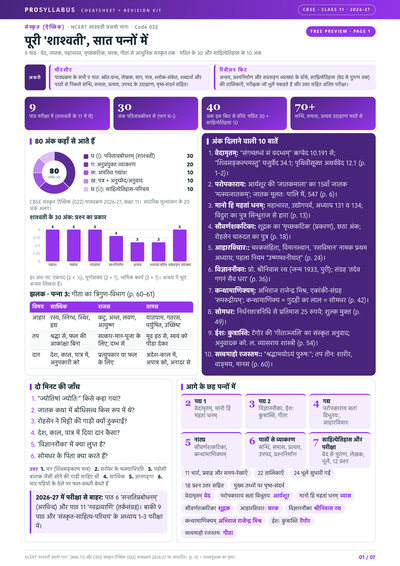
CBSE Class 11 kits Marks booster + cheatsheet: key concepts in 2 lines each, common traps 25 marks: Unit II, Ch 4–8 23 marks: Unit I, Ch 1–3 Common traps, corrected Conic table and standard values Graphs plotted from the book's own tables Page 1 free about 8 min read , Full kit about 55 min read ₹159
Read page 1 free Get the kit Get the kit One payment · instant PDF · ₹159 View details Marks booster + cheatsheet: key concepts in 2 lines each, common traps 23-mark block: Ch 1–4 17-mark block: Ch 5–7 Common traps, corrected 7 chapters: every solved-example result Every unit and dimension, listed Page 1 free about 8 min read , Full kit about 55 min read ₹159
Read page 1 free Get the kit Get the kit One payment · instant PDF · ₹159 View details Marks booster + cheatsheet: key concepts in 2 lines each, common traps 20-mark block: Ch 8–12 10-mark block: Oscillations and Waves Common traps, corrected 7 chapters: every solved-example result Sound, standing waves and beats covered Page 1 free about 8 min read , Full kit about 55 min read ₹159
Read page 1 free Get the kit Get the kit One payment · instant PDF · ₹159 View details Marks booster + cheatsheet: key concepts in 2 lines each, common traps 9 marks each: Atom and Thermodynamics Constants and formulas, with page numbers Common traps, corrected Periodic trends from the real data pH, buffers and solubility product Page 1 free about 8 min read , Full kit about 55 min read ₹159
Read page 1 free Get the kit Get the kit One payment · instant PDF · ₹159 View details Marks booster + cheatsheet: key concepts in 2 lines each, common traps 10 marks: Hydrocarbons Every reaction with reagent and condition Common traps that cost marks, listed IUPAC naming rules Oxidation-number rules and balancing Page 1 free about 8 min read , Full kit about 55 min read ₹159
Read page 1 free Get the kit Get the kit One payment · instant PDF · ₹159 View details Marks booster + cheatsheet: key concepts in 2 lines each, common traps 18 marks: Unit V, breathing to hormones 15 marks each: Units I and III Common traps, corrected Five kingdoms classification table Physiological numbers, with page numbers Page 1 free about 8 min read , Full kit about 55 min read ₹159
Read page 1 free Get the kit Get the kit One payment · instant PDF · ₹159 View details Marks booster + cheatsheet: key concepts in 2 lines each, common traps 44 marks: Unit 2, recording to depreciation Journal formats and special purpose books Traps from all seven chapters Bank reconciliation adjustments Depreciation formulas, book's worked figures Page 1 free about 8 min read , Full kit about 55 min read ₹159
Read page 1 free Get the kit Get the kit One payment · instant PDF · ₹159 View details Marks booster + cheatsheet: key concepts in 2 lines each 12 exam traps, listed Five calculations the paper keeps asking Each adjustment: one entry, two effects Both formats: trading and P&L, balance sheet Yogita illustration solved line by line Page 1 free about 8 min read , Full kit about 55 min read ₹159
Read page 1 free Get the kit Get the kit One payment · instant PDF · ₹159 View details Marks booster + cheatsheet: key concepts in 2 lines each, common traps 20 marks: finance and MSME units 20 marks: internal and international trade Five comparison tables, insurance to retail Case cues for each chapter Common traps, corrected Page 1 free about 8 min read , Full kit about 55 min read ₹159
Read page 1 free Get the kit Get the kit One payment · instant PDF · ₹159 View details Marks booster + cheatsheet: key concepts in 2 lines each, common traps 15 marks: Ch 1–4, data to diagrams 7 chapters: every formula, worked numbers Common mistakes, corrected Book exercise answers included Part C project route Page 1 free about 8 min read , Full kit about 55 min read ₹159
Read page 1 free Get the kit Get the kit One payment · instant PDF · ₹159 View details Marks booster + cheatsheet: key concepts in 2 lines each, common traps 14 marks: Production and Costs, Unit 6 8 marks: Market Equilibrium, Unit 7 Common traps, corrected PPF, TU–MU, MRS and cost table drawn Demand and supply schedules from the book Page 1 free about 8 min read , Full kit about 55 min read ₹159
Read page 1 free Get the kit Get the kit One payment · instant PDF · ₹159 View details Marks booster + cheatsheet: key concepts in 2 lines each, common traps 20 marks: Empires section 20 marks: Changing Cultural Traditions 15 marks: Paths to Modernisation, Japan 5 marks: map work on the book's maps Common traps, corrected Page 1 free about 8 min read , Full kit about 55 min read ₹159
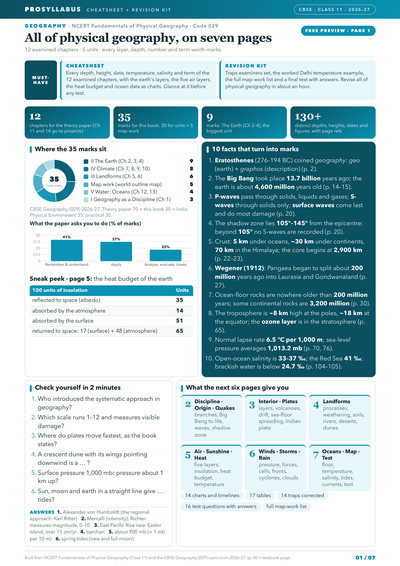
Read page 1 free Get the kit Get the kit One payment · instant PDF · ₹159 View details Marks booster + cheatsheet: key concepts in 2 lines each, common traps 8 marks: Climate unit, Ch 7–10 5 marks: map work, covered 4 marks: ocean data as charts, Unit V Heat budget and five air layers as charts Common traps, corrected Page 1 free about 8 min read , Full kit about 55 min read ₹159
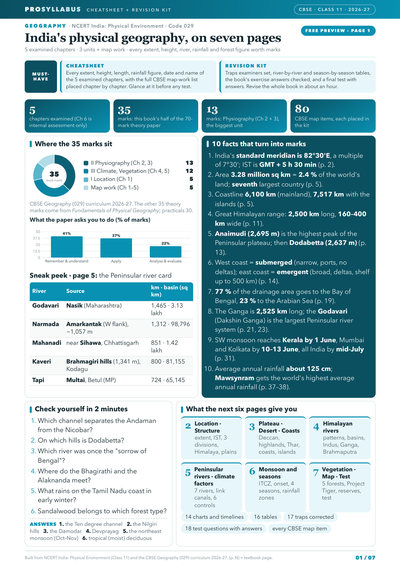
Read page 1 free Get the kit Get the kit One payment · instant PDF · ₹159 View details Marks booster + cheatsheet: key concepts in 2 lines each, common traps 12 marks: Climate, Vegetation (Unit III) Full CBSE map-work list, chapter by chapter Indus, Ganga, Brahmaputra river systems Monsoon mechanism, onset and four seasons Common traps, corrected Page 1 free about 8 min read , Full kit about 55 min read ₹159
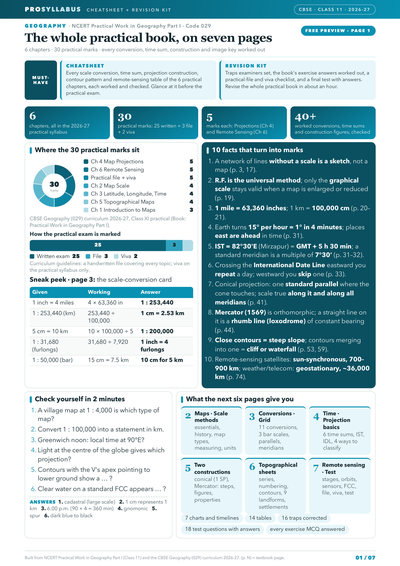
Read page 1 free Get the kit Get the kit One payment · instant PDF · ₹159 View details Marks booster + cheatsheet: key concepts in 2 lines each 4 marks: Map Scale, conversions worked 4 marks: Latitude, Longitude and Time 4 marks: Topographical Maps, contours 5 marks: practical file and viva Conical and Mercator's construction steps Page 1 free about 8 min read , Full kit about 55 min read ₹159
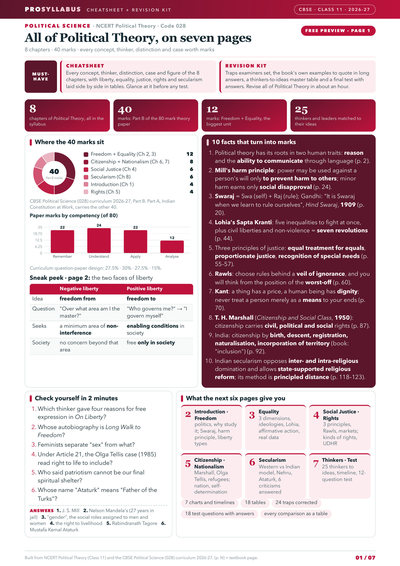
Read page 1 free Get the kit Get the kit One payment · instant PDF · ₹159 View details Marks booster + cheatsheet: key concepts in 2 lines each, common traps 8 marks together: Citizenship, Nationalism 6 marks each: Social Justice, Secularism 8 chapters: thinkers and a timeline Liberty, equality, justice side by side Common traps, corrected Page 1 free about 8 min read , Full kit about 55 min read ₹159
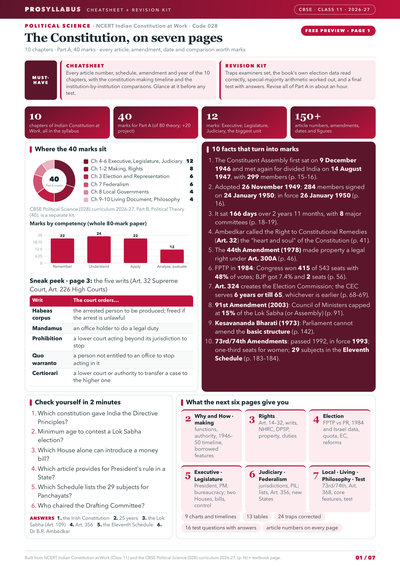
Read page 1 free Get the kit Get the kit One payment · instant PDF · ₹159 View details Marks booster + cheatsheet: key concepts in 2 lines each 12 marks: Executive to Judiciary Constitution-making timeline Institution-by-institution comparisons 6 marks: elections, FPTP, PR, reserved seats Fundamental Rights and Directive Principles Page 1 free about 8 min read , Full kit about 55 min read ₹159
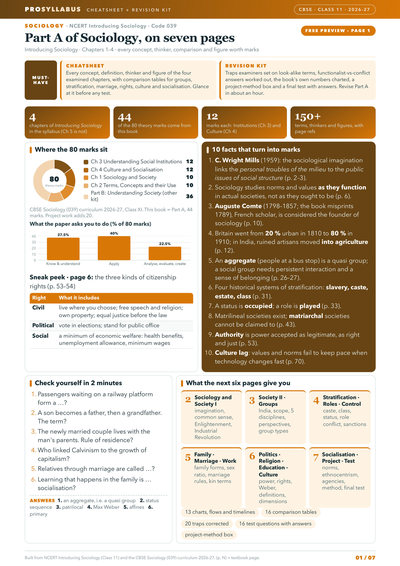
Read page 1 free Get the kit Get the kit One payment · instant PDF · ₹159 View details Marks booster + cheatsheet: key concepts in 2 lines each, common traps 10 marks each: Units 1 and 2 20 marks: project work, covered Tables: groups, stratification, marriage Every thinker and concept of Chapters 1–4 Common traps, corrected Page 1 free about 8 min read , Full kit about 55 min read ₹159
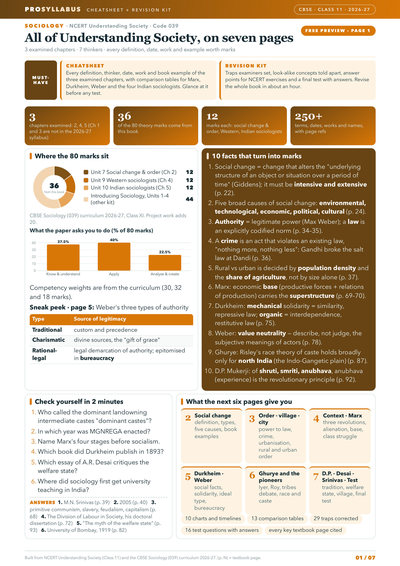
Read page 1 free Get the kit Get the kit One payment · instant PDF · ₹159 View details Marks booster + cheatsheet: key concepts in 2 lines each, common traps 12 marks each: Units 7, 9 and 10 7 thinkers: dates, works, examples Four Indian sociologists, in tables Ideal type, bureaucracy, division of labour Common traps, corrected Page 1 free about 8 min read , Full kit about 55 min read ₹159
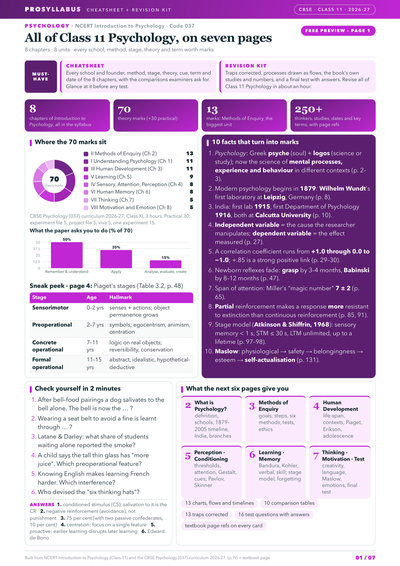
Read page 1 free Get the kit Get the kit One payment · instant PDF · ₹159 View details Marks booster + cheatsheet: key concepts in 2 lines each 11 marks each: Units I and III 9 marks: Learning, Unit V 8 marks each: Perception and Memory Every school with its founder Comparisons examiners ask for Page 1 free about 8 min read , Full kit about 55 min read ₹159
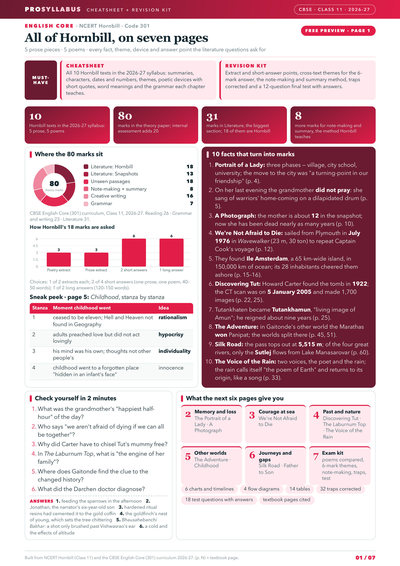
Read page 1 free Get the kit Get the kit One payment · instant PDF · ₹159 View details Marks booster + cheatsheet: key concepts in 2 lines each, common traps 8 marks: note-making and summary 5 poems compared, cross-text themes Common traps, corrected Poetic devices with short quotes Grammar each chapter teaches Page 1 free about 8 min read , Full kit about 55 min read ₹159
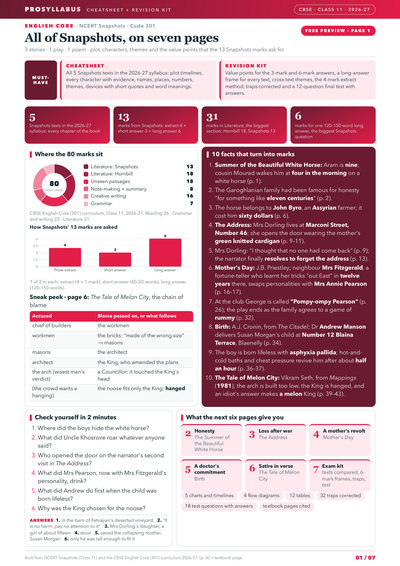
Read page 1 free Get the kit Get the kit One payment · instant PDF · ₹159 View details Marks booster + cheatsheet: key concepts in 2 lines each, common traps 4-, 3- and 6-mark answers: how to write them Plot timeline for every text Common traps, corrected Every character, with evidence Cross-text themes, side by side Page 1 free about 8 min read , Full kit about 55 min read ₹159
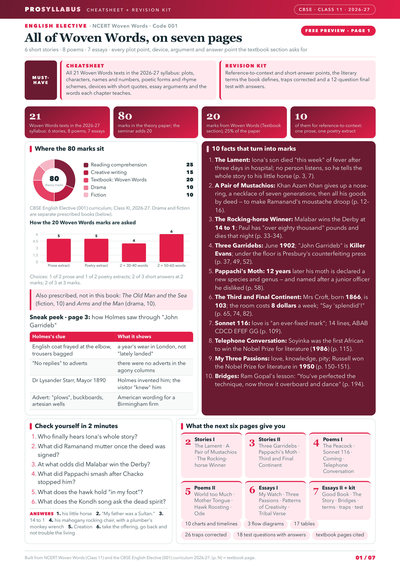
Read page 1 free Get the kit Get the kit One payment · instant PDF · ₹159 View details Marks booster + cheatsheet: key concepts in 2 lines each, common traps Poetic forms and rhyme schemes Devices with short quotes Common traps, corrected Essay arguments, essay by essay Words each chapter teaches Page 1 free about 8 min read , Full kit about 55 min read ₹159
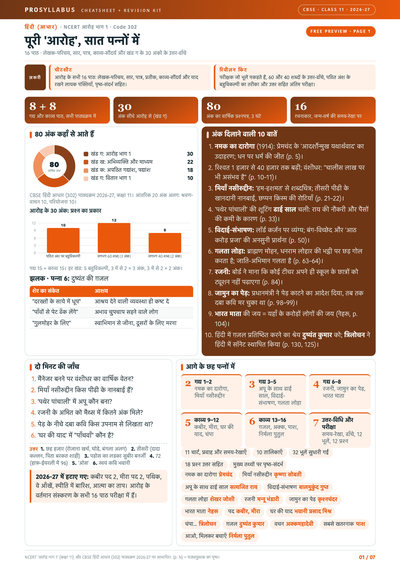
Read page 1 free Get the kit Get the kit One payment · instant PDF · ₹159 View details Marks booster + cheatsheet: key concepts in 2 lines each 16 writers placed on one timeline 60- and 40-word answer frames 8 काव्य पाठ: प्रतीक and काव्य-सौंदर्य Lines worth remembering, with page refs 12 common mistakes, corrected Page 1 free about 8 min read , Full kit about 55 min read ₹159
Read page 1 free Get the kit Get the kit One payment · instant PDF · ₹159 View details Marks booster + cheatsheet: key concepts in 2 lines each 10 marks (2 × 5): answer frames 5-mark answers in about 60 words 4 lessons: argument, events, characters Lines worth remembering, by page 12 common mistakes, corrected Page 1 free about 8 min read , Full kit about 55 min read ₹159
Read page 1 free Get the kit Get the kit One payment · instant PDF · ₹159 View details Marks booster + cheatsheet: key concepts in 2 lines each 16 writers placed on one timeline 40-word and व्याख्या answer frames 8 काव्य पाठ: प्रतीक, उपमान, काव्य-सौंदर्य Lines worth remembering, with page refs 12 common mistakes, corrected Page 1 free about 8 min read , Full kit about 55 min read ₹159
Read page 1 free Get the kit Get the kit One payment · instant PDF · ₹159 View details Marks booster + cheatsheet: key concepts in 2 lines each 5-mark, 100-word answer frames 9 exercise questions: आवारा मसीहा 7 exercise questions: हुसैन की कहानी Life events linked to the works 12 common mistakes, corrected Page 1 free about 8 min read , Full kit about 55 min read ₹159
Read page 1 free Get the kit Get the kit One payment · instant PDF · ₹159 View details Marks booster + cheatsheet: key concepts in 2 lines each 20 marks: grammar, from text words Sandhi, pratyaya and lakar examples Anvaya and bhavartha answer method Source text and author for every lesson 10 common errors, corrected Page 1 free about 8 min read , Full kit about 55 min read ₹159
Read page 1 free Get the kit Get the kit One payment · instant PDF · ₹159 View details Marks booster + cheatsheet: key concepts in 2 lines each 20 marks: grammar, भाग ग, from the text 10 marks: history of literature Sandhi, samasa, pratyaya, upapada examples Source text and author for every lesson Common errors, corrected Page 1 free about 8 min read , Full kit about 55 min read ₹159
Read page 1 free Get the kit Get the kit One payment · instant PDF · ₹159 View details Marks booster + cheatsheet: key concepts in 2 lines each Author, genre and characters per lesson Couplets explained: Insha and Fani ghazals Grammar for Section A Letter and advertisement formats 10 common mistakes, corrected Page 1 free about 8 min read , Full kit about 55 min read ₹159
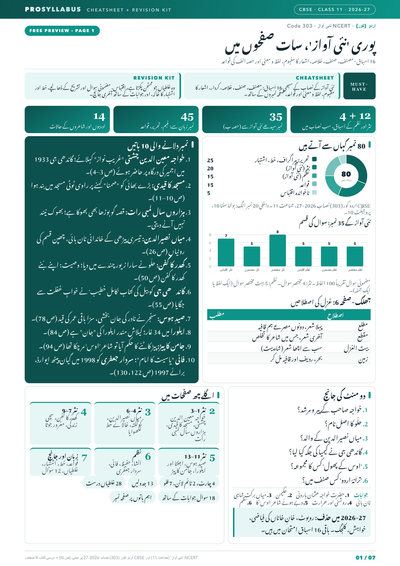
Read page 1 free Get the kit Get the kit One payment · instant PDF · ₹159 View details Marks booster + cheatsheet: key concepts in 2 lines each 38 marks: the answer frame 13 genres, each introduced 18 writers and poets: dates and works Literary devices (صنعتیں) and key words Common mistakes, corrected Page 1 free about 8 min read , Full kit about 55 min read ₹159
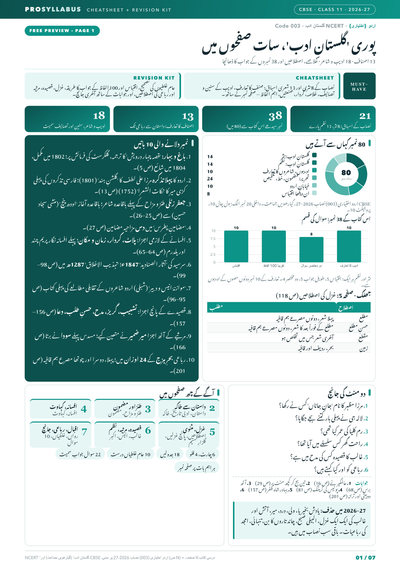
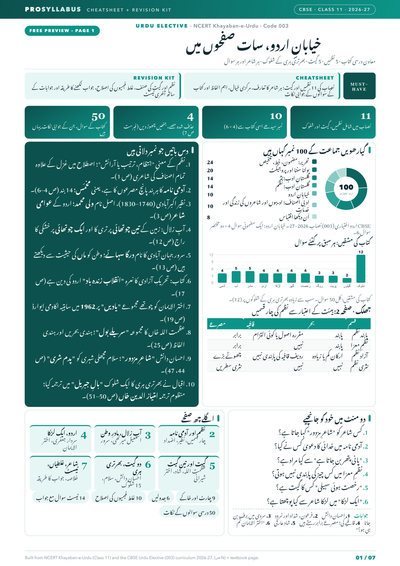
Read page 1 free Get the kit Get the kit One payment · instant PDF · ₹159 View details Marks booster + cheatsheet: key concepts in 2 lines each 10 marks: literary forms, covered 5 geets, each with its poet Nazm defined, with its four kinds Answer points for the book's questions Common mistakes, corrected Page 1 free about 8 min read , Full kit about 55 min read ₹159
Read page 1 free Get the kit Get the kit One payment · instant PDF · ₹159 View details Marks booster + cheatsheet: key concepts in 2 lines each, common traps 15 marks: Unit 3, society, law and ethics 10 marks: Unit 1, number-system conversions Common traps that cost marks, listed Truth tables for Boolean logic String, list and dictionary methods Page 1 free about 8 min read , Full kit about 55 min read ₹159
Read page 1 free Get the kit Get the kit One payment · instant PDF · ₹159 View details Marks booster + cheatsheet: key concepts in 2 lines each, common traps 25 marks: Python, lists, NumPy (Unit 2) 10 marks: Computer System (Unit 1) Common traps, corrected Every list and dictionary method, with output SQL queries re-run on the book's tables Page 1 free about 8 min read , Full kit about 55 min read ₹159
Read page 1 free Get the kit Get the kit One payment · instant PDF · ₹159 View details Marks booster + cheatsheet: key concepts in 2 lines each, common traps 23 marks: Unit II 15 marks: Unit III, health and hygiene Common traps, corrected Five food groups, RDA and the pyramid Nine fibres and the burning test Page 1 free about 8 min read , Full kit about 55 min read ₹159
Read page 1 free Get the kit Get the kit One payment · instant PDF · ₹159 View details Marks booster + cheatsheet: key concepts in 2 lines each 15 marks each: Childhood and Adulthood units RDAs and diet quantities by age Vaccine ages Budget steps and investment principles Stain-removal methods Page 1 free about 8 min read , Full kit about 55 min read ₹159
Read page 1 free Get the kit Get the kit One payment · instant PDF · ₹159 View details Marks booster + cheatsheet: key concepts in 2 lines each 15 marks each: the two theory units What to write when asked to appreciate Bharhut, Sanchi and the cave sites Temple architecture: how a temple is built Bronzes and Indo-Islamic buildings Page 1 free about 8 min read , Full kit about 55 min read ₹159
Read page 1 free Get the kit Get the kit One payment · instant PDF · ₹159 View details Marks booster + cheatsheet: key concepts in 2 lines each, common traps 20 marks each: Units II and III Enzyme kinetics and bioenergetics Common traps, corrected Mendel-to-operon genetics Tables and numbers, each with its page Page 1 free about 8 min read , Full kit about 55 min read ₹159
Read page 1 free Get the kit Get the kit One payment · instant PDF · ₹159 View details Marks booster + cheatsheet: key concepts in 2 lines each, common traps 15 marks: language and literature 14 marks: the nine darśanas Common traps, corrected 13 marks: astronomy in India 4 chapters, each with answer frames Page 1 free about 8 min read , Full kit about 55 min read ₹159
Read page 1 free Get the kit Get the kit One payment · instant PDF · ₹159 View details Marks booster + cheatsheet: key concepts in 2 lines each Frames for news, interview and review Inverted pyramid and the six ककार Play-writing frame Translation rules, with solved examples Common mistakes, corrected Page 1 free about 8 min read , Full kit about 55 min read ₹159
Read page 1 free Get the kit Get the kit One payment · instant PDF · ₹159 View details Marks booster + cheatsheet: key concepts in 2 lines each 50 marks: games and sports strand 25 marks: health and fitness strand Eight team games, side by side Fitness tests, norms and formulas Yoga asanas for wellness Page 1 free about 8 min read , Full kit about 55 min read ₹159
Read page 1 free Get the kit Get the kit One payment · instant PDF · ₹159 View details Marks booster + cheatsheet: key concepts in 2 lines each 22 श्रुतियाँ and 10 थाट, defined बिहाग, भीमपलासी, भैरवी with बंदिश notation तीनताल, एकताल, चौताल: ठाह, दुगुन, चौगुन तानसेन, भातखंडे, पलुस्कर profiled 12 common mistakes, corrected Page 1 free about 8 min read , Full kit about 55 min read ₹159
Read page 1 free Get the kit Get the kit One payment · instant PDF · ₹159 View details Marks booster + cheatsheet: key concepts in 2 lines each वादी-संवादी, पकड़ and बंदिश for each राग तीनताल, एकताल, चौताल: ठाह, दुगुन, चौगुन तानसेन, भातखंडे, पलुस्कर profiled Four classes of instruments, तानपुरा, सितार 12 common mistakes, corrected Page 1 free about 8 min read , Full kit about 55 min read ₹159
Read page 1 free Get the kit Get the kit One payment · instant PDF · ₹159 View details Marks booster + cheatsheet: key concepts in 2 lines each 6 marks each: all five units ठाह, दुगुन, तिगुन, चौगुन written out 14 artists with dates कुदऊ सिंह and नाना पानसे: two lives 14 common mistakes, corrected Page 1 free about 8 min read , Full kit about 55 min read ₹159
Read page 1 free Get the kit Get the kit One payment · instant PDF · ₹159 View details Get alerts for CBSE Class 11 Annual Assessment
Dates, results and cutoffs, by email when they are announced. Free.
Google, Apple, or a code to your phone or email. It is saved to your account.
This chapter is part of the CBSE Class 11 Annual Assessment Board Examination Explore every chapter — summary, notes, extra questions & MCQ quizzes Preparing for CBSE Class 11 Annual Assessment? Students also sit JEE is set on the Class 11 and 12 Physics, Chemistry and Maths syllabus; students prepare for boards and JEE together.
Tests are played signed in — sign in (free, 10 seconds) so your attempts, rank and XP are saved to you #1
Discovering Tut: the Saga Continues
Start here
#2
#3
Constitution: Why and How?
#4
#5
#6
#7
#8
Methods of Enquiry in Psychology
#9
#10
An Empire Across Three Continents
#11
#12
The Summer of the Beautiful White Horse
#13
#14
#15
We're Not Afraid to Die... if We Can All Be Together
#16
#17
Election and Representation
#18
Political Theory: An Introduction
#19
#20
Biological Classification
#21
Motion in a Straight Line
#22
Accountancy (Class 11) Practice Quiz | CBSE Class 11 Annual Assessment
#23
Sets and Venn Operations Fundamentals — Free CBSE Class 11 Annual Assessment Quiz
#24
#25
#26
#27
Rights in the Indian Constitution
#28
#29
#30
#31
#32
Changing Cultural Traditions
#33
#34
#35
#36
#37
Private, Public and Global Enterprises
#38
Depreciation, Provisions and Reserves
#39
Introduction to Accounting
#40
Cell Cycle and Cell Division
#41
#42
Anatomy of Flowering Plants
#43
Organic Chemistry – Some Basic Principles and Techniques
#44
#45
#46
#47
#48
#49
#50
#51
#52
#53
#54
#55
The Ailing Planet: the Green Movement's Role
#56
#57
#58
#59
Sensory, Attentional and Perceptual Processes
#60
#61
#62
Introducing Western Sociologists
#63
#64
Social Change and Social Order in Rural and Urban Society
#65
Social Structure, Stratification and Social Processes in Society
#66
Doing Sociology: Research Methods
#67
Culture and Socialisation
#68
Understanding Social Institutions
#69
Terms, Concepts and Their Use in Sociology
#70
#71
The Philosophy of the Constitution
#72
Constitution as a Living Document
#73
#74
#75
#76
#77
#78
#79
#80
#81
#82
Natural Hazards and Disasters
#83
#84
#85
#86
Structure and Physiography
#87
Biodiversity and Conservation
#88
#89
#90
World Climate and Climate Change
#91
Atmospheric Circulation and Weather Systems
#92
Solar Radiation, Heat Balance and Temperature
#93
Composition and Structure of Atmosphere
#94
Landforms and their Evolution
#95
#96
Distribution of Oceans and Continents
#97
#98
The Origin and Evolution of the Earth
#99
Geography as a Discipline
#100
Displacing Indigenous Peoples
#101
#102
Comparative Development Experiences of India and its Neighbours
#103
Environment and Sustainable Development
#104
Employment: Growth, Informalisation and Other Issues
#105
#106
Human Capital Formation in India
#107
Liberalisation, Privatisation and Globalisation: An Appraisal
#108
Indian Economy on the Eve of Independence
#109
#110
#111
#112
Measures of Central Tendency
#113
#114
#115
#116
#117
MSME and Business Entrepreneurship
#118
Sources of Business Finance
#119
#120
Social Responsibilities of Business and Business Ethics
#121
Emerging Modes of Business
#122
#123
Forms of Business Organisation
#124
Business, Trade and Commerce
#125
Financial Statements - II
#126
#127
Trial Balance and Rectification of Errors
#128
Bank Reconciliation Statement
#129
Recording of Transactions - II
#130
Recording of Transactions - I
#131
Theory Base of Accounting
#132
#133
#134
#135
Introduction to Three Dimensional Geometry
#136
#137
#138
#139
#140
Permutations and Combinations
#141
#142
Complex Numbers and Quadratic Equations
#143
#144
#145
Chemical Coordination and Integration
#146
Neural Control and Coordination
#147
#148
Excretory Products and their Elimination
#149
Body Fluids and Circulation
#150
Breathing and Exchange of Gases
#151
Plant Growth and Development
#152
#153
Photosynthesis in Higher Plants
#154
#155
Structural Organisation in Animals
#156
Morphology of Flowering Plants
#157
#158
#159
Chemical Bonding and Molecular Structure
#160
Classification of Elements and Periodicity in Properties
#161
Some Basic Concepts of Chemistry
#162
#163
#164
#165
#166
Thermal Properties of Matter
#167
Mechanical Properties of Fluids
#168
Mechanical Properties of Solids
#169
#170
Systems of Particles and Rotational Motion
#171
#172
#173
Business Studies (Class 11) Practice Quiz | CBSE Class 11 Annual Assessment
#174
Economics (Class 11) Practice Quiz | CBSE Class 11 Annual Assessment
#175
Humanities Subjects Practice Quiz | CBSE Class 11 Annual Assessment
#176
Motion in a Straight Line Practice Quiz | CBSE Class 11 Annual Assessment
#177
Thermodynamic Processes and Laws Advanced Challenge | CBSE Class 11 Annual Assessment
More on CBSE Class 11 Annual Assessment20 guides Tuples and Dictionaries – NCERT Class 11 Computer Science Chapter 10 – Tuple Operations and Dictionary Handling in Python Strings – NCERT Class 11 Computer Science Chapter 8 – String Operations, Traversal, and Methods in Python Getting Started with Python – NCERT Class 11 Computer Science Chapter 5 – Basics, Data Types, Operators, and Debugging Functions – NCERT Class 11 Computer Science Chapter 7 – Defining, Calling, and Understanding Functions in Python Complete Summary and Solutions for Emerging Trends – NCERT Class XI Informatics Practices, Chapter 2 – Explanation, Questions, Answers Mathematical Modelling – NCERT Class 11 Mathematics Appendix 2 – Concepts, Importance, and Applications in Real-world Problems Complete Summary and Solutions for Database Concepts – NCERT Class XI Informatics Practices, Chapter 7 – Explanation, Questions, Answers Encoding Schemes and Number System – NCERT Class 11 Computer Science Chapter 2 – ASCII, ISCII, UNICODE, Binary, Octal, Decimal, Hexadecimal Complete Summary and Solutions for Brief Overview of Python – NCERT Class XI Informatics Practices, Chapter 3 – Explanation, Questions, Answers Complete Summary and Solutions for Computer System – NCERT Class XI Informatics Practices, Chapter 1 – Explanation, Questions, Answers Introduction to Problem Solving – NCERT Class 11 Computer Science Chapter 4 – Algorithms, Flowcharts, Pseudocode, and Control Structures Flow of Control – NCERT Class 11 Computer Science Chapter 6 – Conditional and Looping Constructs in Python Alerts and Updates for CBSE Class 11 Annual Assessment Complete Summary and Solutions for Adventure Sports – Health and Physical Education Textbook for Class XI, Chapter 11 – Explanation, Questions, Answers Complete Summary and Solutions for Tournaments and Competitions – Health and Physical Education Textbook for Class XI, Chapter 10 – Explanation, Questions, Answers Complete Summary and Solutions for Measurement and Evaluation – Health and Physical Education Textbook for Class XI, Chapter 9 – Explanation, Questions, Answers Complete Summary and Solutions for Health Related Physical Fitness – Health and Physical Education Textbook for Class XI, Chapter 8 – Explanation, Questions, Answers Complete Summary and Solutions for Safety and Security – Health and Physical Education Textbook for Class XI, Chapter 7 – Explanation, Questions, Answers Complete Summary and Solutions for Yoga and Its Relevance in the Modern Times – Health and Physical Education Textbook for Class XI, Chapter 6 – Explanation, Questions, Answers Complete Summary and Solutions for Team Games – Health and Physical Education Textbook for Class XI, Chapter 5 – Explanation, Questions, Answers Notebook backup + AI Save your notes. Revise with AI. Learn more → Share this article