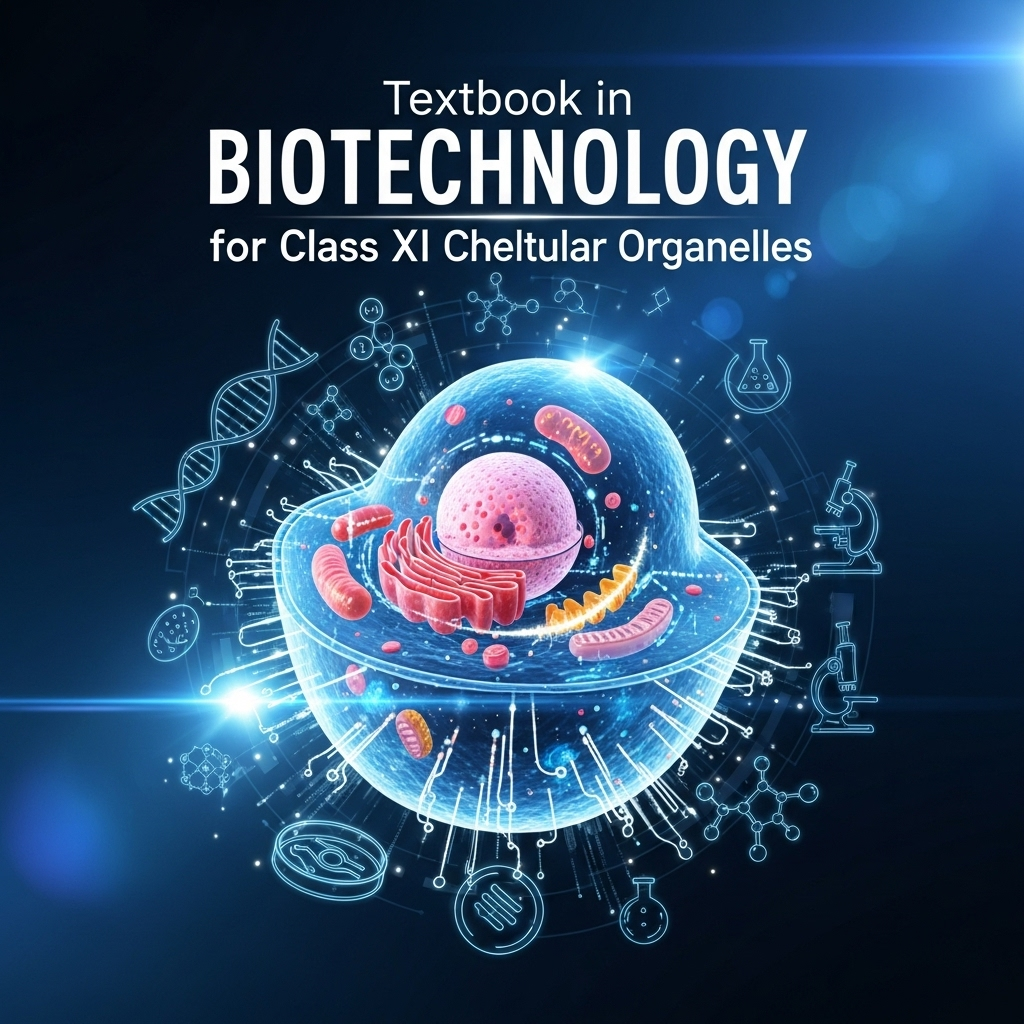
ProSyllabus Journal CBSE Class 11 Annual Assessment Complete Summary and Solutions for Cellular Organelles – NCERT Class XI Biotechnology, Chapter 2 – Structure, Functions, Mechanisms, Exercises Comprehensive summary and explanation of Chapter 2 'Cellular Organelles' from the NCERT Class XI Biotechnology textbook, covering structure, classification, functions, mechanisms of cellular transport, major organelles, and answers to all textbook questions.
Updated 1 year ago NCERT · Class XI · Biotechnology · Chapter 2 · Cellular Biology · Organelles · Structure · Function · Summary · Questions · Answers
#Cellular Organelles #NCERT #Class 11 #Biotechnology #Summary #Structure #Function #Mechanisms #Cell Theory #Organelles #Plasma Membrane #Nucleus #Mitochondria #Plastids #Ribosomes #Chapter 2 #Answers #Extra Questions
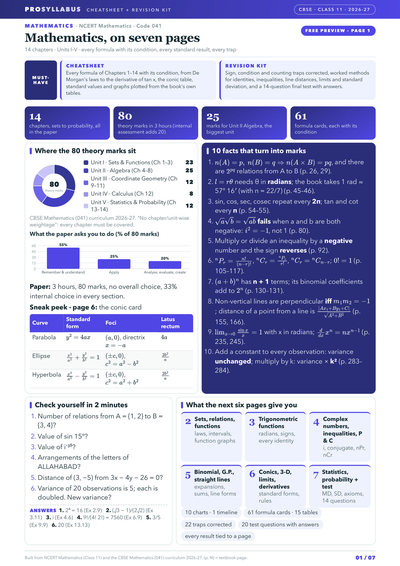
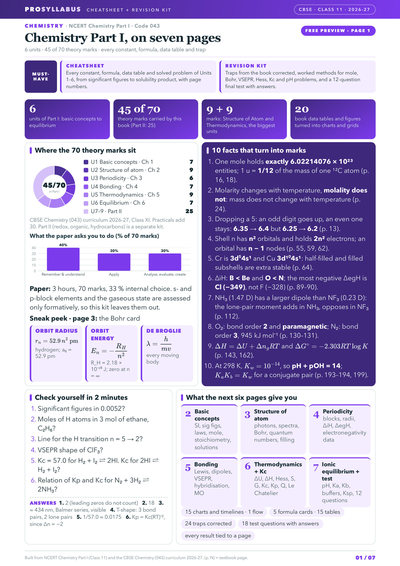
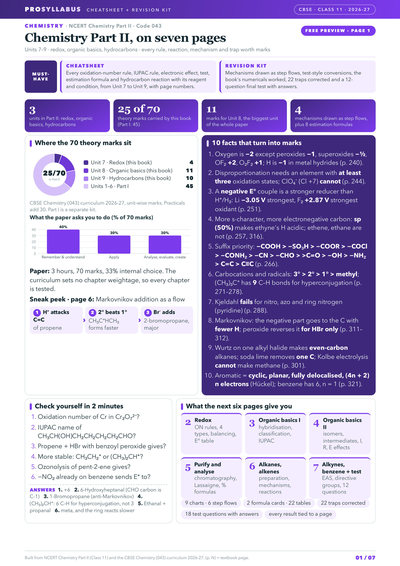
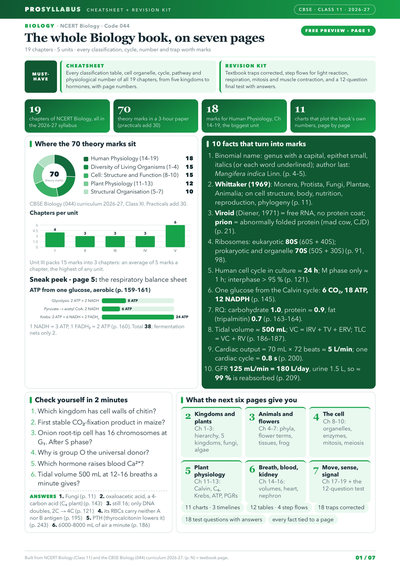
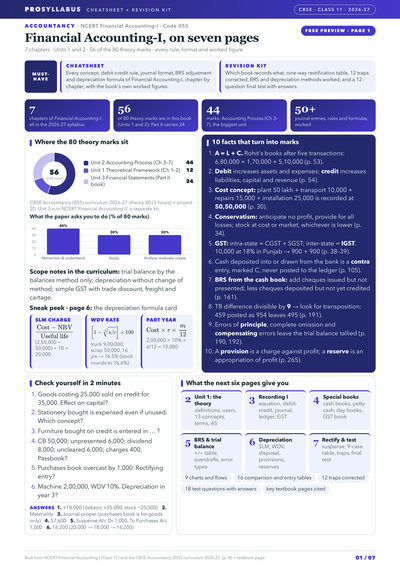
Marks booster + cheatsheet: key concepts in 2 lines each, common traps 25 marks: Unit II, Ch 4–8 23 marks: Unit I, Ch 1–3 Common traps, corrected Conic table and standard values Graphs plotted from the book's own tables Page 1 free about 8 min read , Full kit about 55 min read ₹159
Read page 1 free Get the kit Get the kit One payment · instant PDF · ₹159 View details
Cellular Organelles: Class 11 NCERT Chapter 2 - Ultimate Study Guide, Notes, Questions, Quiz 2025
Full Chapter Summary & Detailed Notes
Key Definitions & Terms
60+ Questions & Answers
Key Concepts
Historical Perspectives
Solved Examples
Interactive Quiz (10 Q)
Quick Revision Notes & Mnemonics
Key Terms & Processes
Key Processes & Diagrams
Full Chapter Summary & Detailed Notes - Cellular Organelles Class 11 NCERT
Overview & Key Concepts
Chapter Goal : Understand structure and functions of prokaryotic and eukaryotic cells, focusing on organelles. Exam Focus: Fluid mosaic model, transport mechanisms, cell wall differences, endomembrane system. 2025 Updates: Emphasis on dynamic nature of membranes, role in cellular processes. Fun Fact: Cells perform multitasking like digestion and protein synthesis simultaneously. Core Idea: Cells as basic units with specialized organelles. Real-World: Organelle dysfunction links to diseases like mitochondrial disorders. Ties: Builds on cell theory; leads to biomolecules (Ch3). Expanded: All subtopics covered point-wise with diagram descriptions for visual learning.Wider Scope : From prokaryotic simplicity to eukaryotic complexity; common components like plasma membrane.Expanded Content : Detailed on all 12 sections (2.1-2.12), including transport, walls, systems, powerhouses, factories, skeletons, motility, control centers.
2.1 Plasma Membrane
Structure & Function : Selective boundary of cytoplasm, guarded by extracellular matrix; maintains cell identity and relations with environment.Historical Insight : Chemical composition (lipids ~40%, proteins ~52% in RBCs) understood post-electron microscope; Edwin Gorter & F. Grendel (1925) proposed bilayer from RBC lipids covering surface twice.Fluid Mosaic Model (Singer & Nicolson, 1972) : Quasi-fluid lipid bilayer with embedded globular proteins; dynamic, allows lateral diffusion of lipids/proteins.Components : Phospholipids (hydrophilic heads outward, hydrophobic tails inward); cholesterol for fluidity; peripheral proteins (signaling, superficial); integral proteins (transmembrane channels, most abundant).Prokaryotic Similarity : Structurally akin to eukaryotic membranes.Special Structures : Mesosomes (extensions as vesicles/tubules/lamellae) increase surface area in prokaryotes.Dynamic Nature : Enables cell division, growth, secretion, endocytosis, intercellular communication.
Fig. 2.1: Schematic Diagram of Fluid Mosaic Model (Description)
Bilayer with hydrophilic heads outside/inside, hydrophobic tails in middle; embedded integral/peripheral proteins, cholesterol, glycoproteins/glycolipids on outer surface; shows channel proteins and quasifluid state.
Box 1: Gorter & Grendel Experiment (Description)
RBCs washed/extracted with acetone; lipids formed two-molecule layer covering cell surface; electron micrograph shows 'railroad track' (dense lines for heads, light for tails); proposed bilayer over monolayer.
Transport Across Membrane
Selective Permeability : Restricts movement, maintains composition.Passive Transport : No energy; diffusion/osmosis along gradient.Facilitated Transport : Carrier/channel proteins for ions/uncharged molecules (e.g., glucose transporter, aquaporins for water, ion-gated channels in muscle/nerve).Active Transport : Against gradient, uses ATP (e.g., Na+-K+ pump: 3 Na+ out, 2 K+ in, maintains -60mV potential).Coupled Transport : ATP-independent; symport (same direction, e.g., Na+/glucose), antiport (opposite, e.g., Na+/Ca2+), uniport (single, e.g., glucose facilitated).
Fig. 2.2: Membrane Transport (Description)
(a) Facilitated: Glucose enters via carrier protein. (b) Ion-gated channel: Closed/open pore with gate for ions.
Fig. 2.3: Na+-K+ Pump (Description)
Pump extrudes Na+, imports K+ using ATP; shows concentrations (high Na+ out, high K+ in) and membrane potential.
2.2 Cell Wall
Presence & Role : Surrounds plasma membrane in bacteria/algae/fungi/plants (absent in animals); provides rigidity, shape, osmotic protection, cell-cell interaction, mechanical strength against infection.Prokaryotic Structure : Peptidoglycan (polysaccharide cross-linked by peptides); Gram-positive: Thick wall + single membrane; Gram-negative: Thin wall + dual membrane with periplasmic space, LPS, porins.Growth & Antibiotics : Expands/divides with cell; antibiotics inhibit peptidoglycan cross-linking.Glycocalyx : Glycosylated protein layer; slime layer (loose) or capsule (thick); barrier to pathogens, cell interactions, stress protection.Eukaryotic Structure : Polysaccharides; plants: Cellulose (β-D-glucose β1→4 links); fungi: Chitin (N-acetylglucosamine β1→4 links).Plant Cell Wall Layers : Primary (thin, expandable); secondary (thick, lignified, rigid); middle lamella (calcium pectate) joins cells; plasmodesmata connect cytoplasms.
Fig. 2.4: Prokaryotic Cell Wall (Description)
(a) Gram-positive: Thick peptidoglycan, teichoic acid, single membrane. (b) Gram-negative: Thin peptidoglycan, outer membrane with LPS/porins, periplasm.
Fig. 2.5: Eukaryotic Cell Wall Components (Description)
(a) Cellulose: Linear β-D-glucose chains via β1→4 glycosidic bonds. (b) Chitin: Linear N-acetylglucosamine chains via β1→4 glycosidic bonds.
2.3 Endomembrane System
Overview : Coordinated membrane-bound organelles for protein/lipid synthesis, processing, packaging, transport; includes ER, Golgi, lysosomes, vacuoles.2.3.1 Endoplasmic Reticulum : Extensive tubules/cisternae network near nucleus/Golgi; eukaryotic only; large/dynamic.Types : Rough ER (ribosome-studded, protein synthesis); Smooth ER (lipid synthesis, detoxification).Functions : Protein folding/transport, Ca2+ storage, steroid synthesis.
Box 2: Endomembrane System Role (Description)
Flow: ER synthesis → Golgi processing/packaging → Lysosome/vacuole delivery; lipids/proteins modified en route.
2.4 Mitochondria
Structure : Double-membrane (outer smooth, inner cristae-folded); matrix with DNA/ribosomes; 'powerhouse'.Functions : ATP production via oxidative phosphorylation; Krebs cycle in matrix.Origin : Endosymbiotic from aerobic bacteria.
2.5 Plastids
Types : Chloroplasts (photosynthesis, thylakoids/stroma), chromoplasts (pigments), leucoplasts (storage).Functions : Light energy capture, pigment/color, starch/oil/protein storage.Plant-Specific : Semi-autonomous with DNA.
2.6 Ribosomes
Structure : Non-membrane, 70S prokaryotic/80S eukaryotic; rRNA + proteins.Functions : Protein synthesis sites; free (cytosol) or ER-bound.Universal : In all cells.
2.7 Microbodies
Types : Peroxisomes (H2O2 breakdown), glyoxysomes (fatty acid metabolism in seeds).Functions : Detoxification, photorespiration, lipid mobilization.Single-Membrane : Oxidative reactions.
2.8 Cytoskeleton
Components : Microtubules (tubulin, motility/spindle), microfilaments (actin, contraction), intermediate filaments (support).Functions : Shape maintenance, intracellular transport, cytokinesis, organelle positioning.Dynamic : Polymerize/depolymerize.
2.9 Cilia and Flagella
Structure : 9+2 microtubule arrangement; basal body (9 triplets).Functions : Motility (flagella few/long, cilia many/short); e.g., sperm flagella, respiratory cilia.Eukaryotic : Dynein-powered bending.
2.10 Centrosome and Centrioles
Structure : Centrosome with two centrioles (9 triplets microtubules); animal cells.Functions : Microtubule organizing center; spindle formation in division.Absent in Higher Plants : Alternative mechanisms.
2.11 Nucleus
Structure : Double membrane with pores; chromatin (DNA+proteins), nucleolus (rRNA).Functions : Genetic control, transcription, ribosome assembly.Eukaryotic Hallmark : Membrane-bound.
2.12 Chromosome
Structure : Condensed chromatin during division; histones, centromere/telomeres.Functions : Gene packaging, segregation in mitosis/meiosis.Number Varies : Hereditary material carrier.
Summary
Cells: Prokaryotic (simple, no nucleus) vs. Eukaryotic (complex, organelles); common: Plasma membrane, ribosomes.
Organelles: Specialized for energy, synthesis, support, control.
Why This Guide Stands Out
Cell-focused: Detailed subtopics, transport steps, wall comparisons. Free 2025 with point-wise notes, diagram desc for easy visualization.
Key Themes & Tips
Aspects : Structure-function link, prokaryote-eukaryote differences, dynamic processes.Tip: Mnemonics for organelles (e.g., 'PME-MPRC' for Plasma, Mitochondria, ER, etc.); draw fluid mosaic for recall.
Exam Case Studies
Mesosome role in prokaryotes: Surface increase for respiration. Aquaporins: Water channels prevent wilting in plants.
Project & Group Ideas
Model cell organelles with clay/3D print.
Debate: Cell wall necessity in plants vs. animals.
Research: Mitochondrial diseases and ATP defects.
Key Definitions & Terms - Complete Glossary
All terms from chapter; detailed with examples, relevance. Expanded: 20+ terms with depth for easy learning; grouped by subtopic.
Plasma Membrane
Semipermeable lipid bilayer boundary. Relevance: Cell identity. Ex: RBC 52% protein. Depth: Fluid mosaic; dynamic diffusion.
Fluid Mosaic Model
Dynamic bilayer with protein mosaic. Relevance: Membrane function. Ex: Singer-Nicolson 1972. Depth: Quasi-fluid, lateral movement.
Passive Transport
Gradient-driven, no energy movement. Relevance: Simple diffusion. Ex: Osmosis. Depth: Along concentration; no carriers needed.
Active Transport
Energy-requiring against gradient. Relevance: Ion balance. Ex: Na+-K+ pump. Depth: ATP hydrolysis; maintains potential.
Aquaporins
Water channel proteins. Relevance: Hydration. Ex: Plant/animal cells. Depth: Facilitated diffusion; critical for osmosis.
Cell Wall
Rigid outer layer for support. Relevance: Osmotic protection. Ex: Peptidoglycan in bacteria. Depth: Gram +/- differences.
Peptidoglycan
Cross-linked polysaccharide-peptide. Relevance: Bacterial rigidity. Ex: Antibiotic target. Depth: Inhibited by penicillin.
Glycocalyx
Glycosylated protein layer. Relevance: Pathogen barrier. Ex: Capsule in bacteria. Depth: Slime vs. capsule forms.
Cellulose
β1→4 glucose polymer. Relevance: Plant wall. Ex: Primary wall. Depth: Linear chains; expandable.
Chitin
N-acetylglucosamine polymer. Relevance: Fungal wall. Ex: Exoskeleton. Depth: β1→4 links; rigid.
Endomembrane System
Coordinated organelles for synthesis/transport. Relevance: Protein processing. Ex: ER-Golgi-lysosome. Depth: Membrane continuity.
Endoplasmic Reticulum (ER)
Tubule/cisternae network. Relevance: Synthesis. Ex: Rough ER proteins. Depth: RER ribosomes, SER lipids.
Mitochondria
Double-membrane ATP factory. Relevance: Energy. Ex: Cristae for ETC. Depth: Own DNA; endosymbiotic.
Plastids
Plant organelles for photosynthesis/storage. Relevance: Pigments. Ex: Chloroplast thylakoids. Depth: Chloroplast/chromoleucoplasts.
Ribosomes
Protein synthesis machinery. Relevance: Translation. Ex: 80S eukaryotic. Depth: Free/bound; universal.
Peroxisomes
Microbody for H2O2 detox. Relevance: Oxidation. Ex: Glyoxysomes in seeds. Depth: Single membrane.
Cytoskeleton
Protein network for shape/movement. Relevance: Support. Ex: Microtubules in spindle. Depth: Actin/tubulin/intermediate.
Cilia/Flagella
Motile 9+2 structures. Relevance: Locomotion. Ex: Sperm flagella. Depth: Dynein arms; basal body.
Centrioles
9-triplet MTOC. Relevance: Division. Ex: Spindle poles. Depth: Animal cells only.
Nucleus
Control center with DNA. Relevance: Heredity. Ex: Nuclear pores for mRNA. Depth: Double membrane, nucleolus.
Chromosome
Condensed chromatin. Relevance: Gene carrier. Ex: Mitosis segregation. Depth: Histone-packaged.
Tip: Group by prokary/eukary; examples for recall. Depth: Functions link to processes. Errors: Confuse RER/SER. Historical: Gorter 1925 bilayer. Interlinks: Biomolecules Ch3. Advanced: Endosymbiosis. Real-Life: Cilia defects in respiratory diseases. Graphs: Fig 2.1 model. Coherent: Structure → Function → Transport. For easy learning: Flashcard per term.
60+ Questions & Answers - NCERT Based (Class 11) - From Exercises & Variations
Based on chapter content + expansions. Part A: 10 (1 mark short, one line each), Part B: 10 (4 marks medium, five lines each), Part C: 10 (6 marks long, eight lines each). Answers point-wise, step-by-step for marks. Easy learning: Structured, concise.
Part A: 1 Mark Questions (10 Qs - Short from Content)
1. Who proposed the fluid mosaic model of plasma membrane?
1 Mark Answer: Singer and Nicolson in 1972.
2. What is the major lipid in plasma membrane?
1 Mark Answer: Phospholipids.
3. Name the transport requiring ATP against gradient.
1 Mark Answer: Active transport.
4. What is the bacterial cell wall component?
1 Mark Answer: Peptidoglycan.
5. Differentiate Gram-positive and Gram-negative walls.
1 Mark Answer: Gram-positive thick peptidoglycan; Gram-negative thin with outer membrane.
6. What is the plant cell wall polymer?
1 Mark Answer: Cellulose.
7. Name the endomembrane system components.
1 Mark Answer: ER, Golgi, lysosomes, vacuoles.
8. What is the function of mitochondria?
1 Mark Answer: ATP production.
9. What is the 9+2 structure in?
1 Mark Answer: Cilia and flagella.
10. What organizes spindle in animal cells?
1 Mark Answer: Centrioles.
Part B: 4 Marks Questions (10 Qs - Medium, Exactly 5 Lines Each)
1. Describe the fluid mosaic model.
4 Marks Answer:
Proposed by Singer and Nicolson in 1972.
Lipid bilayer with embedded proteins in mosaic pattern.
Quasifluid state allows lateral diffusion.
Phospholipids: Hydrophilic heads out, tails in.
Proteins: Peripheral (signaling), integral (channels).
2. Explain passive and facilitated transport.
4 Marks Answer:
Passive: No energy, along gradient via diffusion/osmosis.
Limited to small uncharged molecules.
Facilitated: Carrier/channel proteins for larger/charged (e.g., glucose).
Aquaporins: Water-specific channels.
Ion channels: Gated in muscle/nerve.
3. Describe Na+-K+ pump mechanism.
4 Marks Answer:
Active transport using ATP.
Pumps 3 Na+ out, 2 K+ in against gradient.
Maintains -60mV potential.
High Na+ outside, high K+ inside.
Essential for nerve/muscle function.
4. Differentiate prokaryotic cell walls.
4 Marks Answer:
Gram-positive: Thick peptidoglycan, teichoic acid, single membrane.
Gram-negative: Thin peptidoglycan, periplasm, outer LPS membrane.
Porins in outer for nutrient entry.
Antibiotics target cross-linking.
Glycocalyx: Capsule/slime for protection.
5. Explain plant cell wall layers.
4 Marks Answer:
Primary: Thin, cellulose for expansion.
Secondary: Thick, lignified for rigidity.
Middle lamella: Calcium pectate joins cells.
Plasmodesmata: Cytoplasmic connections.
Prevents bursting from osmosis.
6. Describe endomembrane system.
4 Marks Answer:
ER, Golgi, lysosomes, vacuoles coordinated.
Protein/lipid synthesis to transport.
Membrane continuity for modification.
RER: Ribosome-bound protein synthesis.
SER: Lipid/detox functions.
7. Outline mitochondria structure.
4 Marks Answer:
Double membrane: Outer smooth, inner cristae.
Matrix: Enzymes, mtDNA, 70S ribosomes.
Site of Krebs/ETC.
Endosymbiotic origin.
Autonomous replication.
8. What are plastids? Give types.
4 Marks Answer:
Plant double-membrane organelles.
Chloroplasts: Photosynthesis, thylakoids.
Chromoplasts: Pigments for color.
Leucoplasts: Storage (amyloplasts starch).
Interconvertible.
9. Explain cytoskeleton components.
4 Marks Answer:
Microtubules: Tubulin, spindle/transport.
Microfilaments: Actin, contraction/cytokinesis.
Intermediate: Keratin, mechanical strength.
Dynamic assembly.
Maintains shape, motility.
10. Describe nucleus functions.
4 Marks Answer:
Double membrane with pores.
Chromatin: DNA+histones for genes.
Nucleolus: rRNA/ribosome assembly.
Transcription site.
Controls cellular activities.
Part C: 6 Marks Questions (10 Qs - Long, Exactly 8 Lines Each)
1. Explain plasma membrane structure and transport.
6 Marks Answer:
Fluid mosaic: Bilayer phospholipids, proteins mosaic.
Heads hydrophilic out, tails hydrophobic in.
Cholesterol fluidity; peripheral/integral proteins.
Passive: Diffusion/osmosis no energy.
Facilitated: Carriers for glucose/aquaporins water.
Active: ATP for Na+-K+ pump, maintains ions.
Coupled: Symport/antiport/uniport.
Dynamic for division/secretion/endocytosis.
2. Compare prokaryotic and eukaryotic cell walls.
6 Marks Answer:
Prokaryotic: Peptidoglycan rigid; Gram+ thick single membrane.
Gram- thin dual membrane, LPS periplasm.
Glycocalyx capsule protection.
Eukaryotic: Polysaccharides; plants cellulose primary/secondary.
Fungi chitin; middle lamella pectate.
Plasmodesmata connections in plants.
Functions: Shape, osmosis, infection barrier.
Antibiotics target bacterial cross-links.
3. Describe endomembrane system and ER.
6 Marks Answer:
ER/Golgi/lysosomes/vacuoles for synthesis/transport.
Membrane-bound, co-ordinated functions.
ER: Tubules/cisternae near nucleus.
RER: Ribosomes protein synthesis/folding.
SER: Lipids, detox, Ca2+ storage.
Dynamic eukaryotic structure.
Protein modification en route to Golgi.
Essential for secretion/packaging.
4. Elaborate on mitochondria and plastids.
6 Marks Answer:
Mitochondria: Double membrane, cristae for ETC.
Matrix Krebs, ATP powerhouse.
mtDNA semi-autonomous.
Plastids: Plant-specific, double membrane.
Chloroplasts: Thylakoids photosynthesis.
Chromoplasts pigments, leucoplasts storage.
Interconvert; own DNA.
Endosymbiotic origins both.
5. Discuss ribosomes and microbodies.
6 Marks Answer:
Ribosomes: Non-membrane, 70S/80S protein factories.
Free cytosol, bound RER.
rRNA+proteins; universal.
Microbodies: Single membrane peroxisomes.
H2O2 catalase breakdown.
Glyoxysomes: Seed lipid to carbs.
Oxidative reactions.
Detox/photorespiration roles.
6. Explain cytoskeleton functions.
6 Marks Answer:
Microtubules: Tubulin tracks for transport/spindle.
Microfilaments: Actin cytokinesis/amoeboid movement.
Intermediate: Tensile strength.
Dynamic polymerization.
Organelle positioning.
Cell shape maintenance.
Motility in non-ciliated cells.
Essential for division.
7. Describe cilia/flagella and centrosome.
6 Marks Answer:
9+2 microtubules, dynein bending.
Flagella: Long, propulsion (sperm).
Cilia: Short, sweeping (trachea).
Basal body anchors.
Centrosome: Two centrioles MTOC.
9 triplets tubulin.
Spindle in animal mitosis.
Absent in plants.
8. Outline nucleus and chromosome.
6 Marks Answer:
Double envelope, pores for exchange.
Chromatin loose, nucleolus rRNA.
Transcription/ribosome assembly.
Genetic control center.
Chromosome: Condensed chromatin division.
Histone coils, centromere kinetochore.
Telomeres ends.
Segregation in mitosis.
9. Compare prokaryotic and eukaryotic cells.
6 Marks Answer:
Prokaryotic: No nucleus, 70S ribosomes, mesosomes.
Flagella simple, peptidoglycan wall.
Eukaryotic: Nucleus, 80S ribosomes, organelles.
Membrane-bound mito/plastids.
Cilia 9+2, cytoskeleton complex.
Common: Plasma membrane, DNA.
Evo: Prokaryotes simpler, ancestors.
Functions adapted complexity.
10. Discuss organelle roles in cellular processes.
6 Marks Answer:
Plasma: Barrier/transport.
Wall: Support/protection.
Endomembrane: Synthesis/packaging.
Mito/plastids: Energy.
Ribosomes: Proteins.
Cytoskeleton: Movement/shape.
Cilia: Motility.
Nucleus/chromosomes: Control/inheritance.
Tip: Use diagrams/transport examples for marks; practice point-wise. Easy learning: Short for recall, long for essays.
Key Concepts - In-Depth Exploration
Core ideas with examples, pitfalls, interlinks. Expanded: All concepts from 2.1-2.12 with steps/examples/steps for easy learning.
Fluid Mosaic Model
Dynamic membrane. Steps: 1. Bilayer formation, 2. Protein embed, 3. Diffusion. Ex: RBC proteins 52%. Pitfall: Static view. Interlink: Transport. Depth: Gorter bilayer basis; cholesterol modulation.
Membrane Transport
Movement mechanisms. Steps: Passive (gradient), Facilitated (proteins), Active (ATP). Ex: Aquaporins water. Pitfall: Confuse uniport/symport. Interlink: Bioenergetics Ch4. Depth: Na+-K+ maintains potential; coupled for efficiency.
Cell Wall Differences
Support structures. Steps: Prok peptidoglycan cross-link, Euk polysaccharide deposit. Ex: Gram staining. Pitfall: Ignore glycocalyx. Interlink: Cellular processes Ch5. Depth: Plasmodesmata communication; lignin rigidity.
Endomembrane System
Synthesis-transport network. Steps: ER synthesis → Golgi modify → Lysosome digest. Ex: Protein glycosylation. Pitfall: Overlook continuity. Interlink: Biomolecules Ch3. Depth: RER/SER specializations; vacuole storage.
Mitochondria & Plastids
Energy organelles. Steps: Mito ETC/ATP, Plastid light reactions. Ex: Chloroplast thylakoids. Pitfall: Forget endosymbiosis. Interlink: Enzymes Ch4. Depth: Own genome; interconversion in plants.
Ribosomes & Microbodies
Synthesis/detox sites. Steps: Ribosome translation, Peroxisome H2O2 catalase. Ex: Glyoxysomes gluconeogenesis. Pitfall: Non-membrane confusion. Interlink: Protein synth. Depth: 70S/80S; beta-oxidation.
Cytoskeleton
Internal framework. Steps: Polymerize (tubulin/actin), depolymerize for change. Ex: Spindle mitosis. Pitfall: Static skeleton. Interlink: Division Ch5. Depth: Motor proteins kinesin/dynein transport.
Cilia/Flagella & Centrosome
Motility/control. Steps: Dynein slide microtubules 9+2. Ex: Ciliary beating. Pitfall: Prok/euk flagella diff. Interlink: Reproduction. Depth: Basal body = centriole; plant alternatives.
Nucleus & Chromosome
Genetic center. Steps: Transcription in nucleoplasm, condensation to chromosomes. Ex: Nucleolus ribosomes. Pitfall: Chromatin vs. chromosome. Interlink: Genetics. Depth: Pores mRNA export; histone acetylation.
Prok vs. Euk Cells
Organization types. Steps: Prok nucleoid/mesosomes, Euk compartments. Ex: 70S vs. 80S. Pitfall: Overlap ignore. Interlink: Evolution. Depth: Endosymbiosis for organelles; complexity increase.
Advanced: Vesicle trafficking. Pitfalls: Membrane fluidity role. Interlinks: Ch1 cell theory. Real: Cystic fibrosis CFTR channel defect. Depth: 9+2 axoneme. Examples: Mesosome respiration. Graphs: Fig 2.3 pump. Errors: Wall in animals. Tips: Steps for transport; compare tables.
Historical Perspectives - Detailed Guide
Timeline of cell organelle discoveries; expanded with points for easy learning; links to microscopy advances.
Early Microscopy (17th C)
Hooke 1665: Cells in cork. Leeuwenhoek 1674: Animalcules. Prok/euk distinction later. Depth: Basic cell view; no organelles.
19th C Cell Theory
Schleiden/Schwann 1838: All from cells. Virchow 1855: Omnis cellula. Membrane models begin. Depth: Foundation for organelle study.
20th C Advances
Gorter/Grendel 1925: Bilayer. Singer/Nicolson 1972: Fluid mosaic. Electron mic: Organelles detailed. Depth: EM reveals cristae, thylakoids.
Modern Insights
Endosymbiosis Margulis 1967: Mito/plastids. 9+2 cilia 1950s EM. Dynamic cytoskeleton 1980s. Depth: Molecular biology reveals functions.
Tip: Link to tools (EM for details). Depth: Pasteur spontaneous generation disproval aids cell study. Examples: Hooke 'cellulae'. Graphs: Timeline. Advanced: GFP tagging organelles. Easy: Chronological bullets.
Solved Examples - From Text with Simple Explanations
Expanded with more examples, steps for easy understanding; focus on key figures.
Example 1: Fluid Mosaic Model (Fig 2.1)
Simple Explanation: Membrane as fluid protein mosaic; allows movement.
Step 1: Phospholipid bilayer self-assembles.
Step 2: Proteins insert (integral span, peripheral attach).
Step 3: Glycoproteins for recognition.
Step 4: Cholesterol stabilizes fluidity.
Simple Way: Like a crowded dance floor, molecules slide.
Example 2: Na+-K+ Pump (Fig 2.3)
Simple Explanation: Ion balance for signals; uses energy.
Step 1: ATP binds, changes conformation.
Step 2: Releases 3 Na+ outside.
Step 3: Binds 2 K+ from outside.
Step 4: Hydrolyzes ATP, returns shape.
Simple Way: Door pumps out trash (Na+), lets in recyclables (K+).
Example 3: Gram-Negative Wall (Fig 2.4b)
Simple Explanation: Extra protection but antibiotic entry via porins.
Step 1: Thin peptidoglycan core.
Step 2: Periplasm enzymes.
Step 3: Outer LPS/endotoxin.
Step 4: Porins selective pores.
Simple Way: Double fence with gate (porins).
Example 4: Plant Wall Layers
Simple Explanation: Builds strength as cell matures.
Step 1: Primary thin for growth.
Step 2: Secondary lignified rigid.
Step 3: Middle lamella glues neighbors.
Step 4: Plasmodesmata channels.
Simple Way: Flexible skin to armor plating.
Example 5: ER Functions
Simple Explanation: Cell's workshop for proteins/lipids.
Step 1: RER ribosomes translate.
Step 2: Fold in lumen.
Step 3: Vesicles to Golgi.
Step 4: SER detoxifies drugs.
Simple Way: Assembly line to shipping.
Tip: Practice labeling diagrams; link steps to functions.
Interactive Quiz - Master Cellular Organelles
10 MCQs in full sentences; 80%+ goal. Covers membrane, walls, organelles. Questions phrased as complete sentences for clarity.
Start Quiz
Quick Revision Notes & Mnemonics
Concise notes for all subtopics 2.1-2.12; mnemonics for easy recall. Covers structures, functions, differences.
2.1 Plasma Membrane
Fluid mosaic: Bilayer + proteins (Mnemonic: "Phospho-Lipid Protein Party" - PLPP). Transport: Passive/Facilitated/Active ( "PFA Energy None/Some/Full" - PFA). Na-K pump: 3 out 2 in ATP.
2.2 Cell Wall
Prok: Peptido Gram+/- ( "Pepto Thick/Thin Dual" - PTD). Euk: Cellulose/Chitin Plant/Fungus ( "Cell Chit Green/Mushroom" - CCG). Layers: Primary/Secondary Lamella ( "PSL Grow Rigid Glue" - PSL).
2.3 Endomembrane
ER/Golgi/Lys/Vac ( "EGLV Synth Pack Digest Store" - EGLV). RER: Ribosomes proteins; SER: Smooth lipids ( "Rough Smooth Protein Lipid" - RSPL).
2.4 Mitochondria
Double Cristae Matrix ATP ( "DCMA Powerhouse" - DCMA). mtDNA endosymbiotic.
2.5 Plastids
Chloro/Chromo/Leuco Photo/Color/Store ( "CCL Green Pigment Starch" - CCL). Thylakoids stroma.
2.6 Ribosomes
70S/80S Free/Bound Translate ( "70 Free Prok, 80 Bound Euk" - 70F80B).
2.7 Microbodies
Peroxisome H2O2; Glyoxy Seed Fat ( "PH GSF Detox" - PHGSF).
2.8 Cytoskeleton
MicroTub/Actin/Inter Spindle/Contract/Support ( "TAI Move Shape" - TAI).
2.9 Cilia/Flagella
9+2 Dynein Beat ( "9+2 DB Motile" - 9DB). Many short cilia, few long flagella.
2.10 Centrosome
Centrioles 9 triplets MTOC Spindle ( "9T MS Animal" - 9TMS).
2.11 Nucleus
Double Pores Chromatin Nucleolus ( "DPCN Control" - DPCN).
2.12 Chromosome
Condensed Histone Centromere Segregate ( "CHCS Divide" - CHCS).
Overall Mnemonic: "Plasma Wall Endo Mito Plast Ribo Micro Cyto Cilia Centro Nucle Chromo" (PWEMPRMMCNC). Flashcards: One per section. Easy: Bullets, bold functions.
Key Terms & Processes - All Key
Expanded table with more rows; comprehensive for quick reference.
Term/Process Description Example Usage
Fluid Mosaic Model Dynamic bilayer with proteins RBC membrane Structure Active Transport ATP against gradient Na+-K+ pump Ion balance Peptidoglycan Cross-linked wall polymer Bacterial rigidity Prok wall Glycocalyx Glyco-protein layer Capsule protection Barrier Cellulose β-glucose chains Plant primary wall Support Endomembrane System Coordinated organelles ER to Golgi Synthesis Rough ER Ribosome-studded tubules Protein folding RER function Mitochondria Double-membrane ATP site Cristae ETC Energy Chloroplast Thylakoid photosynthesis Stroma Calvin Light capture Ribosomes Protein synthesis 80S eukaryotic Translation Peroxisomes H2O2 breakdown Catalase Detox Microtubules Tubulin polymers Spindle fibers Cytoskeleton 9+2 Arrangement Microtubule motility Cilia beating Locomotion Centrioles MTOC in centrosome Mitotic spindle Division Nuclear Pores Envelope channels mRNA export Exchange Chromatin DNA-protein complex Gene expression Nucleus Mesosomes PM folds in prok Surface increase Respiration Plasmodesmata Cytoplasmic bridges Cell communication Plants Symport Coupled same direction Na+/glucose Transport Endosymbiosis Organelle origin Mito from bacteria Evolution
Tip: Examples aid memory; sort by function. Easy: Table scan for exams.
Key Processes & Diagrams - Solved Step-by-Step
Expanded with all major processes; descriptions for diagrams; steps for visualization.
Process 1: Membrane Transport (Figs 2.2-2.3)
Step-by-Step:
Step 1: Passive diffusion for small molecules.
Step 2: Facilitated via carriers (glucose) or channels (ions/water).
Step 3: Active ATP hydrolysis changes pump shape.
Step 4: Ions move against gradient.
Step 5: Coupled uses one gradient for another.
Diagram Desc: 2.2 Carrier pore; 2.3 Pump with ATP/ions.
Process 2: Cell Wall Formation (Fig 2.4-2.5)
Step-by-Step:
Step 1: Peptidoglycan synthesis/cross-link in prok.
Step 2: Gram- outer LPS assembly.
Step 3: Plant primary cellulose deposit.
Step 4: Secondary lignin for strength.
Step 5: Middle lamella secretion.
Diagram Desc: 2.4 Walls labeled; 2.5 Polysaccharide chains.
Process 3: Protein Synthesis in Endomembrane
Step-by-Step:
Step 1: RER ribosomes translate mRNA.
Step 2: Polypeptide enters lumen.
Step 3: Folding/glycosylation.
Step 4: Vesicle to Golgi.
Step 5: Packaging/lysosome delivery.
Diagram Desc: Flow from ER to plasma.
Process 4: ATP Production in Mitochondria
Step-by-Step:
Step 1: Glycolysis cytosol to pyruvate.
Step 2: Krebs matrix CO2/NADH.
Step 3: ETC cristae electrons/O2.
Step 4: Proton gradient ATP synthase.
Step 5: ATP export.
Diagram Desc: Inner fold cristae, matrix enzymes.
Process 5: Ciliary Movement
Step-by-Step:
Step 1: 9+2 doublets with dynein.
Step 2: ATP dynein walks on adjacent.
Step 3: Sliding bends axoneme.
Step 4: Power/recovery stroke.
Step 5: Fluid propulsion.
Diagram Desc: Cross-section 9+2, bending wave.
Tip: Draw processes; label diagrams. Easy: Numbered steps with simple analogies.
CBSE Class 11 kits Marks booster + cheatsheet: key concepts in 2 lines each, common traps 25 marks: Unit II, Ch 4–8 23 marks: Unit I, Ch 1–3 Common traps, corrected Conic table and standard values Graphs plotted from the book's own tables Page 1 free about 8 min read , Full kit about 55 min read ₹159
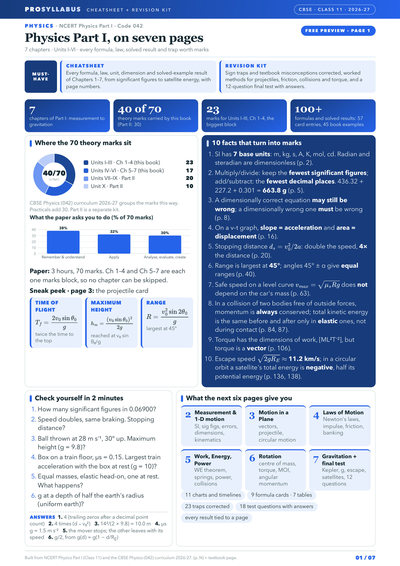
Read page 1 free Get the kit Get the kit One payment · instant PDF · ₹159 View details Marks booster + cheatsheet: key concepts in 2 lines each, common traps 23-mark block: Ch 1–4 17-mark block: Ch 5–7 Common traps, corrected 7 chapters: every solved-example result Every unit and dimension, listed Page 1 free about 8 min read , Full kit about 55 min read ₹159
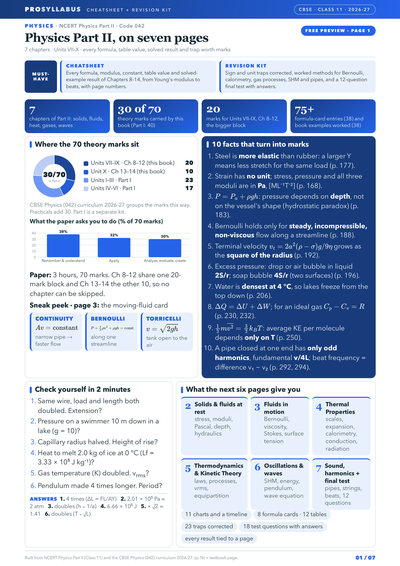
Read page 1 free Get the kit Get the kit One payment · instant PDF · ₹159 View details Marks booster + cheatsheet: key concepts in 2 lines each, common traps 20-mark block: Ch 8–12 10-mark block: Oscillations and Waves Common traps, corrected 7 chapters: every solved-example result Sound, standing waves and beats covered Page 1 free about 8 min read , Full kit about 55 min read ₹159
Read page 1 free Get the kit Get the kit One payment · instant PDF · ₹159 View details Marks booster + cheatsheet: key concepts in 2 lines each, common traps 9 marks each: Atom and Thermodynamics Constants and formulas, with page numbers Common traps, corrected Periodic trends from the real data pH, buffers and solubility product Page 1 free about 8 min read , Full kit about 55 min read ₹159
Read page 1 free Get the kit Get the kit One payment · instant PDF · ₹159 View details Marks booster + cheatsheet: key concepts in 2 lines each, common traps 10 marks: Hydrocarbons Every reaction with reagent and condition Common traps that cost marks, listed IUPAC naming rules Oxidation-number rules and balancing Page 1 free about 8 min read , Full kit about 55 min read ₹159
Read page 1 free Get the kit Get the kit One payment · instant PDF · ₹159 View details Marks booster + cheatsheet: key concepts in 2 lines each, common traps 18 marks: Unit V, breathing to hormones 15 marks each: Units I and III Common traps, corrected Five kingdoms classification table Physiological numbers, with page numbers Page 1 free about 8 min read , Full kit about 55 min read ₹159
Read page 1 free Get the kit Get the kit One payment · instant PDF · ₹159 View details Marks booster + cheatsheet: key concepts in 2 lines each, common traps 44 marks: Unit 2, recording to depreciation Journal formats and special purpose books Traps from all seven chapters Bank reconciliation adjustments Depreciation formulas, book's worked figures Page 1 free about 8 min read , Full kit about 55 min read ₹159
Read page 1 free Get the kit Get the kit One payment · instant PDF · ₹159 View details Marks booster + cheatsheet: key concepts in 2 lines each 12 exam traps, listed Five calculations the paper keeps asking Each adjustment: one entry, two effects Both formats: trading and P&L, balance sheet Yogita illustration solved line by line Page 1 free about 8 min read , Full kit about 55 min read ₹159
Read page 1 free Get the kit Get the kit One payment · instant PDF · ₹159 View details Marks booster + cheatsheet: key concepts in 2 lines each, common traps 20 marks: finance and MSME units 20 marks: internal and international trade Five comparison tables, insurance to retail Case cues for each chapter Common traps, corrected Page 1 free about 8 min read , Full kit about 55 min read ₹159
Read page 1 free Get the kit Get the kit One payment · instant PDF · ₹159 View details Marks booster + cheatsheet: key concepts in 2 lines each, common traps 15 marks: Ch 1–4, data to diagrams 7 chapters: every formula, worked numbers Common mistakes, corrected Book exercise answers included Part C project route Page 1 free about 8 min read , Full kit about 55 min read ₹159
Read page 1 free Get the kit Get the kit One payment · instant PDF · ₹159 View details Marks booster + cheatsheet: key concepts in 2 lines each, common traps 14 marks: Production and Costs, Unit 6 8 marks: Market Equilibrium, Unit 7 Common traps, corrected PPF, TU–MU, MRS and cost table drawn Demand and supply schedules from the book Page 1 free about 8 min read , Full kit about 55 min read ₹159
Read page 1 free Get the kit Get the kit One payment · instant PDF · ₹159 View details Marks booster + cheatsheet: key concepts in 2 lines each, common traps 20 marks: Empires section 20 marks: Changing Cultural Traditions 15 marks: Paths to Modernisation, Japan 5 marks: map work on the book's maps Common traps, corrected Page 1 free about 8 min read , Full kit about 55 min read ₹159
Read page 1 free Get the kit Get the kit One payment · instant PDF · ₹159 View details Marks booster + cheatsheet: key concepts in 2 lines each, common traps 8 marks: Climate unit, Ch 7–10 5 marks: map work, covered 4 marks: ocean data as charts, Unit V Heat budget and five air layers as charts Common traps, corrected Page 1 free about 8 min read , Full kit about 55 min read ₹159
Read page 1 free Get the kit Get the kit One payment · instant PDF · ₹159 View details Marks booster + cheatsheet: key concepts in 2 lines each, common traps 12 marks: Climate, Vegetation (Unit III) Full CBSE map-work list, chapter by chapter Indus, Ganga, Brahmaputra river systems Monsoon mechanism, onset and four seasons Common traps, corrected Page 1 free about 8 min read , Full kit about 55 min read ₹159
Read page 1 free Get the kit Get the kit One payment · instant PDF · ₹159 View details Marks booster + cheatsheet: key concepts in 2 lines each 4 marks: Map Scale, conversions worked 4 marks: Latitude, Longitude and Time 4 marks: Topographical Maps, contours 5 marks: practical file and viva Conical and Mercator's construction steps Page 1 free about 8 min read , Full kit about 55 min read ₹159
Read page 1 free Get the kit Get the kit One payment · instant PDF · ₹159 View details Marks booster + cheatsheet: key concepts in 2 lines each, common traps 8 marks together: Citizenship, Nationalism 6 marks each: Social Justice, Secularism 8 chapters: thinkers and a timeline Liberty, equality, justice side by side Common traps, corrected Page 1 free about 8 min read , Full kit about 55 min read ₹159
Read page 1 free Get the kit Get the kit One payment · instant PDF · ₹159 View details Marks booster + cheatsheet: key concepts in 2 lines each 12 marks: Executive to Judiciary Constitution-making timeline Institution-by-institution comparisons 6 marks: elections, FPTP, PR, reserved seats Fundamental Rights and Directive Principles Page 1 free about 8 min read , Full kit about 55 min read ₹159
Read page 1 free Get the kit Get the kit One payment · instant PDF · ₹159 View details Marks booster + cheatsheet: key concepts in 2 lines each, common traps 10 marks each: Units 1 and 2 20 marks: project work, covered Tables: groups, stratification, marriage Every thinker and concept of Chapters 1–4 Common traps, corrected Page 1 free about 8 min read , Full kit about 55 min read ₹159
Read page 1 free Get the kit Get the kit One payment · instant PDF · ₹159 View details Marks booster + cheatsheet: key concepts in 2 lines each, common traps 12 marks each: Units 7, 9 and 10 7 thinkers: dates, works, examples Four Indian sociologists, in tables Ideal type, bureaucracy, division of labour Common traps, corrected Page 1 free about 8 min read , Full kit about 55 min read ₹159
Read page 1 free Get the kit Get the kit One payment · instant PDF · ₹159 View details Marks booster + cheatsheet: key concepts in 2 lines each 11 marks each: Units I and III 9 marks: Learning, Unit V 8 marks each: Perception and Memory Every school with its founder Comparisons examiners ask for Page 1 free about 8 min read , Full kit about 55 min read ₹159
Read page 1 free Get the kit Get the kit One payment · instant PDF · ₹159 View details Marks booster + cheatsheet: key concepts in 2 lines each, common traps 8 marks: note-making and summary 5 poems compared, cross-text themes Common traps, corrected Poetic devices with short quotes Grammar each chapter teaches Page 1 free about 8 min read , Full kit about 55 min read ₹159
Read page 1 free Get the kit Get the kit One payment · instant PDF · ₹159 View details Marks booster + cheatsheet: key concepts in 2 lines each, common traps 4-, 3- and 6-mark answers: how to write them Plot timeline for every text Common traps, corrected Every character, with evidence Cross-text themes, side by side Page 1 free about 8 min read , Full kit about 55 min read ₹159
Read page 1 free Get the kit Get the kit One payment · instant PDF · ₹159 View details Marks booster + cheatsheet: key concepts in 2 lines each, common traps Poetic forms and rhyme schemes Devices with short quotes Common traps, corrected Essay arguments, essay by essay Words each chapter teaches Page 1 free about 8 min read , Full kit about 55 min read ₹159
Read page 1 free Get the kit Get the kit One payment · instant PDF · ₹159 View details Marks booster + cheatsheet: key concepts in 2 lines each 16 writers placed on one timeline 60- and 40-word answer frames 8 काव्य पाठ: प्रतीक and काव्य-सौंदर्य Lines worth remembering, with page refs 12 common mistakes, corrected Page 1 free about 8 min read , Full kit about 55 min read ₹159
Read page 1 free Get the kit Get the kit One payment · instant PDF · ₹159 View details Marks booster + cheatsheet: key concepts in 2 lines each 10 marks (2 × 5): answer frames 5-mark answers in about 60 words 4 lessons: argument, events, characters Lines worth remembering, by page 12 common mistakes, corrected Page 1 free about 8 min read , Full kit about 55 min read ₹159
Read page 1 free Get the kit Get the kit One payment · instant PDF · ₹159 View details Marks booster + cheatsheet: key concepts in 2 lines each 16 writers placed on one timeline 40-word and व्याख्या answer frames 8 काव्य पाठ: प्रतीक, उपमान, काव्य-सौंदर्य Lines worth remembering, with page refs 12 common mistakes, corrected Page 1 free about 8 min read , Full kit about 55 min read ₹159
Read page 1 free Get the kit Get the kit One payment · instant PDF · ₹159 View details Marks booster + cheatsheet: key concepts in 2 lines each 5-mark, 100-word answer frames 9 exercise questions: आवारा मसीहा 7 exercise questions: हुसैन की कहानी Life events linked to the works 12 common mistakes, corrected Page 1 free about 8 min read , Full kit about 55 min read ₹159
Read page 1 free Get the kit Get the kit One payment · instant PDF · ₹159 View details Marks booster + cheatsheet: key concepts in 2 lines each 20 marks: grammar, from text words Sandhi, pratyaya and lakar examples Anvaya and bhavartha answer method Source text and author for every lesson 10 common errors, corrected Page 1 free about 8 min read , Full kit about 55 min read ₹159
Read page 1 free Get the kit Get the kit One payment · instant PDF · ₹159 View details Marks booster + cheatsheet: key concepts in 2 lines each 20 marks: grammar, भाग ग, from the text 10 marks: history of literature Sandhi, samasa, pratyaya, upapada examples Source text and author for every lesson Common errors, corrected Page 1 free about 8 min read , Full kit about 55 min read ₹159
Read page 1 free Get the kit Get the kit One payment · instant PDF · ₹159 View details Marks booster + cheatsheet: key concepts in 2 lines each Author, genre and characters per lesson Couplets explained: Insha and Fani ghazals Grammar for Section A Letter and advertisement formats 10 common mistakes, corrected Page 1 free about 8 min read , Full kit about 55 min read ₹159
Read page 1 free Get the kit Get the kit One payment · instant PDF · ₹159 View details Marks booster + cheatsheet: key concepts in 2 lines each 38 marks: the answer frame 13 genres, each introduced 18 writers and poets: dates and works Literary devices (صنعتیں) and key words Common mistakes, corrected Page 1 free about 8 min read , Full kit about 55 min read ₹159
Read page 1 free Get the kit Get the kit One payment · instant PDF · ₹159 View details Marks booster + cheatsheet: key concepts in 2 lines each 10 marks: literary forms, covered 5 geets, each with its poet Nazm defined, with its four kinds Answer points for the book's questions Common mistakes, corrected Page 1 free about 8 min read , Full kit about 55 min read ₹159
Read page 1 free Get the kit Get the kit One payment · instant PDF · ₹159 View details Marks booster + cheatsheet: key concepts in 2 lines each, common traps 15 marks: Unit 3, society, law and ethics 10 marks: Unit 1, number-system conversions Common traps that cost marks, listed Truth tables for Boolean logic String, list and dictionary methods Page 1 free about 8 min read , Full kit about 55 min read ₹159
Read page 1 free Get the kit Get the kit One payment · instant PDF · ₹159 View details Marks booster + cheatsheet: key concepts in 2 lines each, common traps 25 marks: Python, lists, NumPy (Unit 2) 10 marks: Computer System (Unit 1) Common traps, corrected Every list and dictionary method, with output SQL queries re-run on the book's tables Page 1 free about 8 min read , Full kit about 55 min read ₹159
Read page 1 free Get the kit Get the kit One payment · instant PDF · ₹159 View details Marks booster + cheatsheet: key concepts in 2 lines each, common traps 23 marks: Unit II 15 marks: Unit III, health and hygiene Common traps, corrected Five food groups, RDA and the pyramid Nine fibres and the burning test Page 1 free about 8 min read , Full kit about 55 min read ₹159
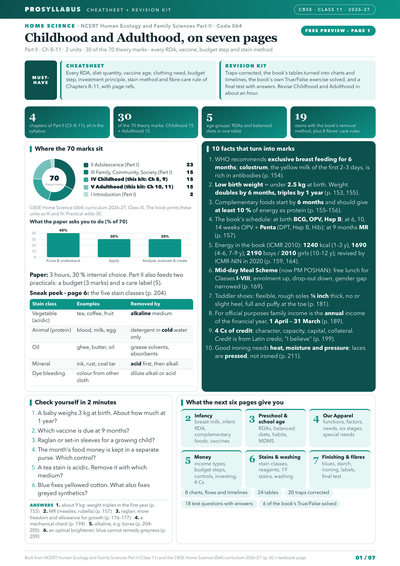
Read page 1 free Get the kit Get the kit One payment · instant PDF · ₹159 View details Marks booster + cheatsheet: key concepts in 2 lines each 15 marks each: Childhood and Adulthood units RDAs and diet quantities by age Vaccine ages Budget steps and investment principles Stain-removal methods Page 1 free about 8 min read , Full kit about 55 min read ₹159
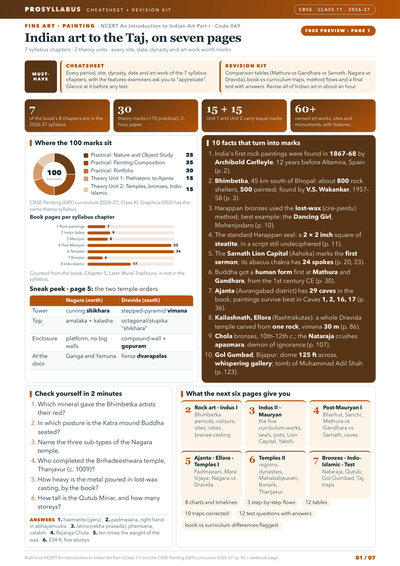
Read page 1 free Get the kit Get the kit One payment · instant PDF · ₹159 View details Marks booster + cheatsheet: key concepts in 2 lines each 15 marks each: the two theory units What to write when asked to appreciate Bharhut, Sanchi and the cave sites Temple architecture: how a temple is built Bronzes and Indo-Islamic buildings Page 1 free about 8 min read , Full kit about 55 min read ₹159
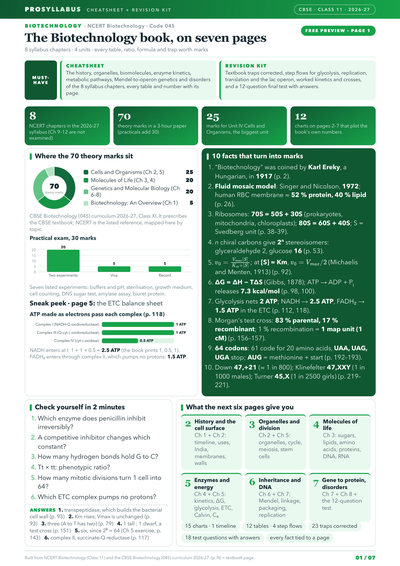
Read page 1 free Get the kit Get the kit One payment · instant PDF · ₹159 View details Marks booster + cheatsheet: key concepts in 2 lines each, common traps 20 marks each: Units II and III Enzyme kinetics and bioenergetics Common traps, corrected Mendel-to-operon genetics Tables and numbers, each with its page Page 1 free about 8 min read , Full kit about 55 min read ₹159
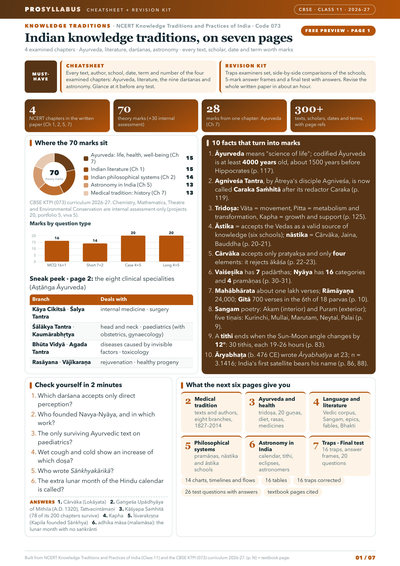
Read page 1 free Get the kit Get the kit One payment · instant PDF · ₹159 View details Marks booster + cheatsheet: key concepts in 2 lines each, common traps 15 marks: language and literature 14 marks: the nine darśanas Common traps, corrected 13 marks: astronomy in India 4 chapters, each with answer frames Page 1 free about 8 min read , Full kit about 55 min read ₹159
Read page 1 free Get the kit Get the kit One payment · instant PDF · ₹159 View details Marks booster + cheatsheet: key concepts in 2 lines each Frames for news, interview and review Inverted pyramid and the six ककार Play-writing frame Translation rules, with solved examples Common mistakes, corrected Page 1 free about 8 min read , Full kit about 55 min read ₹159
Read page 1 free Get the kit Get the kit One payment · instant PDF · ₹159 View details Marks booster + cheatsheet: key concepts in 2 lines each 50 marks: games and sports strand 25 marks: health and fitness strand Eight team games, side by side Fitness tests, norms and formulas Yoga asanas for wellness Page 1 free about 8 min read , Full kit about 55 min read ₹159
Read page 1 free Get the kit Get the kit One payment · instant PDF · ₹159 View details Marks booster + cheatsheet: key concepts in 2 lines each 22 श्रुतियाँ and 10 थाट, defined बिहाग, भीमपलासी, भैरवी with बंदिश notation तीनताल, एकताल, चौताल: ठाह, दुगुन, चौगुन तानसेन, भातखंडे, पलुस्कर profiled 12 common mistakes, corrected Page 1 free about 8 min read , Full kit about 55 min read ₹159
Read page 1 free Get the kit Get the kit One payment · instant PDF · ₹159 View details Marks booster + cheatsheet: key concepts in 2 lines each वादी-संवादी, पकड़ and बंदिश for each राग तीनताल, एकताल, चौताल: ठाह, दुगुन, चौगुन तानसेन, भातखंडे, पलुस्कर profiled Four classes of instruments, तानपुरा, सितार 12 common mistakes, corrected Page 1 free about 8 min read , Full kit about 55 min read ₹159
Read page 1 free Get the kit Get the kit One payment · instant PDF · ₹159 View details Marks booster + cheatsheet: key concepts in 2 lines each 6 marks each: all five units ठाह, दुगुन, तिगुन, चौगुन written out 14 artists with dates कुदऊ सिंह and नाना पानसे: two lives 14 common mistakes, corrected Page 1 free about 8 min read , Full kit about 55 min read ₹159
Read page 1 free Get the kit Get the kit One payment · instant PDF · ₹159 View details Get alerts for CBSE Class 11 Annual Assessment
Dates, results and cutoffs, by email when they are announced. Free.
Google, Apple, or a code to your phone or email. It is saved to your account.
This chapter is part of the CBSE Class 11 Annual Assessment Board Examination Explore every chapter — summary, notes, extra questions & MCQ quizzes Preparing for CBSE Class 11 Annual Assessment? Students also sit JEE is set on the Class 11 and 12 Physics, Chemistry and Maths syllabus; students prepare for boards and JEE together.
Tests are played signed in — sign in (free, 10 seconds) so your attempts, rank and XP are saved to you #1
Discovering Tut: the Saga Continues
Start here
#2
#3
Constitution: Why and How?
#4
#5
#6
#7
#8
Methods of Enquiry in Psychology
#9
#10
An Empire Across Three Continents
#11
#12
The Summer of the Beautiful White Horse
#13
#14
#15
We're Not Afraid to Die... if We Can All Be Together
#16
#17
Election and Representation
#18
Political Theory: An Introduction
#19
#20
Biological Classification
#21
Motion in a Straight Line
#22
Accountancy (Class 11) Practice Quiz | CBSE Class 11 Annual Assessment
#23
Sets and Venn Operations Fundamentals — Free CBSE Class 11 Annual Assessment Quiz
#24
#25
#26
#27
Rights in the Indian Constitution
#28
#29
#30
#31
#32
Changing Cultural Traditions
#33
#34
#35
#36
#37
Private, Public and Global Enterprises
#38
Depreciation, Provisions and Reserves
#39
Introduction to Accounting
#40
Cell Cycle and Cell Division
#41
#42
Anatomy of Flowering Plants
#43
Organic Chemistry – Some Basic Principles and Techniques
#44
#45
#46
#47
#48
#49
#50
#51
#52
#53
#54
#55
The Ailing Planet: the Green Movement's Role
#56
#57
#58
#59
Sensory, Attentional and Perceptual Processes
#60
#61
#62
Introducing Western Sociologists
#63
#64
Social Change and Social Order in Rural and Urban Society
#65
Social Structure, Stratification and Social Processes in Society
#66
Doing Sociology: Research Methods
#67
Culture and Socialisation
#68
Understanding Social Institutions
#69
Terms, Concepts and Their Use in Sociology
#70
#71
The Philosophy of the Constitution
#72
Constitution as a Living Document
#73
#74
#75
#76
#77
#78
#79
#80
#81
#82
Natural Hazards and Disasters
#83
#84
#85
#86
Structure and Physiography
#87
Biodiversity and Conservation
#88
#89
#90
World Climate and Climate Change
#91
Atmospheric Circulation and Weather Systems
#92
Solar Radiation, Heat Balance and Temperature
#93
Composition and Structure of Atmosphere
#94
Landforms and their Evolution
#95
#96
Distribution of Oceans and Continents
#97
#98
The Origin and Evolution of the Earth
#99
Geography as a Discipline
#100
Displacing Indigenous Peoples
#101
#102
Comparative Development Experiences of India and its Neighbours
#103
Environment and Sustainable Development
#104
Employment: Growth, Informalisation and Other Issues
#105
#106
Human Capital Formation in India
#107
Liberalisation, Privatisation and Globalisation: An Appraisal
#108
Indian Economy on the Eve of Independence
#109
#110
#111
#112
Measures of Central Tendency
#113
#114
#115
#116
#117
MSME and Business Entrepreneurship
#118
Sources of Business Finance
#119
#120
Social Responsibilities of Business and Business Ethics
#121
Emerging Modes of Business
#122
#123
Forms of Business Organisation
#124
Business, Trade and Commerce
#125
Financial Statements - II
#126
#127
Trial Balance and Rectification of Errors
#128
Bank Reconciliation Statement
#129
Recording of Transactions - II
#130
Recording of Transactions - I
#131
Theory Base of Accounting
#132
#133
#134
#135
Introduction to Three Dimensional Geometry
#136
#137
#138
#139
#140
Permutations and Combinations
#141
#142
Complex Numbers and Quadratic Equations
#143
#144
#145
Chemical Coordination and Integration
#146
Neural Control and Coordination
#147
#148
Excretory Products and their Elimination
#149
Body Fluids and Circulation
#150
Breathing and Exchange of Gases
#151
Plant Growth and Development
#152
#153
Photosynthesis in Higher Plants
#154
#155
Structural Organisation in Animals
#156
Morphology of Flowering Plants
#157
#158
#159
Chemical Bonding and Molecular Structure
#160
Classification of Elements and Periodicity in Properties
#161
Some Basic Concepts of Chemistry
#162
#163
#164
#165
#166
Thermal Properties of Matter
#167
Mechanical Properties of Fluids
#168
Mechanical Properties of Solids
#169
#170
Systems of Particles and Rotational Motion
#171
#172
#173
Business Studies (Class 11) Practice Quiz | CBSE Class 11 Annual Assessment
#174
Economics (Class 11) Practice Quiz | CBSE Class 11 Annual Assessment
#175
Humanities Subjects Practice Quiz | CBSE Class 11 Annual Assessment
#176
Motion in a Straight Line Practice Quiz | CBSE Class 11 Annual Assessment
#177
Thermodynamic Processes and Laws Advanced Challenge | CBSE Class 11 Annual Assessment
More on CBSE Class 11 Annual Assessment20 guides Tuples and Dictionaries – NCERT Class 11 Computer Science Chapter 10 – Tuple Operations and Dictionary Handling in Python Strings – NCERT Class 11 Computer Science Chapter 8 – String Operations, Traversal, and Methods in Python Getting Started with Python – NCERT Class 11 Computer Science Chapter 5 – Basics, Data Types, Operators, and Debugging Functions – NCERT Class 11 Computer Science Chapter 7 – Defining, Calling, and Understanding Functions in Python Complete Summary and Solutions for Emerging Trends – NCERT Class XI Informatics Practices, Chapter 2 – Explanation, Questions, Answers Mathematical Modelling – NCERT Class 11 Mathematics Appendix 2 – Concepts, Importance, and Applications in Real-world Problems Complete Summary and Solutions for Database Concepts – NCERT Class XI Informatics Practices, Chapter 7 – Explanation, Questions, Answers Encoding Schemes and Number System – NCERT Class 11 Computer Science Chapter 2 – ASCII, ISCII, UNICODE, Binary, Octal, Decimal, Hexadecimal Complete Summary and Solutions for Brief Overview of Python – NCERT Class XI Informatics Practices, Chapter 3 – Explanation, Questions, Answers Complete Summary and Solutions for Computer System – NCERT Class XI Informatics Practices, Chapter 1 – Explanation, Questions, Answers Introduction to Problem Solving – NCERT Class 11 Computer Science Chapter 4 – Algorithms, Flowcharts, Pseudocode, and Control Structures Flow of Control – NCERT Class 11 Computer Science Chapter 6 – Conditional and Looping Constructs in Python Alerts and Updates for CBSE Class 11 Annual Assessment Complete Summary and Solutions for Adventure Sports – Health and Physical Education Textbook for Class XI, Chapter 11 – Explanation, Questions, Answers Complete Summary and Solutions for Tournaments and Competitions – Health and Physical Education Textbook for Class XI, Chapter 10 – Explanation, Questions, Answers Complete Summary and Solutions for Measurement and Evaluation – Health and Physical Education Textbook for Class XI, Chapter 9 – Explanation, Questions, Answers Complete Summary and Solutions for Health Related Physical Fitness – Health and Physical Education Textbook for Class XI, Chapter 8 – Explanation, Questions, Answers Complete Summary and Solutions for Safety and Security – Health and Physical Education Textbook for Class XI, Chapter 7 – Explanation, Questions, Answers Complete Summary and Solutions for Yoga and Its Relevance in the Modern Times – Health and Physical Education Textbook for Class XI, Chapter 6 – Explanation, Questions, Answers Complete Summary and Solutions for Team Games – Health and Physical Education Textbook for Class XI, Chapter 5 – Explanation, Questions, Answers Notebook backup + AI Save your notes. Revise with AI. Learn more → Share this article