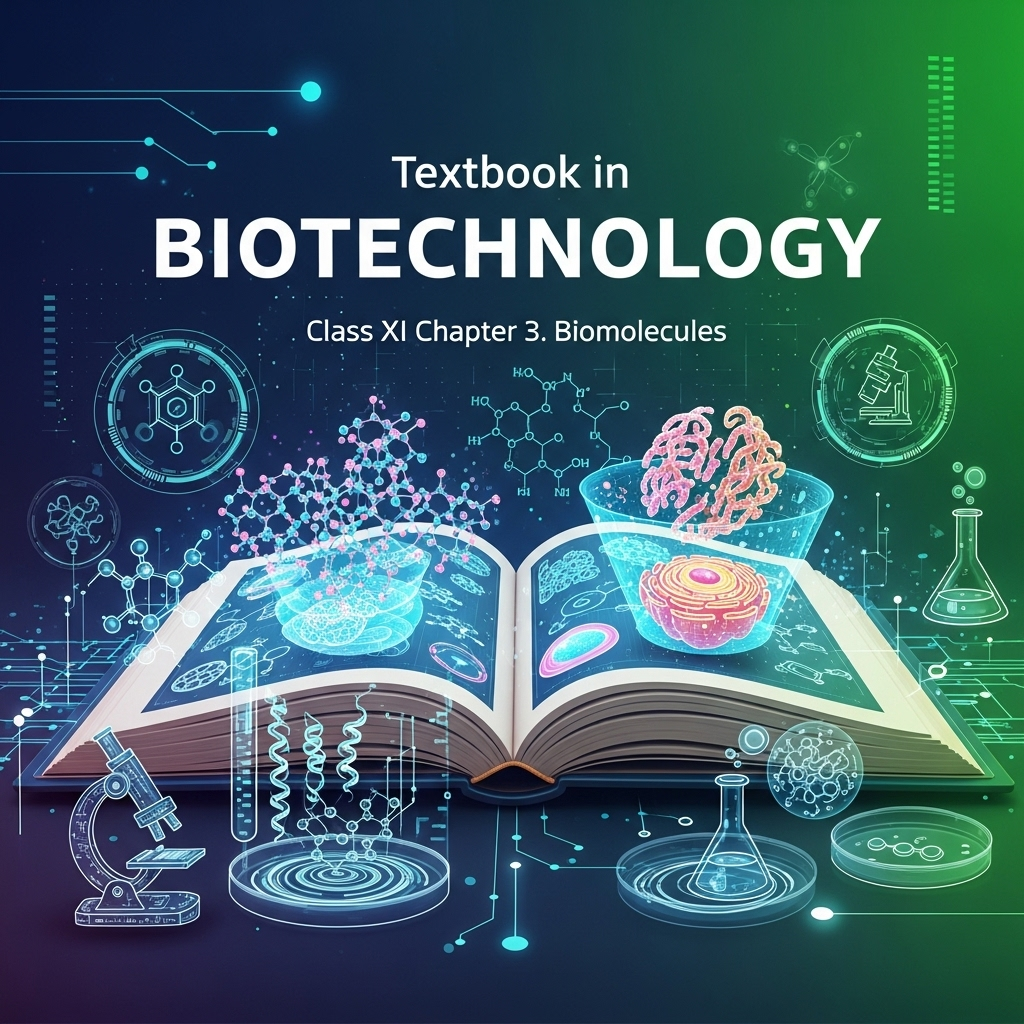
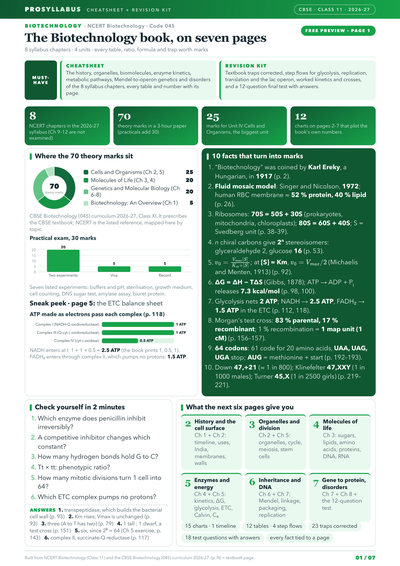
ProSyllabus Journal CBSE Class 11 Annual Assessment Complete Summary and Solutions for Biomolecules – NCERT Class XI Biotechnology, Chapter 3 – Types, Structure, Functions, Exercises Comprehensive summary and explanation of Chapter 3 'Biomolecules' from the NCERT Class XI Biotechnology textbook, covering carbohydrates, lipids, proteins, nucleic acids, their structure, classification, and answers to all textbook exercises and questions.
Updated 1 year ago NCERT · Class XI · Biotechnology · Chapter 3 · Biomolecules · Carbohydrates · Proteins · Lipids · Nucleic Acids · Structure · Function · Summary · Questions · Answers
#Biomolecules #NCERT #Class 11 #Biotechnology #Carbohydrates #Lipids #Proteins #Nucleic Acids #Structure #Classification #Functions #Summary #Chapter 3 #Answers #Extra Questions
Marks booster + cheatsheet: key concepts in 2 lines each, common traps 25 marks: Unit II, Ch 4–8 23 marks: Unit I, Ch 1–3 Common traps, corrected Conic table and standard values Graphs plotted from the book's own tables Page 1 free about 8 min read , Full kit about 55 min read ₹159
Read page 1 free Get the kit Get the kit One payment · instant PDF · ₹159 View details
Biomolecules: Class 11 NCERT Chapter 3 - Ultimate Study Guide, Notes, Questions, Quiz 2025
Full Chapter Summary & Detailed Notes
Key Definitions & Terms
60+ Questions & Answers
Key Concepts
Historical Perspectives
Solved Examples
Interactive Quiz (10 Q)
Quick Revision Notes & Mnemonics
Key Terms & Processes
Key Processes & Diagrams
Full Chapter Summary & Detailed Notes - Biomolecules Class 11 NCERT
Overview & Key Concepts
Chapter Goal : Explore structure and functions of major biomolecules: carbohydrates, lipids, proteins, nucleic acids as building blocks of cells and their roles in processes. Exam Focus: Classification, structures (e.g., glycosidic bonds, peptide bonds), properties (e.g., chirality, denaturation), enzymes. 2025 Updates: Emphasis on biomolecular interactions in health/disease. Fun Fact: DNA's double helix stores life's blueprint. Core Idea: Biomolecules as life's macromolecules. Real-World: Mutations in proteins cause diseases like sickle cell anemia. Ties: Links to cell organelles (Ch2); leads to enzymes (Ch4). Expanded: All subtopics 3.1-3.5 covered point-wise with diagram descriptions for visual learning; includes metabolic roles, conjugates.Wider Scope : From simple monomers to complex polymers; roles in energy, structure, information, catalysis.Expanded Content : Detailed on carbohydrates (classification, structures, polysaccharides like starch/cellulose), lipids (fatty acids, types, functions), amino acids (structure, classification), proteins (levels of structure, folding), nucleic acids (DNA/RNA, bases, replication basics).
3.1 Carbohydrates
Definition & Abundance : Aldehyde/ketone derivatives of polyhydric alcohols; most abundant biomolecules; primary energy source, stores, cell wall components, metabolic intermediates.Roles : Energy (glucose), storage (starch/glycogen), structure (cellulose/chitin), informational (glycoproteins for cell recognition).(A) Classification : Monosaccharides (simple, e.g., glucose), oligosaccharides (2-10 units, e.g., sucrose), polysaccharides (>10 units, e.g., starch).Monosaccharides : Cn(H2O)n; trioses (C3, glyceraldehyde), tetroses (C4, erythrose), pentoses (C5, ribose), hexoses (C6, glucose); aldoses (aldehyde) vs. ketoses (ketone) - see Table 3.1.Oligosaccharides : Glycosidic bonds join units; disaccharides like maltose (glucose-glucose α1→4), lactose (galactose-glucose β1→4), sucrose (glucose-fructose α1→β2).Polysaccharides : Homo (one type, e.g., starch) vs. hetero (mixed, e.g., peptidoglycan); storage (starch, glycogen) vs. structural (cellulose, chitin); glycoconjugates: glycoproteins (protein dominant), proteoglycans (carb dominant), glycolipids (lipid-carb).(B) Structure & Properties : Open-chain vs. cyclic (hemiacetal/ketal formation); chiral carbons cause optical activity (D/L based on C5 OH in hexoses); anomers (α/β at C1, mutarotation); epimers (differ at one C, e.g., glucose-mannose at C2).
Fig. 3.1: Structure of Some Monosaccharides (Description)
Open-chain forms: Glyceraldehyde (triose aldose), erythrose (tetrose aldose), ribose (pentose aldose), xylose (pentose aldose), glucose/galactose (hexose aldoses), fructose (hexose ketose); shows CHO/CH2OH ends, OH positions.
Fig. 3.2: Structure of Glucose (a) Straight Chain (b) Cyclic Form (Description)
(a) Linear: C1 aldehyde, C2-5 chiral with OH, C6 CH2OH. (b) Pyranose ring: C1-C5 cycle via O, α/β OH at C1; numbered carbons.
Fig. 3.3: L and D Forms of Glucose (Description)
D-Glucose: OH on C5 right; L-Glucose: left; Fischer projection with CHO top, CH2OH bottom.
Fig. 3.4: Two Cyclic Forms of Glucose (Description)
α-D-glucopyranose: OH below ring at C1; β-D-glucopyranose: above; shows mutarotation arrow to open chain.
Fig. 3.5: Epimers of Glucose (Description)
α-D-galactose (epimer at C4), α-D-glucose, α-D-mannose (epimer at C2); Haworth projections.
Fig. 3.6: Formation of Maltose (Description)
Two α-D-glucose → maltose via α1→4 glycosidic bond; condensation releases H2O.
Fig. 3.7: Structure of Lactose (Description)
β-D-galactopyranosyl-(1→4)-D-glucopyranose; β1→4 glycosidic bond highlighted.
Examples of Polysaccharides : Starch (amylose linear α1→4, amylopectin branched α1→6 every 24-30 units; blue/reddish iodine); glycogen (branched animal storage, 1-10% dry wt in muscle/liver); cellulose (β1→4 linear, 15,000 units, indigestible by humans); chitin (β1→4 N-acetylglucosamine, exoskeleton); peptidoglycan (NAM-NAG alternating, peptide cross-links in bacteria).
Fig. 3.8: Structure of Amylose (Description)
Linear chain of α-D-glucose with α1→4 bonds; reducing/non-reducing ends.
Fig. 3.9: Structure of Amylopectin (Description)
Branched: α1→4 main, α1→6 branches; shows repeating units.
Fig. 3.10: Structure of Cellulose (Description)
Linear β-D-glucose β1→4 bonds; reducing/non-reducing ends; H-bonds between chains.
Table 3.1: Classification of Monosaccharides (Description)
Trioses: Glyceraldehyde (aldose), dihydroxyacetone (ketose); tetroses: Erythrose/erythrulose; pentoses: Ribose/ribulose; hexoses: Glucose/fructose.
Table 3.2: Common Homopolysaccharides (Description)
Starch (α-D-glucose, plant energy); glycogen (α-D-glucose, animal storage); cellulose (β-D-glucose, plant wall); chitin (β-N-acetyl-D-glucosamine, exoskeleton); inulin (β-D-fructose, plant storage); pectin (α-D-galacturonic acid, plant wall); dextran (α-D-glucose, bacterial adhesive); xylan (β-D-xylose, plant support).
3.2 Fatty Acids and Lipids
Definition : Hydrophobic/ amphipathic; fatty acids: long hydrocarbon chains with COOH; saturated (no double bonds, e.g., palmitic C16:0) vs. unsaturated (double bonds, e.g., oleic C18:1).Classification : Simple (fats/oils: glycerol + 3 FA), compound (phospholipids, glycolipids), derived (steroids like cholesterol).Functions : Energy reserve (9 kcal/g), membrane components (phospholipids bilayer), hormones (steroids), insulation/cushioning.Properties : Insoluble in water, soluble in organic solvents; micelle formation; essential FA (e.g., linoleic) for health.Phospholipids : Glycerol + 2 FA + phosphate (e.g., lecithin); amphipathic for membranes.Steroids : Four fused rings; cholesterol stabilizes membranes, precursor for bile acids/hormones.
Fig. 3.11: Structure of a Fatty Acid (Description)
CH3-(CH2)n-COOH; saturated chain shown.
Fig. 3.12: Triglyceride Formation (Description)
Glycerol + 3 FA → triacylglycerol via ester bonds; H2O released.
3.3 Amino Acids
Structure : α-amino acids: H2N-CH(R)-COOH; 20 standard; R side chain determines properties (non-polar, polar, acidic, basic).Classification : Non-essential (body synthesizes, e.g., alanine), essential (dietary, e.g., lysine); based on R: hydrophobic (valine), hydrophilic (serine).Properties : Zwitterion at pI; peptide bond formation (condensation); chiral (L-form in proteins).Functions : Protein building, neurotransmitters (e.g., glycine), precursors (e.g., tyrosine for dopamine).
Table 3.3: Classification of Amino Acids (Description)
Non-polar: Glycine, alanine; polar: Serine, threonine; acidic: Aspartic, glutamic; basic: Lysine, arginine; aromatic: Phenylalanine, tyrosine.
Fig. 3.13: General Structure of Amino Acid (Description)
Central C with NH2, COOH, H, R; zwitterion form shown.
3.4 Protein Structure
Primary : Linear peptide chain; sequence determines function (e.g., sickle cell mutation).Secondary : α-helix (H-bonds every 3.6 residues), β-pleated sheet (parallel/antiparallel).Tertiary : 3D folding via H-bonds, ionic, hydrophobic, disulfide bridges; globular/fibrous.Quaternary : Multi-subunit (e.g., hemoglobin 4 chains).Denaturation : Loss of structure by heat/pH (reversible/irreversible).Functions : Enzymes (catalase), transport (hemoglobin), structure (collagen), defense (antibodies).
Fig. 3.14: Levels of Protein Structure (Description)
Primary: Sequence; secondary: Helix/sheet; tertiary: Fold; quaternary: Assembly.
3.5 Nucleic Acids
Components : Nucleotides: Base (purine/pyrimidine), sugar (ribose/DNA deoxyribose), phosphate.DNA : Double helix (A-T, G-C H-bonds), antiparallel, supercoiling; genetic material.RNA : Single strand, types: mRNA (messenger), tRNA (transfer), rRNA (ribosomal); U instead of T.Functions : Information storage (DNA), expression (RNA), protein synthesis.Properties : Phosphodiester bonds; Chargaff's rules (A=T, G=C).
Fig. 3.15: DNA Double Helix (Description)
Watson-Crick model: Twisted ladder, base pairs inside, sugar-phosphate backbone.
Fig. 3.16: Nucleotide Structure (Description)
Adenine-ribose-phosphate; glycosidic bond to base.
Summary
Biomolecules: Carbs (energy/structure), lipids (membranes/energy), proteins (catalysis/structure), nucleic acids (information).
Key: Monomers → polymers via bonds; chirality/optical activity; conjugates for diversity.
Why This Guide Stands Out
Biomolecule-focused: Detailed classifications, bond formations, diagram desc. Free 2025 with point-wise notes, examples for easy visualization; includes conjugates, metabolic links.
Key Themes & Tips
Aspects : Structure-function, classification, bonds (glycosidic/peptide/phosphodiester).Tip: Mnemonics for levels (Primary-Sequence, Secondary-Helix, Tertiary-Fold, Quaternary-Team - PSHFT); draw rings for carbs.
Exam Case Studies
Diabetes: Insulin protein defect. Scurvy: Collagen (vitamin C for hydroxylation). DNA fingerprinting: Base sequence uniqueness.
Project & Group Ideas
Model DNA helix with pipe cleaners.
Debate: Essential vs. non-essential amino acids in diet.
Research: Lipid rafts in signaling.
Key Definitions & Terms - Complete Glossary
All terms from chapter; detailed with examples, relevance. Expanded: 25+ terms with depth; grouped by subtopic for easy learning; includes bonds, chirality, conjugates.
Carbohydrate
Aldehyde/ketone polyol. Relevance: Energy. Ex: Glucose C6H12O6. Depth: Cn(H2O)n; most abundant biomolecule.
Monosaccharide
Simple sugar, non-hydrolyzable. Relevance: Building block. Ex: Ribose in RNA. Depth: Aldose/ketose; tri/pent/hex.
Glycosidic Bond
C-O-C link between sugars. Relevance: Polymer formation. Ex: α1→4 in starch. Depth: α/β anomeric config.
Anomer
α/β isomers at C1. Relevance: Mutarotation. Ex: α/β glucose. Depth: Cyclic forms interconvert in water.
Epimer
Differ at one chiral C. Relevance: Specificity. Ex: Galactose (C4 of glucose). Depth: Mannose C2 epimer.
Starch
Plant storage polysaccharide. Relevance: Energy reserve. Ex: Amylose/amylopectin. Depth: Iodine blue/reddish.
Cellulose
β1→4 glucose polymer. Relevance: Plant wall. Ex: Indigestible fiber. Depth: H-bonds for strength.
Chitin
N-acetylglucosamine polymer. Relevance: Exoskeleton. Ex: Insect shells. Depth: β1→4 links like cellulose.
Fatty Acid
Carboxyl long chain. Relevance: Lipid base. Ex: Palmitic saturated. Depth: Cis/trans unsaturation.
Phospholipid
Glycerol + 2 FA + phosphate. Relevance: Membrane. Ex: Lecithin. Depth: Amphipathic bilayer.
Amino Acid
H2N-CH(R)-COOH. Relevance: Protein monomer. Ex: Glycine (R=H). Depth: 20 standard, L-chiral.
Peptide Bond
Amide link between AA. Relevance: Polypeptide. Ex: Dipeptide. Depth: Condensation, planar.
Primary Structure
AA sequence. Relevance: Function basis. Ex: Insulin chain. Depth: Determines higher levels.
α-Helix
Secondary coiled structure. Relevance: Stability. Ex: Keratin. Depth: 3.6 res/turn, H-bonds.
Tertiary Structure
3D folding. Relevance: Active site. Ex: Myoglobin. Depth: Hydrophobic core, disulfide.
Nucleotide
Base + sugar + phosphate. Relevance: Nucleic acid. Ex: dATP. Depth: Phosphodiester backbone.
DNA
Deoxyribonucleic acid double helix. Relevance: Heredity. Ex: Chromosomes. Depth: A-T/G-C pairs.
RNA
Ribonucleic acid single strand. Relevance: Expression. Ex: mRNA. Depth: A-U/G-C, ribose sugar.
Glycoprotein
Protein + carb conjugate. Relevance: Recognition. Ex: ABO blood groups. Depth: Protein dominant.
Denaturation
Loss of 3D structure. Relevance: Cooking eggs. Ex: Heat/pH. Depth: Primary intact, function lost.
Zwitterion
AA dipolar form. Relevance: Solubility. Ex: At pI=7. Depth: NH3+/COO-.
Mutarotation
α/β interconversion. Relevance: Solution equilibrium. Ex: Glucose [α]D changes. Depth: Via open chain.
Peptidoglycan
Bacterial wall polymer. Relevance: Rigidity. Ex: Gram staining. Depth: NAM-NAG + peptides.
Tip: Group by biomolecule; examples for recall. Depth: Bonds link monomers. Errors: Confuse α/β. Historical: Fischer stereochemistry. Interlinks: Ch2 organelles made of these. Advanced: Prions misfolded proteins. Real-Life: Lactose intolerance (lactase deficiency). Graphs: Fig 3.1 structures. Coherent: Monomer → Polymer → Function. For easy learning: Flashcard per term with diagram sketch.
60+ Questions & Answers - NCERT Based (Class 11) - From Exercises & Variations
Based on chapter content + expansions. Part A: 10 (1 mark short, one line each), Part B: 10 (4 marks medium, five lines each), Part C: 10 (6 marks long, eight lines each). Answers point-wise, step-by-step for marks. Easy learning: Structured, concise; covers all sections.
Part A: 1 Mark Questions (10 Qs - Short from Content)
1. What is the general formula of monosaccharides?
1 Mark Answer: Cn(H2O)n.
2. Name the bond joining monosaccharides in maltose.
1 Mark Answer: α1→4 glycosidic bond.
3. What determines D or L configuration in sugars?
1 Mark Answer: Orientation of OH on the penultimate carbon.
4. Which polysaccharide gives blue color with iodine?
1 Mark Answer: Amylose in starch.
5. Name the storage lipid in animals.
1 Mark Answer: Triacylglycerol.
6. What is the R group in amino acids called?
1 Mark Answer: Side chain.
7. Which bond links amino acids?
1 Mark Answer: Peptide bond.
8. Name the secondary structure with 3.6 residues per turn.
1 Mark Answer: α-helix.
9. What pairs with adenine in DNA?
1 Mark Answer: Thymine.
10. What is a zwitterion?
1 Mark Answer: Dipolar form of amino acid.
Part B: 4 Marks Questions (10 Qs - Medium, Exactly 5 Lines Each)
1. Classify carbohydrates with examples.
4 Marks Answer:
Monosaccharides: Simple, e.g., glucose (hexose aldose).
Oligosaccharides: 2-10 units, e.g., sucrose (disaccharide).
Polysaccharides: >10 units, e.g., starch (storage).
Based on functional group: Aldoses (aldehyde), ketoses (ketone).
Carbon atoms: Triose (C3), pentose (C5), hexose (C6).
2. Explain D and L configuration in sugars.
4 Marks Answer:
Based on OH at penultimate C (C5 in hexose).
D: OH right in Fischer projection.
L: OH left; biological sugars mostly D.
Chiral carbons cause optical activity.
Enantiomers: Mirror images, e.g., D/L-glucose.
3. Describe structure of starch.
4 Marks Answer:
Amylose: 15-20%, linear α1→4 glucose.
Amylopectin: 80-85%, branched α1→6 every 24-30.
Storage in plants (tubers/seeds).
Iodine: Amylose blue, amylopectin reddish.
Hydrolyzed by amylase to glucose.
4. Differentiate saturated and unsaturated fatty acids.
4 Marks Answer:
Saturated: No double bonds, straight chain, solid (e.g., butter).
Unsaturated: Double bonds, kinked, liquid (e.g., oil).
Notation: C16:0 palmitic saturated.
Health: Unsaturated reduce cholesterol.
Essential: Omega-3/6 unsaturated.
5. Explain amino acid classification based on R group.
4 Marks Answer:
Non-polar: Hydrophobic, e.g., alanine (aliphatic).
Polar uncharged: Hydrophilic, e.g., serine (OH).
Acidic: Negative, e.g., aspartic (COOH).
Basic: Positive, e.g., lysine (NH2).
Aromatic: Ring, e.g., phenylalanine.
6. Describe primary and secondary protein structure.
4 Marks Answer:
Primary: Linear AA sequence via peptide bonds.
Determines all higher structures.
Secondary: Local folding, H-bonds.
α-helix: Coiled, 3.6 res/turn.
β-sheet: Pleated, parallel/antiparallel.
7. Outline tertiary and quaternary structure.
4 Marks Answer:
Tertiary: 3D globular fold, hydrophobic interactions.
Disulfide bridges stabilize.
Quaternary: Multi-subunit assembly.
E.g., Hemoglobin 4 chains.
Active sites formed at interfaces.
8. What are nucleic acids? Differentiate DNA and RNA.
4 Marks Answer:
Nucleic acids: Polymers of nucleotides.
DNA: Deoxyribose, double helix, T base, hereditary.
RNA: Ribose, single strand, U base, functional.
Purine: A/G; pyrimidine: C/T/U.
DNA in nucleus, RNA in cytoplasm.
9. Explain mutarotation in glucose.
4 Marks Answer:
Interconversion α/β anomers in solution.
Via open-chain intermediate.
[α]D changes from +112° (α) to +52.7° equilibrium.
Anomeric carbon C1.
Biological importance: Enzyme specificity.
10. Describe peptidoglycan structure.
4 Marks Answer:
Heteropolysaccharide: Alternating NAM-NAG β1→4.
Short peptides cross-link NAM.
Rigid bacterial wall component.
Gram+ thick, Gram- thin with outer membrane.
Antibiotics inhibit cross-linking.
Part C: 6 Marks Questions (10 Qs - Long, Exactly 8 Lines Each)
1. Explain classification and properties of carbohydrates.
6 Marks Answer:
Monosaccharides: Simple, Cn(H2O)n, e.g., glucose aldose.
Oligosaccharides: 2-10 units glycosidic, e.g., lactose disaccharide.
Polysaccharides: >10, homo/hetero, storage/structural.
Properties: Chiral, optical isomers; D/L by C5 OH.
Anomers α/β at C1, mutarotation via open chain.
Epimers differ at one C, e.g., mannose C2 of glucose.
Cyclic hemiacetal forms pyranose/furanose rings.
Functions: Energy, cell wall (cellulose β1→4).
2. Describe structure and function of polysaccharides with examples.
6 Marks Answer:
Polymers >10 monosaccharides via glycosidic bonds.
Storage: Starch (amylose linear α1→4, amylopectin branched).
Glycogen: Highly branched animal storage α1→4/6.
Structural: Cellulose linear β1→4, H-bonds for rigidity.
Chitin: β1→4 N-acetylglucosamine, exoskeleton tough.
Peptidoglycan: NAM-NAG cross-linked, bacterial wall.
Functions: Energy reserve, support, protection.
Conjugates: Glycoproteins for cell signaling.
3. Discuss lipids: Types and roles in cells.
6 Marks Answer:
Fatty acids: Saturated (straight, solid), unsaturated (kinked, liquid).
Simple lipids: Triacylglycerols (glycerol + 3 FA), energy storage.
Compound: Phospholipids (amphipathic, membranes), glycolipids (recognition).
Derived: Steroids (cholesterol fluidity, hormones like estrogen).
Roles: High energy (9 kcal/g), thermal insulation, shock absorption.
Membrane bilayer: Phospholipid tails inside, heads out.
Essential FA: Linoleic for prostaglandins.
Micelles: Hydrophobic aggregation in water.
4. Elaborate on amino acids: Structure and classification.
6 Marks Answer:
General: H2N-CH(R)-COOH, α-carbon chiral (L-form).
Zwitterion: NH3+/COO- at physiological pH.
Classification: Essential (9, e.g., valine dietary), non-essential (11, e.g., glycine).
By R: Non-polar (leucine hydrophobic core), polar (asparagine H-bonds).
Acidic (glutamic negative charge), basic (histidine buffers).
Aromatic (tryptophan UV absorb).
Peptide bond: Condensation, trans planar.
Functions: Precursors for heme, neurotransmitters.
5. Explain levels of protein structure with factors stabilizing.
6 Marks Answer:
Primary: AA sequence, covalent peptide bonds.
Secondary: α-helix/β-sheet, H-bonds between backbone.
Tertiary: 3D fold, hydrophobic, ionic, H-bonds, disulfide.
Quaternary: Subunit interactions, e.g., enzyme active sites.
Stabilizers: Van der Waals, salt bridges.
Denaturation: Heat disrupts non-covalent, primary intact.
Fibrous (collagen elongated), globular (enzymes compact).
Misfolding: Prions diseases.
6. Describe nucleic acids: Components and differences between DNA/RNA.
6 Marks Answer:
Nucleotides: Nitrogen base, pentose sugar, phosphate.
Bases: Purines (A/G large), pyrimidines (C/T/U small).
DNA: Deoxyribose, double helix, A-T (2 H), G-C (3 H).
Antiparallel strands, phosphodiester backbone.
RNA: Ribose (OH at 2'), single strand, A-U, G-C.
Types: mRNA codes, tRNA adapter, rRNA ribosome.
Functions: DNA replication/heredity, RNA transcription/translation.
Chargaff: A=T, G=C in DNA.
7. Compare storage and structural polysaccharides.
6 Marks Answer:
Storage: Easily hydrolyzed, α-links, e.g., starch branched for quick access.
Glycogen more branched than amylopectin.
Structural: β-links rigid, linear, e.g., cellulose H-bonds sheets.
Chitin acetylated for toughness.
Peptidoglycan cross-linked for bacteria.
Functions: Storage energy on demand, structural support/protection.
Indigestible: Humans lack cellulase.
Conjugates: Proteoglycans in ECM.
8. Discuss protein denaturation and its implications.
6 Marks Answer:
Disruption of higher structures, primary intact.
Agents: Heat (vibrates bonds), pH (ionizes), urea (H-bonds).
Reversible: Ribonuclease refolds; irreversible: Egg white coagulates.
Implications: Loss of function, e.g., enzyme inactive.
Diseases: Alzheimer's amyloid aggregates.
Chaperones prevent misfolding.
Industrial: Denatured soy for texture.
Thermostable proteins in thermophiles.
9. Explain chirality in biomolecules and its biological significance.
6 Marks Answer:
Chiral C: Four different groups, non-superimposable mirror images.
Sugars: D-series biological, L rare.
AA: L-form in proteins, D in bacterial walls.
Optical activity: Rotate plane-polarized light.
Significance: Enzyme specificity, e.g., only D-glucose used.
Thalidomide: Enantiomers different effects (therapeutic/toxic).
Nucleic acids: Right-handed DNA helix.
Stereoisomers: 2^n for n chiral centers.
10. Outline functions of biomolecules in cellular processes.
6 Marks Answer:
Carbs: Energy (ATP from glucose), structure (cell wall).
Lipids: Membranes (fluidity), signaling (hormones).
Proteins: Catalysis (enzymes), transport (channels).
Nucleic acids: Information (DNA replication), expression (RNA).
Conjugates: Glycoproteins immune recognition.
Metabolism: Intermediates (glycolysis carbs to energy).
Diversity: Polymers from monomers for specificity.
Diseases: Mutations alter function (e.g., CFTR protein defect).
Tip: Use diagrams/bonds for marks; practice point-wise. Easy learning: Short for recall, long for essays; link to figures.
Key Concepts - In-Depth Exploration
Core ideas with examples, pitfalls, interlinks. Expanded: All concepts from 3.1-3.5 with steps/examples/steps for easy learning; includes bonds, chirality, folding.
Carbohydrate Classification
Monooligopoly. Steps: 1. Monomers (glucose), 2. Short chains (sucrose), 3. Long polymers (starch). Ex: Ribose pentose in RNA. Pitfall: Ignore hetero. Interlink: Ch2 cell wall. Depth: Glycosidic α/β digestion difference.
Glycosidic Bond Formation
Sugar linkage. Steps: 1. OH of one + C1 of other, 2. H2O loss, 3. α/β config. Ex: Maltose α1→4. Pitfall: Confuse with peptide. Interlink: Polysacch. Depth: Hydrolysis by amylase.
Chirality & Optical Isomers
Asymmetric C. Steps: 1. Four groups on C, 2. D/L by penultimate OH, 3. 2^n stereoisomers. Ex: Glucose 16 isomers. Pitfall: Enantiomer vs epimer. Interlink: AA chirality. Depth: Fischer projection.
Mutarotation & Anomers
Cyclic interconversion. Steps: 1. Ring open to chain, 2. Reclose α/β, 3. Equilibrium. Ex: Glucose +112° to +52°. Pitfall: Only cyclic. Interlink: Enzyme binding. Depth: Hemiacetal at C1.
Polysaccharide Functions
Storage/structural. Steps: 1. α-links soluble (starch), 2. β-links rigid (cellulose). Ex: Glycogen quick energy. Pitfall: All digestible. Interlink: Lipids storage alt. Depth: Branching solubility.
Fatty Acid Saturation
Double bonds effect. Steps: 1. Saturated pack tight (solid), 2. Unsaturated kink (liquid). Ex: Oleic cis bend. Pitfall: Trans fats health. Interlink: Membrane fluidity. Depth: Omega numbering.
Phospholipid Bilayer
Membrane basis. Steps: 1. Hydrophilic heads out, 2. Tails in core, 3. Amphipathic self-assemble. Ex: Cell PM. Pitfall: Symmetric. Interlink: Ch2 fluid mosaic. Depth: Cholesterol modulate.
Amino Acid Zwitterion
Ionic form. Steps: 1. Low pH +H3N/COOH, 2. pI zwitter, 3. High pH NH2/COO-. Ex: Glycine pI=6. Depth: Isoelectric focusing.
Peptide Bond Properties
Polypeptide link. Steps: 1. Carboxyl + amino condense, 2. Planar trans, 3. Partial double bond. Ex: Dipeptide. Pitfall: Rotatable. Interlink: Primary struct. Depth: Hydrolysis by proteases.
Protein Folding Levels
Hierarchy. Steps: 1. Primary sequence, 2. Secondary local H-bonds, 3. Tertiary global interactions, 4. Quaternary assembly. Ex: Hemoglobin. Pitfall: Linear only. Interlink: Chaperones. Depth: Anfinsen experiment.
Nucleotide Polymerization
Nucleic chain. Steps: 1. 5' phosphate + 3' OH, 2. Phosphodiester, 3. Directionality 5'→3'. Ex: DNA backbone. Pitfall: Base links. Interlink: Replication. Depth: Antiparallel strands.
DNA Double Helix
Watson-Crick. Steps: 1. Base pairs A-T/G-C, 2. Sugar-phosphate rails, 3. Twist 10 bp/turn. Ex: B-DNA. Pitfall: RNA helix. Interlink: Transcription. Depth: Major/minor groove.
Advanced: Glycan arrays for carbs. Pitfalls: Bond types mix-up. Interlinks: Ch4 enzymes from proteins. Real: COVID spike glycoprotein. Depth: Epimerase enzymes. Examples: Lactose β-galactosidase. Graphs: Fig 3.2 cyclic. Errors: Keto vs aldose. Tips: Steps for bond formation; compare tables for class.
Historical Perspectives - Detailed Guide
Timeline of biomolecule discoveries; expanded with points for easy learning; links to techniques like X-ray crystallography.
19th C Foundations
Fischer 1890: Glucose stereochemistry, D/L. Emil Fischer: Amino acids, peptide synthesis. Carbohydrates as polyhydroxy aldehydes. Depth: Fischer projection standard.
Early 20th C Lipids/Proteins
Bangham 1960s: Lipid bilayers liposomes. Svedberg 1920s: Ultracentrifuge protein MW. Northrop/Sumner 1930s: Enzymes as proteins. Depth: Proved catalytic role.
Mid-20th C Nucleic Acids
Chargaff 1940s: Base ratios A=T. Watson/Crick 1953: DNA double helix model. Pauling 1951: α-helix protein structure. Depth: Rosalind Franklin X-ray data key.
Modern Advances
Anfinsen 1970s: Folding from sequence. PCR 1980s: DNA amplification. Glycobiology 1990s: Carbs in signaling. Depth: NMR for 3D structures.
Tip: Link to tools (crystallography for helix). Depth: Miescher 1869 nuclein discovery. Examples: Levene tetranucleotide hypothesis wrong. Graphs: Timeline. Advanced: CRISPR from nucleic acid study. Easy: Chronological bullets with impacts.
Solved Examples - From Text with Simple Explanations
Expanded with more examples, steps for easy understanding; focus on key figures and calculations (e.g., stereoisomers).
Example 1: Glucose Stereoisomers (Fig 3.3)
Simple Explanation: 4 chiral C → 16 isomers; only D-glucose used.
Step 1: Identify chiral carbons (C2,3,4,5).
Step 2: 2^4 = 16 possible.
Step 3: D/L by C5 OH right/left.
Step 4: Epimers like mannose differ at C2.
Simple Way: Like left/right hands, but biology prefers one.
Example 2: Maltose Formation (Fig 3.6)
Simple Explanation: Two glucoses link, lose H2O for bond.
Step 1: α-OH C4 one glucose + C1 other.
Step 2: Condensation, glycosidic α1→4.
Step 3: Hydrolysis reverses to monomers.
Step 4: Maltase enzyme specific.
Simple Way: Sugars "handshake" via bond.
Example 3: Cellulose vs Starch Digestion
Simple Explanation: β vs α links; humans digest starch not cellulose.
Step 1: Amylase cleaves α1→4.
Step 2: No cellulase for β1→4.
Step 3: Cows use microbes for cellulase.
Step 4: Fiber aids digestion.
Simple Way: Starch "zipper" easy open, cellulose "chainmail" tough.
Example 4: Peptide Bond in Dipeptide
Simple Explanation: AA link forms amide.
Step 1: COOH glycine + NH2 alanine.
Step 2: Lose H2O, form C-N bond.
Step 3: Planar, restricts rotation.
Step 4: Protease hydrolyzes.
Simple Way: Beads (AA) glued end-to-end.
Example 5: DNA Base Pairing
Simple Explanation: Complementary for stability.
Step 1: A (purine) pairs T (pyrimidine) 2 H-bonds.
Step 2: G-C 3 H-bonds stronger.
Step 3: Antiparallel 5'-3' strands.
Step 4: Replication semi-conservative.
Simple Way: Locks (bases) fit specific keys.
Tip: Practice drawing bonds; link steps to functions. Add: Calculate stereoisomers for ribose (3 chiral → 8).
Interactive Quiz - Master Biomolecules
10 MCQs in full sentences; 80%+ goal. Covers carbs, lipids, proteins, nucleic acids. Questions phrased as complete sentences for clarity.
Start Quiz
Quick Revision Notes & Mnemonics
Concise notes for all subtopics 3.1-3.5; mnemonics for easy recall. Covers structures, functions, differences; expanded with all concepts.
3.1 Carbohydrates
Classification: Mono (simple Cn(H2O)n), Oligo (2-10 glycosidic), Poly (>10 homo/hetero) (Mnemonic: "MOP Storage Energy" - MSE). Structures: D/L (C5 OH right/left), α/β anomers (C1), epimers (one C diff) ( "DALE Chirality" - DC). Bonds: α1→4 starch, β1→4 cellulose ( "Alpha Digest, Beta Rigid" - ABR). Poly: Starch (amylose/pectin iodine blue), glycogen branched, cellulose indigestible ( "SGC Wall Energy" - SGCE).
3.2 Fatty Acids & Lipids
FA: Saturated (no DB, solid), Unsaturated (DB, liquid) ( "SU Straight Unsaturated Kink" - SUK). Lipids: Triacyl (energy), Phospho (membrane amphipathic), Steroid (cholesterol fluidity) ( "TPS Membrane Store" - TMS). Functions: 9 kcal/g, insulation, hormones ( "EIH High Energy" - EIHE).
3.3 Amino Acids
Structure: H2N-CH(R)-COOH, zwitterion pI ( "HRC Zwitter Ionic" - HRCZI). Class: Essential 9 (diet), Non 11; R: Nonpol/acid/basic ( "ENAB Hydrophilic" - ENABH). Chiral L-form, peptide bond planar ( "LPP Condense" - LPPC).
3.4 Protein Structure
Primary: Sequence peptide; Secondary: Helix/sheet H-bonds (3.6/turn); Tertiary: Fold hydrophobic/disulfide; Quaternary: Subunits ( "PSHT Fold Team" - PSHTFT). Denature heat/pH, chaperones help ( "DHC Misfold" - DHCM). Functions: Enzyme/transport/structure ( "ETS Catalysis" - ETSC).
3.5 Nucleic Acids
Nucleotide: Base (A/G purine, C/T/U pyr), sugar (deoxy/ribo), phos; DNA double A-T/G-C, RNA single A-U ( "BSP DNA Helix" - BSPDH). Backbone 5'-3' phosphodiester, Chargaff A=T ( "5PC Equal" - 5PCE). Functions: Heredity (DNA), expression (RNA m/t/r) ( "HER RNA Types" - HERT).
Overall Mnemonic: "Carb Lipid AA Protein Nucleic" (CLAPN). Flashcards: One per subtopic. Easy: Bullets bold key terms; revise bonds first.
Key Terms & Processes - All Key
Expanded table with 25+ rows; comprehensive for quick reference; added processes like mutarotation.
Term/Process Description Example Usage
Monosaccharide Simple sugar Cn(H2O)n Glucose hexose Energy unit Glycosidic Bond C-O-C sugar link α1→4 maltose Polymerization Anomer α/β at anomeric C α-glucose Cyclic forms Mutarotation α/β equilibrium Glucose solution Optical rotation Epimer Differ at one chiral C Mannose C2 Stereoisomers Amylose Linear α1→4 glucose Starch component Storage Cellulose β1→4 glucose chain Plant fiber Structure Saturated FA No double bonds Palmitic C16:0 Fats solid Phospholipid Glycerol 2FA phosphate Lecithin membrane Bilayer Amino Acid H2N-CH(R)-COOH Alanine R=CH3 Protein monomer Zwitterion NH3+/COO- form Glycine pI Solubility Peptide Bond Amide AA link Dipeptide Primary struct α-Helix Coiled secondary Myosin Stability Tertiary Structure 3D folding Enzyme pocket Function Nucleotide Base-sugar-phosphate AMP Nucleic monomer DNA Double Helix A-T G-C pairs Chromatin Heredity RNA Types m/t/r RNA mRNA codes Expression Denaturation Structure loss Boiled egg Irreversible Glycoprotein Protein-carb conjugate Mucin mucus Signaling Chiral Carbon Four different groups C2 glucose Optical activity Peptidoglycan NAM-NAG cross-link Bacterial wall Rigidity Essential AA Diet required Lysine Growth Phosphodiester Bond Sugar-phosphate link DNA backbone Polymer Hydrophobic Interaction Non-polar clustering Protein core Folding Chargaff's Rule A=T G=C DNA composition Base pairing
Tip: Examples aid memory; sort by section. Easy: Table scan; quiz yourself on examples.
Key Processes & Diagrams - Solved Step-by-Step
Expanded with all major processes; descriptions for diagrams; steps for visualization; added peptide formation, base pairing.
Process 1: Glycosidic Bond Formation (Figs 3.6-3.7)
Step-by-Step:
Step 1: Anomeric C1 OH activated.
Step 2: Attacks C4 OH of another sugar.
Step 3: H2O eliminated, bond forms.
Step 4: α/β depending on config.
Step 5: Hydrolysis reverses with enzyme.
Diagram Desc: 3.6 Maltose α1→4; 3.7 Lactose β1→4.
Process 2: Mutarotation (Fig 3.4)
Step-by-Step:
Step 1: α-ring opens at hemiacetal.
Step 2: Aldehyde chain intermediate.
Step 3: Recloses to β or α.
Step 4: Equilibrium ~36% α, 64% β glucose.
Step 5: Catalyzed by acid/base.
Diagram Desc: α/β pyranose with open arrow.
Process 3: Peptide Bond Formation
Step-by-Step:
Step 1: tRNA delivers AA to ribosome.
Step 2: Growing chain carboxyl + new amino.
Step 3: Condensation, H2O loss.
Step 4: Planar trans amide bond.
Step 5: Chain elongates 5'→3' mRNA.
Diagram Desc: Two AA → dipeptide, N/C terminals.
Process 4: Protein Folding (Fig 3.14)
Step-by-Step:
Step 1: Primary sequence synthesized.
Step 2: Secondary helices/sheets form locally.
Step 3: Tertiary hydrophobic collapse.
Step 4: Disulfide/ionic stabilize.
Step 5: Quaternary subunits associate.
Diagram Desc: Levels from linear to 3D.
Process 5: DNA Base Pairing (Fig 3.15)
Step-by-Step:
Step 1: Complementary bases align (A-T, G-C).
Step 2: H-bonds form (2/3).
Step 3: Sugar-phosphate backbones twist.
Step 4: 10 bp/turn right-handed helix.
Step 5: Grooves for protein binding.
Diagram Desc: Ladder twist, base pairs inside.
Tip: Draw processes; label diagrams. Easy: Numbered steps with simple analogies (e.g., folding like origami).
CBSE Class 11 kits Marks booster + cheatsheet: key concepts in 2 lines each, common traps 25 marks: Unit II, Ch 4–8 23 marks: Unit I, Ch 1–3 Common traps, corrected Conic table and standard values Graphs plotted from the book's own tables Page 1 free about 8 min read , Full kit about 55 min read ₹159
Read page 1 free Get the kit Get the kit One payment · instant PDF · ₹159 View details Marks booster + cheatsheet: key concepts in 2 lines each, common traps 23-mark block: Ch 1–4 17-mark block: Ch 5–7 Common traps, corrected 7 chapters: every solved-example result Every unit and dimension, listed Page 1 free about 8 min read , Full kit about 55 min read ₹159
Read page 1 free Get the kit Get the kit One payment · instant PDF · ₹159 View details Marks booster + cheatsheet: key concepts in 2 lines each, common traps 20-mark block: Ch 8–12 10-mark block: Oscillations and Waves Common traps, corrected 7 chapters: every solved-example result Sound, standing waves and beats covered Page 1 free about 8 min read , Full kit about 55 min read ₹159
Read page 1 free Get the kit Get the kit One payment · instant PDF · ₹159 View details Marks booster + cheatsheet: key concepts in 2 lines each, common traps 9 marks each: Atom and Thermodynamics Constants and formulas, with page numbers Common traps, corrected Periodic trends from the real data pH, buffers and solubility product Page 1 free about 8 min read , Full kit about 55 min read ₹159
Read page 1 free Get the kit Get the kit One payment · instant PDF · ₹159 View details Marks booster + cheatsheet: key concepts in 2 lines each, common traps 10 marks: Hydrocarbons Every reaction with reagent and condition Common traps that cost marks, listed IUPAC naming rules Oxidation-number rules and balancing Page 1 free about 8 min read , Full kit about 55 min read ₹159
Read page 1 free Get the kit Get the kit One payment · instant PDF · ₹159 View details Marks booster + cheatsheet: key concepts in 2 lines each, common traps 18 marks: Unit V, breathing to hormones 15 marks each: Units I and III Common traps, corrected Five kingdoms classification table Physiological numbers, with page numbers Page 1 free about 8 min read , Full kit about 55 min read ₹159
Read page 1 free Get the kit Get the kit One payment · instant PDF · ₹159 View details Marks booster + cheatsheet: key concepts in 2 lines each, common traps 44 marks: Unit 2, recording to depreciation Journal formats and special purpose books Traps from all seven chapters Bank reconciliation adjustments Depreciation formulas, book's worked figures Page 1 free about 8 min read , Full kit about 55 min read ₹159
Read page 1 free Get the kit Get the kit One payment · instant PDF · ₹159 View details Marks booster + cheatsheet: key concepts in 2 lines each 12 exam traps, listed Five calculations the paper keeps asking Each adjustment: one entry, two effects Both formats: trading and P&L, balance sheet Yogita illustration solved line by line Page 1 free about 8 min read , Full kit about 55 min read ₹159
Read page 1 free Get the kit Get the kit One payment · instant PDF · ₹159 View details Marks booster + cheatsheet: key concepts in 2 lines each, common traps 20 marks: finance and MSME units 20 marks: internal and international trade Five comparison tables, insurance to retail Case cues for each chapter Common traps, corrected Page 1 free about 8 min read , Full kit about 55 min read ₹159
Read page 1 free Get the kit Get the kit One payment · instant PDF · ₹159 View details Marks booster + cheatsheet: key concepts in 2 lines each, common traps 15 marks: Ch 1–4, data to diagrams 7 chapters: every formula, worked numbers Common mistakes, corrected Book exercise answers included Part C project route Page 1 free about 8 min read , Full kit about 55 min read ₹159
Read page 1 free Get the kit Get the kit One payment · instant PDF · ₹159 View details Marks booster + cheatsheet: key concepts in 2 lines each, common traps 14 marks: Production and Costs, Unit 6 8 marks: Market Equilibrium, Unit 7 Common traps, corrected PPF, TU–MU, MRS and cost table drawn Demand and supply schedules from the book Page 1 free about 8 min read , Full kit about 55 min read ₹159
Read page 1 free Get the kit Get the kit One payment · instant PDF · ₹159 View details Marks booster + cheatsheet: key concepts in 2 lines each, common traps 20 marks: Empires section 20 marks: Changing Cultural Traditions 15 marks: Paths to Modernisation, Japan 5 marks: map work on the book's maps Common traps, corrected Page 1 free about 8 min read , Full kit about 55 min read ₹159
Read page 1 free Get the kit Get the kit One payment · instant PDF · ₹159 View details Marks booster + cheatsheet: key concepts in 2 lines each, common traps 8 marks: Climate unit, Ch 7–10 5 marks: map work, covered 4 marks: ocean data as charts, Unit V Heat budget and five air layers as charts Common traps, corrected Page 1 free about 8 min read , Full kit about 55 min read ₹159
Read page 1 free Get the kit Get the kit One payment · instant PDF · ₹159 View details Marks booster + cheatsheet: key concepts in 2 lines each, common traps 12 marks: Climate, Vegetation (Unit III) Full CBSE map-work list, chapter by chapter Indus, Ganga, Brahmaputra river systems Monsoon mechanism, onset and four seasons Common traps, corrected Page 1 free about 8 min read , Full kit about 55 min read ₹159
Read page 1 free Get the kit Get the kit One payment · instant PDF · ₹159 View details Marks booster + cheatsheet: key concepts in 2 lines each 4 marks: Map Scale, conversions worked 4 marks: Latitude, Longitude and Time 4 marks: Topographical Maps, contours 5 marks: practical file and viva Conical and Mercator's construction steps Page 1 free about 8 min read , Full kit about 55 min read ₹159
Read page 1 free Get the kit Get the kit One payment · instant PDF · ₹159 View details Marks booster + cheatsheet: key concepts in 2 lines each, common traps 8 marks together: Citizenship, Nationalism 6 marks each: Social Justice, Secularism 8 chapters: thinkers and a timeline Liberty, equality, justice side by side Common traps, corrected Page 1 free about 8 min read , Full kit about 55 min read ₹159
Read page 1 free Get the kit Get the kit One payment · instant PDF · ₹159 View details Marks booster + cheatsheet: key concepts in 2 lines each 12 marks: Executive to Judiciary Constitution-making timeline Institution-by-institution comparisons 6 marks: elections, FPTP, PR, reserved seats Fundamental Rights and Directive Principles Page 1 free about 8 min read , Full kit about 55 min read ₹159
Read page 1 free Get the kit Get the kit One payment · instant PDF · ₹159 View details Marks booster + cheatsheet: key concepts in 2 lines each, common traps 10 marks each: Units 1 and 2 20 marks: project work, covered Tables: groups, stratification, marriage Every thinker and concept of Chapters 1–4 Common traps, corrected Page 1 free about 8 min read , Full kit about 55 min read ₹159
Read page 1 free Get the kit Get the kit One payment · instant PDF · ₹159 View details Marks booster + cheatsheet: key concepts in 2 lines each, common traps 12 marks each: Units 7, 9 and 10 7 thinkers: dates, works, examples Four Indian sociologists, in tables Ideal type, bureaucracy, division of labour Common traps, corrected Page 1 free about 8 min read , Full kit about 55 min read ₹159
Read page 1 free Get the kit Get the kit One payment · instant PDF · ₹159 View details Marks booster + cheatsheet: key concepts in 2 lines each 11 marks each: Units I and III 9 marks: Learning, Unit V 8 marks each: Perception and Memory Every school with its founder Comparisons examiners ask for Page 1 free about 8 min read , Full kit about 55 min read ₹159
Read page 1 free Get the kit Get the kit One payment · instant PDF · ₹159 View details Marks booster + cheatsheet: key concepts in 2 lines each, common traps 8 marks: note-making and summary 5 poems compared, cross-text themes Common traps, corrected Poetic devices with short quotes Grammar each chapter teaches Page 1 free about 8 min read , Full kit about 55 min read ₹159
Read page 1 free Get the kit Get the kit One payment · instant PDF · ₹159 View details Marks booster + cheatsheet: key concepts in 2 lines each, common traps 4-, 3- and 6-mark answers: how to write them Plot timeline for every text Common traps, corrected Every character, with evidence Cross-text themes, side by side Page 1 free about 8 min read , Full kit about 55 min read ₹159
Read page 1 free Get the kit Get the kit One payment · instant PDF · ₹159 View details Marks booster + cheatsheet: key concepts in 2 lines each, common traps Poetic forms and rhyme schemes Devices with short quotes Common traps, corrected Essay arguments, essay by essay Words each chapter teaches Page 1 free about 8 min read , Full kit about 55 min read ₹159
Read page 1 free Get the kit Get the kit One payment · instant PDF · ₹159 View details Marks booster + cheatsheet: key concepts in 2 lines each 16 writers placed on one timeline 60- and 40-word answer frames 8 काव्य पाठ: प्रतीक and काव्य-सौंदर्य Lines worth remembering, with page refs 12 common mistakes, corrected Page 1 free about 8 min read , Full kit about 55 min read ₹159
Read page 1 free Get the kit Get the kit One payment · instant PDF · ₹159 View details Marks booster + cheatsheet: key concepts in 2 lines each 10 marks (2 × 5): answer frames 5-mark answers in about 60 words 4 lessons: argument, events, characters Lines worth remembering, by page 12 common mistakes, corrected Page 1 free about 8 min read , Full kit about 55 min read ₹159
Read page 1 free Get the kit Get the kit One payment · instant PDF · ₹159 View details Marks booster + cheatsheet: key concepts in 2 lines each 16 writers placed on one timeline 40-word and व्याख्या answer frames 8 काव्य पाठ: प्रतीक, उपमान, काव्य-सौंदर्य Lines worth remembering, with page refs 12 common mistakes, corrected Page 1 free about 8 min read , Full kit about 55 min read ₹159
Read page 1 free Get the kit Get the kit One payment · instant PDF · ₹159 View details Marks booster + cheatsheet: key concepts in 2 lines each 5-mark, 100-word answer frames 9 exercise questions: आवारा मसीहा 7 exercise questions: हुसैन की कहानी Life events linked to the works 12 common mistakes, corrected Page 1 free about 8 min read , Full kit about 55 min read ₹159
Read page 1 free Get the kit Get the kit One payment · instant PDF · ₹159 View details Marks booster + cheatsheet: key concepts in 2 lines each 20 marks: grammar, from text words Sandhi, pratyaya and lakar examples Anvaya and bhavartha answer method Source text and author for every lesson 10 common errors, corrected Page 1 free about 8 min read , Full kit about 55 min read ₹159
Read page 1 free Get the kit Get the kit One payment · instant PDF · ₹159 View details Marks booster + cheatsheet: key concepts in 2 lines each 20 marks: grammar, भाग ग, from the text 10 marks: history of literature Sandhi, samasa, pratyaya, upapada examples Source text and author for every lesson Common errors, corrected Page 1 free about 8 min read , Full kit about 55 min read ₹159
Read page 1 free Get the kit Get the kit One payment · instant PDF · ₹159 View details Marks booster + cheatsheet: key concepts in 2 lines each Author, genre and characters per lesson Couplets explained: Insha and Fani ghazals Grammar for Section A Letter and advertisement formats 10 common mistakes, corrected Page 1 free about 8 min read , Full kit about 55 min read ₹159
Read page 1 free Get the kit Get the kit One payment · instant PDF · ₹159 View details Marks booster + cheatsheet: key concepts in 2 lines each 38 marks: the answer frame 13 genres, each introduced 18 writers and poets: dates and works Literary devices (صنعتیں) and key words Common mistakes, corrected Page 1 free about 8 min read , Full kit about 55 min read ₹159
Read page 1 free Get the kit Get the kit One payment · instant PDF · ₹159 View details Marks booster + cheatsheet: key concepts in 2 lines each 10 marks: literary forms, covered 5 geets, each with its poet Nazm defined, with its four kinds Answer points for the book's questions Common mistakes, corrected Page 1 free about 8 min read , Full kit about 55 min read ₹159
Read page 1 free Get the kit Get the kit One payment · instant PDF · ₹159 View details Marks booster + cheatsheet: key concepts in 2 lines each, common traps 15 marks: Unit 3, society, law and ethics 10 marks: Unit 1, number-system conversions Common traps that cost marks, listed Truth tables for Boolean logic String, list and dictionary methods Page 1 free about 8 min read , Full kit about 55 min read ₹159
Read page 1 free Get the kit Get the kit One payment · instant PDF · ₹159 View details Marks booster + cheatsheet: key concepts in 2 lines each, common traps 25 marks: Python, lists, NumPy (Unit 2) 10 marks: Computer System (Unit 1) Common traps, corrected Every list and dictionary method, with output SQL queries re-run on the book's tables Page 1 free about 8 min read , Full kit about 55 min read ₹159
Read page 1 free Get the kit Get the kit One payment · instant PDF · ₹159 View details Marks booster + cheatsheet: key concepts in 2 lines each, common traps 23 marks: Unit II 15 marks: Unit III, health and hygiene Common traps, corrected Five food groups, RDA and the pyramid Nine fibres and the burning test Page 1 free about 8 min read , Full kit about 55 min read ₹159
Read page 1 free Get the kit Get the kit One payment · instant PDF · ₹159 View details Marks booster + cheatsheet: key concepts in 2 lines each 15 marks each: Childhood and Adulthood units RDAs and diet quantities by age Vaccine ages Budget steps and investment principles Stain-removal methods Page 1 free about 8 min read , Full kit about 55 min read ₹159
Read page 1 free Get the kit Get the kit One payment · instant PDF · ₹159 View details Marks booster + cheatsheet: key concepts in 2 lines each 15 marks each: the two theory units What to write when asked to appreciate Bharhut, Sanchi and the cave sites Temple architecture: how a temple is built Bronzes and Indo-Islamic buildings Page 1 free about 8 min read , Full kit about 55 min read ₹159
Read page 1 free Get the kit Get the kit One payment · instant PDF · ₹159 View details Marks booster + cheatsheet: key concepts in 2 lines each, common traps 20 marks each: Units II and III Enzyme kinetics and bioenergetics Common traps, corrected Mendel-to-operon genetics Tables and numbers, each with its page Page 1 free about 8 min read , Full kit about 55 min read ₹159
Read page 1 free Get the kit Get the kit One payment · instant PDF · ₹159 View details Marks booster + cheatsheet: key concepts in 2 lines each, common traps 15 marks: language and literature 14 marks: the nine darśanas Common traps, corrected 13 marks: astronomy in India 4 chapters, each with answer frames Page 1 free about 8 min read , Full kit about 55 min read ₹159
Read page 1 free Get the kit Get the kit One payment · instant PDF · ₹159 View details Marks booster + cheatsheet: key concepts in 2 lines each Frames for news, interview and review Inverted pyramid and the six ककार Play-writing frame Translation rules, with solved examples Common mistakes, corrected Page 1 free about 8 min read , Full kit about 55 min read ₹159
Read page 1 free Get the kit Get the kit One payment · instant PDF · ₹159 View details Marks booster + cheatsheet: key concepts in 2 lines each 50 marks: games and sports strand 25 marks: health and fitness strand Eight team games, side by side Fitness tests, norms and formulas Yoga asanas for wellness Page 1 free about 8 min read , Full kit about 55 min read ₹159
Read page 1 free Get the kit Get the kit One payment · instant PDF · ₹159 View details Marks booster + cheatsheet: key concepts in 2 lines each 22 श्रुतियाँ and 10 थाट, defined बिहाग, भीमपलासी, भैरवी with बंदिश notation तीनताल, एकताल, चौताल: ठाह, दुगुन, चौगुन तानसेन, भातखंडे, पलुस्कर profiled 12 common mistakes, corrected Page 1 free about 8 min read , Full kit about 55 min read ₹159
Read page 1 free Get the kit Get the kit One payment · instant PDF · ₹159 View details Marks booster + cheatsheet: key concepts in 2 lines each वादी-संवादी, पकड़ and बंदिश for each राग तीनताल, एकताल, चौताल: ठाह, दुगुन, चौगुन तानसेन, भातखंडे, पलुस्कर profiled Four classes of instruments, तानपुरा, सितार 12 common mistakes, corrected Page 1 free about 8 min read , Full kit about 55 min read ₹159
Read page 1 free Get the kit Get the kit One payment · instant PDF · ₹159 View details Marks booster + cheatsheet: key concepts in 2 lines each 6 marks each: all five units ठाह, दुगुन, तिगुन, चौगुन written out 14 artists with dates कुदऊ सिंह and नाना पानसे: two lives 14 common mistakes, corrected Page 1 free about 8 min read , Full kit about 55 min read ₹159
Read page 1 free Get the kit Get the kit One payment · instant PDF · ₹159 View details Get alerts for CBSE Class 11 Annual Assessment
Dates, results and cutoffs, by email when they are announced. Free.
Google, Apple, or a code to your phone or email. It is saved to your account.
This chapter is part of the CBSE Class 11 Annual Assessment Board Examination Explore every chapter — summary, notes, extra questions & MCQ quizzes Preparing for CBSE Class 11 Annual Assessment? Students also sit JEE is set on the Class 11 and 12 Physics, Chemistry and Maths syllabus; students prepare for boards and JEE together.
Tests are played signed in — sign in (free, 10 seconds) so your attempts, rank and XP are saved to you #1
Discovering Tut: the Saga Continues
Start here
#2
#3
Constitution: Why and How?
#4
#5
#6
#7
#8
Methods of Enquiry in Psychology
#9
#10
An Empire Across Three Continents
#11
#12
The Summer of the Beautiful White Horse
#13
#14
#15
We're Not Afraid to Die... if We Can All Be Together
#16
#17
Election and Representation
#18
Political Theory: An Introduction
#19
#20
Biological Classification
#21
Motion in a Straight Line
#22
Accountancy (Class 11) Practice Quiz | CBSE Class 11 Annual Assessment
#23
Sets and Venn Operations Fundamentals — Free CBSE Class 11 Annual Assessment Quiz
#24
#25
#26
#27
Rights in the Indian Constitution
#28
#29
#30
#31
#32
Changing Cultural Traditions
#33
#34
#35
#36
#37
Private, Public and Global Enterprises
#38
Depreciation, Provisions and Reserves
#39
Introduction to Accounting
#40
Cell Cycle and Cell Division
#41
#42
Anatomy of Flowering Plants
#43
Organic Chemistry – Some Basic Principles and Techniques
#44
#45
#46
#47
#48
#49
#50
#51
#52
#53
#54
#55
The Ailing Planet: the Green Movement's Role
#56
#57
#58
#59
Sensory, Attentional and Perceptual Processes
#60
#61
#62
Introducing Western Sociologists
#63
#64
Social Change and Social Order in Rural and Urban Society
#65
Social Structure, Stratification and Social Processes in Society
#66
Doing Sociology: Research Methods
#67
Culture and Socialisation
#68
Understanding Social Institutions
#69
Terms, Concepts and Their Use in Sociology
#70
#71
The Philosophy of the Constitution
#72
Constitution as a Living Document
#73
#74
#75
#76
#77
#78
#79
#80
#81
#82
Natural Hazards and Disasters
#83
#84
#85
#86
Structure and Physiography
#87
Biodiversity and Conservation
#88
#89
#90
World Climate and Climate Change
#91
Atmospheric Circulation and Weather Systems
#92
Solar Radiation, Heat Balance and Temperature
#93
Composition and Structure of Atmosphere
#94
Landforms and their Evolution
#95
#96
Distribution of Oceans and Continents
#97
#98
The Origin and Evolution of the Earth
#99
Geography as a Discipline
#100
Displacing Indigenous Peoples
#101
#102
Comparative Development Experiences of India and its Neighbours
#103
Environment and Sustainable Development
#104
Employment: Growth, Informalisation and Other Issues
#105
#106
Human Capital Formation in India
#107
Liberalisation, Privatisation and Globalisation: An Appraisal
#108
Indian Economy on the Eve of Independence
#109
#110
#111
#112
Measures of Central Tendency
#113
#114
#115
#116
#117
MSME and Business Entrepreneurship
#118
Sources of Business Finance
#119
#120
Social Responsibilities of Business and Business Ethics
#121
Emerging Modes of Business
#122
#123
Forms of Business Organisation
#124
Business, Trade and Commerce
#125
Financial Statements - II
#126
#127
Trial Balance and Rectification of Errors
#128
Bank Reconciliation Statement
#129
Recording of Transactions - II
#130
Recording of Transactions - I
#131
Theory Base of Accounting
#132
#133
#134
#135
Introduction to Three Dimensional Geometry
#136
#137
#138
#139
#140
Permutations and Combinations
#141
#142
Complex Numbers and Quadratic Equations
#143
#144
#145
Chemical Coordination and Integration
#146
Neural Control and Coordination
#147
#148
Excretory Products and their Elimination
#149
Body Fluids and Circulation
#150
Breathing and Exchange of Gases
#151
Plant Growth and Development
#152
#153
Photosynthesis in Higher Plants
#154
#155
Structural Organisation in Animals
#156
Morphology of Flowering Plants
#157
#158
#159
Chemical Bonding and Molecular Structure
#160
Classification of Elements and Periodicity in Properties
#161
Some Basic Concepts of Chemistry
#162
#163
#164
#165
#166
Thermal Properties of Matter
#167
Mechanical Properties of Fluids
#168
Mechanical Properties of Solids
#169
#170
Systems of Particles and Rotational Motion
#171
#172
#173
Business Studies (Class 11) Practice Quiz | CBSE Class 11 Annual Assessment
#174
Economics (Class 11) Practice Quiz | CBSE Class 11 Annual Assessment
#175
Humanities Subjects Practice Quiz | CBSE Class 11 Annual Assessment
#176
Motion in a Straight Line Practice Quiz | CBSE Class 11 Annual Assessment
#177
Thermodynamic Processes and Laws Advanced Challenge | CBSE Class 11 Annual Assessment
More on CBSE Class 11 Annual Assessment20 guides Tuples and Dictionaries – NCERT Class 11 Computer Science Chapter 10 – Tuple Operations and Dictionary Handling in Python Strings – NCERT Class 11 Computer Science Chapter 8 – String Operations, Traversal, and Methods in Python Getting Started with Python – NCERT Class 11 Computer Science Chapter 5 – Basics, Data Types, Operators, and Debugging Functions – NCERT Class 11 Computer Science Chapter 7 – Defining, Calling, and Understanding Functions in Python Complete Summary and Solutions for Emerging Trends – NCERT Class XI Informatics Practices, Chapter 2 – Explanation, Questions, Answers Mathematical Modelling – NCERT Class 11 Mathematics Appendix 2 – Concepts, Importance, and Applications in Real-world Problems Complete Summary and Solutions for Database Concepts – NCERT Class XI Informatics Practices, Chapter 7 – Explanation, Questions, Answers Encoding Schemes and Number System – NCERT Class 11 Computer Science Chapter 2 – ASCII, ISCII, UNICODE, Binary, Octal, Decimal, Hexadecimal Complete Summary and Solutions for Brief Overview of Python – NCERT Class XI Informatics Practices, Chapter 3 – Explanation, Questions, Answers Complete Summary and Solutions for Computer System – NCERT Class XI Informatics Practices, Chapter 1 – Explanation, Questions, Answers Introduction to Problem Solving – NCERT Class 11 Computer Science Chapter 4 – Algorithms, Flowcharts, Pseudocode, and Control Structures Flow of Control – NCERT Class 11 Computer Science Chapter 6 – Conditional and Looping Constructs in Python Alerts and Updates for CBSE Class 11 Annual Assessment Complete Summary and Solutions for Adventure Sports – Health and Physical Education Textbook for Class XI, Chapter 11 – Explanation, Questions, Answers Complete Summary and Solutions for Tournaments and Competitions – Health and Physical Education Textbook for Class XI, Chapter 10 – Explanation, Questions, Answers Complete Summary and Solutions for Measurement and Evaluation – Health and Physical Education Textbook for Class XI, Chapter 9 – Explanation, Questions, Answers Complete Summary and Solutions for Health Related Physical Fitness – Health and Physical Education Textbook for Class XI, Chapter 8 – Explanation, Questions, Answers Complete Summary and Solutions for Safety and Security – Health and Physical Education Textbook for Class XI, Chapter 7 – Explanation, Questions, Answers Complete Summary and Solutions for Yoga and Its Relevance in the Modern Times – Health and Physical Education Textbook for Class XI, Chapter 6 – Explanation, Questions, Answers Complete Summary and Solutions for Team Games – Health and Physical Education Textbook for Class XI, Chapter 5 – Explanation, Questions, Answers Notebook backup + AI Save your notes. Revise with AI. Learn more → Share this article