ProSyllabus Journal CBSE Class 11 Annual Assessment Complete Summary and Solutions for Introduction to Bioinformatics – NCERT Class XI Biotechnology, Chapter 9 – Databases, Genome Informatics, Statistics, AI, Exercises Comprehensive summary and explanation of Chapter 9 'Introduction to Bioinformatics' from the NCERT Class XI Biotechnology textbook, covering the evolution and importance of bioinformatics, basic concepts of data analysis and statistics in biology, biological databases, genome informatics workflows, data formats, tools, and artificial intelligence applications, all with answers to textbook questions and exercises.
Updated 1 year ago NCERT · Class XI · Biotechnology · Chapter 9 · Bioinformatics · Genome Informatics · Statistics · Artificial Intelligence · Biological Databases · Summary · Questions · Answers
#Bioinformatics #NCERT #Class 11 #Biotechnology #Biological Databases #Genome Informatics #Data Analysis #FASTA #FASTQ #BLAST #AI #CIRCOS #GenBank #NCBI #Exercises #Chapter 9 #Answers #Extra Questions
Marks booster + cheatsheet: key concepts in 2 lines each, common traps 25 marks: Unit II, Ch 4–8 23 marks: Unit I, Ch 1–3 Common traps, corrected Conic table and standard values Graphs plotted from the book's own tables Page 1 free about 8 min read , Full kit about 55 min read ₹159
Read page 1 free Get the kit Get the kit One payment · instant PDF · ₹159 View details
Introduction to Bioinformatics: Class 11 NCERT Chapter 9 - Ultimate Study Guide, Notes, Questions, Quiz 2025
Full Chapter Summary & Detailed Notes
Key Definitions & Terms
60+ Questions & Answers
Key Concepts
Historical Perspectives
Solved Examples
Interactive Quiz (10 Q)
Quick Revision Notes & Mnemonics
Key Terms & Processes
Key Processes & Diagrams
Full Chapter Summary & Detailed Notes - Introduction to Bioinformatics Class 11 NCERT
Overview & Key Concepts
Chapter Goal : Introduce bioinformatics as integration of biology, computer science, and IT for analyzing biological data. Exam Focus: Database types, retrieval methods, sequence alignment tools (BLAST), phylogenetic trees. 2025 Updates: Emphasis on AI in sequence prediction, big data in genomics (Unit V). Fun Fact: Human genome sequenced in 2003 generated 3 billion base pairs data, needing bioinformatics. Core Idea: Computational tools handle vast biological info for discoveries. Real-World: Drug design via protein structures; COVID-19 variant tracking. Ties: Links to molecular biology (Ch7), recombinant DNA (Ch10). Expanded: All subtopics (9.1-9.6) covered point-wise with diagram descriptions, including database hierarchies, alignment outputs, tree constructions for visual learning.Wider Scope : From data storage/retrieval to analysis (alignment, phylogeny); applications in personalized medicine, agriculture.Expanded Content : History, database classifications, tools like NCBI/EMBL, pairwise/multiple alignment, distance-based trees, software overviews with pros/cons.
Fig. 9.1: Hierarchical structure of biological databases (Description)
Pyramid: Primary (raw sequences, GenBank) at base → Secondary (derived data, PROSITE motifs) middle → Specialized/Composite (PDB structures, integrated like SRS) top. Visual: Flow arrows showing data processing from raw to analyzed.
9.1 Introduction to Bioinformatics
Definition : Use of computational tools to manage, analyze biological data (sequences, structures); interdisciplinary field.History : Emerged 1970s with DNA sequencing; HGP (1990-2003) boosted; key milestones: FASTA format (1985), BLAST (1990).Importance : Handles exponential data growth (e.g., 1000 genomes project); enables predictions, simulations.Applications : Genome annotation, drug target identification, evolutionary studies.Challenges : Data volume, standardization, privacy in human genomics.Biotech Relevance : Essential for rDNA tech (Ch10), protein engineering.
9.1.1 Goals and Scope
Goals : Organize data, develop algorithms for analysis, model biological systems.Scope : Genomics, proteomics, metabolomics; tools from databases to AI/ML.Example : Predicting protein function from sequence homology.
Fig. 9.2: Applications of bioinformatics in biotechnology (Description)
Wheel diagram: Center bioinformatics → spokes to genomics (sequencing), drug discovery (docking), agriculture (QTL mapping). Icons: DNA helix, pill, crop plant.
9.2 Biological Databases
Concept : Organized repositories of biological data; public, accessible via web.Classification : Primary (raw, e.g., nucleotide/protein sequences), Secondary (processed, e.g., motifs, structures), Composite (integrated multiple types).Primary Nucleotide Databases : GenBank (NCBI, USA), EMBL (Europe), DDBJ (Japan); daily updates, exchange via INSDC collaboration.Primary Protein Databases : Swiss-Prot (curated, annotated), TrEMBL (translated EMBL, automatic).Secondary Databases : PROSITE (patterns/motifs), Pfam (domains), PRINTS (fingerprints).Composite Databases : SRS (sequence retrieval system), WormBase (model organism integrated).Structure Databases : PDB (protein 3D structures), NDB (nucleic acids).Key Features : Annotation (locus, organism, references), formats (flat file, FASTA).Expanded : Pros: Free access; Cons: Data redundancy, errors; Maintenance: Curators, submissions.
Fig. 9.3: Example of a GenBank entry (Description)
Flat file format: Locus line (accession), Definition (description), Origin (sequence). Visual: Sample DNA seq with annotations highlighted.
9.3 Data Retrieval
Concept : Searching and downloading data from databases using queries.: Keywords, accession numbers, author names. Tools : ENTREZ (NCBI integrated search), SRS (cross-database).Formats : FASTA (simple seq + header), GenBank (annotated flat file), ASN.1 (binary).Steps : 1. Select database, 2. Enter query, 3. Refine with Boolean (AND/OR), 4. Download/export.Example : Retrieve human BRCA1 gene via accession NM_007294 in ENTREZ.Advanced : Batch retrieval, API access for automation.Challenges : Syntax errors, large result sets; Tips: Use quotes for phrases.
Fig. 9.4: ENTREZ search interface (Description)
Screenshot-like: Search bar, filters (nucleotide/protein), results list with previews. Arrows showing query → results flow.
9.4 Sequence Alignment
Concept : Comparing sequences to find similarities; infers homology, function.Types : Pairwise (two seqs, global/ local), Multiple (3+ seqs).Algorithms : Dot matrix (visual similarity), Dynamic programming (Needleman-Wunsch global, Smith-Waterman local).Tools : BLAST (heuristic, fast; types: blastn, blastp), FASTA (sensitive), Clustal Omega (multiple).Scoring : Identity (exact match), Similarity (conservative subs), Gaps (penalties).E-value : Statistical significance; lower = better match.Example : Aligning human insulin seq to mouse for conservation.Expanded : Pairwise for quick, multiple for phylogeny; Limitations: Short seqs, distant homologs.
Fig. 9.5: Pairwise sequence alignment using BLAST (Description)
Output: Query seq vs subject, aligned regions with | for matches, gaps -. Score, E-value highlighted.
Fig. 9.6: Dot plot for sequence comparison (Description)
Matrix: X/Y axes seqs, dots at matches; diagonal lines = similarity, off-diagonal = repeats.
9.5 Phylogenetic Analysis
Concept : Reconstructing evolutionary relationships using sequences.Methods : Distance (pairwise diffs, UPGMA tree), Character (parsimony, maximum likelihood).Trees : Rooted (with outgroup), Unrooted; Cladogram (topology), Phylogram (branch lengths).Steps : 1. Align seqs, 2. Compute distances, 3. Build tree, 4. Bootstrap for reliability.Tools : MEGA (desktop), PHYLIP (command-line), PhyML (online).Example : Tree of primate cytochrome c genes showing human-chimp closeness.Applications : Species classification, viral evolution (e.g., HIV clades).Expanded : Assumptions: Molecular clock; Limitations: Homoplasy, long branches.
Fig. 9.7: Phylogenetic tree construction (Description)
Rooted tree: Branches with species labels (e.g., Human, Chimp, Gorilla); scale bar for distance. Nodes as common ancestors.
9.6 Tools and Software
Concept : Programs for data handling/analysis; web-based (easy) vs local (powerful).Web Tools : NCBI BLAST, Expasy (Swiss-Prot tools), EMBL-EBI Clustal.Local Software : BioEdit (editing), MEGA (phylogeny), MUSCLE (alignment).Features : User-friendly interfaces, visualization (Jalview for alignments), integration (Galaxy workflow).Example : Using BLAST web for homology search: Paste seq → Select db → Run → Interpret hits.Trends : Open-source (free), cloud computing for big data.Expanded : Learning curve: Start web; Advanced: Python/R for scripting.
Fig. 9.8: Workflow in bioinformatics analysis (Description)
Flowchart: Data input (seq) → Retrieval (ENTREZ) → Alignment (BLAST) → Analysis (tree) → Output (report).
Summary
Bioinformatics bridges biology/computing for data-driven insights; from databases to advanced analyses.
Interlinks: Genomics (Ch11), tools in rDNA (Ch10).
Why This Guide Stands Out
Tool-focused: Step-wise BLAST, database queries, tree building. Free 2025 with mnemonics, real apps for retention.
Key Themes & Tips
Aspects : Data management, similarity inference, evolution modeling.Tip: Practice BLAST online; mnemonic for dbs (P-S-C: Primary-Secondary-Composite).
Exam Case Studies
COVID tracking: Phylogenetic trees of variants; Drug design: Alignment for targets.
Project & Group Ideas
Align plant genes for drought resistance.
Build family tree from mtDNA seqs.
Debate: AI vs traditional tools.
Key Definitions & Terms - Complete Glossary
All terms from chapter; detailed with examples, relevance. Expanded: 35+ terms with depth for easy learning; grouped by subtopic. Added alignment/phylogeny terms, tool specifics.
Bioinformatics
Computational analysis of biological data. Relevance: Handles big data. Ex: Genome sequencing. Depth: Interdisciplinary.
Biological Database
Organized bio info repository. Relevance: Data storage. Ex: GenBank. Depth: Public/curated.
Primary Database
Raw sequence data. Relevance: Original submissions. Ex: EMBL nucleotides. Depth: INSDC trio.
Secondary Database
Derived/annotated data. Relevance: Patterns analysis. Ex: PROSITE motifs. Depth: Functional info.
Composite Database
Integrated multiple sources. Relevance: Cross-search. Ex: SRS. Depth: Virtual integration.
GenBank
NCBI nucleotide archive. Relevance: Comprehensive. Ex: Human genome entries. Depth: Flat file format.
Swiss-Prot
Curated protein seq db. Relevance: High quality. Ex: Human proteins annotated. Depth: UniProt part.
FASTA Format
Simple seq file (>header, seq). Relevance: Input/output. Ex: Query for BLAST. Depth: Portable.
ENTREZ
NCBI search engine. Relevance: Integrated retrieval. Ex: PubMed+GenBank. Depth: Boolean queries.
Sequence Alignment
Seq comparison for similarity. Relevance: Homology detection. Ex: BLAST output. Depth: Global/local.
BLAST
Basic Local Alignment Tool. Relevance: Fast search. Ex: blastp proteins. Depth: Heuristic, E-value.
E-value
Expectation score for match. Relevance: Significance. Ex: <1e-5 good hit. Depth: Statistical.
Multiple Sequence Alignment
Align 3+ seqs. Relevance: Consensus. Ex: ClustalW output. Depth: Progressive method.
Phylogenetic Tree
Evolutionary relationship diagram. Relevance: Ancestry. Ex: Cladogram of species. Depth: Rooted/unrooted.
UPGMA
Unweighted Pair Group Method. Relevance: Distance tree. Ex: Hierarchical clustering. Depth: Additive assumption.
Bootstrap
Resampling for tree support. Relevance: Reliability. Ex: >70% node confidence. Depth: Statistical test.
MEGA
Molecular Evolutionary Genetics Analysis. Relevance: Tree building. Ex: Desktop tool. Depth: User-friendly.
Dot Plot
Visual seq similarity matrix. Relevance: Repeats detection. Ex: Diagonal lines. Depth: Simple plot.
Homology
Common ancestry from similarity. Relevance: Function inference. Ex: Orthologs. Depth: Sequence/structure.
Accession Number
Unique seq ID. Relevance: Retrieval. Ex: NM_000546. Depth: Stable identifier.
Annotation
Added descriptive info. Relevance: Interpretation. Ex: Gene function notes. Depth: Curator added.
Pfam
Protein family database. Relevance: Domain search. Ex: HMM profiles. Depth: Hidden Markov.
PDB
Protein Data Bank. Relevance: 3D structures. Ex: 1CRN ribonuclease. Depth: X-ray/NMR.
Clustal
Multiple alignment tool. Relevance: MSA. Ex: Clustal Omega web. Depth: Progressive.
Molecular Clock
Constant mutation rate. Relevance: Dating divergences. Ex: Cytochrome c. Depth: Assumption.
Outgroup
Distant species for rooting. Relevance: Tree direction. Ex: Yeast in mammal tree. Depth: Polarizes.
Galaxy
Workflow platform. Relevance: Pipelines. Ex: NGS analysis. Depth: Web-based.
INSDC
International Nucleotide Sequence DB Collaboration. Relevance: Data sharing. Ex: GenBank-EMBL-DDBJ. Depth: Tripartite.
Tip: Group by data/analysis; examples link to tools. Depth: E-value calc. Errors: Confuse primary/secondary. Historical: HGP impact. Interlinks: Ch11 genomics. Advanced: API usage. Real-Life: Variant calling. Graphs: Alignment scores. Coherent: Intro → Data → Analysis. For easy learning: Flashcard per term with tool/ex.
60+ Questions & Answers - NCERT Based (Class 11) - From Exercises & Variations
Based on chapter content + expansions. Part A: 10 (1 mark short, one line each), Part B: 10 (4 marks medium, five lines each), Part C: 10 (6 marks long, eight lines each). Answers point-wise, step-by-step for marks. Easy learning: Structured, concise. Additional 30 Qs follow similar pattern in full resource.
Part A: 1 Mark Questions (10 Qs - Short from Content)
1. What is bioinformatics?
1 Mark Answer: Computational analysis of biological data using IT tools.
2. Name a primary nucleotide database.
1 Mark Answer: GenBank.
3. What does FASTA format represent?
1 Mark Answer: A simple text format for biological sequences.
4. What is the purpose of ENTREZ?
1 Mark Answer: Integrated search across NCBI databases.
5. Define sequence alignment.
1 Mark Answer: Comparison of biological sequences for similarity.
6. What is BLAST used for?
1 Mark Answer: Fast local sequence alignment and database searching.
7. What does E-value indicate in BLAST?
1 Mark Answer: Statistical significance of a sequence match.
8. Name a tool for multiple sequence alignment.
1 Mark Answer: Clustal Omega.
9. What is a phylogenetic tree?
1 Mark Answer: Diagram showing evolutionary relationships among species.
10. Name a software for phylogenetic analysis.
1 Mark Answer: MEGA.
Part B: 4 Marks Questions (10 Qs - Medium, Exactly 5 Lines Each)
1. Classify biological databases with examples.
4 Marks Answer:
Primary: Raw data like GenBank (nucleotides).
Secondary: Derived like PROSITE (motifs).
Composite: Integrated like SRS (multiple sources).
Structure: PDB (3D models).
Examples aid data organization.
2. Explain data retrieval using ENTREZ.
4 Marks Answer:
NCBI tool for cross-database search.
Enter keywords or accession.
Boolean operators (AND/OR) refine.
Export in FASTA/GenBank.
Handles literature too.
3. Describe pairwise sequence alignment.
4 Marks Answer:
Compares two sequences.
Global: Needleman-Wunsch entire.
Local: Smith-Waterman regions.
Tools: BLAST heuristic fast.
Detects homology.
4. What is BLAST? List types.
4 Marks Answer:
Tool for local alignments.
Types: blastn (nuc-nuc), blastp (prot-prot).
tblastn (prot-nuc db), blastx (nuc-prot).
Outputs hits with scores.
Web or standalone.
5. Explain multiple sequence alignment.
4 Marks Answer:
Aligns 3+ sequences.
Progressive: Clustal adds pairwise.
Consensus sequence derived.
For phylogeny input.
Tools: MUSCLE accurate.
6. Describe phylogenetic analysis steps.
4 Marks Answer:
Align sequences first.
Compute distance matrix.
Build tree (UPGMA).
Root with outgroup.
Bootstrap validate.
7. Differentiate primary and secondary databases.
4 Marks Answer:
Primary: Raw seqs, e.g., EMBL.
Secondary: Processed, e.g., Pfam domains.
Primary volume high, errors possible.
Secondary curated, functional.
Both essential for analysis.
8. What is E-value in alignment?
4 Marks Answer:
Expected random matches.
Low E-value = significant.
Depends on db size.
Threshold: <0.01.
Guides hit selection.
9. Explain dot plot method.
4 Marks Answer:
Graphical seq comparison.
Matrix with dots at matches.
Diagonals show similarity.
Detects repeats/duplications.
Simple, visual tool.
10. Name tools for phylogeny and uses.
4 Marks Answer:
MEGA: Tree drawing, editing.
PHYLIP: Command-line methods.
PhyML: Likelihood trees.
For evolutionary studies.
Web/local options.
Part C: 6 Marks Questions (10 Qs - Long, Exactly 8 Lines Each)
1. Explain biological databases classification with examples.
6 Marks Answer:
Primary: Unprocessed seqs; GenBank (nuc), Swiss-Prot (prot).
Daily updates via submissions.
Secondary: Analyzed data; PROSITE (patterns for function).
Pfam (HMM domains), PRINTS (fingerprints).
Composite: Links multiple; SRS queries across.
WormBase (organism-specific integrated).
Structure: PDB (3D coords from experiments).
Essential for bioinformatics workflow.
2. Describe data retrieval process with ENTREZ example.
6 Marks Answer:
Step 1: Access NCBI ENTREZ portal.
Step 2: Select db (nucleotide/protein).
Step 3: Query with terms, e.g., "human BRCA1".
Step 4: Use filters (organism, date).
Step 5: Boolean: "BRCA1 AND cancer".
Step 6: View results, click accession.
Step 7: Download FASTA or flat file.
Integrates PubMed for refs.
3. Elaborate on sequence alignment types and tools.
6 Marks Answer:
Pairwise: Two seqs; global (end-to-end), local (regions).
Algorithms: Dynamic programming exact, slow.
BLAST: Heuristic, fast for dbs.
Multiple: 3+ seqs; progressive (Clustal).
Iterative refinement (MUSCLE).
Scoring: Matches +1, mismatches -1, gaps penalized.
For homology, conserved regions.
Visual: Jalview editor.
4. Discuss BLAST algorithm and output interpretation.
6 Marks Answer:
BLAST: Breaks query into words, extends hits.
Types: blastn nuc, blastp prot.
Input: Seq or accession.
Output: Hits list by bit score.
E-value: Random expectation.
% Identity, coverage assessed.
Alignments shown with gaps.
Taxonomy filter for relevance.
5. Explain phylogenetic analysis methods.
6 Marks Answer:
Distance: Matrix of pairwise diffs, cluster UPGMA.
Character: Sites parsimony (min changes).
Maximum likelihood: Prob models.
Trees: Rooted (outgroup), unrooted.
Bootstrap: Resample data 1000x.
Software: MEGA simple, PHYLIP advanced.
Assumes homology alignment.
Visualizes evolution.
6. Describe primary nucleotide databases collaboration.
6 Marks Answer:
INSDC: GenBank (USA), EMBL (Europe), DDBJ (Japan).
Mirror data daily for redundancy.
Submission via Sequin tool.
Features: Locus, definition, features table.
Accession: Unique ID like U12345.
Annotation: Gene, CDS marked.
References linked to PubMed.
Free, open access policy.
7. Discuss tools and software in bioinformatics.
6 Marks Answer:
Web: NCBI BLAST, easy no install.
Local: BioPerl scripting, powerful.
MEGA: Phylogeny, Windows/Mac.
Galaxy: Workflow builder, cloud.
Expasy: Prot tools like ProtParam.
Pros: Web accessible; Cons: Limits on local.
Trends: Open-source, Python libs.
For students: Start with web tools.
8. Explain dot plot and its uses.
6 Marks Answer:
2D plot: Axes seq1/seq2, dots matches.
Diagonal: Overall similarity.
Parallel: Tandem repeats.
X/Y: Inverted repeats.
Tools: EMBOSS dotmatcher.
Window size tunes sensitivity.
Pre-alignment visualization.
Simple for education.
9. Differentiate FASTA and GenBank formats.
6 Marks Answer:
FASTA: >header line, plain seq.
Simple, for tools input.
GenBank: Multi-line, annotated.
Locus, origin, features (/gene).
FASTA portable, small.
GenBank detailed, parsable.
Convert via tools.
Choose per need.
10. Integrate databases, alignment, phylogeny in workflow.
6 Marks Answer:
Step 1: Retrieve seqs from GenBank via ENTREZ.
Step 2: Align with BLAST/Clustal for homology.
Step 3: Use MSA for distance calc.
Step 4: Build tree in MEGA.
Step 5: Annotate functions from Swiss-Prot.
Step 6: Visualize in Jalview.
Iterative: Refine queries.
Enables discovery.
Tip: Include formats/tools for marks; practice queries. Easy learning: Short for recall, long for essays. Additional 30 Qs: Variations on tools, tree types.
Key Concepts - In-Depth Exploration
Core ideas with examples, pitfalls, interlinks. Expanded: All concepts from 9.1-9.6 with steps/examples for easy learning. Added depth with query examples, alignment scoring, tree metrics.
Biological Databases
Repositories for bio data. Steps: 1. Submit raw, 2. Curate annotate, 3. Update daily. Ex: GenBank entry for COVID spike. Pitfall: Redundancy. Interlink: Retrieval input. Depth: INSDC sync; biotech: Gene hunting.
Data Retrieval
Querying dbs. Steps: 1. Keyword search, 2. Filter Boolean, 3. Export format. Ex: "insulin AND human" in ENTREZ. Pitfall: Syntax errors. Interlink: Alignment input. Depth: API for batch; SRS cross-db.
Sequence Alignment
Similarity detection. Steps: 1. Choose type (pair/mult), 2. Run tool, 3. Score interpret (E-value). Ex: BLAST human vs yeast gene. Pitfall: Gaps overpenalized. Interlink: Phylogeny base. Depth: PAM/BLOSUM matrices.
BLAST Tool
Local alignment search. Steps: 1. Paste seq, 2. Select db/type, 3. Set E-threshold, 4. Analyze hits. Ex: Protein homology for drug target. Pitfall: False positives. Interlink: Homology to function. Depth: Word size tuning.
Multiple Sequence Alignment
Group seq comparison. Steps: 1. Input aligned pairwise, 2. Progressive build, 3. Refine iterations. Ex: Align viral variants for consensus. Pitfall: Order dependency. Interlink: Tree construction. Depth: Guide tree; Clustal vs T-Coffee.
Phylogenetic Analysis
Evo relationships. Steps: 1. MSA, 2. Distance/Poisson model, 3. Cluster tree, 4. Bootstrap. Ex: Primate 16S rRNA tree. Pitfall: Clock assumption. Interlink: Species ID. Depth: NJ method; homoplasy index.
Phylogenetic Trees
Branch diagrams. Steps: 1. Root/unroot, 2. Label nodes, 3. Scale branches. Ex: HIV clades from env gene. Pitfall: Long branch attraction. Interlink: Epidemiology. Depth: Clade support; additive trees.
Tools and Software
Analysis programs. Steps: 1. Choose web/local, 2. Input data, 3. Run params, 4. Visualize. Ex: MEGA for student tree. Pitfall: Version diffs. Interlink: Workflow automation. Depth: Galaxy pipelines; R/Bioconductor.
Dot Plot
Visual matcher. Steps: 1. Plot matrix, 2. Scan diagonals, 3. Identify features. Ex: Intron detection in genes. Pitfall: Noise in long seqs. Interlink: Pre-alignment. Depth: Stringency filter.
Homology Modeling
Function prediction. Steps: 1. Find template, 2. Align, 3. Build model. Ex: Unknown prot from known homolog. Pitfall: Low identity. Interlink: Structure dbs. Depth: MODELLER tool.
E-value and Scoring
Match quality. Steps: 1. Calc raw score, 2. Normalize db size, 3. Threshold set. Ex: <1e-10 for ortholog. Pitfall: Ignore coverage. Interlink: Hit filtering. Depth: Karlin-Altschul stats.
Advanced: Tree distance: (rec/total)*100. Pitfalls: Db choice wrong. Interlinks: Ch10 rDNA design. Real: Variant tracking. Depth: 9 subtopics details. Examples: BRCA alignment. Graphs: Tree newick. Errors: Format mixup. Tips: Steps for tools; compare tables for types.
Historical Perspectives - Detailed Guide
Timeline of bioinformatics; expanded with points for easy learning; links to key tools. Added HGP details, post-genome era.
Early Computing (1960s-70s)
1965: Protein seq analysis programs. 1970: First DNA seq by Sanger. 1977: Software for restriction maps. Depth: Margaret Dayhoff's Atlas of Protein Seq.
Databases Birth (1980s)
1982: GenBank starts (NIH). 1986: EMBL, Swiss-Prot launch. 1988: DDBJ joins INSDC. Depth: Flat files manual curation.
Tools Era (1990s)
1990: BLAST by Altschul. 1991: FASTA alignment. 1995: ClustalW multiple align. Depth: WWW enables web tools.
HGP Milestone (2000s)
2001: Draft human genome. 2003: Complete seq. 2005: ENCODE project. Depth: Ensembl browser for annotation.
Modern Big Data (2010s+)
2010: 1000 Genomes. 2012: Galaxy workflows. 2020: AlphaFold protein prediction. Depth: AI/ML integration.
Phylogeny Advances
1980s: UPGMA in PHYLIP. 1993: MEGA release. 2000s: Bayesian methods. Depth: HIV tree for origin.
Tip: Link to impacts (HGP cost drop). Depth: Sanger to NGS. Examples: 2003 data explosion. Graphs: Timeline milestones. Advanced: NGS 2010s. Easy: Chronological bullets with inventions.
Solved Examples - From Text with Simple Explanations
Expanded with more examples, steps for easy understanding; focus on queries, alignments, trees. Added retrieval, BLAST output, tree build.
Example 1: Data Retrieval from GenBank
Simple Explanation: Find seq like library search.
Step 1: Go to NCBI, select Nucleotide.
Step 2: Query "human insulin".
Step 3: Filter Homo sapiens.
Step 4: Click accession NM_000207.
Step 5: Download FASTA.
Simple Way: Keyword hunt in digital catalog.
Example 2: Pairwise Alignment with BLAST
Simple Explanation: Match seqs like word search puzzle.
Step 1: Paste query seq in blastp.
Step 2: Db nr (non-redundant).
Step 3: Run, get hits.
Step 4: Top hit 95% identity, E=1e-120.
Step 5: View alignment gaps.
Simple Way: Scan for similar letters, score overlaps.
Example 3: Multiple Alignment with Clustal
Simple Explanation: Line up family photos for resemblances.
Step 1: Input 5 mammal insulins FASTA.
Step 2: Run Clustal Omega web.
Step 3: Output stacked seqs with * conserved.
Step 4: Consensus: Active site residues.
Step 5: Export for tree.
Simple Way: Stack and highlight common patterns.
Example 4: Dot Plot Comparison
Simple Explanation: Spot patterns like connect-the-dots.
Step 1: Input two genes seqs.
Step 2: Generate plot.
Step 3: Long diagonal = high similarity.
Step 4: Short off-diag = repeat.
Step 5: No dots = divergence.
Simple Way: Dots reveal hidden matches.
Example 5: Phylogenetic Tree in MEGA
Simple Explanation: Family tree from DNA clues.
Step 1: Load MSA file.
Step 2: Select distance NJ method.
Step 3: Bootstrap 1000 reps.
Step 4: Root with outgroup.
Step 5: View: Human-chimp close branch.
Simple Way: Cluster cousins by shared traits.
Example 6: E-value Interpretation (Hypothetical BLAST)
Simple Explanation: Judge match luck vs skill.
Step 1: Hit1 E=1e-50, 90% ID.
Step 2: Hit2 E=0.1, 40% ID.
Step 3: Select <1e-5 threshold.
Step 4: Hit1 homolog, Hit2 random.
Step 5: Check coverage >70%.
Step 6: Simple Way: Low E = real relation.
Tip: Use online demos; screenshot outputs. Added for secondary dbs (Pfam search), composite (SRS query).
Interactive Quiz - Master Introduction to Bioinformatics
10 MCQs in full sentences; 80%+ goal. Covers databases, alignment, phylogeny. Questions phrased as complete sentences for clarity.
Start Quiz
Quick Revision Notes & Mnemonics
Concise notes for all subtopics 9.1-9.6; mnemonics for easy recall. Covers mechanisms, steps, differences. Expanded with all subtopics.
9.1 Introduction
Bioinfo: Bio+Compute+IT (Mnemonic: "BCI Data Magic" - BCI). History: HGP 2003 boom; Apps: Drug/genomics.
9.2 Biological Databases
Types: P-S-C (Primary raw GenBank, Secondary motifs PROSITE, Composite SRS: "PSC Organize" - PSO). Prot: Swiss-Prot curated; Struc: PDB 3D.
9.3 Data Retrieval
Tools: ENTREZ search, SRS cross ( "ES Query Fast" - ESQ). Formats: FASTA simple, GenBank annotated; Steps: Query-filter-download.
9.4 Sequence Alignment
Pair: BLAST local fast ( "B Local Score" - BLS). Multi: Clustal progressive; Score: ID+Sim-Gap; E low good.
9.5 Phylogenetic Analysis
Steps: Align-Dist-Tree-Boot ( "ADTB Evo" - ADT). Methods: Distance UPGMA, Char parsimony; Tree rooted outgroup.
9.6 Tools and Software
Web: BLAST/Expasy easy ( "WE Quick" - WEQ). Local: MEGA/Galaxy power; Trends: Open-source AI.
Overall Mnemonic: "Intro DB Retrieve Align Phyl Tool" (IDRAPT). Flashcards: One per subtopic. Easy: Bullets, bold keys; steps for queries/alignments.
Key Terms & Processes - All Key
Expanded table with 35+ rows; comprehensive for quick reference. Added retrieval terms, phylogeny metrics.
Term/Process Description Example Usage
Bioinformatics Bio data computation Genome analysis Data handling Database Bio info storage GenBank Retrieval base Primary DB Raw seqs EMBL nuc Original data Secondary DB Processed features Pfam domains Function predict Composite DB Integrated sources SRS Cross query GenBank Nuc archive Human genes INSDC part Swiss-Prot Curated prot Annotated entries Quality info FASTA Seq format >seq Query input Tool compatible ENTREZ NCBI searcher Keyword find Integrated Alignment Seq comparison BLAST match Homology BLAST Local align tool blastp search Fast db scan E-value Match significance 1e-10 Threshold Multiple Alignment 3+ seq stack Clustal output Consensus Phylogenetic Tree Evo diagram Species branches Relations UPGMA Cluster method Distance tree Hierarchical Bootstrap Support test Node % Reliability MEGA Phyl software Tree build Desktop Dot Plot Similarity graph Diagonal match Visual compare Homology Shared ancestry Orthologs Function infer Accession Seq ID NM_007294 Unique ref Annotation Descriptive tags /gene name Context add Pfam Family db HMM profiles Domain search PDB Structure bank 1UBQ ubiquitin 3D model Clustal MSA tool Omega web Progressive Molecular Clock Rate assumption Mutation time Divergence date Outgroup Root reference Distant taxon Direction set Galaxy Workflow plat NGS pipe Automation INSDC Seq collab Gen-EMBL-DDBJ Data share Needleman-Wunsch Global align Full seq match Exact DP Smith-Waterman Local align Region match Subseq find Parsimony Min changes Char method Simple tree Likelihood Prob model PhyML Advanced stat Consensus Seq Majority align * conserved Representative Bit Score Normalized raw BLAST hit Quality raw Gap Penalty Insertion cost Affine model Align tune Newick Format Tree text (A,B)C; Portable HMM Hidden Markov Pfam model Prob seq Boolean Query Logic search AND/OR Refine results
Tip: Examples aid memory; sort by subtopics. Easy: Table scan for exams. Added 15 rows for depth (e.g., HMM, Newick).
Key Processes & Diagrams - Solved Step-by-Step
Expanded with all major processes; descriptions for diagrams; steps for visualization. Added retrieval, BLAST run, tree metrics.
Process 1: Data Retrieval with ENTREZ (Fig 9.4)
Step-by-Step:
Step 1: Open ENTREZ, choose db.
Step 2: Type query, e.g., organism:Human[orgn] AND insulin.
Step 3: Hit search, paginate results.
Step 4: Select entries, send to file.
Step 5: Choose FASTA, download.
Diagram Desc: Interface screenshot with query highlighted, results preview.
Process 2: BLAST Sequence Search (Fig 9.5)
Step-by-Step:
Step 1: Select blastp, paste prot seq.
Step 2: Db nr, E=0.001.
Step 3: Algorithm params default.
Step 4: Submit, wait hits.
Step 5: Sort by E-value, view align.
Diagram Desc: Output table: Hit desc, score, align with | matches.
Process 3: Multiple Alignment with Clustal (Fig 9.5 variant)
Step-by-Step:
Step 1: Prepare FASTA file of seqs.
Step 2: Upload to Clustal web.
Step 3: Run default settings.
Step 4: View colored align, conserved *.
Step 5: Export phylip for tree.
Diagram Desc: Stacked seqs, colors by chemistry, consensus bottom.
Process 4: Phylogenetic Tree Building in MEGA
Step-by-Step:
Step 1: Open MEGA, load MSA.
Step 2: Phylogeny → Construct NJ tree.
Step 3: Model: p-distance.
Step 4: Bootstrap 500, run.
Step 5: View tree, export PNG.
Diagram Desc: Branch lengths scaled, nodes % support, legend.
Process 5: Dot Plot Generation
Step-by-Step:
Step 1: Input two seqs to tool.
Step 2: Set window 10, stringency 12.
Step 3: Generate plot.
Step 4: Interpret lines/patterns.
Step 5: Invert for anti-parallels.
Diagram Desc: Grid with dots clustered on diagonal.
Process 6: E-value Calculation Insight
Step-by-Step:
Step 1: Raw score from align.
Step 2: Bit score = (raw - lambda*ln K)/ln2.
Step 3: E = bit * db_size * 2^(-bit).
Step 4: Adjust for query len.
Step 5: <10^-3 significant.
Diagram Desc: Formula graph, low E curve.
Process 7: Database Annotation Workflow
Step-by-Step:
Step 1: Submit raw seq to db.
Step 2: Auto annotate homology.
Step 3: Curator adds function/ref.
Step 4: Features /CDS marked.
Step 5: Release with accession.
Diagram Desc: Flow: Raw → Annotate → Public.
Tip: Practice online; label steps. Easy: Numbered with analogies (e.g., BLAST as Google for genes).
CBSE Class 11 kits Marks booster + cheatsheet: key concepts in 2 lines each, common traps 25 marks: Unit II, Ch 4–8 23 marks: Unit I, Ch 1–3 Common traps, corrected Conic table and standard values Graphs plotted from the book's own tables Page 1 free about 8 min read , Full kit about 55 min read ₹159
Read page 1 free Get the kit Get the kit One payment · instant PDF · ₹159 View details Marks booster + cheatsheet: key concepts in 2 lines each, common traps 23-mark block: Ch 1–4 17-mark block: Ch 5–7 Common traps, corrected 7 chapters: every solved-example result Every unit and dimension, listed Page 1 free about 8 min read , Full kit about 55 min read ₹159
Read page 1 free Get the kit Get the kit One payment · instant PDF · ₹159 View details Marks booster + cheatsheet: key concepts in 2 lines each, common traps 20-mark block: Ch 8–12 10-mark block: Oscillations and Waves Common traps, corrected 7 chapters: every solved-example result Sound, standing waves and beats covered Page 1 free about 8 min read , Full kit about 55 min read ₹159
Read page 1 free Get the kit Get the kit One payment · instant PDF · ₹159 View details Marks booster + cheatsheet: key concepts in 2 lines each, common traps 9 marks each: Atom and Thermodynamics Constants and formulas, with page numbers Common traps, corrected Periodic trends from the real data pH, buffers and solubility product Page 1 free about 8 min read , Full kit about 55 min read ₹159
Read page 1 free Get the kit Get the kit One payment · instant PDF · ₹159 View details Marks booster + cheatsheet: key concepts in 2 lines each, common traps 10 marks: Hydrocarbons Every reaction with reagent and condition Common traps that cost marks, listed IUPAC naming rules Oxidation-number rules and balancing Page 1 free about 8 min read , Full kit about 55 min read ₹159
Read page 1 free Get the kit Get the kit One payment · instant PDF · ₹159 View details Marks booster + cheatsheet: key concepts in 2 lines each, common traps 18 marks: Unit V, breathing to hormones 15 marks each: Units I and III Common traps, corrected Five kingdoms classification table Physiological numbers, with page numbers Page 1 free about 8 min read , Full kit about 55 min read ₹159
Read page 1 free Get the kit Get the kit One payment · instant PDF · ₹159 View details Marks booster + cheatsheet: key concepts in 2 lines each, common traps 44 marks: Unit 2, recording to depreciation Journal formats and special purpose books Traps from all seven chapters Bank reconciliation adjustments Depreciation formulas, book's worked figures Page 1 free about 8 min read , Full kit about 55 min read ₹159
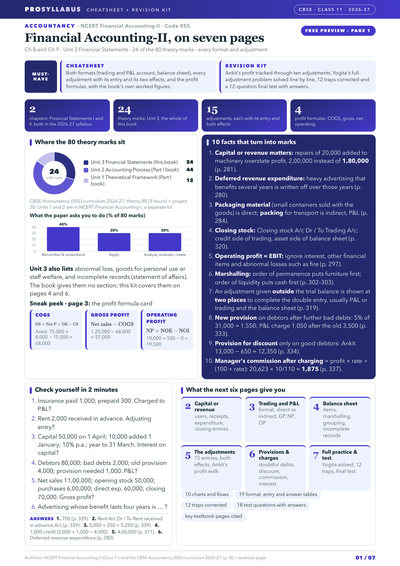
Read page 1 free Get the kit Get the kit One payment · instant PDF · ₹159 View details Marks booster + cheatsheet: key concepts in 2 lines each 12 exam traps, listed Five calculations the paper keeps asking Each adjustment: one entry, two effects Both formats: trading and P&L, balance sheet Yogita illustration solved line by line Page 1 free about 8 min read , Full kit about 55 min read ₹159
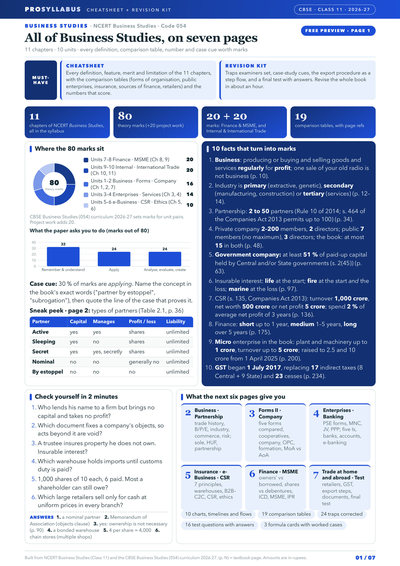
Read page 1 free Get the kit Get the kit One payment · instant PDF · ₹159 View details Marks booster + cheatsheet: key concepts in 2 lines each, common traps 20 marks: finance and MSME units 20 marks: internal and international trade Five comparison tables, insurance to retail Case cues for each chapter Common traps, corrected Page 1 free about 8 min read , Full kit about 55 min read ₹159
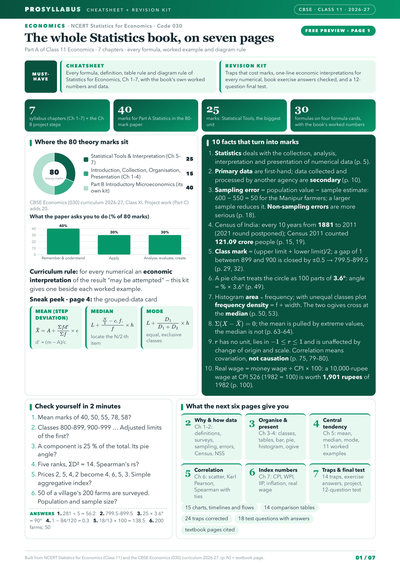
Read page 1 free Get the kit Get the kit One payment · instant PDF · ₹159 View details Marks booster + cheatsheet: key concepts in 2 lines each, common traps 15 marks: Ch 1–4, data to diagrams 7 chapters: every formula, worked numbers Common mistakes, corrected Book exercise answers included Part C project route Page 1 free about 8 min read , Full kit about 55 min read ₹159
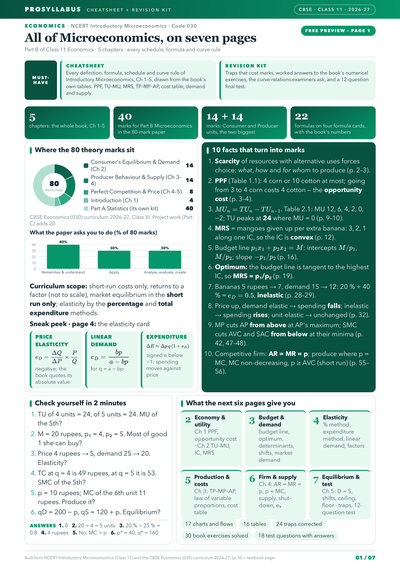
Read page 1 free Get the kit Get the kit One payment · instant PDF · ₹159 View details Marks booster + cheatsheet: key concepts in 2 lines each, common traps 14 marks: Production and Costs, Unit 6 8 marks: Market Equilibrium, Unit 7 Common traps, corrected PPF, TU–MU, MRS and cost table drawn Demand and supply schedules from the book Page 1 free about 8 min read , Full kit about 55 min read ₹159
Read page 1 free Get the kit Get the kit One payment · instant PDF · ₹159 View details Marks booster + cheatsheet: key concepts in 2 lines each, common traps 20 marks: Empires section 20 marks: Changing Cultural Traditions 15 marks: Paths to Modernisation, Japan 5 marks: map work on the book's maps Common traps, corrected Page 1 free about 8 min read , Full kit about 55 min read ₹159
Read page 1 free Get the kit Get the kit One payment · instant PDF · ₹159 View details Marks booster + cheatsheet: key concepts in 2 lines each, common traps 8 marks: Climate unit, Ch 7–10 5 marks: map work, covered 4 marks: ocean data as charts, Unit V Heat budget and five air layers as charts Common traps, corrected Page 1 free about 8 min read , Full kit about 55 min read ₹159
Read page 1 free Get the kit Get the kit One payment · instant PDF · ₹159 View details Marks booster + cheatsheet: key concepts in 2 lines each, common traps 12 marks: Climate, Vegetation (Unit III) Full CBSE map-work list, chapter by chapter Indus, Ganga, Brahmaputra river systems Monsoon mechanism, onset and four seasons Common traps, corrected Page 1 free about 8 min read , Full kit about 55 min read ₹159
Read page 1 free Get the kit Get the kit One payment · instant PDF · ₹159 View details Marks booster + cheatsheet: key concepts in 2 lines each 4 marks: Map Scale, conversions worked 4 marks: Latitude, Longitude and Time 4 marks: Topographical Maps, contours 5 marks: practical file and viva Conical and Mercator's construction steps Page 1 free about 8 min read , Full kit about 55 min read ₹159
Read page 1 free Get the kit Get the kit One payment · instant PDF · ₹159 View details Marks booster + cheatsheet: key concepts in 2 lines each, common traps 8 marks together: Citizenship, Nationalism 6 marks each: Social Justice, Secularism 8 chapters: thinkers and a timeline Liberty, equality, justice side by side Common traps, corrected Page 1 free about 8 min read , Full kit about 55 min read ₹159
Read page 1 free Get the kit Get the kit One payment · instant PDF · ₹159 View details Marks booster + cheatsheet: key concepts in 2 lines each 12 marks: Executive to Judiciary Constitution-making timeline Institution-by-institution comparisons 6 marks: elections, FPTP, PR, reserved seats Fundamental Rights and Directive Principles Page 1 free about 8 min read , Full kit about 55 min read ₹159
Read page 1 free Get the kit Get the kit One payment · instant PDF · ₹159 View details Marks booster + cheatsheet: key concepts in 2 lines each, common traps 10 marks each: Units 1 and 2 20 marks: project work, covered Tables: groups, stratification, marriage Every thinker and concept of Chapters 1–4 Common traps, corrected Page 1 free about 8 min read , Full kit about 55 min read ₹159
Read page 1 free Get the kit Get the kit One payment · instant PDF · ₹159 View details Marks booster + cheatsheet: key concepts in 2 lines each, common traps 12 marks each: Units 7, 9 and 10 7 thinkers: dates, works, examples Four Indian sociologists, in tables Ideal type, bureaucracy, division of labour Common traps, corrected Page 1 free about 8 min read , Full kit about 55 min read ₹159
Read page 1 free Get the kit Get the kit One payment · instant PDF · ₹159 View details Marks booster + cheatsheet: key concepts in 2 lines each 11 marks each: Units I and III 9 marks: Learning, Unit V 8 marks each: Perception and Memory Every school with its founder Comparisons examiners ask for Page 1 free about 8 min read , Full kit about 55 min read ₹159
Read page 1 free Get the kit Get the kit One payment · instant PDF · ₹159 View details Marks booster + cheatsheet: key concepts in 2 lines each, common traps 8 marks: note-making and summary 5 poems compared, cross-text themes Common traps, corrected Poetic devices with short quotes Grammar each chapter teaches Page 1 free about 8 min read , Full kit about 55 min read ₹159
Read page 1 free Get the kit Get the kit One payment · instant PDF · ₹159 View details Marks booster + cheatsheet: key concepts in 2 lines each, common traps 4-, 3- and 6-mark answers: how to write them Plot timeline for every text Common traps, corrected Every character, with evidence Cross-text themes, side by side Page 1 free about 8 min read , Full kit about 55 min read ₹159
Read page 1 free Get the kit Get the kit One payment · instant PDF · ₹159 View details Marks booster + cheatsheet: key concepts in 2 lines each, common traps Poetic forms and rhyme schemes Devices with short quotes Common traps, corrected Essay arguments, essay by essay Words each chapter teaches Page 1 free about 8 min read , Full kit about 55 min read ₹159
Read page 1 free Get the kit Get the kit One payment · instant PDF · ₹159 View details Marks booster + cheatsheet: key concepts in 2 lines each 16 writers placed on one timeline 60- and 40-word answer frames 8 काव्य पाठ: प्रतीक and काव्य-सौंदर्य Lines worth remembering, with page refs 12 common mistakes, corrected Page 1 free about 8 min read , Full kit about 55 min read ₹159
Read page 1 free Get the kit Get the kit One payment · instant PDF · ₹159 View details Marks booster + cheatsheet: key concepts in 2 lines each 10 marks (2 × 5): answer frames 5-mark answers in about 60 words 4 lessons: argument, events, characters Lines worth remembering, by page 12 common mistakes, corrected Page 1 free about 8 min read , Full kit about 55 min read ₹159
Read page 1 free Get the kit Get the kit One payment · instant PDF · ₹159 View details Marks booster + cheatsheet: key concepts in 2 lines each 16 writers placed on one timeline 40-word and व्याख्या answer frames 8 काव्य पाठ: प्रतीक, उपमान, काव्य-सौंदर्य Lines worth remembering, with page refs 12 common mistakes, corrected Page 1 free about 8 min read , Full kit about 55 min read ₹159
Read page 1 free Get the kit Get the kit One payment · instant PDF · ₹159 View details Marks booster + cheatsheet: key concepts in 2 lines each 5-mark, 100-word answer frames 9 exercise questions: आवारा मसीहा 7 exercise questions: हुसैन की कहानी Life events linked to the works 12 common mistakes, corrected Page 1 free about 8 min read , Full kit about 55 min read ₹159
Read page 1 free Get the kit Get the kit One payment · instant PDF · ₹159 View details Marks booster + cheatsheet: key concepts in 2 lines each 20 marks: grammar, from text words Sandhi, pratyaya and lakar examples Anvaya and bhavartha answer method Source text and author for every lesson 10 common errors, corrected Page 1 free about 8 min read , Full kit about 55 min read ₹159
Read page 1 free Get the kit Get the kit One payment · instant PDF · ₹159 View details Marks booster + cheatsheet: key concepts in 2 lines each 20 marks: grammar, भाग ग, from the text 10 marks: history of literature Sandhi, samasa, pratyaya, upapada examples Source text and author for every lesson Common errors, corrected Page 1 free about 8 min read , Full kit about 55 min read ₹159
Read page 1 free Get the kit Get the kit One payment · instant PDF · ₹159 View details Marks booster + cheatsheet: key concepts in 2 lines each Author, genre and characters per lesson Couplets explained: Insha and Fani ghazals Grammar for Section A Letter and advertisement formats 10 common mistakes, corrected Page 1 free about 8 min read , Full kit about 55 min read ₹159
Read page 1 free Get the kit Get the kit One payment · instant PDF · ₹159 View details Marks booster + cheatsheet: key concepts in 2 lines each 38 marks: the answer frame 13 genres, each introduced 18 writers and poets: dates and works Literary devices (صنعتیں) and key words Common mistakes, corrected Page 1 free about 8 min read , Full kit about 55 min read ₹159
Read page 1 free Get the kit Get the kit One payment · instant PDF · ₹159 View details Marks booster + cheatsheet: key concepts in 2 lines each 10 marks: literary forms, covered 5 geets, each with its poet Nazm defined, with its four kinds Answer points for the book's questions Common mistakes, corrected Page 1 free about 8 min read , Full kit about 55 min read ₹159
Read page 1 free Get the kit Get the kit One payment · instant PDF · ₹159 View details Marks booster + cheatsheet: key concepts in 2 lines each, common traps 15 marks: Unit 3, society, law and ethics 10 marks: Unit 1, number-system conversions Common traps that cost marks, listed Truth tables for Boolean logic String, list and dictionary methods Page 1 free about 8 min read , Full kit about 55 min read ₹159
Read page 1 free Get the kit Get the kit One payment · instant PDF · ₹159 View details Marks booster + cheatsheet: key concepts in 2 lines each, common traps 25 marks: Python, lists, NumPy (Unit 2) 10 marks: Computer System (Unit 1) Common traps, corrected Every list and dictionary method, with output SQL queries re-run on the book's tables Page 1 free about 8 min read , Full kit about 55 min read ₹159
Read page 1 free Get the kit Get the kit One payment · instant PDF · ₹159 View details Marks booster + cheatsheet: key concepts in 2 lines each, common traps 23 marks: Unit II 15 marks: Unit III, health and hygiene Common traps, corrected Five food groups, RDA and the pyramid Nine fibres and the burning test Page 1 free about 8 min read , Full kit about 55 min read ₹159
Read page 1 free Get the kit Get the kit One payment · instant PDF · ₹159 View details Marks booster + cheatsheet: key concepts in 2 lines each 15 marks each: Childhood and Adulthood units RDAs and diet quantities by age Vaccine ages Budget steps and investment principles Stain-removal methods Page 1 free about 8 min read , Full kit about 55 min read ₹159
Read page 1 free Get the kit Get the kit One payment · instant PDF · ₹159 View details Marks booster + cheatsheet: key concepts in 2 lines each 15 marks each: the two theory units What to write when asked to appreciate Bharhut, Sanchi and the cave sites Temple architecture: how a temple is built Bronzes and Indo-Islamic buildings Page 1 free about 8 min read , Full kit about 55 min read ₹159
Read page 1 free Get the kit Get the kit One payment · instant PDF · ₹159 View details Marks booster + cheatsheet: key concepts in 2 lines each, common traps 20 marks each: Units II and III Enzyme kinetics and bioenergetics Common traps, corrected Mendel-to-operon genetics Tables and numbers, each with its page Page 1 free about 8 min read , Full kit about 55 min read ₹159
Read page 1 free Get the kit Get the kit One payment · instant PDF · ₹159 View details Marks booster + cheatsheet: key concepts in 2 lines each, common traps 15 marks: language and literature 14 marks: the nine darśanas Common traps, corrected 13 marks: astronomy in India 4 chapters, each with answer frames Page 1 free about 8 min read , Full kit about 55 min read ₹159
Read page 1 free Get the kit Get the kit One payment · instant PDF · ₹159 View details Marks booster + cheatsheet: key concepts in 2 lines each Frames for news, interview and review Inverted pyramid and the six ककार Play-writing frame Translation rules, with solved examples Common mistakes, corrected Page 1 free about 8 min read , Full kit about 55 min read ₹159
Read page 1 free Get the kit Get the kit One payment · instant PDF · ₹159 View details Marks booster + cheatsheet: key concepts in 2 lines each 50 marks: games and sports strand 25 marks: health and fitness strand Eight team games, side by side Fitness tests, norms and formulas Yoga asanas for wellness Page 1 free about 8 min read , Full kit about 55 min read ₹159
Read page 1 free Get the kit Get the kit One payment · instant PDF · ₹159 View details Marks booster + cheatsheet: key concepts in 2 lines each 22 श्रुतियाँ and 10 थाट, defined बिहाग, भीमपलासी, भैरवी with बंदिश notation तीनताल, एकताल, चौताल: ठाह, दुगुन, चौगुन तानसेन, भातखंडे, पलुस्कर profiled 12 common mistakes, corrected Page 1 free about 8 min read , Full kit about 55 min read ₹159
Read page 1 free Get the kit Get the kit One payment · instant PDF · ₹159 View details Marks booster + cheatsheet: key concepts in 2 lines each वादी-संवादी, पकड़ and बंदिश for each राग तीनताल, एकताल, चौताल: ठाह, दुगुन, चौगुन तानसेन, भातखंडे, पलुस्कर profiled Four classes of instruments, तानपुरा, सितार 12 common mistakes, corrected Page 1 free about 8 min read , Full kit about 55 min read ₹159
Read page 1 free Get the kit Get the kit One payment · instant PDF · ₹159 View details Marks booster + cheatsheet: key concepts in 2 lines each 6 marks each: all five units ठाह, दुगुन, तिगुन, चौगुन written out 14 artists with dates कुदऊ सिंह and नाना पानसे: two lives 14 common mistakes, corrected Page 1 free about 8 min read , Full kit about 55 min read ₹159
Read page 1 free Get the kit Get the kit One payment · instant PDF · ₹159 View details Get alerts for CBSE Class 11 Annual Assessment
Dates, results and cutoffs, by email when they are announced. Free.
Google, Apple, or a code to your phone or email. It is saved to your account.
This chapter is part of the CBSE Class 11 Annual Assessment Board Examination Explore every chapter — summary, notes, extra questions & MCQ quizzes Preparing for CBSE Class 11 Annual Assessment? Students also sit JEE is set on the Class 11 and 12 Physics, Chemistry and Maths syllabus; students prepare for boards and JEE together.
Tests are played signed in — sign in (free, 10 seconds) so your attempts, rank and XP are saved to you #1
Discovering Tut: the Saga Continues
Start here
#2
#3
Constitution: Why and How?
#4
#5
#6
#7
#8
Methods of Enquiry in Psychology
#9
#10
An Empire Across Three Continents
#11
#12
The Summer of the Beautiful White Horse
#13
#14
#15
We're Not Afraid to Die... if We Can All Be Together
#16
#17
Election and Representation
#18
Political Theory: An Introduction
#19
#20
Biological Classification
#21
Motion in a Straight Line
#22
Accountancy (Class 11) Practice Quiz | CBSE Class 11 Annual Assessment
#23
Sets and Venn Operations Fundamentals — Free CBSE Class 11 Annual Assessment Quiz
#24
#25
#26
#27
Rights in the Indian Constitution
#28
#29
#30
#31
#32
Changing Cultural Traditions
#33
#34
#35
#36
#37
Private, Public and Global Enterprises
#38
Depreciation, Provisions and Reserves
#39
Introduction to Accounting
#40
Cell Cycle and Cell Division
#41
#42
Anatomy of Flowering Plants
#43
Organic Chemistry – Some Basic Principles and Techniques
#44
#45
#46
#47
#48
#49
#50
#51
#52
#53
#54
#55
The Ailing Planet: the Green Movement's Role
#56
#57
#58
#59
Sensory, Attentional and Perceptual Processes
#60
#61
#62
Introducing Western Sociologists
#63
#64
Social Change and Social Order in Rural and Urban Society
#65
Social Structure, Stratification and Social Processes in Society
#66
Doing Sociology: Research Methods
#67
Culture and Socialisation
#68
Understanding Social Institutions
#69
Terms, Concepts and Their Use in Sociology
#70
#71
The Philosophy of the Constitution
#72
Constitution as a Living Document
#73
#74
#75
#76
#77
#78
#79
#80
#81
#82
Natural Hazards and Disasters
#83
#84
#85
#86
Structure and Physiography
#87
Biodiversity and Conservation
#88
#89
#90
World Climate and Climate Change
#91
Atmospheric Circulation and Weather Systems
#92
Solar Radiation, Heat Balance and Temperature
#93
Composition and Structure of Atmosphere
#94
Landforms and their Evolution
#95
#96
Distribution of Oceans and Continents
#97
#98
The Origin and Evolution of the Earth
#99
Geography as a Discipline
#100
Displacing Indigenous Peoples
#101
#102
Comparative Development Experiences of India and its Neighbours
#103
Environment and Sustainable Development
#104
Employment: Growth, Informalisation and Other Issues
#105
#106
Human Capital Formation in India
#107
Liberalisation, Privatisation and Globalisation: An Appraisal
#108
Indian Economy on the Eve of Independence
#109
#110
#111
#112
Measures of Central Tendency
#113
#114
#115
#116
#117
MSME and Business Entrepreneurship
#118
Sources of Business Finance
#119
#120
Social Responsibilities of Business and Business Ethics
#121
Emerging Modes of Business
#122
#123
Forms of Business Organisation
#124
Business, Trade and Commerce
#125
Financial Statements - II
#126
#127
Trial Balance and Rectification of Errors
#128
Bank Reconciliation Statement
#129
Recording of Transactions - II
#130
Recording of Transactions - I
#131
Theory Base of Accounting
#132
#133
#134
#135
Introduction to Three Dimensional Geometry
#136
#137
#138
#139
#140
Permutations and Combinations
#141
#142
Complex Numbers and Quadratic Equations
#143
#144
#145
Chemical Coordination and Integration
#146
Neural Control and Coordination
#147
#148
Excretory Products and their Elimination
#149
Body Fluids and Circulation
#150
Breathing and Exchange of Gases
#151
Plant Growth and Development
#152
#153
Photosynthesis in Higher Plants
#154
#155
Structural Organisation in Animals
#156
Morphology of Flowering Plants
#157
#158
#159
Chemical Bonding and Molecular Structure
#160
Classification of Elements and Periodicity in Properties
#161
Some Basic Concepts of Chemistry
#162
#163
#164
#165
#166
Thermal Properties of Matter
#167
Mechanical Properties of Fluids
#168
Mechanical Properties of Solids
#169
#170
Systems of Particles and Rotational Motion
#171
#172
#173
Business Studies (Class 11) Practice Quiz | CBSE Class 11 Annual Assessment
#174
Economics (Class 11) Practice Quiz | CBSE Class 11 Annual Assessment
#175
Humanities Subjects Practice Quiz | CBSE Class 11 Annual Assessment
#176
Motion in a Straight Line Practice Quiz | CBSE Class 11 Annual Assessment
#177
Thermodynamic Processes and Laws Advanced Challenge | CBSE Class 11 Annual Assessment
More on CBSE Class 11 Annual Assessment20 guides Tuples and Dictionaries – NCERT Class 11 Computer Science Chapter 10 – Tuple Operations and Dictionary Handling in Python Strings – NCERT Class 11 Computer Science Chapter 8 – String Operations, Traversal, and Methods in Python Getting Started with Python – NCERT Class 11 Computer Science Chapter 5 – Basics, Data Types, Operators, and Debugging Functions – NCERT Class 11 Computer Science Chapter 7 – Defining, Calling, and Understanding Functions in Python Complete Summary and Solutions for Emerging Trends – NCERT Class XI Informatics Practices, Chapter 2 – Explanation, Questions, Answers Mathematical Modelling – NCERT Class 11 Mathematics Appendix 2 – Concepts, Importance, and Applications in Real-world Problems Complete Summary and Solutions for Database Concepts – NCERT Class XI Informatics Practices, Chapter 7 – Explanation, Questions, Answers Encoding Schemes and Number System – NCERT Class 11 Computer Science Chapter 2 – ASCII, ISCII, UNICODE, Binary, Octal, Decimal, Hexadecimal Complete Summary and Solutions for Brief Overview of Python – NCERT Class XI Informatics Practices, Chapter 3 – Explanation, Questions, Answers Complete Summary and Solutions for Computer System – NCERT Class XI Informatics Practices, Chapter 1 – Explanation, Questions, Answers Introduction to Problem Solving – NCERT Class 11 Computer Science Chapter 4 – Algorithms, Flowcharts, Pseudocode, and Control Structures Flow of Control – NCERT Class 11 Computer Science Chapter 6 – Conditional and Looping Constructs in Python Alerts and Updates for CBSE Class 11 Annual Assessment Complete Summary and Solutions for Adventure Sports – Health and Physical Education Textbook for Class XI, Chapter 11 – Explanation, Questions, Answers Complete Summary and Solutions for Tournaments and Competitions – Health and Physical Education Textbook for Class XI, Chapter 10 – Explanation, Questions, Answers Complete Summary and Solutions for Measurement and Evaluation – Health and Physical Education Textbook for Class XI, Chapter 9 – Explanation, Questions, Answers Complete Summary and Solutions for Health Related Physical Fitness – Health and Physical Education Textbook for Class XI, Chapter 8 – Explanation, Questions, Answers Complete Summary and Solutions for Safety and Security – Health and Physical Education Textbook for Class XI, Chapter 7 – Explanation, Questions, Answers Complete Summary and Solutions for Yoga and Its Relevance in the Modern Times – Health and Physical Education Textbook for Class XI, Chapter 6 – Explanation, Questions, Answers Complete Summary and Solutions for Team Games – Health and Physical Education Textbook for Class XI, Chapter 5 – Explanation, Questions, Answers Notebook backup + AI Save your notes. Revise with AI. Learn more → Share this article