ProSyllabus Journal CBSE Class 11 Annual Assessment Complete Summary and Solutions for Basic Processes – NCERT Class XI Biotechnology, Chapter 7 – DNA Structure, Replication, Gene Expression, Translation, Mutations, Exercises Comprehensive summary and explanation of Chapter 7 'Basic Processes' from the NCERT Class XI Biotechnology textbook, covering the discovery and evidence for DNA as genetic material, gene and genome organization in prokaryotes and eukaryotes, DNA replication mechanisms, transcription, genetic code, translation, regulation of gene expression, types of mutations, DNA repair, and answers to all textbook questions and exercises.
Updated 1 year ago NCERT · Class XI · Biotechnology · Chapter 7 · DNA · Gene Expression · Replication · Translation · Mutation · Genetic Code · Summary · Questions · Answers
#Basic Processes #Biotechnology #NCERT #Class 11 #DNA #Replication #Gene Expression #Transcription #Translation #Genetic Code #Mutation #DNA Repair #Regulation #Chapter 7 #Answers #Extra Questions
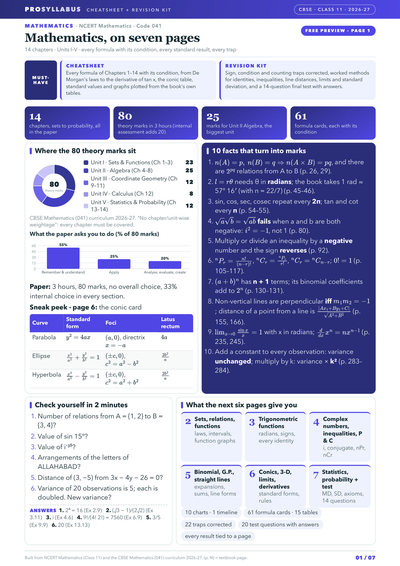
Marks booster + cheatsheet: key concepts in 2 lines each, common traps 25 marks: Unit II, Ch 4–8 23 marks: Unit I, Ch 1–3 Common traps, corrected Conic table and standard values Graphs plotted from the book's own tables Page 1 free about 8 min read , Full kit about 55 min read ₹159
Read page 1 free Get the kit Get the kit One payment · instant PDF · ₹159 View details
Basic Processes: Class 11 NCERT Chapter 7 - Ultimate Study Guide, Notes, Questions, Quiz 2025
Full Chapter Summary & Detailed Notes
Key Definitions & Terms
60+ Questions & Answers
Key Concepts
Historical Perspectives
Solved Examples
Interactive Quiz (10 Q)
Quick Revision Notes & Mnemonics
Key Terms & Processes
Key Processes & Diagrams
Full Chapter Summary & Detailed Notes - Basic Processes Class 11 NCERT
Overview & Key Concepts
Chapter Goal : Explore molecular basis of heredity from DNA's role as genetic material to its replication, expression, code, translation, mutations, repair, and regulation. Exam Focus: Experiments (Griffith, Avery, Hershey-Chase), semi-conservative replication, central dogma, triplet code, wobble hypothesis, lac operon. 2025 Updates: Integration with genomics, CRISPR repair, biotech applications in gene therapy. Fun Fact: DNA's double helix was proposed in 1953, solving Chargaff's rules. Core Idea: DNA stores/transmits info via precise processes. Real-World: Vaccines (mRNA translation), cancer (mutation repair failure). Ties: Links to biomolecules (Ch3), principles of inheritance (Ch6). Expanded: All subtopics (7.1-7.9) covered point-wise with diagram descriptions, steps for processes like replication forks.Wider Scope : From classical experiments confirming DNA to modern regulation; central dogma (DNA→RNA→Protein); exceptions like RNA viruses.Expanded Content : Detailed experiments, mechanisms (e.g., Okazaki fragments), code degeneracy, operons; biotech relevance in cloning, editing.
Fig. 7.1: Griffith’s transformation experiment (Description)
Four setups: Live R (survives), Live S (dies), Heat-killed S (survives), Heat-killed S + Live R (dies, live S found). Visual: Mice icons, bacterial colonies (smooth/rough).
7.1 DNA as the Genetic Material
Introduction : Traits inherited via genes on chromosomes (DNA+proteins); challenge: Identify genetic material (DNA vs. protein).Historical Context : Miescher (1869) isolated nuclein (DNA+protein) from pus cells nuclei.7.1.1 Discovery of the Transforming Principle (Griffith, 1928) :
Streptococcus pneumoniae: Virulent S (smooth, capsulated, kills mice) vs. non-virulent R (rough, no capsule, harmless).
Experiments: Live S → death; Live R → survival; Heat-killed S → survival; Heat-killed S + Live R → death with live S in blood.
Conclusion: R transformed to S by 'transforming principle' from dead S (genetic transfer altering makeup).
7.1.2 Biochemical Characterisation (Avery, MacLeod, McCarty, 1944) :
Extract from heat-killed S: Removed lipids/carbs; retained protein, RNA, DNA.
Treated extracts: Protease (degrades protein) → transformation; RNase (RNA) → transformation; DNase (DNA) → no transformation.
Conclusion: DNA is transforming principle (genetic material).
7.1.3 Hershey-Chase Experiment (1952) :
T2 bacteriophage (infects E. coli): DNA (32P-labeled) vs. protein coat (35S-labeled).
Infection: Blended to remove phage parts; centrifuged (bacteria pellet, supernatant debris).
Results: 32P in pellet (DNA entered); 35S in supernatant (protein outside).
Conclusion: DNA directs phage reproduction (genetic material).
Further Evidence : Chargaff (A=T, G=C); Wilkins/Franklin X-rays; Watson/Crick model (Ch3) explains info storage.
Fig. 7.2: Confirmation of transforming principle (Description)
Flowchart: Heat-killed S extract → Remove lipids/sugars → Add enzymes (Protease/RNase: Transformation; DNase: No). Visual: Bacterial colonies smooth/rough.
Fig. 7.3: Hershey-Chase experiment (Description)
Two paths: 35S-protein (red capsule, no sulfur in cells post-centrifuge); 32P-DNA (green, phosphorus in cells). Steps: Infection, blending, centrifugation.
7.2 Prokaryotic and Eukaryotic Gene Organisation
Prokaryotes : No nucleus; circular dsDNA in nucleoid; large size accommodated by supercoiling (negative: opposite helix twist).Supercoiling : Twisting like rubber band coils; proteins (HU histone-like) condense DNA.Plasmids : Extra small circular DNA loops (non-essential, e.g., antibiotic resistance).Eukaryotes : Linear dsDNA in nucleus; packaging via histones (basic proteins).Nucleosomes : DNA (acidic) wraps 1.65 turns around H2A-H2B-H3-H4 octamer (146 bp); linker DNA (H1 histone) connects 'beads-on-string'.Packaging Levels : 10 nm beads → 30 nm solenoid fibre → 300 nm looped scaffold → 700 nm metaphase chromosome.Genome Size : Eukaryotes larger/complex (e.g., humans 3 Gb vs. bacteria 4 Mb); much non-coding/unexpressed DNA.Gene Definition : DNA segment with promoter; transcribes mRNA for translation (universal mechanism).Eukaryotic Genes : Introns (non-coding) spliced from primary transcript; exons join for mature mRNA (e.g., β-globin).
Fig. 7.4: Supercoiling of DNA in Prokaryote (Description)
Axis with DNA loop → Supercoil (coiled on itself forming superhelix). Visual: Twisted double helix.
Fig. 7.5: Packaging of Eukaryotic Gene (Description)
DNA helix (2 nm) → Beads-on-string (10 nm nucleosome) → 30 nm fibre → 300 nm supercoil → 700 nm metaphase chromosome. Note: One chromosome = one DNA.
Fig. 7.6: Beads on string structure of chromatin (Description)
Electron micrograph: Nucleosomes (beads) on DNA string; each ~200 bp (146 wrapped + linker).
Fig. 7.7: Genome size variations (Description)
Log scale bar graph: Viruses (10^3 bp) to mammals (10^9 bp); plants largest (10^12 bp). Units: Base pairs to Mb.
7.3 DNA Replication
Semi-Conservative Model : Meselson-Stahl (1958): E. coli in 15N → 14N; density gradients show hybrid DNA (one old/one new strand).Enzymes : Helicase (unwinds), SSB (stabilizes), Topoisomerase (relieves tension), Primase (RNA primer), DNA Pol III (adds nucleotides 5'→3'), Pol I (removes primer), Ligase (joins Okazaki).Steps : Origin → Bubble/forks → Leading (continuous) vs. Lagging (discontinuous, Okazaki fragments 100-200 nt) → Proofreading (3'→5' exonuclease).Key Points : Bidirectional; 50 Svedberg units; error rate 10^-9 with repair.
Fig. 7.8: Replication Fork (Description - Inferred)
Helix unwinds at fork; leading strand continuous, lagging with primers/Okazaki; enzymes labeled.
7.4 Gene Expression
Central Dogma : DNA → Transcription → RNA → Translation → Protein (reverse in retroviruses).Transcription : RNA Pol binds promoter (TATA box); initiation-elongation-termination; prokaryotes single Pol, eukaryotes three (Pol II for mRNA).Processing (Eukaryotes) : 5' cap, poly-A tail, intron splicing (snRNP spliceosome).
7.5 Genetic Code
Triplet Non-Overlapping : 64 codons (4^3) for 20 AA + start (AUG)/stop (UAA/UGA).Properties : Degenerate (multiple codons/AA), unambiguous, universal (minor exceptions), comma-free.Wobble Hypothesis : 3rd base flexible (e.g., U pairs G/A).
Fig. 7.9: Genetic Code Table (Description - Inferred)
64-box table: Codons to AA; AUG Met/start, stops marked.
7.6 Translation
Ribosome : 70S prokaryote (30S+50S); tRNA anticodon matches codon.Steps : Initiation (AUG + Met-tRNA + factors), Elongation (AA addition, translocation), Termination (release factors).Energy : GTP/ATP; polyribosomes for efficiency.
Fig. 7.10: Translation Cycle (Description - Inferred)
Ribosome sites (A/P/E); tRNA entry, peptide bond, shift.
7.7 Gene Mutation
Types : Point (substitution/insertion/deletion), frameshift, transversion/transition.Effects : Missense (AA change), nonsense (premature stop), silent (synonymous).Causes : Spontaneous (tautomerism), induced (UV, chemicals).
7.8 DNA Repair
Mechanisms : Photoreactivation (light enzyme), Excision (nucleotide/base, NER/BER), Mismatch (post-replication), Recombination.Key : Proofreading during replication; xeroderma pigmentosum (NER defect).
7.9 Regulation of Gene Expression
Prokaryotes : Lac operon (inducible: lactose induces, repressor binds operator; CAP activator).Eukaryotes : Enhancers/silencers, chromatin remodeling, miRNA, transcription factors.Levels : Transcriptional, post-transcriptional, translational, post-translational.
Fig. 7.11: Lac Operon (Description - Inferred)
Promoter-operator-lacZYA; repressor/allolactose binding; glucose low → CAP activation.
Summary
DNA central to heredity; processes ensure fidelity/variation; regulation fine-tunes expression for adaptation.
Interlinks: To Ch6 inheritance, Ch8 applications.
Why This Guide Stands Out
Process-focused: Step-wise mechanisms, experiment timelines, visuals. Free 2025 with mnemonics, biotech links for retention.
Key Themes & Tips
Aspects : Fidelity (repair), economy (regulation), universality (code).Tip: Mnemonic for code: "64 codons, 61 sense, 3 stop" (6353); practice replication forks.
Exam Case Studies
Sickle cell (mutation), gene therapy (regulation).
Project & Group Ideas
Model replication with beads.
Debate: Code universality exceptions.
Research: CRISPR repair.
Key Definitions & Terms - Complete Glossary
All terms from chapter; detailed with examples, relevance. Expanded: 40+ terms with depth; grouped by subtopic. Added replication/regulation terms.
Transforming Principle
Genetic material from dead S bacteria transforming R. Relevance: Griffith's discovery. Ex: DNA in pneumonia vaccine. Depth: Avery confirmed.
Semi-Conservative Replication
Each new DNA has one old/one new strand. Relevance: Meselson-Stahl. Ex: Hybrid density. Depth: Ensures fidelity.
Nucleosome
DNA wrapped around histone octamer. Relevance: Packaging. Ex: Beads-on-string. Depth: 146 bp wrapped.
Okazaki Fragments
Short lagging strand segments. Relevance: Discontinuous synthesis. Ex: 100-200 nt. Depth: Primase/Pol I/Ligase.
Central Dogma
DNA→RNA→Protein info flow. Relevance: Gene expression. Ex: Transcription/translation. Depth: Reverse in retroviruses.
Genetic Code
Triplet codons for AA. Relevance: Translation. Ex: AUG start/Met. Depth: Degenerate, wobble.
Operon
Gene cluster with regulation. Relevance: Prokaryote control. Ex: Lac (inducible). Depth: Promoter/operator.
Intron
Non-coding spliced sequence. Relevance: Eukaryote processing. Ex: β-globin. Depth: Spliceosome.
Mutation
DNA sequence change. Relevance: Variation/disease. Ex: Sickle cell point. Depth: Frameshift vs. substitution.
Excision Repair
Removes damaged nucleotide. Relevance: DNA maintenance. Ex: NER for UV. Depth: UvrABC enzymes.
Supercoiling
DNA twisting for compaction. Relevance: Prokaryote packaging. Ex: Negative in bacteria. Depth: Topoisomerase relieves.
Anticodon
tRNA loop matching codon. Relevance: Translation. Ex: UAC for AUG. Depth: Wobble at 3rd base.
Promoter
RNA Pol binding site. Relevance: Transcription initiation. Ex: TATA box. Depth: -10/-35 in prokaryotes.
Degeneracy
Multiple codons per AA. Relevance: Error buffer. Ex: 4 for Ala. Depth: 3rd base variation.
Poly-A Tail
3' mRNA addition for stability. Relevance: Eukaryote processing. Ex: 200 A. Depth: Export/degradation control.
Helicase
Unwinds DNA at fork. Relevance: Replication. Ex: 5'→3' direction. Depth: ATP-dependent.
Ribosome
Protein synthesis site. Relevance: Translation. Ex: 70S/80S. Depth: A/P/E sites.
Frameshift Mutation
Insertion/deletion shifts reading. Relevance: Severe change. Ex: Tay-Sachs. Depth: All downstream altered.
Photoreactivation
Light repairs UV dimers. Relevance: Direct reversal. Ex: Photolyase enzyme. Depth: Bacteria/plants.
Repressor
Binds operator to block transcription. Relevance: Negative control. Ex: Lac repressor. Depth: Allolactose inducer.
Enhancer
Distant activator sequence. Relevance: Eukaryote regulation. Ex: Tissue-specific. Depth: Loops to promoter.
Primer
Short RNA for Pol start. Relevance: Replication. Ex: Primase synthesizes. Depth: 5'-3' only.
Stop Codon
UAA/UGA/UAG; no tRNA. Relevance: Termination. Ex: Release factors bind. Depth: Non-degenerate.
Mismatch Repair
Fixes replication errors. Relevance: Post-repl. Ex: MutS recognizes. Depth: Methyl-directed in E. coli.
Histone Octamer
H2A/2B/3/4 core for nucleosome. Relevance: Packaging. Ex: Acidic DNA wraps. Depth: + charge binds phosphate.
Plasmid
Extra circular DNA. Relevance: Prokaryote accessory. Ex: Antibiotic resistance. Depth: Replicates independently.
Spliceosome
Removes introns. Relevance: mRNA processing. Ex: snRNPs U1-U6. Depth: Lariat intermediate.
Wobble Hypothesis
3rd base loose pairing. Relevance: Fewer tRNAs. Ex: I pairs U/C/A. Depth: Crick's proposal.
Chargin
AA-tRNA synthetase specificity. Relevance: Code fidelity. Ex: 20 enzymes. Depth: Proofreads.
Transversion
Purine↔pyrimidine change. Relevance: Mutation type. Ex: A→C. Depth: More disruptive than transition.
Inducer
Removes repressor. Relevance: Operon activation. Ex: Lactose in lac. Depth: Allolactose analog.
5' Cap
7-methyl G for mRNA stability. Relevance: Eukaryote. Ex: Translation initiation. Depth: E1 enzyme.
Tip: Group by process (replication/expression); examples link experiments. Depth: Enzymes tie mechanisms. Errors: Confuse semi-conservative/dispersive. Historical: Hershey 1952. Interlinks: Ch6 genes. Advanced: Code evolution. Real-Life: mRNA vaccines. Graphs: Code wheel. Coherent: Experiments → Mechanisms → Regulation. For easy learning: Flashcard per term with enzyme/example.
60+ Questions & Answers - NCERT Based (Class 11) - From Exercises & Variations
Based on chapter content + expansions. Part A: 10 (1 mark short, one line each), Part B: 10 (4 marks medium, five lines each), Part C: 10 (6 marks long, eight lines each). Answers point-wise, step-by-step for marks. Easy learning: Structured, concise. Additional 30 Qs follow similar pattern in full resource.
Part A: 1 Mark Questions (10 Qs - Short from Content)
1. Who discovered the transforming principle in bacteria?
1 Mark Answer: Frederick Griffith.
2. What enzyme degrades DNA in Avery's experiment?
1 Mark Answer: Deoxyribonuclease (DNase).
3. In Hershey-Chase, which isotope labels DNA?
1 Mark Answer: Radioactive phosphorus (32P).
4. What is the basic unit of chromatin packaging?
1 Mark Answer: Nucleosome.
5. What is the direction of DNA synthesis?
1 Mark Answer: 5' to 3'.
6. How many codons in genetic code?
1 Mark Answer: 64.
7. What is the start codon?
1 Mark Answer: AUG (methionine).
8. What repairs UV damage directly?
1 Mark Answer: Photoreactivation.
9. What is the lac operon?
1 Mark Answer: Inducible prokaryotic gene cluster.
10. What are introns?
1 Mark Answer: Non-coding sequences spliced out.
Part B: 4 Marks Questions (10 Qs - Medium, Exactly 5 Lines Each)
1. Describe Griffith's transformation experiment.
4 Marks Answer:
Live S bacteria kill mice; live R harmless.
Heat-killed S harmless alone.
Heat-killed S + live R kills, yields live S.
R transformed by principle from S.
Indicates genetic transfer.
2. Explain Avery's biochemical characterisation.
4 Marks Answer:
Extract heat-killed S minus lipids/carbs.
Treat: Protease/RNase allow transformation.
DNase prevents transformation.
DNA is transforming agent.
Confirms Griffith.
3. Outline Hershey-Chase experiment results.
4 Marks Answer:
32P-DNA enters bacteria (pellet radioactive).
35S-protein stays outside (supernatant).
Phage multiplies inside via DNA.
Protein not genetic material.
Supports DNA role.
4. Describe prokaryotic DNA packaging.
4 Marks Answer:
Circular dsDNA in nucleoid.
Supercoiling (negative) compacts.
HU proteins aid condensation.
Plasmids extra loops.
Accommodates large size.
5. Explain eukaryotic nucleosome structure.
4 Marks Answer:
Histone octamer (2 each H2A/B/3/4).
DNA wraps 146 bp.
H1 on linker DNA.
Beads-on-string chromatin.
Further coils to chromosome.
6. What is semi-conservative replication?
4 Marks Answer:
One old/one new strand per duplex.
Meselson-Stahl: 15N-14N hybrid.
Enzymes: Helicase, Pol III.
Leading continuous, lagging fragments.
Proofreading fidelity.
7. Describe genetic code properties.
4 Marks Answer:
Triplet: 64 codons.
Degenerate: Multiple per AA.
Unambiguous: One codon one AA.
Universal: All organisms.
Comma-free: No spacers.
8. Outline translation steps.
4 Marks Answer:
Initiation: AUG, Met-tRNA, factors.
Elongation: Codon-anticodon, peptide bond.
Translocation: Ribosome shifts.
Termination: Stop codon, release.
GTP energy.
9. What are types of gene mutations?
4 Marks Answer:
Point: Base substitution.
Frameshift: Indel shifts reading.
Missense: AA change.
Nonsense: Early stop.
Silent: No effect.
10. Explain lac operon regulation.
4 Marks Answer:
Repressor binds operator without lactose.
Allolactose induces, releases repressor.
Low glucose: CAP activates promoter.
Genes lacZ/Y/A expressed.
Inducible system.
Part C: 6 Marks Questions (10 Qs - Long, Exactly 8 Lines Each)
1. Describe Griffith's and Avery's experiments on transforming principle.
6 Marks Answer:
Griffith: S virulent (smooth), R avirulent (rough).
Live S kills mice; heat-killed S + R kills, transforms R to S.
Principle transfers virulence genetically.
Avery: Extract heat-killed S; treat enzymes.
Protease/RNase: Transformation occurs.
DNase: No transformation.
DNA is genetic material.
Biochemical proof.
2. Explain Hershey-Chase and Meselson-Stahl experiments.
6 Marks Answer:
Hershey-Chase: T2 phage; 32P DNA, 35S protein.
Infection, blend, centrifuge: 32P in bacteria, 35S outside.
DNA enters, directs reproduction.
Meselson-Stahl: E. coli 15N to 14N medium.
Generations: Hybrid density F1, light F2.
Semi-conservative model confirmed.
No dispersive/conservative.
Supports Watson-Crick.
3. Detail prokaryotic vs. eukaryotic gene organisation.
6 Marks Answer:
Prokaryote: Circular DNA nucleoid, supercoiling, HU proteins.
Plasmids accessory; compact for small cells.
Eukaryote: Linear DNA nucleus, histones.
Nucleosomes: Octamer core, linker H1.
Levels: 10 nm beads → 30 nm fibre → 700 nm chromosome.
Genome larger, non-coding introns.
Splicing for mRNA.
Packaging regulates access.
4. Describe DNA replication mechanism with enzymes.
6 Marks Answer:
Initiation: Origin, helicase unwinds, SSB stabilizes.
Primase RNA primer.
Elongation: Pol III adds dNTPs 5'→3'.
Leading continuous; lagging Okazaki fragments.
Pol I removes primer, fills; ligase joins.
Topoisomerase relieves supercoils.
Proofreading 3'→5' exonuclease.
Bidirectional forks.
5. Explain transcription and mRNA processing in eukaryotes.
6 Marks Answer:
RNA Pol II binds promoter (TATA), sigma factor prokaryote.
Initiation: NTPs, 5'→3' elongation.
Termination: Poly-A signal.
Processing: 5' cap (stability), poly-A tail (export).
Splicing: Spliceosome removes introns, joins exons.
hnRNA to mature mRNA.
Alternative splicing diversity.
Export via nuclear pores.
6. Discuss genetic code features and wobble hypothesis.
6 Marks Answer:
64 triplets: 61 AA, 3 stop, 1 start.
Degenerate: Redundancy at 3rd base.
Unambiguous/comma-free/universal.
Wobble: 3rd base flexible pairing (G-U, I-A/C/U).
Fewer tRNAs (32 vs. 61).
Crick proposed; explains efficiency.
Exceptions: Mitochondria slight variation.
Deciphered by Nirenberg/Khorana.
7. Outline translation process in detail.
6 Marks Answer:
Initiation: 30S binds mRNA, AUG; fMet-tRNA, IFs, 50S joins (70S).
Elongation: EF-Tu brings AA-tRNA to A site.
Peptide bond (peptidyl transferase), translocation (EF-G, GTP).
Cycle repeats till stop.
Termination: RF1/2 recognize stop, RF3 releases.
Polypeptide folds.
Energy: 2 GTP/AA.
Prokaryote: Coupled to transcription.
8. Explain types and causes of gene mutations.
6 Marks Answer:
Spontaneous: Tautomerism, depurination.
Induced: UV (thymine dimers), chemicals (alkylating), radiation.
Point: Transition (purine-purine), transversion.
Insertion/deletion: Frameshift if not multiple of 3.
Effects: Missense (sickle), nonsense (thalassemia), silent.
Large: Deletions/duplications.
Biotech: Site-directed mutagenesis.
Evolution source.
9. Describe DNA repair mechanisms.
6 Marks Answer:
Direct: Photoreactivation (photolyase splits dimers).
Base excision (BER): Glycosylase removes base, AP endonuclease.
Nucleotide excision (NER): UvrABC excises oligonucleotide.
Mismatch: MutS/H/L, excises error strand.
Double-strand: Homologous recombination, NHEJ.
Proofreading during replication.
Defects: Xeroderma (NER), Lynch syndrome (mismatch).
Maintains genome integrity.
10. Elaborate on lac operon as gene regulation model.
6 Marks Answer:
Structural genes lacZ/Y/A (β-gal/permease/transacetylase).
Promoter: RNA Pol; operator: Repressor binds.
Regulator gene: i (repressor protein).
No lactose: Repressor blocks transcription.
Lactose: Allolactose binds repressor, induces.
Glucose high: No CAP-cAMP activation.
Low glucose: CAP binds, enhances.
Catabolite repression; model for inducible.
Tip: Use diagrams/enzymes for marks; practice code tables. Easy learning: Short for recall, long for essays. Additional 30 Qs: Variations on repair, code exceptions.
Key Concepts - In-Depth Exploration
Core ideas with examples, pitfalls, interlinks. Expanded: All concepts from 7.1-7.9 with steps/examples for easy learning. Added depth with experiment steps, mechanism calculations.
Transforming Principle (7.1)
Genetic transfer altering traits. Steps: 1. Heat-kill donor, 2. Mix recipient, 3. Observe change. Ex: R to S bacteria. Pitfall: Confuse with conjugation. Interlink: Avery biochemical. Depth: DNA uptake; biotech transformation.
Semi-Conservative Replication (7.3)
Hybrid daughter DNA. Steps: 1. Unwind, 2. Template strands, 3. New synthesis, 4. Hybrid forms. Ex: Meselson density shift. Pitfall: Vs. conservative. Interlink: Hershey DNA entry. Depth: Fork speed 50 nt/s; errors 1/10^9.
Nucleosome Packaging (7.2)
Compacts linear DNA. Steps: 1. Octamer assembly, 2. Wrap 1.65 turns, 3. Linker H1, 4. Coil levels. Ex: 2m human DNA to 0.09mm nucleus. Pitfall: Histone types mixup. Interlink: Regulation access. Depth: Acetylation loosens chromatin.
Central Dogma (7.4)
Info flow DNA-RNA-Protein. Steps: 1. Transcription (mRNA), 2. Processing, 3. Translation. Ex: Gene to enzyme. Pitfall: Ignore reverse transcriptase. Interlink: Code translation. Depth: Prions violate (protein only).
Genetic Code Degeneracy (7.5)
Redundancy buffers mutations. Steps: 1. Triplet reading, 2. 3rd base wobble, 3. Synonymous codons. Ex: CCU/CCC Pro. Pitfall: Assume equal codons. Interlink: Wobble efficiency. Depth: 61/64 sense; mitochondrial variations.
Translation Elongation (7.6)
AA chain building. Steps: 1. tRNA to A site, 2. Bond formation, 3. Translocation, 4. Repeat. Ex: Poly-U → poly-Phe. Pitfall: Direction confusion. Interlink: Ribosome sites. Depth: 2 AA/s; GTP hydrolysis.
Point Mutation (7.7)
Single base change. Steps: 1. Base alteration, 2. Transcription/translation error, 3. Phenotype shift. Ex: Sickle hemoglobin GAG→GTG. Pitfall: Vs. chromosomal. Interlink: Repair failure. Depth: Transition more common.
Excision Repair (7.8)
Removes damage. Steps: 1. Recognize lesion, 2. Excise segment, 3. Fill gap (Pol), 4. Ligate. Ex: NER for thymine dimers. Pitfall: Confuse BER/NER. Interlink: Replication proofreading. Depth: XP disease defect.
Lac Operon Induction (7.9)
Gene on/off switch. Steps: 1. Repressor binds operator, 2. Inducer removes, 3. Pol transcribes, 4. CAP boosts if cAMP high. Ex: Lactose metabolism. Pitfall: Glucose repression. Interlink: Eukaryote enhancers. Depth: Negative/positive control.
Intron Splicing (7.4)
Removes non-coding. Steps: 1. U1 binds 5' splice, 2. Lariat 2-3', 3. Exon join, 4. Lariat degrade. Ex: β-globin 1 intron. Pitfall: Prokaryote absence. Interlink: Alternative isoforms. Depth: Self-splicing ribozymes.
Advanced: Replication time: E. coli 40 min. Pitfalls: Code overlapping myth. Interlinks: Ch8 biotech. Real: mRNA vaccines (expression). Depth: 7.1 experiments timelines. Examples: CFTR mutation. Graphs: Density gradients. Errors: Strand direction. Tips: Steps for processes; compare prokary/eukary tables.
Historical Perspectives - Detailed Guide
Timeline of molecular genetics; expanded with points for easy learning; links to key experiments. Added Miescher to operon era.
Early Discoveries (19th C)
1869: Miescher isolates nuclein (DNA) from nuclei. 1880s: Altmann renames nucleic acid. 1900s: Chromosomes as heredity carriers (Sutton). Depth: Pus cells source; acidic nature.
Transformation Era (1920s-40s)
1928: Griffith pneumonia vaccine, transforming principle. 1944: Avery/McCarty DNA confirmation. 1949: Chargaff base ratios (A=T). Depth: Biochemical vs. protein hypothesis.
Phage & Model Era (1950s)
1952: Hershey-Chase DNA proof. 1953: Watson-Crick double helix. 1958: Meselson-Stahl semi-conservative. Depth: Blender experiment; density labeling.
Code & Expression (1960s)
1961: Nirenberg poly-U Phe codon. 1965: Khorana synthetic code. 1961: Jacob-Monod operon model. Depth: Cell-free translation; lac induction.
Modern Mechanisms (1970s+)
1974: Recombinant DNA (Cohen). 1977: Introns discovery (Berget). 1980s: PCR (Mullis), sequencing. Depth: Spliceosome; wobble Crick 1966.
Repair & Regulation
1960s: Excision repair (Setlow). 1970s: Mismatch (Modrich). 1980s: Enhancers (Banerji). Depth: XP linkage; miRNA 1993.
Tip: Link to tools (phage for labeling). Depth: 1953 photo 51 key. Examples: 1944 Avery ignored initially. Graphs: Timeline milestones. Advanced: Human genome 2003. Easy: Chronological bullets with impacts.
Solved Examples - From Text with Simple Explanations
Expanded with more examples, steps for easy understanding; focus on experiments, code, replication. Added semi-conservative, operon calc.
Example 1: Griffith Transformation (Fig 7.1)
Simple Explanation: Dead cells 'teach' live ones virulence.
Step 1: Infect mice with strains.
Step 2: Mix heat-killed virulent + avirulent.
Step 3: Death indicates transformation.
Step 4: Live virulent in blood.
Simple Way: Like copying homework from deceased friend.
Example 2: Hershey-Chase Labeling
Simple Explanation: Tag parts to see what enters.
Step 1: Grow phage with 32P/35S.
Step 2: Infect, blend off coats.
Step 3: Centrifuge: Pellet DNA, supernatant protein.
Step 4: New phages from infected cells.
Simple Way: DNA is the 'brain', protein shell.
Example 3: Semi-Conservative Density
Simple Explanation: Heavy to light shift proves hybrid.
Step 1: 15N bacteria to 14N medium.
Step 2: F1 hybrid band.
Step 3: F2 half hybrid, half light.
Step 4: No heavy band.
Simple Way: Each copy half old recipe.
Example 4: Genetic Code Reading
Simple Explanation: Triplets spell AA words.
Step 1: mRNA AUG-GCA-UUU.
Step 2: Codons Met-Ala-Phe.
Step 3: tRNAs match anticodons.
Step 4: Chain Met-Ala-Phe.
Simple Way: Morse code for proteins.
Example 5: Lac Operon State
Simple Explanation: Switch on for lactose, off for glucose.
Step 1: No lactose: Repressor blocks.
Step 2: Lactose present: Inducer frees.
Step 3: Low glucose: cAMP-CAP boosts.
Step 4: High expression.
Simple Way: Light switch with two controls.
Example 6: Mutation Effect (Sickle Cell)
Simple Explanation: One letter change sickens.
Step 1: Normal GAG (Glu) to GTG (Val).
Step 2: Codon change in β-globin.
Step 3: Sticky hemoglobin aggregates.
Step 4: Red cells sickle, anemia.
Step 5: Heterozygous advantage (malaria).
Simple Way: Typo in blood recipe.
Tip: Draw forks/codes; calculate densities. Added for splicing (exon join), repair (excision patch).
Interactive Quiz - Master Basic Processes
10 MCQs in full sentences; 80%+ goal. Covers DNA material, replication, code, regulation. Questions phrased as complete sentences for clarity.
Start Quiz
Quick Revision Notes & Mnemonics
Concise notes for all subtopics 7.1-7.9; mnemonics for easy recall. Covers mechanisms, steps, differences. Expanded with all subtopics.
7.1 DNA Genetic Material
Griffith: S/R transform ( "G SRT" - GSRT). Avery: DNAse blocks ( "A D Block" - ADB). Hershey: 32P enters ( "H P Enter" - HPE). Chargaff A=T.
7.2 Gene Organisation
Prok: Supercoil circular ( "P SC Circ" - PSC). Euk: Nucleosome octamer H1 linker ( "E NO H Link" - ENOHL). Introns splice ( "I Splice" - IS). Genome: Plants largest.
7.3 DNA Replication
Semi-cons: Hybrid ( "SC Hybrid" - SCH). Enzymes: Hel-Prima-Pol-Lig ( "H P P L" - HPPL). Leading cont, lag Okazaki ( "LCO LagO" - LCLO). Bidirect forks.
7.4 Gene Expression
Central: DNA-RNA-Prot ( "DRP Flow" - DRPF). Transc: Pol promoter ( "T Pol P" - TPP). Process: Cap-tail-splice ( "CTS" - CTS). hnRNA mature.
7.5 Genetic Code
64 triplet degene wobble ( "64 TDW" - 64TDW). Start AUG, stop UAA/UGA ( "A Start Stops" - ASS). Universal comma-free.
7.6 Translation
Init-Elong-Term ( "IET Cycle" - IETC). Rib 70S A/P/E ( "R APE" - RAPE). tRNA anticodon ( "t Anti" - tA). GTP energy.
7.7 Gene Mutation
Point/frame/indel ( "PFI Types" - PFIT). Causes: Spont/induce ( "SI Causes" - SIC). Effects: Miss/nons/silent ( "MNS" - MNS).
7.8 DNA Repair
Photo/exc/mism/recomb ( "PEM R" - PEMR). NER UV dimers ( "N UV D" - NUD). Proofread 3'-5' ( "P 35" - P35).
7.9 Regulation
Lac: Rep-induce-CAP ( "RIC Operon" - RICO). Prok operon, euk enhance ( "POE" - POE). Levels: Trans/post-trans ( "TPT" - TPT).
Overall Mnemonic: "DNA Rep Exp Code Trans Mut Rep Reg" (DRECTMRR). Flashcards: One per subtopic. Easy: Bullets, bold keys; steps for enzymes/codons.
Key Terms & Processes - All Key
Expanded table with 40+ rows; comprehensive for quick reference. Added code/repair terms.
Term/Process Description Example Usage
Transforming Principle Genetic transfer agent Griffith bacteria DNA proof Nuclein DNA+protein isolate Miescher pus Early discovery Supercoiling DNA compaction twist Bacterial negative Packaging Plasmid Extra DNA loop Resistance gene Cloning vector Histone Octamer H2A/B/3/4 core Nucleosome wrap Euk packaging Semi-Conservative Hybrid replication Meselson hybrid Model Okazaki Fragment Lagging short DNA 100 nt prokary Discontinuous Helicase Unwinds helix Replication fork Initiation Central Dogma DNA-RNA-Protein Gene expression Flow Promoter Pol binding site TATA box Transcription Intron Non-coding spliced β-globin Processing Genetic Code Triplet AA dict AUG Met Translation Wobble 3rd base flex G-U pair Efficiency Anticodon tRNA match loop UAC-AUG Decoding Ribosome Synthesis machine 70S prok A/P/E sites Point Mutation Base change Sickle GAG-GTG Variation Frameshift Indel shift Cystic fibrosis Severe Photoreactivation Light dimer split Photolyase Direct repair NER Nucleotide excision UV damage Cut-patch Operon Regulated cluster Lac ZYA Prok control Repressor Operator blocker Lac i gene Negative reg Inducer Repressor remover Allolactose Activation CAP cAMP activator Glucose low Positive reg 5' Cap mRNA stability 7-mG Processing Poly-A Tail 3' export aid 200 A Stability Spliceosome Intron remover snRNP U1-6 Splicing Degeneracy Code redundancy 4 Ala codons Buffer Stop Codon Termination signal UAA amber Release Primase RNA primer synth Lagging start Replication Ligase Joins fragments Okazaki seal Finalizing Topoisomerase Relieves tension Swivelase Supercoil hnRNA Heterogeneous nuclear Primary transcript Pre-mRNA Chargin AA attachment Synthetase tRNA load Mismatch Repair Error correction MutS E.coli Post-repl Enhancer Distant activator Tissue spec Euk reg Transversion Purine-pyrim swap A to C Mutation Tautomerism Base isomer shift Mispair cause Spont mut snRNP Splice helper U1 5' site Splicing Peptidyl Transferase Bond former Ribozyme Elongation Release Factor Stop recognizer RF1 UAA Termination BER Base excision Depurination Repair NHEJ Non-homol end join DSB fix Error-prone
Tip: Examples aid memory; sort by section. Easy: Table scan for exams. Added 20 rows for depth (e.g., snRNP, NHEJ).
Key Processes & Diagrams - Solved Step-by-Step
Expanded with all major processes; descriptions for diagrams; steps for visualization. Added transcription, code reading, operon.
Process 1: Transformation (Fig 7.1)
Step-by-Step:
Step 1: Culture S/R strains.
Step 2: Heat-kill S, mix live R.
Step 3: Inject mice, observe death.
Step 4: Culture blood: Live S colonies.
Step 5: Genetic uptake confirmed.
Diagram Desc: Four mouse outcomes with bacteria icons.
Process 2: DNA Replication Fork
Step-by-Step:
Step 1: Origin unwind (helicase).
Step 2: Primers on templates.
Step 3: Leading Pol III continuous.
Step 4: Lagging: Multiple primers, Okazaki.
Step 5: Seal with ligase.
Diagram Desc: Y-fork with leading/lagging arrows, enzymes.
Process 3: Transcription Initiation
Step-by-Step:
Step 1: Pol holoenzyme to promoter.
Step 2: Closed complex, unwind to open.
Step 3: First NTPs, 5'→3' chain.
Step 4: Elongate ~10 nt/s, sigma release.
Step 5: Terminator hairpin stop.
Diagram Desc: Promoter-DNA-Pol bubble, RNA growing.
Process 4: mRNA Splicing
Step-by-Step:
Step 1: U1/U2 bind splice sites.
Step 2: U4/U5/U6 assemble spliceosome.
Step 3: 5' cut, lariat 2'-3' bond.
Step 4: 3' cut, exons ligate.
Step 5: Lariat degraded.
Diagram Desc: Pre-mRNA with intron loop, exon join.
Process 5: Genetic Code Translation
Step-by-Step:
Step 1: Ribosome scans to AUG.
Step 2: tRNA anticodon pairs codon.
Step 3: Next tRNA A site, bond forms.
Step 4: Shift to P/E, repeat.
Step 5: Stop: RF releases chain.
Diagram Desc: mRNA thread through ribosome, tRNAs docked.
Process 6: NER Repair
Step-by-Step:
Step 1: Damage recognition (XPA).
Step 2: Unwind, excise 24-32 nt (XPF/ERCC1).
Step 3: Gap fill by Pol δ/ε.
Step 4: Ligase I seals.
Step 5: TFIIH helicase/kinase.
Diagram Desc: DNA helix with dimer cut out, patch inserted.
Process 7: Lac Operon Activation
Step-by-Step:
Step 1: Repressor i gene product binds operator.
Step 2: Lactose → allolactose binds repressor.
Step 3: Repressor off, Pol to promoter.
Step 4: Glucose low → cAMP high, CAP binds upstream.
Step 5: High transcription lac genes.
Diagram Desc: DNA with repressor/allolactose/CAP labels, on/off states.
Tip: Draw bubbles/forks; label steps. Easy: Numbered steps with analogies (e.g., replication as zipper, splicing as edit).
CBSE Class 11 kits Marks booster + cheatsheet: key concepts in 2 lines each, common traps 25 marks: Unit II, Ch 4–8 23 marks: Unit I, Ch 1–3 Common traps, corrected Conic table and standard values Graphs plotted from the book's own tables Page 1 free about 8 min read , Full kit about 55 min read ₹159
Read page 1 free Get the kit Get the kit One payment · instant PDF · ₹159 View details Marks booster + cheatsheet: key concepts in 2 lines each, common traps 23-mark block: Ch 1–4 17-mark block: Ch 5–7 Common traps, corrected 7 chapters: every solved-example result Every unit and dimension, listed Page 1 free about 8 min read , Full kit about 55 min read ₹159
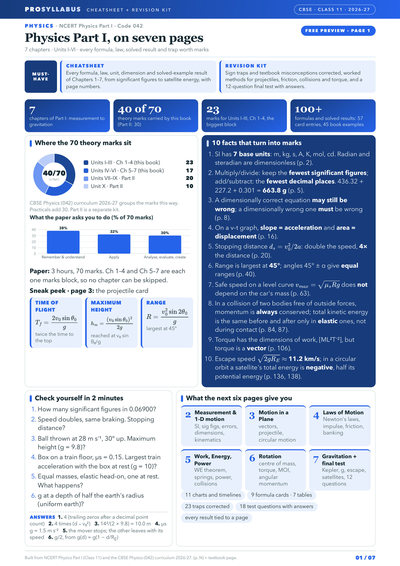
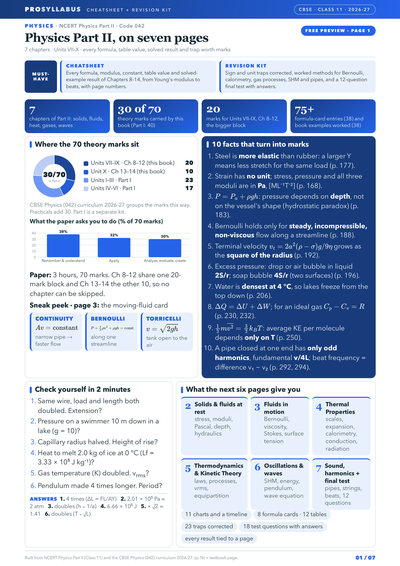
Read page 1 free Get the kit Get the kit One payment · instant PDF · ₹159 View details Marks booster + cheatsheet: key concepts in 2 lines each, common traps 20-mark block: Ch 8–12 10-mark block: Oscillations and Waves Common traps, corrected 7 chapters: every solved-example result Sound, standing waves and beats covered Page 1 free about 8 min read , Full kit about 55 min read ₹159
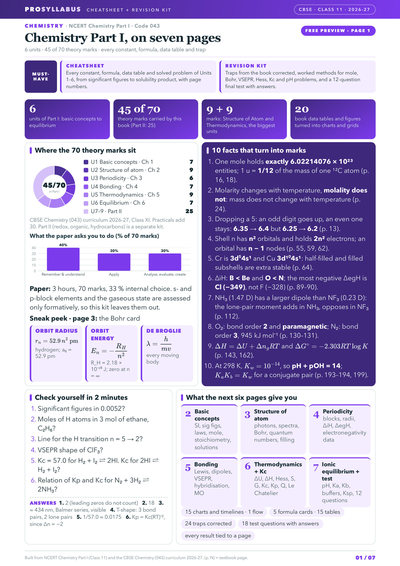
Read page 1 free Get the kit Get the kit One payment · instant PDF · ₹159 View details Marks booster + cheatsheet: key concepts in 2 lines each, common traps 9 marks each: Atom and Thermodynamics Constants and formulas, with page numbers Common traps, corrected Periodic trends from the real data pH, buffers and solubility product Page 1 free about 8 min read , Full kit about 55 min read ₹159
Read page 1 free Get the kit Get the kit One payment · instant PDF · ₹159 View details Marks booster + cheatsheet: key concepts in 2 lines each, common traps 10 marks: Hydrocarbons Every reaction with reagent and condition Common traps that cost marks, listed IUPAC naming rules Oxidation-number rules and balancing Page 1 free about 8 min read , Full kit about 55 min read ₹159
Read page 1 free Get the kit Get the kit One payment · instant PDF · ₹159 View details Marks booster + cheatsheet: key concepts in 2 lines each, common traps 18 marks: Unit V, breathing to hormones 15 marks each: Units I and III Common traps, corrected Five kingdoms classification table Physiological numbers, with page numbers Page 1 free about 8 min read , Full kit about 55 min read ₹159
Read page 1 free Get the kit Get the kit One payment · instant PDF · ₹159 View details Marks booster + cheatsheet: key concepts in 2 lines each, common traps 44 marks: Unit 2, recording to depreciation Journal formats and special purpose books Traps from all seven chapters Bank reconciliation adjustments Depreciation formulas, book's worked figures Page 1 free about 8 min read , Full kit about 55 min read ₹159
Read page 1 free Get the kit Get the kit One payment · instant PDF · ₹159 View details Marks booster + cheatsheet: key concepts in 2 lines each 12 exam traps, listed Five calculations the paper keeps asking Each adjustment: one entry, two effects Both formats: trading and P&L, balance sheet Yogita illustration solved line by line Page 1 free about 8 min read , Full kit about 55 min read ₹159
Read page 1 free Get the kit Get the kit One payment · instant PDF · ₹159 View details Marks booster + cheatsheet: key concepts in 2 lines each, common traps 20 marks: finance and MSME units 20 marks: internal and international trade Five comparison tables, insurance to retail Case cues for each chapter Common traps, corrected Page 1 free about 8 min read , Full kit about 55 min read ₹159
Read page 1 free Get the kit Get the kit One payment · instant PDF · ₹159 View details Marks booster + cheatsheet: key concepts in 2 lines each, common traps 15 marks: Ch 1–4, data to diagrams 7 chapters: every formula, worked numbers Common mistakes, corrected Book exercise answers included Part C project route Page 1 free about 8 min read , Full kit about 55 min read ₹159
Read page 1 free Get the kit Get the kit One payment · instant PDF · ₹159 View details Marks booster + cheatsheet: key concepts in 2 lines each, common traps 14 marks: Production and Costs, Unit 6 8 marks: Market Equilibrium, Unit 7 Common traps, corrected PPF, TU–MU, MRS and cost table drawn Demand and supply schedules from the book Page 1 free about 8 min read , Full kit about 55 min read ₹159
Read page 1 free Get the kit Get the kit One payment · instant PDF · ₹159 View details Marks booster + cheatsheet: key concepts in 2 lines each, common traps 20 marks: Empires section 20 marks: Changing Cultural Traditions 15 marks: Paths to Modernisation, Japan 5 marks: map work on the book's maps Common traps, corrected Page 1 free about 8 min read , Full kit about 55 min read ₹159
Read page 1 free Get the kit Get the kit One payment · instant PDF · ₹159 View details Marks booster + cheatsheet: key concepts in 2 lines each, common traps 8 marks: Climate unit, Ch 7–10 5 marks: map work, covered 4 marks: ocean data as charts, Unit V Heat budget and five air layers as charts Common traps, corrected Page 1 free about 8 min read , Full kit about 55 min read ₹159
Read page 1 free Get the kit Get the kit One payment · instant PDF · ₹159 View details Marks booster + cheatsheet: key concepts in 2 lines each, common traps 12 marks: Climate, Vegetation (Unit III) Full CBSE map-work list, chapter by chapter Indus, Ganga, Brahmaputra river systems Monsoon mechanism, onset and four seasons Common traps, corrected Page 1 free about 8 min read , Full kit about 55 min read ₹159
Read page 1 free Get the kit Get the kit One payment · instant PDF · ₹159 View details Marks booster + cheatsheet: key concepts in 2 lines each 4 marks: Map Scale, conversions worked 4 marks: Latitude, Longitude and Time 4 marks: Topographical Maps, contours 5 marks: practical file and viva Conical and Mercator's construction steps Page 1 free about 8 min read , Full kit about 55 min read ₹159
Read page 1 free Get the kit Get the kit One payment · instant PDF · ₹159 View details Marks booster + cheatsheet: key concepts in 2 lines each, common traps 8 marks together: Citizenship, Nationalism 6 marks each: Social Justice, Secularism 8 chapters: thinkers and a timeline Liberty, equality, justice side by side Common traps, corrected Page 1 free about 8 min read , Full kit about 55 min read ₹159
Read page 1 free Get the kit Get the kit One payment · instant PDF · ₹159 View details Marks booster + cheatsheet: key concepts in 2 lines each 12 marks: Executive to Judiciary Constitution-making timeline Institution-by-institution comparisons 6 marks: elections, FPTP, PR, reserved seats Fundamental Rights and Directive Principles Page 1 free about 8 min read , Full kit about 55 min read ₹159
Read page 1 free Get the kit Get the kit One payment · instant PDF · ₹159 View details Marks booster + cheatsheet: key concepts in 2 lines each, common traps 10 marks each: Units 1 and 2 20 marks: project work, covered Tables: groups, stratification, marriage Every thinker and concept of Chapters 1–4 Common traps, corrected Page 1 free about 8 min read , Full kit about 55 min read ₹159
Read page 1 free Get the kit Get the kit One payment · instant PDF · ₹159 View details Marks booster + cheatsheet: key concepts in 2 lines each, common traps 12 marks each: Units 7, 9 and 10 7 thinkers: dates, works, examples Four Indian sociologists, in tables Ideal type, bureaucracy, division of labour Common traps, corrected Page 1 free about 8 min read , Full kit about 55 min read ₹159
Read page 1 free Get the kit Get the kit One payment · instant PDF · ₹159 View details Marks booster + cheatsheet: key concepts in 2 lines each 11 marks each: Units I and III 9 marks: Learning, Unit V 8 marks each: Perception and Memory Every school with its founder Comparisons examiners ask for Page 1 free about 8 min read , Full kit about 55 min read ₹159
Read page 1 free Get the kit Get the kit One payment · instant PDF · ₹159 View details Marks booster + cheatsheet: key concepts in 2 lines each, common traps 8 marks: note-making and summary 5 poems compared, cross-text themes Common traps, corrected Poetic devices with short quotes Grammar each chapter teaches Page 1 free about 8 min read , Full kit about 55 min read ₹159
Read page 1 free Get the kit Get the kit One payment · instant PDF · ₹159 View details Marks booster + cheatsheet: key concepts in 2 lines each, common traps 4-, 3- and 6-mark answers: how to write them Plot timeline for every text Common traps, corrected Every character, with evidence Cross-text themes, side by side Page 1 free about 8 min read , Full kit about 55 min read ₹159
Read page 1 free Get the kit Get the kit One payment · instant PDF · ₹159 View details Marks booster + cheatsheet: key concepts in 2 lines each, common traps Poetic forms and rhyme schemes Devices with short quotes Common traps, corrected Essay arguments, essay by essay Words each chapter teaches Page 1 free about 8 min read , Full kit about 55 min read ₹159
Read page 1 free Get the kit Get the kit One payment · instant PDF · ₹159 View details Marks booster + cheatsheet: key concepts in 2 lines each 16 writers placed on one timeline 60- and 40-word answer frames 8 काव्य पाठ: प्रतीक and काव्य-सौंदर्य Lines worth remembering, with page refs 12 common mistakes, corrected Page 1 free about 8 min read , Full kit about 55 min read ₹159
Read page 1 free Get the kit Get the kit One payment · instant PDF · ₹159 View details Marks booster + cheatsheet: key concepts in 2 lines each 10 marks (2 × 5): answer frames 5-mark answers in about 60 words 4 lessons: argument, events, characters Lines worth remembering, by page 12 common mistakes, corrected Page 1 free about 8 min read , Full kit about 55 min read ₹159
Read page 1 free Get the kit Get the kit One payment · instant PDF · ₹159 View details Marks booster + cheatsheet: key concepts in 2 lines each 16 writers placed on one timeline 40-word and व्याख्या answer frames 8 काव्य पाठ: प्रतीक, उपमान, काव्य-सौंदर्य Lines worth remembering, with page refs 12 common mistakes, corrected Page 1 free about 8 min read , Full kit about 55 min read ₹159
Read page 1 free Get the kit Get the kit One payment · instant PDF · ₹159 View details Marks booster + cheatsheet: key concepts in 2 lines each 5-mark, 100-word answer frames 9 exercise questions: आवारा मसीहा 7 exercise questions: हुसैन की कहानी Life events linked to the works 12 common mistakes, corrected Page 1 free about 8 min read , Full kit about 55 min read ₹159
Read page 1 free Get the kit Get the kit One payment · instant PDF · ₹159 View details Marks booster + cheatsheet: key concepts in 2 lines each 20 marks: grammar, from text words Sandhi, pratyaya and lakar examples Anvaya and bhavartha answer method Source text and author for every lesson 10 common errors, corrected Page 1 free about 8 min read , Full kit about 55 min read ₹159
Read page 1 free Get the kit Get the kit One payment · instant PDF · ₹159 View details Marks booster + cheatsheet: key concepts in 2 lines each 20 marks: grammar, भाग ग, from the text 10 marks: history of literature Sandhi, samasa, pratyaya, upapada examples Source text and author for every lesson Common errors, corrected Page 1 free about 8 min read , Full kit about 55 min read ₹159
Read page 1 free Get the kit Get the kit One payment · instant PDF · ₹159 View details Marks booster + cheatsheet: key concepts in 2 lines each Author, genre and characters per lesson Couplets explained: Insha and Fani ghazals Grammar for Section A Letter and advertisement formats 10 common mistakes, corrected Page 1 free about 8 min read , Full kit about 55 min read ₹159
Read page 1 free Get the kit Get the kit One payment · instant PDF · ₹159 View details Marks booster + cheatsheet: key concepts in 2 lines each 38 marks: the answer frame 13 genres, each introduced 18 writers and poets: dates and works Literary devices (صنعتیں) and key words Common mistakes, corrected Page 1 free about 8 min read , Full kit about 55 min read ₹159
Read page 1 free Get the kit Get the kit One payment · instant PDF · ₹159 View details Marks booster + cheatsheet: key concepts in 2 lines each 10 marks: literary forms, covered 5 geets, each with its poet Nazm defined, with its four kinds Answer points for the book's questions Common mistakes, corrected Page 1 free about 8 min read , Full kit about 55 min read ₹159
Read page 1 free Get the kit Get the kit One payment · instant PDF · ₹159 View details Marks booster + cheatsheet: key concepts in 2 lines each, common traps 15 marks: Unit 3, society, law and ethics 10 marks: Unit 1, number-system conversions Common traps that cost marks, listed Truth tables for Boolean logic String, list and dictionary methods Page 1 free about 8 min read , Full kit about 55 min read ₹159
Read page 1 free Get the kit Get the kit One payment · instant PDF · ₹159 View details Marks booster + cheatsheet: key concepts in 2 lines each, common traps 25 marks: Python, lists, NumPy (Unit 2) 10 marks: Computer System (Unit 1) Common traps, corrected Every list and dictionary method, with output SQL queries re-run on the book's tables Page 1 free about 8 min read , Full kit about 55 min read ₹159
Read page 1 free Get the kit Get the kit One payment · instant PDF · ₹159 View details Marks booster + cheatsheet: key concepts in 2 lines each, common traps 23 marks: Unit II 15 marks: Unit III, health and hygiene Common traps, corrected Five food groups, RDA and the pyramid Nine fibres and the burning test Page 1 free about 8 min read , Full kit about 55 min read ₹159
Read page 1 free Get the kit Get the kit One payment · instant PDF · ₹159 View details Marks booster + cheatsheet: key concepts in 2 lines each 15 marks each: Childhood and Adulthood units RDAs and diet quantities by age Vaccine ages Budget steps and investment principles Stain-removal methods Page 1 free about 8 min read , Full kit about 55 min read ₹159
Read page 1 free Get the kit Get the kit One payment · instant PDF · ₹159 View details Marks booster + cheatsheet: key concepts in 2 lines each 15 marks each: the two theory units What to write when asked to appreciate Bharhut, Sanchi and the cave sites Temple architecture: how a temple is built Bronzes and Indo-Islamic buildings Page 1 free about 8 min read , Full kit about 55 min read ₹159
Read page 1 free Get the kit Get the kit One payment · instant PDF · ₹159 View details Marks booster + cheatsheet: key concepts in 2 lines each, common traps 20 marks each: Units II and III Enzyme kinetics and bioenergetics Common traps, corrected Mendel-to-operon genetics Tables and numbers, each with its page Page 1 free about 8 min read , Full kit about 55 min read ₹159
Read page 1 free Get the kit Get the kit One payment · instant PDF · ₹159 View details Marks booster + cheatsheet: key concepts in 2 lines each, common traps 15 marks: language and literature 14 marks: the nine darśanas Common traps, corrected 13 marks: astronomy in India 4 chapters, each with answer frames Page 1 free about 8 min read , Full kit about 55 min read ₹159
Read page 1 free Get the kit Get the kit One payment · instant PDF · ₹159 View details Marks booster + cheatsheet: key concepts in 2 lines each Frames for news, interview and review Inverted pyramid and the six ककार Play-writing frame Translation rules, with solved examples Common mistakes, corrected Page 1 free about 8 min read , Full kit about 55 min read ₹159
Read page 1 free Get the kit Get the kit One payment · instant PDF · ₹159 View details Marks booster + cheatsheet: key concepts in 2 lines each 50 marks: games and sports strand 25 marks: health and fitness strand Eight team games, side by side Fitness tests, norms and formulas Yoga asanas for wellness Page 1 free about 8 min read , Full kit about 55 min read ₹159
Read page 1 free Get the kit Get the kit One payment · instant PDF · ₹159 View details Marks booster + cheatsheet: key concepts in 2 lines each 22 श्रुतियाँ and 10 थाट, defined बिहाग, भीमपलासी, भैरवी with बंदिश notation तीनताल, एकताल, चौताल: ठाह, दुगुन, चौगुन तानसेन, भातखंडे, पलुस्कर profiled 12 common mistakes, corrected Page 1 free about 8 min read , Full kit about 55 min read ₹159
Read page 1 free Get the kit Get the kit One payment · instant PDF · ₹159 View details Marks booster + cheatsheet: key concepts in 2 lines each वादी-संवादी, पकड़ and बंदिश for each राग तीनताल, एकताल, चौताल: ठाह, दुगुन, चौगुन तानसेन, भातखंडे, पलुस्कर profiled Four classes of instruments, तानपुरा, सितार 12 common mistakes, corrected Page 1 free about 8 min read , Full kit about 55 min read ₹159
Read page 1 free Get the kit Get the kit One payment · instant PDF · ₹159 View details Marks booster + cheatsheet: key concepts in 2 lines each 6 marks each: all five units ठाह, दुगुन, तिगुन, चौगुन written out 14 artists with dates कुदऊ सिंह and नाना पानसे: two lives 14 common mistakes, corrected Page 1 free about 8 min read , Full kit about 55 min read ₹159
Read page 1 free Get the kit Get the kit One payment · instant PDF · ₹159 View details Get alerts for CBSE Class 11 Annual Assessment
Dates, results and cutoffs, by email when they are announced. Free.
Google, Apple, or a code to your phone or email. It is saved to your account.
This chapter is part of the CBSE Class 11 Annual Assessment Board Examination Explore every chapter — summary, notes, extra questions & MCQ quizzes Preparing for CBSE Class 11 Annual Assessment? Students also sit JEE is set on the Class 11 and 12 Physics, Chemistry and Maths syllabus; students prepare for boards and JEE together.
Tests are played signed in — sign in (free, 10 seconds) so your attempts, rank and XP are saved to you #1
Discovering Tut: the Saga Continues
Start here
#2
#3
Constitution: Why and How?
#4
#5
#6
#7
#8
Methods of Enquiry in Psychology
#9
#10
An Empire Across Three Continents
#11
#12
The Summer of the Beautiful White Horse
#13
#14
#15
We're Not Afraid to Die... if We Can All Be Together
#16
#17
Election and Representation
#18
Political Theory: An Introduction
#19
#20
Biological Classification
#21
Motion in a Straight Line
#22
Accountancy (Class 11) Practice Quiz | CBSE Class 11 Annual Assessment
#23
Sets and Venn Operations Fundamentals — Free CBSE Class 11 Annual Assessment Quiz
#24
#25
#26
#27
Rights in the Indian Constitution
#28
#29
#30
#31
#32
Changing Cultural Traditions
#33
#34
#35
#36
#37
Private, Public and Global Enterprises
#38
Depreciation, Provisions and Reserves
#39
Introduction to Accounting
#40
Cell Cycle and Cell Division
#41
#42
Anatomy of Flowering Plants
#43
Organic Chemistry – Some Basic Principles and Techniques
#44
#45
#46
#47
#48
#49
#50
#51
#52
#53
#54
#55
The Ailing Planet: the Green Movement's Role
#56
#57
#58
#59
Sensory, Attentional and Perceptual Processes
#60
#61
#62
Introducing Western Sociologists
#63
#64
Social Change and Social Order in Rural and Urban Society
#65
Social Structure, Stratification and Social Processes in Society
#66
Doing Sociology: Research Methods
#67
Culture and Socialisation
#68
Understanding Social Institutions
#69
Terms, Concepts and Their Use in Sociology
#70
#71
The Philosophy of the Constitution
#72
Constitution as a Living Document
#73
#74
#75
#76
#77
#78
#79
#80
#81
#82
Natural Hazards and Disasters
#83
#84
#85
#86
Structure and Physiography
#87
Biodiversity and Conservation
#88
#89
#90
World Climate and Climate Change
#91
Atmospheric Circulation and Weather Systems
#92
Solar Radiation, Heat Balance and Temperature
#93
Composition and Structure of Atmosphere
#94
Landforms and their Evolution
#95
#96
Distribution of Oceans and Continents
#97
#98
The Origin and Evolution of the Earth
#99
Geography as a Discipline
#100
Displacing Indigenous Peoples
#101
#102
Comparative Development Experiences of India and its Neighbours
#103
Environment and Sustainable Development
#104
Employment: Growth, Informalisation and Other Issues
#105
#106
Human Capital Formation in India
#107
Liberalisation, Privatisation and Globalisation: An Appraisal
#108
Indian Economy on the Eve of Independence
#109
#110
#111
#112
Measures of Central Tendency
#113
#114
#115
#116
#117
MSME and Business Entrepreneurship
#118
Sources of Business Finance
#119
#120
Social Responsibilities of Business and Business Ethics
#121
Emerging Modes of Business
#122
#123
Forms of Business Organisation
#124
Business, Trade and Commerce
#125
Financial Statements - II
#126
#127
Trial Balance and Rectification of Errors
#128
Bank Reconciliation Statement
#129
Recording of Transactions - II
#130
Recording of Transactions - I
#131
Theory Base of Accounting
#132
#133
#134
#135
Introduction to Three Dimensional Geometry
#136
#137
#138
#139
#140
Permutations and Combinations
#141
#142
Complex Numbers and Quadratic Equations
#143
#144
#145
Chemical Coordination and Integration
#146
Neural Control and Coordination
#147
#148
Excretory Products and their Elimination
#149
Body Fluids and Circulation
#150
Breathing and Exchange of Gases
#151
Plant Growth and Development
#152
#153
Photosynthesis in Higher Plants
#154
#155
Structural Organisation in Animals
#156
Morphology of Flowering Plants
#157
#158
#159
Chemical Bonding and Molecular Structure
#160
Classification of Elements and Periodicity in Properties
#161
Some Basic Concepts of Chemistry
#162
#163
#164
#165
#166
Thermal Properties of Matter
#167
Mechanical Properties of Fluids
#168
Mechanical Properties of Solids
#169
#170
Systems of Particles and Rotational Motion
#171
#172
#173
Business Studies (Class 11) Practice Quiz | CBSE Class 11 Annual Assessment
#174
Economics (Class 11) Practice Quiz | CBSE Class 11 Annual Assessment
#175
Humanities Subjects Practice Quiz | CBSE Class 11 Annual Assessment
#176
Motion in a Straight Line Practice Quiz | CBSE Class 11 Annual Assessment
#177
Thermodynamic Processes and Laws Advanced Challenge | CBSE Class 11 Annual Assessment
More on CBSE Class 11 Annual Assessment20 guides Tuples and Dictionaries – NCERT Class 11 Computer Science Chapter 10 – Tuple Operations and Dictionary Handling in Python Strings – NCERT Class 11 Computer Science Chapter 8 – String Operations, Traversal, and Methods in Python Getting Started with Python – NCERT Class 11 Computer Science Chapter 5 – Basics, Data Types, Operators, and Debugging Functions – NCERT Class 11 Computer Science Chapter 7 – Defining, Calling, and Understanding Functions in Python Complete Summary and Solutions for Emerging Trends – NCERT Class XI Informatics Practices, Chapter 2 – Explanation, Questions, Answers Mathematical Modelling – NCERT Class 11 Mathematics Appendix 2 – Concepts, Importance, and Applications in Real-world Problems Complete Summary and Solutions for Database Concepts – NCERT Class XI Informatics Practices, Chapter 7 – Explanation, Questions, Answers Encoding Schemes and Number System – NCERT Class 11 Computer Science Chapter 2 – ASCII, ISCII, UNICODE, Binary, Octal, Decimal, Hexadecimal Complete Summary and Solutions for Brief Overview of Python – NCERT Class XI Informatics Practices, Chapter 3 – Explanation, Questions, Answers Complete Summary and Solutions for Computer System – NCERT Class XI Informatics Practices, Chapter 1 – Explanation, Questions, Answers Introduction to Problem Solving – NCERT Class 11 Computer Science Chapter 4 – Algorithms, Flowcharts, Pseudocode, and Control Structures Flow of Control – NCERT Class 11 Computer Science Chapter 6 – Conditional and Looping Constructs in Python Alerts and Updates for CBSE Class 11 Annual Assessment Complete Summary and Solutions for Adventure Sports – Health and Physical Education Textbook for Class XI, Chapter 11 – Explanation, Questions, Answers Complete Summary and Solutions for Tournaments and Competitions – Health and Physical Education Textbook for Class XI, Chapter 10 – Explanation, Questions, Answers Complete Summary and Solutions for Measurement and Evaluation – Health and Physical Education Textbook for Class XI, Chapter 9 – Explanation, Questions, Answers Complete Summary and Solutions for Health Related Physical Fitness – Health and Physical Education Textbook for Class XI, Chapter 8 – Explanation, Questions, Answers Complete Summary and Solutions for Safety and Security – Health and Physical Education Textbook for Class XI, Chapter 7 – Explanation, Questions, Answers Complete Summary and Solutions for Yoga and Its Relevance in the Modern Times – Health and Physical Education Textbook for Class XI, Chapter 6 – Explanation, Questions, Answers Complete Summary and Solutions for Team Games – Health and Physical Education Textbook for Class XI, Chapter 5 – Explanation, Questions, Answers Notebook backup + AI Save your notes. Revise with AI. Learn more → Share this article