The Crisis of Democratic Order
Class 12 Political Science · Politics in India Since Independence · Chapter 6
163 members in the CBSE community
View all










CBSE Class 12 · Political Science
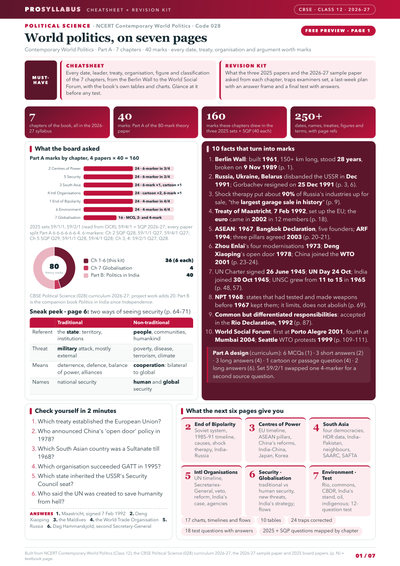
End of Bipolarity: asked in all 4 papers- Marks booster + cheatsheet: most-asked concepts in 2 lines each
- 6-marker in 3 of 4 papers: Security
- 4-marker in all 4 papers: Environment
- 6-marker in 3 of 4 papers: centres of power
- 2 papers asked UN cartoons
- 7 chapters: dates, treaties, leaders
CBSE Class 12 · Political Science
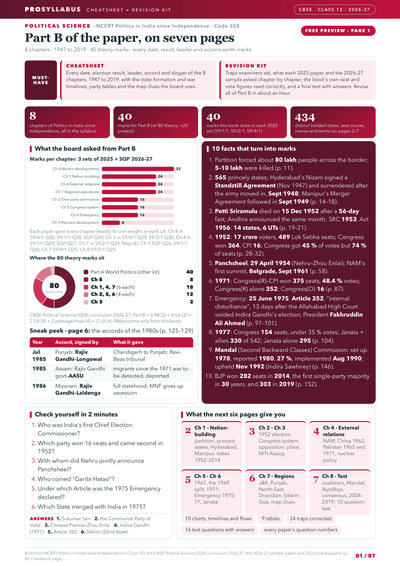
40 theory marks, split chapter by chapter- Marks booster + cheatsheet: key concepts in 2 lines each
- 8 marks: Chapter 8, 1989 to 2019
- 6 marks each: Chapters 1, 4 and 7
- State-formation and war timelines
- Party tables and election results
- Map clues the board uses
Summary
This chapter studies the Emergency of 1975-77, a crucial phase in Indian democracy. After 1971 the economic situation worsened — the Bangladesh crisis, the oil shock, high inflation, unemployment and a failed monsoon caused widespread discontent. Student movements in Gujarat and Bihar, the latter led by Jayaprakash Narayan (JP) who called for 'Total Revolution', and the 1974 railway strike led by George Fernandes intensified the crisis. Tensions between the government and the judiciary grew over Parliament's power to amend Fundamental Rights, culminating in the Kesavananda Bharati case and the supersession of judges. The climax came on 12 June 1975 when the Allahabad High Court declared Indira Gandhi's election invalid. As JP called for a nationwide satyagraha, the government declared a state of Emergency on 25 June 1975 under Article 352, citing internal disturbance. Fundamental Rights were suspended, the press was censored, opposition leaders were jailed, preventive detention was widely used, and the 42nd Amendment was passed. The 1977 elections became a referendum on the Emergency: the newly formed Janata Party, led by JP and headed by Morarji Desai, defeated the Congress, but its internal divisions soon brought it down, and Indira Gandhi returned in 1980.