Challenges to and Restoration of the Congress System
Class 12 Political Science · Politics in India Since Independence · Chapter 5
163 members in the CBSE community
View all










CBSE Class 12 · Political Science
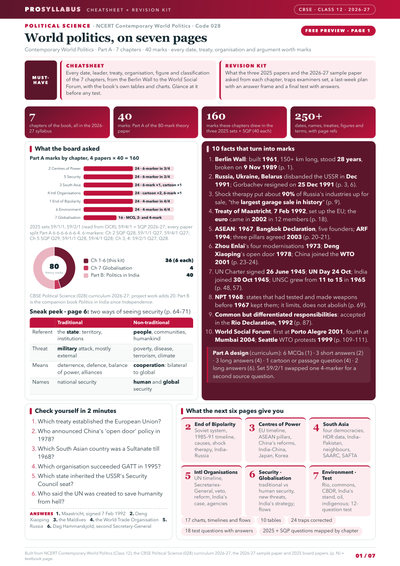
End of Bipolarity: asked in all 4 papers- Marks booster + cheatsheet: most-asked concepts in 2 lines each
- 6-marker in 3 of 4 papers: Security
- 4-marker in all 4 papers: Environment
- 6-marker in 3 of 4 papers: centres of power
- 2 papers asked UN cartoons
- 7 chapters: dates, treaties, leaders
CBSE Class 12 · Political Science
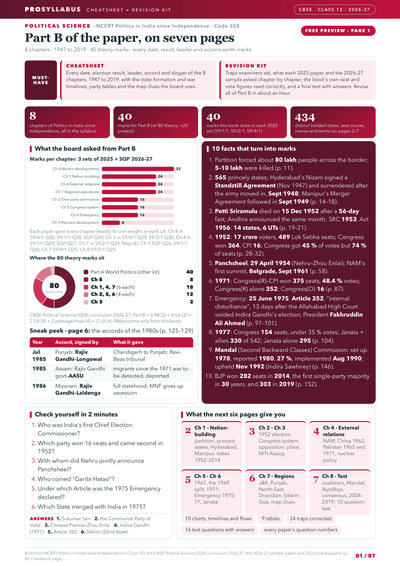
40 theory marks, split chapter by chapter- Marks booster + cheatsheet: key concepts in 2 lines each
- 8 marks: Chapter 8, 1989 to 2019
- 6 marks each: Chapters 1, 4 and 7
- State-formation and war timelines
- Party tables and election results
- Map clues the board uses
Summary
This chapter traces how the Congress system was challenged in the 1960s and then restored by Indira Gandhi. After Nehru died in 1964, a smooth succession brought Lal Bahadur Shastri (1964-66) to power; his slogan 'Jai Jawan Jai Kisan' captured the wars and food crises of his term. After Shastri's death, Indira Gandhi defeated Morarji Desai to become Prime Minister. The fourth general election of 1967 was a landmark 'political earthquake': amid economic crisis, rupee devaluation and price rise, opposition parties united under the strategy of 'non-Congressism' coined by Ram Manohar Lohia. The Congress retained a reduced majority at the Centre but lost power in nine states, where Samyukta Vidhayak Dal coalition governments formed, and the era of coalitions, defections ('Aya Ram, Gaya Ram') and the DMK's rise began. Indira Gandhi faced the 'Syndicate' of powerful party bosses; she converted a power struggle into an ideological one with a Left turn, nationalising banks and abolishing privy purses. The 1969 presidential election split the Congress into Congress (O) and Congress (R). In the 1971 election, her slogan 'Garibi Hatao' against the opposition's 'Grand Alliance' won a sweeping victory, and the Bangladesh war added to her popularity, restoring Congress dominance in a new, leader-centred form.