Regional Aspirations
Class 12 Political Science · Politics in India Since Independence · Chapter 7
163 members in the CBSE community
View all










CBSE Class 12 · Political Science
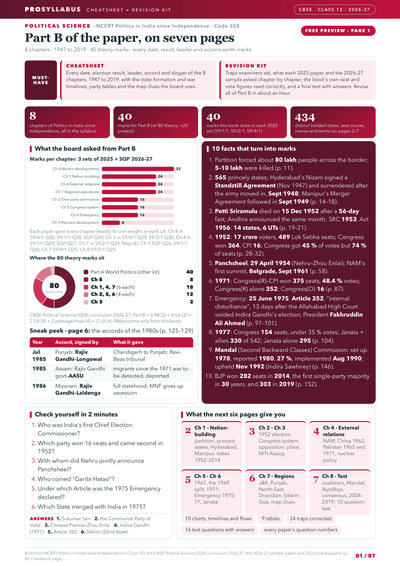
40 theory marks, split chapter by chapter- Marks booster + cheatsheet: key concepts in 2 lines each
- 8 marks: Chapter 8, 1989 to 2019
- 6 marks each: Chapters 1, 4 and 7
- State-formation and war timelines
- Party tables and election results
- Map clues the board uses
CBSE Class 12 · Political Science
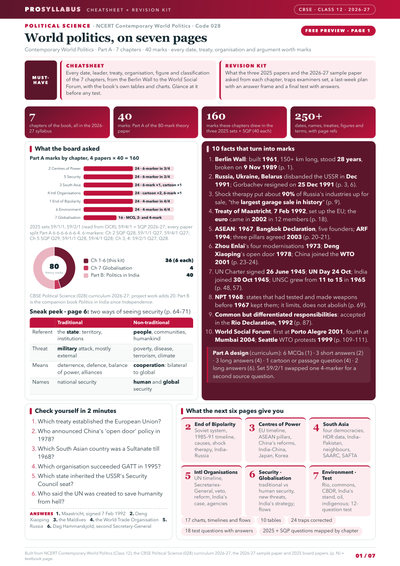
End of Bipolarity: asked in all 4 papers- Marks booster + cheatsheet: most-asked concepts in 2 lines each
- 6-marker in 3 of 4 papers: Security
- 4-marker in all 4 papers: Environment
- 6-marker in 3 of 4 papers: centres of power
- 2 papers asked UN cartoons
- 7 chapters: dates, treaties, leaders
Summary
This chapter examines how regional aspirations for autonomy challenged nation building, especially in the 1980s, and how the Indian approach balanced unity with diversity through democratic negotiation. The Indian Constitution accommodates regional and linguistic cultures rather than treating diversity as a threat. The chapter studies several cases. In Jammu and Kashmir — comprising Jammu, Kashmir and Ladakh — the dispute had external (Pakistan's claim) and internal (autonomy under Article 370) dimensions, with insurgency from 1989; Article 370 was abrogated in 2019, creating two union territories. In Punjab, Akali demands reflected in the 1973 Anandpur Sahib Resolution led to militancy, Operation Blue Star (1984), Indira Gandhi's assassination, anti-Sikh violence, and finally the Rajiv Gandhi-Longowal Accord (1985) and a return to peace. In the North-East, three issues dominated — demands for autonomy, secessionist movements (Mizoram, settled by the 1986 accord with Laldenga; Nagaland, still unresolved), and movements against 'outsiders' (the Assam Movement of 1979-85, ending in the Assam Accord). The Dravidian movement, Sikkim's merger and Goa's liberation are also discussed. The chapter draws lessons: regional aspirations are normal in a democracy and best handled by negotiation, power sharing and balanced development.