Politics of Planned Development
Class 12 Political Science · Politics in India Since Independence · Chapter 3
163 members in the CBSE community
View all










CBSE Class 12 · Political Science
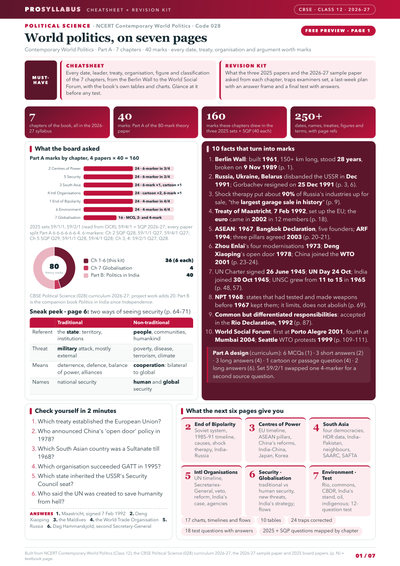
End of Bipolarity: asked in all 4 papers- Marks booster + cheatsheet: most-asked concepts in 2 lines each
- 6-marker in 3 of 4 papers: Security
- 4-marker in all 4 papers: Environment
- 6-marker in 3 of 4 papers: centres of power
- 2 papers asked UN cartoons
- 7 chapters: dates, treaties, leaders
CBSE Class 12 · Political Science
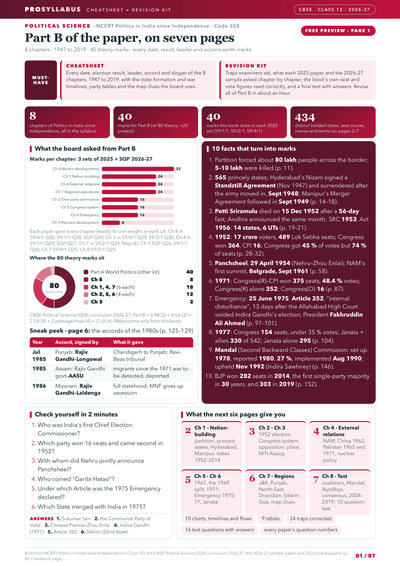
40 theory marks, split chapter by chapter- Marks booster + cheatsheet: key concepts in 2 lines each
- 8 marks: Chapter 8, 1989 to 2019
- 6 marks each: Chapters 1, 4 and 7
- State-formation and war timelines
- Party tables and election results
- Map clues the board uses
Summary
This chapter studies the political choices behind India's economic development. After independence there was broad agreement that development meant both economic growth and social and economic justice, and that the government, not private actors alone, must lead it. The debate was over how big a role the state should play, whether to prioritise industry or agriculture, and how much weight to give justice. India had before it two models — the liberal-capitalist and the socialist — and many leaders, including Nehru, admired the Soviet model. A consensus on planning emerged, reinforced even by industrialists' 1944 Bombay Plan. The Planning Commission, set up in 1950 with the Prime Minister as chairperson, became the central body for development and adopted Five Year Plans. The First Five Year Plan (1951-56), drafted with K.N. Raj's involvement, focused on agriculture, dams like Bhakra Nangal, and land reforms. The Second Plan (1956), led by P.C. Mahalanobis and reflecting the 'socialist pattern of society', stressed rapid industrialisation and heavy industry in the public sector, protected by tariffs. Critics noted its urban bias and neglect of agriculture, while the Green Revolution and milk cooperatives shaped later debates. (The Planning Commission was replaced by NITI Aayog in 2015.)