Molecular Basis of Inheritance
Class 12 Biology · Biology · Chapter 5
163 members in the CBSE community
View all









CBSE Class 12 · Biology
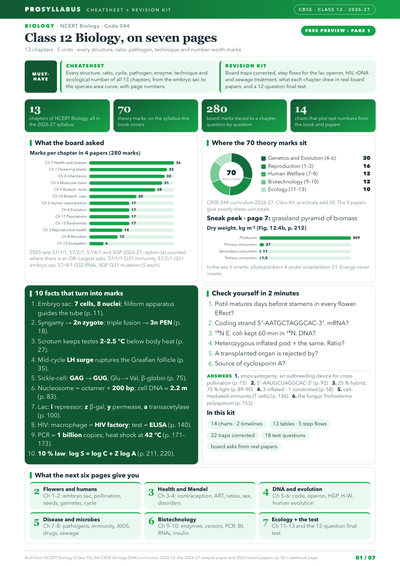
Genetics + Evolution: Unit VII, 20 marks- Marks booster + cheatsheet: key concepts in 2 lines each, common traps
- 16 marks: Reproduction, Unit VI
- 12 marks each: Units VIII and IX
- 10 marks: Ecology, Unit X
- 13 chapters, with page numbers
- Common traps, corrected
CBSE Class 12 · Biology
Genetics + Evolution: Unit VII, 20 marks- Marks booster + cheatsheet: key concepts in 2 lines each, common traps
- 16 marks: Reproduction, Unit VI
- 12 marks each: Units VIII and IX
- 10 marks: Ecology, Unit X
- 13 chapters, with page numbers
- Common traps, corrected
Summary
This chapter explores DNA as the genetic material and the molecular events of inheritance. The structure of DNA, given by Watson and Crick, is an antiparallel double helix with complementary base pairing (A-T, G-C) following Chargaff's rules, with sugar-phosphate backbones. Experiments by Griffith (transformation), Avery, MacLeod and McCarty, and Hershey and Chase established DNA as the genetic material. DNA packaging into nucleosomes and chromatin is described. DNA replication is semiconservative, demonstrated by Meselson and Stahl, and uses enzymes such as DNA polymerase, helicase and ligase at the replication fork, with leading and lagging strand synthesis. The central dogma describes the flow of genetic information from DNA to RNA to protein. Transcription synthesises RNA using RNA polymerase, with post-transcriptional processing (capping, tailing, splicing of introns) in eukaryotes. The genetic code is triplet, degenerate, non-overlapping, unambiguous and nearly universal, with start and stop codons. Translation assembles polypeptides on ribosomes using tRNA and mRNA. Gene regulation is illustrated by the lac operon in bacteria. The chapter concludes with the Human Genome Project, its goals, methods and findings, and DNA fingerprinting based on variable number tandem repeats (VNTRs), used in forensics and parentage testing.