Human Health and Disease
Class 12 Biology · Biology · Chapter 7
163 members in the CBSE community
View all










CBSE Class 12 · Biology
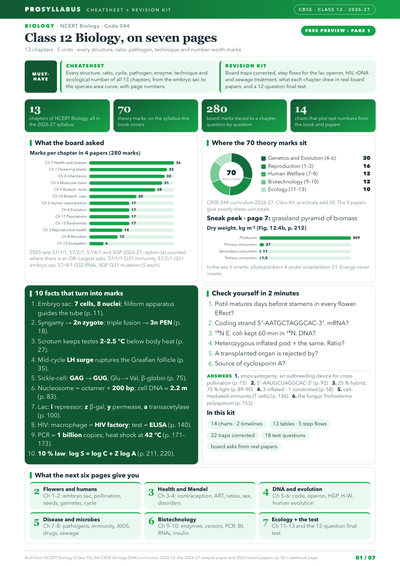
Genetics + Evolution: Unit VII, 20 marks- Marks booster + cheatsheet: key concepts in 2 lines each, common traps
- 16 marks: Reproduction, Unit VI
- 12 marks each: Units VIII and IX
- 10 marks: Ecology, Unit X
- 13 chapters, with page numbers
- Common traps, corrected
CBSE Class 12 · Biology
Genetics + Evolution: Unit VII, 20 marks- Marks booster + cheatsheet: key concepts in 2 lines each, common traps
- 16 marks: Reproduction, Unit VI
- 12 marks each: Units VIII and IX
- 10 marks: Ecology, Unit X
- 13 chapters, with page numbers
- Common traps, corrected
Summary
This chapter examines human health, disease and the body's defence mechanisms. It defines health and discusses common human diseases caused by pathogens, including bacterial (typhoid, pneumonia), viral (common cold), protozoan (malaria caused by Plasmodium, amoebiasis), fungal (ringworm) and helminthic (ascariasis, filariasis) infections, along with their symptoms, life cycles and preventive measures. The immune system is described in detail, distinguishing innate immunity (physical, physiological, cellular and cytokine barriers) from acquired immunity (humoral or antibody-mediated and cell-mediated). The structure of antibodies, types of immunoglobulins, primary and secondary immune responses, active and passive immunity, and the basis of vaccination and immunisation are explained. Allergies, autoimmunity and the role of the lymphoid organs (thymus, bone marrow, spleen, lymph nodes) are covered. AIDS, caused by the Human Immunodeficiency Virus (HIV), its transmission, mode of action on helper T-cells, diagnosis and prevention are detailed. Cancer is explained in terms of cell-cycle deregulation, oncogenes, proto-oncogenes, metastasis, and methods of detection and treatment. The chapter ends with drugs and alcohol abuse, covering opioids, cannabinoids, coca alkaloids, tobacco, their effects, addiction, dependence and the importance of prevention and rehabilitation.