Biotechnology: Principles and Processes
Class 12 Biology · Biology · Chapter 9
163 members in the CBSE community
View all










CBSE Class 12 · Biology
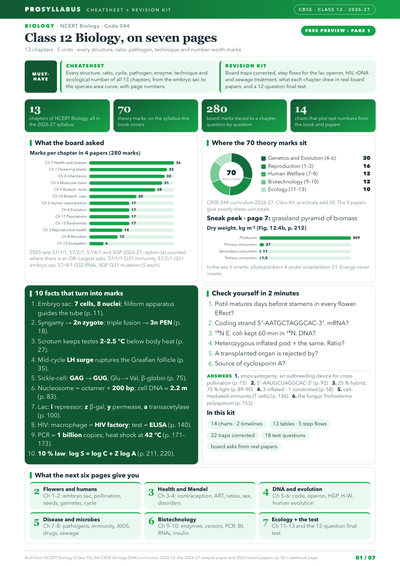
Genetics + Evolution: Unit VII, 20 marks- Marks booster + cheatsheet: key concepts in 2 lines each, common traps
- 16 marks: Reproduction, Unit VI
- 12 marks each: Units VIII and IX
- 10 marks: Ecology, Unit X
- 13 chapters, with page numbers
- Common traps, corrected
CBSE Class 12 · Biology
Genetics + Evolution: Unit VII, 20 marks- Marks booster + cheatsheet: key concepts in 2 lines each, common traps
- 16 marks: Reproduction, Unit VI
- 12 marks each: Units VIII and IX
- 10 marks: Ecology, Unit X
- 13 chapters, with page numbers
- Common traps, corrected
Summary
This chapter introduces biotechnology, the use of living organisms or their components to produce useful products, and the principles and tools underlying recombinant DNA (genetic engineering) technology. The two core techniques are genetic engineering (altering DNA and introducing it into hosts) and maintaining sterile conditions for the large-scale growth of microbes and cells. Key tools of recombinant DNA technology include restriction enzymes (molecular scissors that cut DNA at specific palindromic sequences producing sticky ends), DNA ligase (molecular glue), cloning vectors (plasmids, bacteriophages) with features such as origin of replication, selectable markers and recognition sites, and host organisms. Separation and isolation of DNA fragments is achieved by gel electrophoresis. The process of recombinant DNA technology is described step by step: isolation of the gene of interest, cutting and joining DNA, amplification using the Polymerase Chain Reaction (PCR), insertion into a vector, transfer into a competent host (transformation), selection of transformants, and obtaining the foreign gene product. Methods of introducing recombinant DNA, including microinjection, biolistics (gene gun) and disarmed Agrobacterium, are covered. Bioreactors for scaling up production, downstream processing, and quality control are explained, highlighting the industrial application of these principles.