Ecosystem
Class 12 Biology · Biology · Chapter 12
163 members in the CBSE community
View all









CBSE Class 12 · Biology
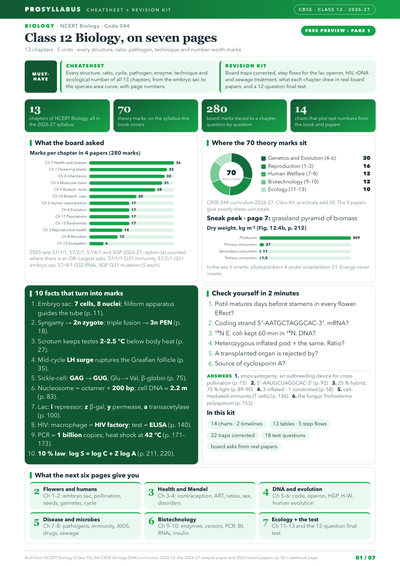
Genetics + Evolution: Unit VII, 20 marks- Marks booster + cheatsheet: key concepts in 2 lines each, common traps
- 16 marks: Reproduction, Unit VI
- 12 marks each: Units VIII and IX
- 10 marks: Ecology, Unit X
- 13 chapters, with page numbers
- Common traps, corrected
CBSE Class 12 · Biology
Genetics + Evolution: Unit VII, 20 marks- Marks booster + cheatsheet: key concepts in 2 lines each, common traps
- 16 marks: Reproduction, Unit VI
- 12 marks each: Units VIII and IX
- 10 marks: Ecology, Unit X
- 13 chapters, with page numbers
- Common traps, corrected
Summary
This chapter examines the structure and function of ecosystems, the functional units of nature where living organisms interact with the physical environment. The structural components include biotic (producers, consumers, decomposers) and abiotic (climate, inorganic and organic substances) factors, while functional aspects include productivity, decomposition, energy flow and nutrient cycling. Productivity is divided into primary productivity (gross and net, GPP and NPP) and secondary productivity. Decomposition breaks down detritus through fragmentation, leaching, catabolism, humification and mineralisation, carried out by decomposers (saprotrophs). Energy flow follows the food chain (grazing and detritus) and food web, obeying the unidirectional flow of energy and the ten per cent law as energy passes through trophic levels. Ecological pyramids of number, biomass and energy depict trophic structure; the pyramid of energy is always upright, while pyramids of number and biomass can be inverted. Ecological succession, the gradual and predictable change in species composition over time, is described for both primary and secondary succession, leading toward a stable climax community, with hydrarch and xerarch examples. Biogeochemical cycles (nutrient cycling) of carbon and phosphorus are explained, distinguishing gaseous and sedimentary cycles. The chapter also covers ecosystem services such as pollination, climate regulation, nutrient cycling and water purification provided by nature.