Terms, Concepts and Their Use in Sociology
Class 11 Sociology · Introducing Sociology · Chapter 2
173 members in the CBSE community
View all










CBSE Class 11 · Sociology
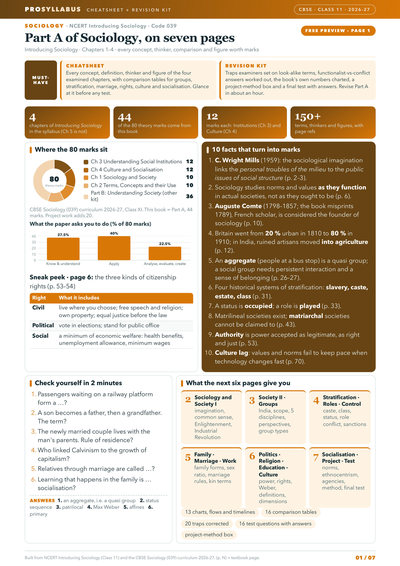
Institutions + Culture: 12 marks each- Marks booster + cheatsheet: key concepts in 2 lines each, common traps
- 10 marks each: Units 1 and 2
- 20 marks: project work, covered
- Tables: groups, stratification, marriage
- Every thinker and concept of Chapters 1–4
- Common traps, corrected
CBSE Class 11 · Sociology
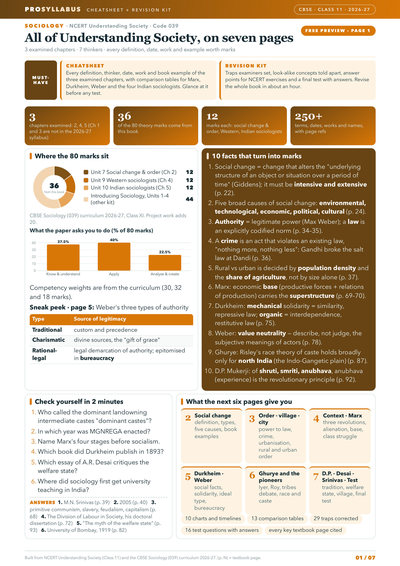
Marx, Durkheim, Weber compared in tables- Marks booster + cheatsheet: key concepts in 2 lines each, common traps
- 12 marks each: Units 7, 9 and 10
- 7 thinkers: dates, works, examples
- Four Indian sociologists, in tables
- Ideal type, bureaucracy, division of labour
- Common traps, corrected
Summary
Sociology needs a precise vocabulary precisely because its subject matter — family, status, social control — is so familiar that we cannot see it clearly. Concepts are keys that open locks to understanding society, but they must be constantly questioned and modified. The chapter explains how individuals form social groups, which differ from mere aggregates (people in the same place, like a bus queue) and quasi-groups (unorganised collections such as a social class that may later become an organised group). A social group has persistent interaction, a sense of belonging, shared norms and a definable structure. Sociologists classify groups into primary (small, intimate, face-to-face, like family) and secondary (large, formal, goal-oriented, like a school), and into community versus society or association, in-groups versus out-groups, peer groups and reference groups. Social stratification refers to structured inequalities between groups; four historical systems are slavery, caste, estate and class. Caste rests on ascribed status fixed by birth and ideas of purity and pollution, while modern class is open and achievement-based, explained variously by Marx, Weber and functionalism. Status is a position in society, role is its dynamic behavioural aspect; statuses may be ascribed or achieved, and individuals occupy a whole status set, facing role conflict and role stereotyping. Finally, social control — formal (law, state) and informal (ridicule, family, custom) — uses sanctions to manage deviance and maintain order, viewed differently by functionalist and conflict theorists.