Introducing Western Sociologists
Class 11 Sociology · Understanding Society · Chapter 4
173 members in the CBSE community
View all











CBSE Class 11 · Sociology
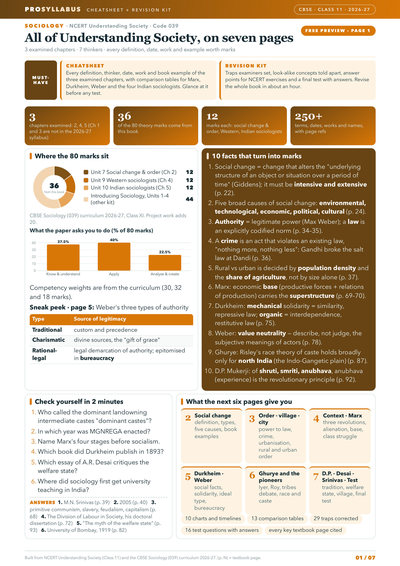
Marx, Durkheim, Weber compared in tables- Marks booster + cheatsheet: key concepts in 2 lines each, common traps
- 12 marks each: Units 7, 9 and 10
- 7 thinkers: dates, works, examples
- Four Indian sociologists, in tables
- Ideal type, bureaucracy, division of labour
- Common traps, corrected
CBSE Class 11 · Sociology
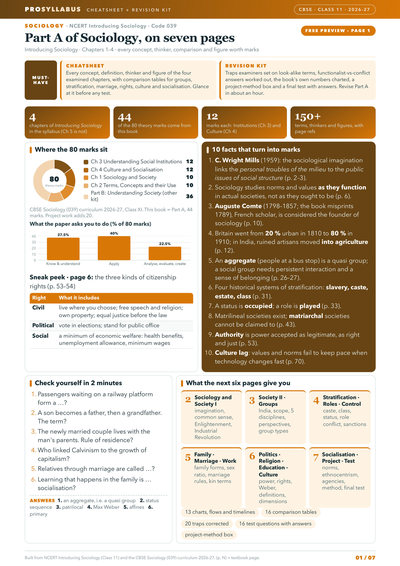
Institutions + Culture: 12 marks each- Marks booster + cheatsheet: key concepts in 2 lines each, common traps
- 10 marks each: Units 1 and 2
- 20 marks: project work, covered
- Tables: groups, stratification, marriage
- Every thinker and concept of Chapters 1–4
- Common traps, corrected
Summary
Sociology is the child of the "age of revolution", born in nineteenth-century Western Europe out of three great upheavals: the Enlightenment, which placed the rational human being at the centre and made society amenable to scientific analysis; the French Revolution, which announced political sovereignty, equality before law and the separation of public and private realms; and the Industrial Revolution, which created factory production, urban domination and the new working class whose problems demanded new knowledge. The chapter introduces three classical thinkers. Karl Marx analysed capitalism critically, arguing that history passes through modes of production — primitive communism, slavery, feudalism, capitalism — each with an economic base (productive forces and relations of production) on which rests a superstructure of ideas and institutions; material life shapes ideas, and the engine of historical change is class struggle between oppressor and oppressed, complicated by dominant ideology and class consciousness, culminating under favourable conditions in revolution. Emile Durkheim, founder of sociology as a formal discipline, made social facts — external, constraining, collective — the empirical subject matter of sociology, and in the Division of Labour distinguished mechanical solidarity (sameness, repressive law) from organic solidarity (interdependence, restitutive law). Max Weber developed an interpretive sociology of social action, requiring empathetic understanding and value-neutrality, and the methodological tool of the ideal type. He distinguished traditional, charismatic and rational-legal authority, the last epitomised in bureaucracy, whose features include fixed official jurisdiction, hierarchy, written records, specialised office management and rule-governed conduct.