Environment and Society
Class 11 Sociology · Understanding Society · Chapter 3
173 members in the CBSE community
View all











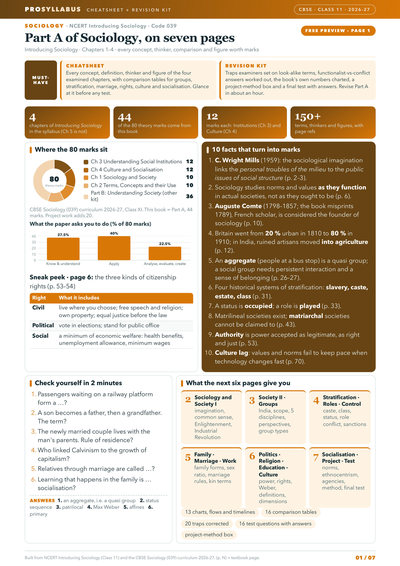
CBSE Class 11 · Sociology
Institutions + Culture: 12 marks each- Marks booster + cheatsheet: key concepts in 2 lines each, common traps
- 10 marks each: Units 1 and 2
- 20 marks: project work, covered
- Tables: groups, stratification, marriage
- Every thinker and concept of Chapters 1–4
- Common traps, corrected
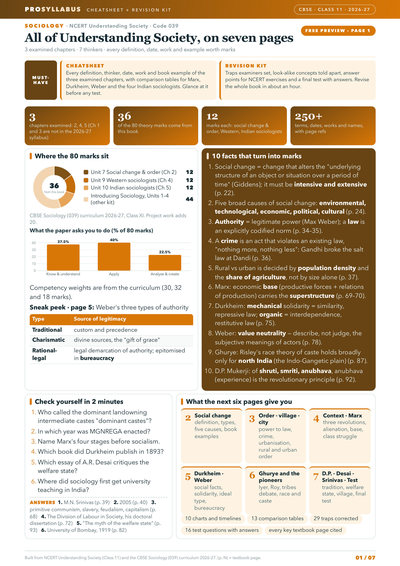
CBSE Class 11 · Sociology
Marx, Durkheim, Weber compared in tables- Marks booster + cheatsheet: key concepts in 2 lines each, common traps
- 12 marks each: Units 7, 9 and 10
- 7 thinkers: dates, works, examples
- Four Indian sociologists, in tables
- Ideal type, bureaucracy, division of labour
- Common traps, corrected
Summary
Every social object — the classroom chair, electricity, the school bag — ultimately draws on natural resources, so all societies have an ecological basis. Ecology is the web of physical and biological systems of which humans are one element, but over time human action modifies ecology, so that apparently "natural" features such as flood-proneness or a forest's species mix are often produced by human intervention. Social environments emerge from a two-way process: nature shapes society and society shapes nature, as the fertile Indo-Gangetic plain supports dense, hierarchical societies while the desert supports mobile pastoralists, and capitalism's automobiles and plantations reshape landscapes worldwide. This interaction is governed by social organisation — property relations decide who may use resources, the division of labour means women and landless labourers relate to nature differently, and values, norms and knowledge systems (capitalist, socialist, religious) shape environmental practice. Environmental management is difficult and modern societies are "risk societies" prone to disasters such as Bhopal and Chernobyl. The major environmental problems are resource depletion (groundwater, topsoil, biodiversity), pollution (air, water, noise, including deadly indoor cooking-fire smoke), global warming from greenhouse gases, genetically modified organisms and natural and man-made disasters. Crucially, environmental problems are also social problems because their impact follows social inequality — rich farmers tap deep tubewells while the poor go thirsty. The school of social ecology argues that ecological problems are rooted in social problems of property, production and inequality, and sustainable development seeks to meet present needs without compromising future generations.