Culture and Socialisation
Class 11 Sociology · Introducing Sociology · Chapter 4
173 members in the CBSE community
View all






CBSE Class 11 · Sociology
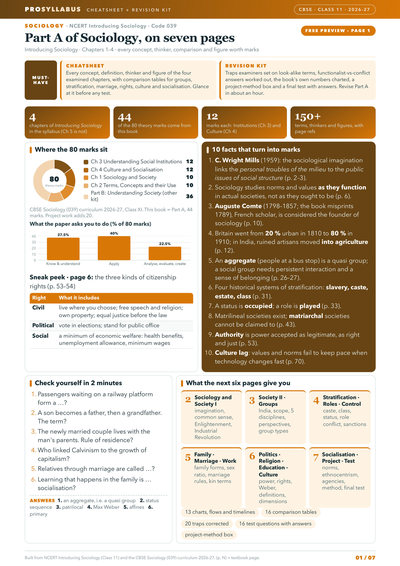
Institutions + Culture: 12 marks each- Marks booster + cheatsheet: key concepts in 2 lines each, common traps
- 10 marks each: Units 1 and 2
- 20 marks: project work, covered
- Tables: groups, stratification, marriage
- Every thinker and concept of Chapters 1–4
- Common traps, corrected
CBSE Class 11 · Sociology
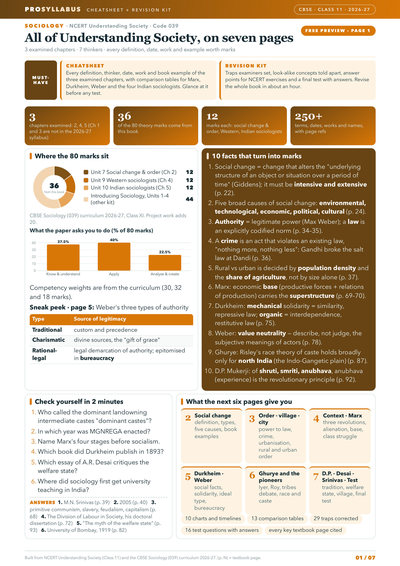
Marx, Durkheim, Weber compared in tables- Marks booster + cheatsheet: key concepts in 2 lines each, common traps
- 12 marks each: Units 7, 9 and 10
- 7 thinkers: dates, works, examples
- Four Indian sociologists, in tables
- Ideal type, bureaucracy, division of labour
- Common traps, corrected
Summary
Culture is the common, learned understanding developed through social interaction that gives a group its identity; unlike the everyday use of the word for refined taste in the arts, sociologists treat it as the whole way of life shared by all members of a society. Cultures are dynamic, always changing, and cannot be ranked as superior or inferior, only judged adequate or inadequate in coping with nature, as the tsunami example of tribal foreknowledge shows. Culture has three dimensions: the cognitive (how we process and give meaning to information), the normative (rules of conduct — folkways, mores, customs, conventions and laws, backed by sanctions) and the material (tools, technology, machines and goods); when material change outpaces non-material values, a culture lag results. Identity is fashioned, not inherited, through roles and through sub-cultures with their own styles and codes. Ethnocentrism judges other cultures by the standards of one's own and assumes superiority, whereas a cosmopolitan outlook values difference and enriches a culture through borrowing. Cultural change may be internal or external, evolutionary or revolutionary. Socialisation is the lifelong process by which a helpless infant becomes a self-aware, knowledgeable member of society; the wolf-children example shows that without it one cannot be fully human. Primary socialisation happens in the family and secondary socialisation through school, peer groups, mass media and work. Socialisation is not mere programming — it is the source of our individuality and freedom, and it is deeply gendered.