What is Psychology?
Class 11 Psychology · Psychology · Chapter 1
163 members in the CBSE community
View all








CBSE Class 11 · Psychology
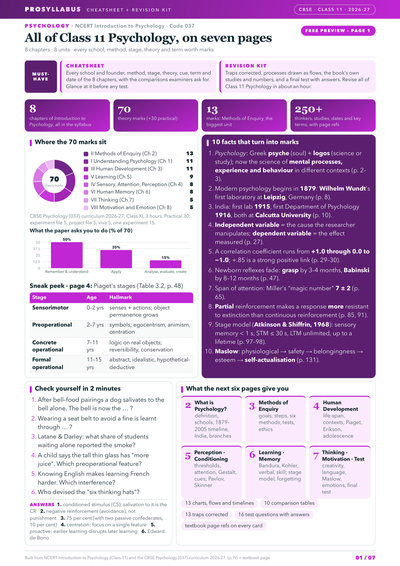
Methods of Enquiry: 13 marks, biggest unit- Marks booster + cheatsheet: key concepts in 2 lines each
- 11 marks each: Units I and III
- 9 marks: Learning, Unit V
- 8 marks each: Perception and Memory
- Every school with its founder
- Comparisons examiners ask for
CBSE Class 11 · Psychology
Methods of Enquiry: 13 marks, biggest unit- Marks booster + cheatsheet: key concepts in 2 lines each
- 11 marks each: Units I and III
- 9 marks: Learning, Unit V
- 8 marks each: Perception and Memory
- Every school with its founder
- Comparisons examiners ask for
Summary
Psychology is formally defined as the science that studies mental processes, experiences and behaviour in different contexts, using methods drawn from both the biological and social sciences. The word comes from the Greek psyche (soul) and logos (study), reflecting its origin in philosophy as a study of the soul or mind, before it became a scientific discipline. Mental processes such as remembering, perceiving, thinking and feeling are internal but interdependent with brain activity, although mind is not identical to brain. Experiences are subjective and embedded in awareness, while behaviours are overt or covert responses linked to stimuli. Psychology runs as two parallel streams: a natural science following the hypothetico-deductive model and an evolutionary approach, and a social science studying behaviour in socio-cultural contexts. Modern psychology formally began in 1879 when Wundt set up the first laboratory in Leipzig, leading to schools such as structuralism, functionalism (James), Gestalt psychology, behaviourism (Watson, Skinner), psychoanalysis (Freud), humanistic (Rogers, Maslow) and cognitive approaches. In India it grew from Calcutta University after 1916. The discipline has many branches including cognitive, biological, developmental, social, clinical and counselling, and sports psychology, and links closely with philosophy, medicine, computer science, law and the arts. Psychology is personally and socially relevant in everyday life.