Thinking
Class 11 Psychology · Psychology · Chapter 7
163 members in the CBSE community
View all










CBSE Class 11 · Psychology
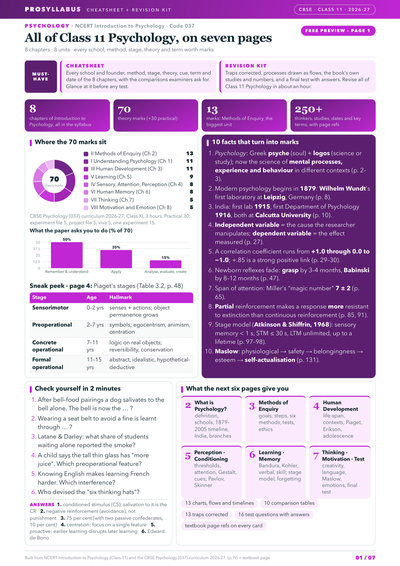
Methods of Enquiry: 13 marks, biggest unit- Marks booster + cheatsheet: key concepts in 2 lines each
- 11 marks each: Units I and III
- 9 marks: Learning, Unit V
- 8 marks each: Perception and Memory
- Every school with its founder
- Comparisons examiners ask for
CBSE Class 11 · Psychology
Methods of Enquiry: 13 marks, biggest unit- Marks booster + cheatsheet: key concepts in 2 lines each
- 11 marks each: Units I and III
- 9 marks: Learning, Unit V
- 8 marks each: Perception and Memory
- Every school with its founder
- Comparisons examiners ask for
Summary
Thinking is the base of all cognitive activities; it is an internal, organised and goal-directed mental process that manipulates information and can be inferred from overt behaviour. The building blocks of thought are mental images and concepts, which group objects and ideas into categories and help us think economically. The major processes of thinking are problem solving, reasoning and decision-making. Problem solving moves from an initial state to a goal state, overcoming obstacles such as mental set and functional fixedness, and uses strategies like algorithms, heuristics, means-end analysis and analogies. Reasoning is goal-directed thinking that draws inferences; it may be deductive (from general premises to a specific conclusion) or inductive (from specific instances to a general conclusion). Decision-making involves choosing among given alternatives by evaluating their costs and benefits. Creative thinking produces ideas that are novel, appropriate and useful; it combines convergent and divergent thinking and passes through preparation, incubation, illumination and verification, aided by lateral thinking and strategies that overcome blocks to creativity. Thought and language are closely linked: language is a system of symbols and rules with the properties of being symbolic, generative and structured. Language develops in an orderly sequence from cooing and babbling to single words, telegraphic speech and full sentences, and bilingualism and multilingualism enrich cognitive flexibility.