Human Development
Class 11 Psychology · Psychology · Chapter 3
163 members in the CBSE community
View all








CBSE Class 11 · Psychology
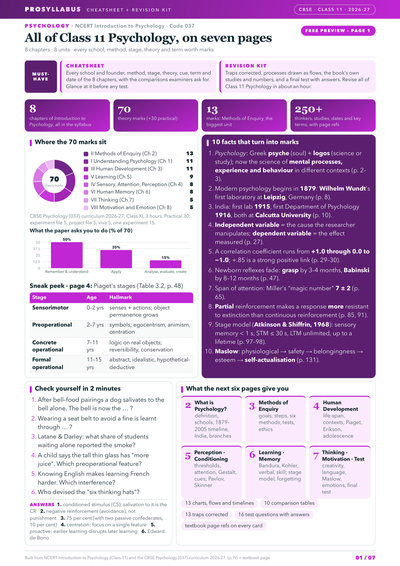
Methods of Enquiry: 13 marks, biggest unit- Marks booster + cheatsheet: key concepts in 2 lines each
- 11 marks each: Units I and III
- 9 marks: Learning, Unit V
- 8 marks each: Perception and Memory
- Every school with its founder
- Comparisons examiners ask for
CBSE Class 11 · Psychology
Methods of Enquiry: 13 marks, biggest unit- Marks booster + cheatsheet: key concepts in 2 lines each
- 11 marks each: Units I and III
- 9 marks: Learning, Unit V
- 8 marks each: Perception and Memory
- Every school with its founder
- Comparisons examiners ask for
Summary
Human development is the pattern of progressive, orderly and predictable changes that begin at conception and continue throughout the lifespan. Development involves growth, maturation and learning, and is studied from a life-span perspective in which development is lifelong, multidimensional, plastic and influenced by historical and cultural conditions. Development results from the interaction of heredity (genetic inheritance through genes and chromosomes) and environment, together with the context of development which includes the family, neighbourhood, school, society and culture. Bronfenbrenner's ecological model describes nested systems (microsystem, mesosystem, exosystem and macrosystem) that influence the developing person. The major stages are the prenatal stage (germinal, embryonic and foetal periods), infancy (rapid sensory-motor development, attachment and language onset), childhood (physical, cognitive and socio-emotional growth, including Piaget's preoperational and concrete-operational thinking and moral development), adolescence as a period of transition marked by puberty, the search for identity, abstract thinking and challenges such as peer pressure, eating disorders and substance abuse, and finally adulthood and old age involving career, marriage, parenthood and adjustment to ageing and retirement. Each stage has distinctive developmental tasks and characteristics that shape the whole personality.